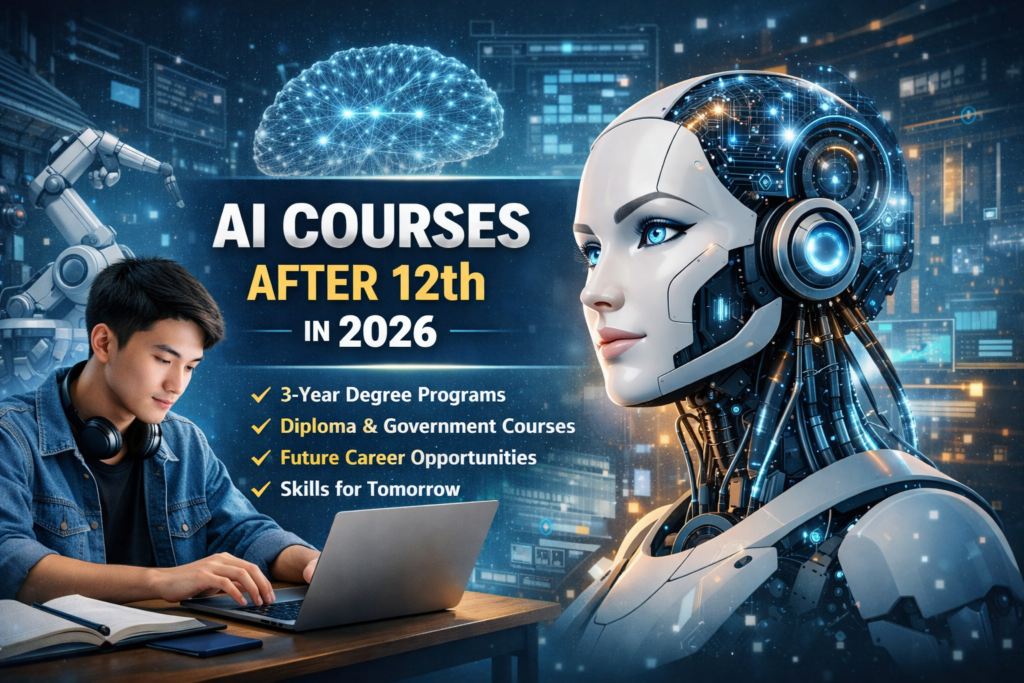
Choosing a career after school is one of the most important decisions in life. In recent years, many students and parents have started exploring AI courses after 12th because Artificial Intelligence is becoming part of almost every industry. However, choosing an AI course without clear understanding can lead to confusion, wasted time, or wrong expectations.
This guide explains everything you must know before choosing an AI-related course in 2026. It is written in simple, neutral English so that students, parents, and counselors can clearly understand what AI education really offers, when it is useful, and when it should be avoided.
| Decision Factor | What Students Should Know |
|---|---|
| Course Duration | AI courses after 12th are available as 3-year degrees, longer academic programs, and short-term diplomas. |
| Eligibility | Most programs prefer mathematics, but some offer foundation learning for beginners. |
| Learning Style | Requires logical thinking, regular practice, and gradual concept building. |
| Career Scope | Useful across technology, healthcare, education, agriculture, and analytics fields. |
| Government Options | AI courses after 12th in government universities focus on academic depth and long-term recognition. |
| Who Should Avoid | Students expecting quick results or disliking structured problem-solving may struggle. |
Table of Contents
What Artificial Intelligence Really Means
Artificial Intelligence is not magic, and it is not only about robots. AI is a technology field where computers are trained to analyze data, recognize patterns, learn from experience, and support decision-making.
AI systems are used in:
- Medical diagnosis support
- Weather and climate prediction
- Language translation
- Smart education platforms
- Traffic and transport planning
- Banking and risk analysis
- Agriculture and food management
Learning AI means learning how data, logic, and computing work together to solve real problems.
Who Should Consider AI After 12th
AI is suitable for students who:
- Enjoy logical thinking
- Are curious about how systems work
- Can patiently learn step by step
- Are comfortable with numbers and patterns
- Want long-term skill-based careers
AI may not be suitable for students who:
- Strongly dislike mathematics
- Expect fast results without practice
- Prefer purely creative or routine work
- Do not want continuous learning
AI is not difficult, but it requires consistency.
Can You Study AI After 12th?
Yes, students can study AI directly after completing 12th grade. Courses are available in different formats, durations, and academic levels. The structure depends on the institution and the education model.
Students from science streams have the widest options, but students from other streams may also enter through foundation or bridge programs.
Is There a 3-Year AI Course After 12th?
Yes, there are structured three-year programs that focus on Artificial Intelligence, usually offered as bachelor-level degrees or integrated technology programs. These programs build skills gradually, starting from basics and moving toward advanced applications.
A three-year format is suitable for students who want:
- A clear academic structure
- Time to build strong fundamentals
- Eligibility for higher studies later
- Better understanding before specialization
Some institutions also follow flexible models with exit options.
Types of AI Courses Available After 12th
Degree-Level AI Programs
These are full-time academic programs designed for deep understanding.
They usually include:
- Programming fundamentals
- Data handling and statistics
- Machine learning concepts
- Ethical use of AI
- Project-based learning
These courses are ideal for students planning:
- Long-term careers
- Higher education
- Research or system design roles
Diploma and Short-Term AI Courses
These courses focus on practical skills and faster learning.
They usually cover:
- Basic AI concepts
- Introductory programming
- Simple data analysis
- Tool-based learning
They are suitable for:
- Skill enhancement
- Career switching
- Supplementing another degree
However, they may not replace a full degree for advanced roles.
AI Courses in Government Institutions
AI courses offered by government-supported institutions are widely trusted.
Benefits include:
- Standardized curriculum
- Lower financial burden
- Academic credibility
- Long-term recognition
These courses focus on:
- Responsible AI
- Public sector applications
- Research-based learning
They are suitable for students who prefer stability and academic depth.
Eligibility Requirements Explained Simply
Most AI courses require:
- Completion of 12th grade
- Mathematics background for advanced programs
- Basic computer awareness
Some programs accept students without mathematics by providing foundation training. However, students must be prepared to learn basic math concepts during the course.
Subjects You Will Study in AI Courses
Core Subjects
- Introduction to programming
- Logic and algorithms
- Data structures
- Artificial Intelligence fundamentals
- Machine learning basics
- Statistics for decision-making
Advanced Topics (in later stages)
- Natural language understanding
- Image and pattern recognition
- Data-driven prediction models
- AI ethics and safety
- Real-world application projects
Courses are usually designed to move from simple concepts to complex systems.
Light Overview Table: AI Course Options After 12th
| Aspect | Degree Programs | Diploma Programs |
|---|---|---|
| Duration | 3–4 years | 6 months–2 years |
| Depth | Strong theoretical base | Practical basics |
| Career Scope | Broad, long-term | Limited, role-specific |
| Suitable For | Career-focused students | Skill-focused learners |
| Academic Recognition | High | Moderate |
How Difficult Are AI Courses?
AI courses are not hard by nature, but they are demanding.
Difficulty depends on:
- Practice consistency
- Willingness to revise
- Problem-solving mindset
Students who regularly practice find AI logical and structured. Students who avoid practice often feel overwhelmed.
Is AI a Good Career Choice in 2026?
AI is a strong career choice when combined with:
- Proper education
- Realistic expectations
- Continuous learning
AI alone does not guarantee success. Skill quality matters more than course names.
Advantages of Choosing AI After 12th
- Applicable across industries
- Flexible career pathways
- Global relevance
- Problem-solving skill development
- High adaptability to future changes
AI skills remain useful even when technology evolves.
Realistic Challenges of AI Education
- Requires regular learning updates
- Not suitable for last-minute studying
- Needs self-discipline
- Abstract concepts may take time
Understanding these challenges early helps students prepare mentally.
When AI Courses Should Be Avoided
Avoid AI courses if:
- You are choosing only because others recommend it
- You expect quick success without effort
- You dislike logical reasoning completely
- You are uncomfortable with structured learning
Choosing AI without interest can lead to frustration.
Is an AI Course Necessary for Everyone?
No. AI is not compulsory for success.
AI is useful if:
- You want technology-based roles
- You enjoy analytical thinking
- You plan long-term skill growth
Many careers succeed without AI. The choice must match personal interest.
Combining AI With Other Fields
AI works well with:
- Healthcare
- Agriculture
- Education
- Business analytics
- Environmental science
Students can use AI as a supporting skill rather than a standalone career.
What Families and Students Should Check Together
Before enrolling:
- Discuss learning style
- Check course structure
- Understand future paths
- Avoid unrealistic promises
Family support helps students stay consistent.
My Practical Recommendation
After reviewing many student outcomes, one pattern is clear:
AI works best for students who:
- Start slow and steady
- Focus on understanding, not speed
- Combine theory with practice
- Accept that learning never stops
If you are unsure, begin with foundation learning before committing to a long program.
Common Myths About AI Courses
- AI is only for geniuses – false
- AI means coding all day – false
- AI replaces all jobs – false
- AI success is instant – false
AI is a structured skill, not magic.
Ethical and Responsible Learning
Modern AI education emphasizes:
- Fairness
- Privacy
- Transparency
- Responsible decision-making
Students are taught to use AI safely and ethically.
Final Decision Guide
Before choosing:
- Check your interest honestly
- Understand effort requirements
- Evaluate long-term goals
- Avoid trend-based decisions
Education works best when aligned with mindset.
Choosing AI courses after 12th in 2026 can be a strong and meaningful decision when done with clarity and preparation. There are three-year academic paths, skill-based options, and government-supported programs available. AI is powerful, but it is not automatic success. It rewards patience, curiosity, and disciplined learning.
A well-informed decision today builds a stable future tomorrow.
Some more you might like