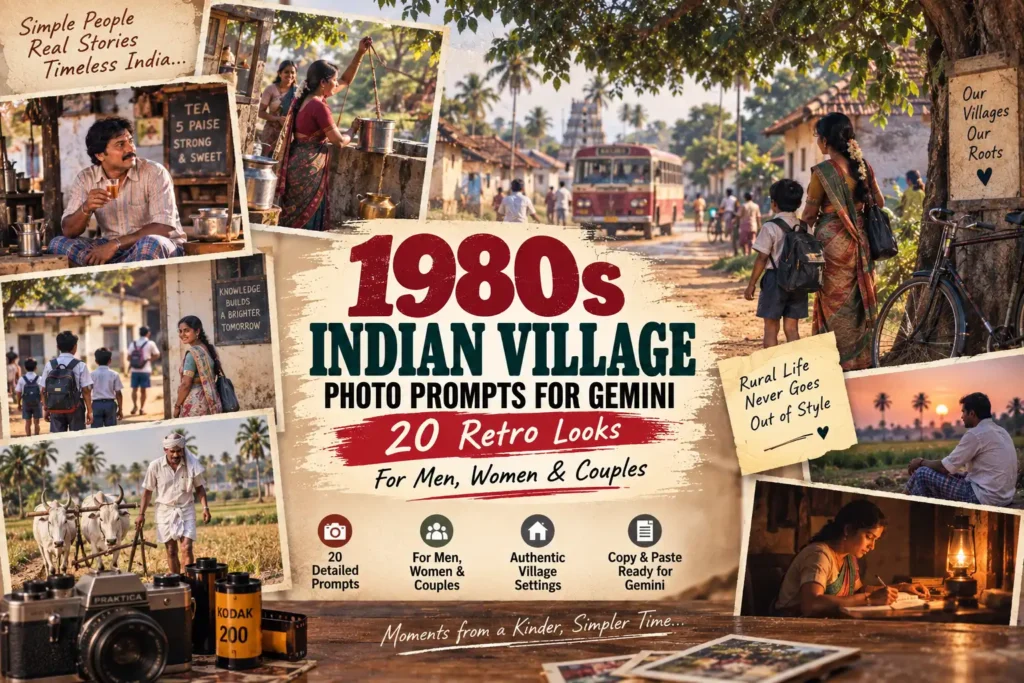
1. 1980s Indian Village — Dawn at the Tea Stall Before the Village Wakes
Use my uploaded photo as the exact facial identity reference. Preserve my recognizable face, facial structure, eyes, nose, lips, skin tone, natural age appearance, hairline, hairstyle characteristics, facial asymmetry, body proportions, and important identifying details. Do not replace my identity with a generic model.DYNAMIC SUBJECT RULE: Adapt this scene automatically to the uploaded person. If the reference contains one man, preserve him naturally as one man. If it contains one woman, preserve her naturally as one woman. If it contains a couple, preserve BOTH partners separately and adapt their interaction as a believable couple. Never invent a romantic partner when only one person is uploaded. Never change gender, swap faces, merge identities, or automatically make anyone younger.
Create an authentic Indian village photograph from approximately 1983–1988 during the minutes before sunrise.
Do not create a glamorous rural fashion portrait.
Place the subject at a tiny roadside village tea stall that has just opened for the morning.
For ONE PERSON: the subject has stopped for the first tea of the day before beginning a journey, household errand, field work, teaching, market visit, or another activity appropriate to their natural age and appearance.
For a COUPLE: both partners have arrived together but should not pose romantically. One may receive the tea while the other checks a cloth bag, folded newspaper, bicycle, bus timing board, or road ahead. Their familiarity should be shown through practical coordination rather than hugging or staged affection.
The tea seller pours hot tea from a blackened kettle into a small glass or steel tumbler.
At that moment, the first bus or another period-plausible vehicle becomes visible far down the village road.
The subject notices it before the tea seller does.
Capture the exact instant attention shifts from the steaming tea toward the distant road.
Build an authentic rural environment: small timber or masonry tea stall, wood or period-plausible stove, blackened kettle, glass jars, wooden bench, roadster bicycle, folded newspapers, cloth sacks, mature trees, modest tiled or thatched houses where regionally appropriate, utility poles, fields beyond the settlement, and faint morning cooking smoke rising naturally from distant homes.
Do not create a poverty spectacle. The village should look functional, inhabited, regionally plausible, and treated with dignity.
COMPOSITION: Photograph from inside the tea stall using approximately a 50mm documentary perspective. Let the kettle or glass jars create soft foreground framing while the subject and distant road form separate visual planes.
LIGHTING: Use cool pre-sunrise ambient light mixed with the warm practical light of the stall. The first weak sunlight may touch distant treetops or fields but should not create artificial golden glow on the face.
PERIOD LOCK: Rural India, approximately 1983–1988. No smartphones, modern motorcycles as dominant objects, LED lights, QR payments, plastic bottled water, contemporary packaged snacks as focal objects, modern highways, current fashion, or present-day architecture.
Preserve realistic tea steam, correct hand grip, believable glass reflections, natural skin pores, individual hair strands, authentic fabric folds, accurate bicycle geometry, distinct secondary faces, and physically consistent shadows.
Use restrained 35mm consumer-film grain, slightly warm analog color, modest contrast, gentle highlight roll-off, mild optical softness, and candid framing.
The final photograph should feel like the first frame of an ordinary village day: the tea has just been poured, the road is still mostly empty, and something approaching in the distance quietly signals that the day has begun.
No text, no watermark, no face swap, no invented partner, no duplicate people, no extra fingers, no plastic skin, no fake AI glow, and no modern objects.
2. 1980s Indian Village — The Bullock Cart Stops Because the Road Has Changed Overnight
Use my uploaded photograph as the strict identity reference. Preserve the recognizable face, natural age, complexion, facial anatomy, eyes, nose, lips, hair characteristics, body proportions, and distinctive identifying features of every uploaded person.DYNAMIC SUBJECT RULE: If the reference contains one man or one woman, create the scene with that single person as the principal subject. If the reference contains a couple, preserve both partners independently with correct age, height relationship, gender presentation, and facial identity. Never add a spouse or romantic partner when none exists in the uploaded reference.
Create an authentic rural Indian travel photograph from the mid-1980s involving a bullock cart on a village road.
Do not create a decorative tourist portrait beside cattle.
The subject is traveling along a familiar unpaved or partially surfaced village road after overnight rain.
The bullock cart has stopped safely because a shallow section of the road ahead has become muddy or waterlogged.
Do not depict dangerous flooding.
The subject steps down or stands safely beside the cart to inspect which dry section of road is usable.
For a SINGLE SUBJECT: show them studying the road while the cart driver or another secondary villager remains naturally in the background.
For a COUPLE: one partner studies the road ahead while the other remains near the cart checking a cloth bag, umbrella, covered basket, or another travel item. Then the second partner notices a narrow dry route around the muddy section and gestures toward it.
Create the decisive moment when the principal subject follows that gesture and realizes the journey can continue without entering the mud.
The bullocks should remain calm, safely harnessed, and treated naturally.
Build the environment with rain-darkened earth, shallow puddles, field bunds, native trees, modest houses farther away, period utility poles where plausible, roadster bicycle tracks, cart-wheel impressions, agricultural landscape, and humid morning atmosphere.
COMPOSITION: Shoot from low near the roadside using approximately a 35mm lens. Use a puddle or cart-wheel track in the foreground to lead toward the people, cart, and road beyond.
Do not let cart shafts, horns, ropes, poles, or branches intersect human heads or bodies unnaturally.
LIGHTING: Soft post-rain morning daylight beneath thinning cloud cover. Wet earth may create subtle reflected light. Avoid cinematic storm lighting.
ANIMAL AND CART REALISM: Correct bullock anatomy, harness placement, cart-wheel geometry, axle position, wooden construction, realistic load weight, and safe spacing between animals and people.
PERIOD LOCK: Rural India, approximately 1983–1988. No smartphones, tractors or modern vehicles dominating the scene, plastic water bottles, LED lights, contemporary road markings, modern synthetic travel luggage, current clothing, or present-day infrastructure.
Use restrained analog grain, muted post-rain colors, modest contrast, natural skin texture, realistic wet-earth reflections, and documentary imperfection.
The final photograph should feel like a real village journey temporarily interrupted by overnight weather: the familiar road has changed, everyone pauses to understand it, and one small observation shows the safe way forward.
No text, no watermark, no invented partner, no face swapping, no duplicate people, no unsafe animal handling, no extra fingers, no plastic skin, and no modern objects.
3. 1980s Indian Village — Noon at the Well When the Rope Slips One Turn
Use my uploaded photo as the exact identity anchor. Preserve every uploaded person's recognizable face independently — natural age, facial proportions, eyes, nose, lips, skin tone, hairline, hairstyle characteristics, facial asymmetry, body proportions, and distinguishing details.DYNAMIC SUBJECT RULE: Automatically adapt the clothing, action, and social interaction to the uploaded reference. One man remains one man. One woman remains one woman. A couple remains two distinct partners. Do not force stereotypical gender roles; choose a plausible village-water or household interaction appropriate to the people shown.
Create an authentic 1980s Indian village photograph around a traditional well or communal water point.
Do not create a posed portrait of someone carrying a decorative water pot.
The subject is performing or assisting with an ordinary water-related task in a safe, period-plausible manner.
A rope and bucket are being handled at a properly constructed well with a raised protective wall.
Create one small unexpected moment.
As the bucket reaches the top, the wet rope slips by only one controlled turn around the pulley or hand grip.
Nobody is in danger.
A nearby person instinctively steadies the rope or bucket.
For a SINGLE SUBJECT: a secondary villager may assist briefly while the uploaded person reacts.
For a COUPLE: one partner controls the rope while the other steadies the filled vessel or bucket, creating a practical moment of teamwork rather than staged romance.
Capture the instant AFTER the bucket is secure again.
One person looks at the other with relieved amusement.
A few drops of water fall back toward the well.
Another villager nearby continues their own task without dramatic reaction.
Build a regionally plausible environment: stone or masonry well, period rope and pulley where appropriate, brass, copper, clay, or stainless-steel vessels consistent with region and era, packed-earth or stone ground, shade tree, modest houses, agricultural fields or village lane, and naturally spaced residents.
Do not overcrowd the well with decorative pots.
COMPOSITION: Photograph from slightly beyond the well wall using approximately a 50mm perspective. The rope may create a diagonal compositional line but must never cross faces or necks unnaturally.
Keep hands, bucket, water droplets, and facial reactions readable.
LIGHTING: Use strong noon daylight softened by a large shade tree, awning, or nearby structure. Reflected light from the well wall should naturally illuminate faces.
WATER REALISM: Correct gravity, wet-rope darkening, realistic droplet size, believable bucket weight, proper hand tension, and physically plausible reflections.
PERIOD LOCK: Indian village, approximately 1983–1988. No electric modern pump as the focal mechanism, smartphones, plastic bottled water, contemporary synthetic containers dominating the scene, LED fixtures, modern fashion, or present-day infrastructure.
Preserve natural skin pores, realistic hands and fingers, age-appropriate anatomy, authentic clothing drape, distinct secondary faces, and correct shadows.
Use restrained consumer-film grain, earthy rural colors, modest dynamic range, mild optical softness, and candid family-album realism.
The final photograph should not be about “village beauty.” It should preserve a tiny practical moment: the rope slips, somebody reacts instinctively, the water is saved, and the seriousness breaks into a brief shared smile.
No text, no watermark, no invented romantic partner, no face swap, no extra fingers, no unsafe well behavior, no plastic skin, and no modern objects.
4. 1980s Indian Village — Weekly Market Purchase Wrapped in Yesterday’s Newspaper
Use my uploaded photograph as the precise facial identity reference. Preserve each uploaded person's recognizable face, natural age, skin tone, facial structure, eyes, nose, lips, hair characteristics, facial asymmetry, body proportions, and important identifying details.DYNAMIC SUBJECT RULE: Adapt naturally to one man, one woman, or a couple. Never add an unnecessary partner. For a couple, preserve BOTH identities separately and show familiar practical interaction rather than generic romantic posing.
Create a richly observed weekly village-market photograph from approximately 1983–1988.
Do not make the subject stand in the middle of colorful produce smiling at the camera.
The subject has nearly finished buying several ordinary household items from a market vendor.
The vendor wraps one small purchase in a piece of old newspaper or plain period paper.
Do not make newspaper text readable.
The wrapped parcel is handed across the counter or ground-level stall.
Create the decisive moment when the bottom fold begins to loosen before the subject has fully taken hold of it.
Nothing spills dramatically.
The subject notices immediately and catches or supports the parcel from underneath.
The vendor simultaneously reaches to reinforce the fold.
For a COUPLE: one partner receives the parcel while the other notices the loose fold first and supports it from below. Their hands should coordinate naturally without becoming a romantic gesture.
For a SINGLE SUBJECT: the vendor provides the second pair of hands.
Capture the instant the parcel is secure and both people realize the small mishap has been avoided.
Build an authentic village market: vegetables or grains appropriate to the region, woven baskets, cloth sacks, manual weighing scale, metal weights, wooden crates, paper wrapping, cloth shopping bags, bicycles, simple awnings, vendors sitting or standing naturally, period bus or bullock cart in the distance where plausible, and a busy but believable market lane.
Do not use poverty as visual decoration. Show ordinary commerce, work, and community life respectfully.
COMPOSITION: Photograph from slightly behind another market stall using approximately a 70mm lens. Let baskets or produce create a soft foreground layer while the parcel exchange and faces remain the storytelling center.
LIGHTING: Bright daylight filtered through cloth awnings creates alternating soft shade and sunlit patches. Keep facial exposure natural and physically consistent.
MARKET REALISM: Correct weighing-scale geometry, believable produce scale, paper folds, realistic hand ownership, proper basket construction, and distinct background people.
PERIOD LOCK: Rural India, approximately 1983–1988. No smartphones, QR payments, digital weighing scales, modern plastic shopping bags as dominant objects, contemporary packaged goods, LED signs, current vehicles, or present-day fashion.
Use restrained 35mm grain, warm earthy colors, modest contrast, mild lens softness, natural skin texture, and documentary framing.
The final photograph should feel like an ordinary weekly-market memory built around one tiny action: a paper parcel nearly opens, two people notice at the same time, and the purchase is saved before anything reaches the ground.
No readable newspaper headlines, no text overlay, no watermark, no invented partner, no duplicate people, no extra fingers, no plastic skin, and no modern objects.
5. 1980s Indian Village — Evening Bus Stop When a Familiar Face Appears at the Window
Use my uploaded photograph as the strict facial identity reference. Preserve every uploaded person's recognizable face independently — facial anatomy, eyes, nose, lips, complexion, natural age, hairline, hairstyle characteristics, facial asymmetry, body proportions, and distinctive identifying features.DYNAMIC SUBJECT RULE: The prompt must work naturally for a man, woman, or couple. One uploaded person remains the only principal subject. If two partners are uploaded, preserve both identities independently. Do not invent spouses, change gender, or alter natural age.
Create an authentic Indian village-bus-stop photograph from the mid-1980s during late afternoon or early evening.
The subject is waiting beside a modest village bus shelter after completing an ordinary errand, school-related visit, market trip, workday, family visit, or another activity appropriate to their natural age.
A period-correct public bus approaches and slows safely at the stop.
Do not show anybody running after the bus or hanging from it.
The emotional moment happens BEFORE boarding.
Through one bus window, the subject unexpectedly notices somebody familiar already seated inside.
Do not clearly show the familiar person's face.
The recognition should be communicated through eye direction and body language.
For a SINGLE SUBJECT: they instinctively step slightly closer to the safe boarding area and raise one hand in a small recognition gesture.
For a COUPLE: one partner notices the familiar passenger first and lightly draws the other partner's attention toward the correct window. The second partner follows the gaze and recognizes the person a fraction of a second later.
Capture the moment when recognition travels from one person to another.
Do not create exaggerated waving or dramatic reunion behavior.
Build a believable rural bus-stop environment: simple shelter, weathered bench, paper timetable board with indistinct writing, roadster bicycle, tea stall nearby, cloth bags, fields or village houses beyond, mature shade trees, utility poles, pedestrians, and a period-correct painted bus with open or sliding windows.
COMPOSITION: Photograph from across the road at a safe position using approximately an 85mm lens. Use natural telephoto compression to place the waiting subject and bus windows within the same visual field.
The familiar passenger should remain visually secondary and indistinct.
LIGHTING: Use warm late-afternoon daylight coming from one side, with open shade beneath the bus shelter keeping faces naturally exposed. Avoid artificial golden-hour glow.
BUS REALISM: Correct wheel geometry, window spacing, door position, road contact, passenger scale, and safe stopping behavior.
PERIOD LOCK: Rural India, approximately 1983–1988. No smartphones, modern buses, LED route displays, digital tickets, contemporary backpacks, plastic bottled water, current vehicles, or present-day road infrastructure dominating the frame.
Use restrained 35mm consumer-film grain, slightly warm colors, modest contrast, gentle telephoto softness, natural skin pores, believable clothing folds, and candid framing.
The final photograph should feel like a small village coincidence: somebody waits for an ordinary bus, the bus arrives, and before the journey even begins a familiar face unexpectedly appears behind one window.
No readable route text, no watermark, no unsafe boarding, no invented partner, no face swapping, no duplicate people, no extra fingers, no plastic skin, and no modern objects.
6. 1980s Indian Village — Harvest Field When the Lunch Carrier Arrives Late
Use my uploaded photo as the exact facial identity reference. Preserve my recognizable face, facial structure, eyes, nose, lips, skin tone, natural age appearance, hairline, hairstyle characteristics, facial asymmetry, body proportions, and important identifying details. Do not replace my identity with a generic rural model or automatically make me younger.DYNAMIC SUBJECT RULE: Adapt the scene naturally to the uploaded reference. If the reference contains one man, preserve him as one man. If it contains one woman, preserve her as one woman. If it contains a couple, preserve BOTH partners separately with their correct natural age, gender presentation, facial identity, body proportions, and height relationship. Never invent a romantic partner when only one person is uploaded.
Create an authentic Indian agricultural-village photograph from approximately 1983–1988 during harvest season.
Do not create a glamorous “farmer portrait” with the subject posing dramatically in crops.
The workday has already been underway for several hours.
Place the subject at the shaded edge of a harvested or partly harvested field during the midday meal break.
Choose crops, field structure, tools, clothing, and landscape that plausibly belong together in one Indian agricultural region. Do not randomly mix rice paddies, wheat harvest, sugarcane, and unrelated regional details.
The subject has just stopped working or arrived at the field when a traditional lunch carrier, cloth-wrapped food bundle, stacked metal tiffin, or other period-plausible meal container finally arrives later than expected.
For a SINGLE SUBJECT: the person who brought the meal may be a secondary family member, field worker, neighbor, or messenger. Do not imply romance automatically.
For a COUPLE: one partner may have been working or waiting at the field while the other arrives with the meal or both may have been working together and discover that their lunch carrier was left beneath the wrong tree or cart. Keep the interaction practical and familiar rather than staged.
Create the decisive moment around one small misunderstanding.
The hungry subject reaches toward what appears to be their lunch carrier.
Another nearby worker realizes it belongs to somebody else and points toward a nearly identical container sitting a few feet away.
The subject stops with their hand halfway there.
For a couple, the second partner may notice first and quietly redirect the hand toward the correct container.
Capture the exact instant everyone realizes the mistake.
The expression should be tired amusement rather than exaggerated comedy.
Build a believable harvest environment: cut crop bundles appropriate to the region, hand tools resting safely on the ground, cloth head coverings where culturally and practically appropriate, steel water vessel, shaded tree, bullock cart or period agricultural transport in the distance where plausible, field bunds, irrigation channels, and neighboring fields disappearing into heat haze.
Do not romanticize hardship or make people dirty merely to signal rural life. Show ordinary work with dignity.
COMPOSITION: Photograph from seated or crouched height near the shade using approximately a 50mm lens. Let a few crop bundles create a soft foreground layer while the mistaken lunch carrier, reaching hand, and facial reactions remain clearly visible.
LIGHTING: Hard midday sunlight should dominate the open field while the people remain primarily in tree or makeshift shade. Reflected earth and crop light should naturally illuminate faces. Preserve the strong brightness difference between shade and field.
FOOD AND OBJECT REALISM: Correct tiffin proportions, believable metal reflections, realistic cloth knots, natural food-container weight, proper hand contact, and no floating objects.
PERIOD LOCK: Rural India, approximately 1983–1988. No smartphones, modern harvesting machinery dominating the scene, plastic bottled water, contemporary synthetic lunch boxes as focal objects, LED equipment, current fashion, or present-day agricultural infrastructure.
Use restrained 35mm grain, sun-warmed earthy colors, modest contrast, mild heat haze in the distance, natural skin texture, believable perspiration appropriate to physical work, realistic fabric folds, and documentary imperfection.
The final photograph should feel like a real harvest-day memory: hours of work stop for lunch, two nearly identical containers create a tiny mistake, and fatigue briefly turns into laughter beneath the shade.
No text, no watermark, no invented partner, no face swap, no duplicate people, no unsafe tool handling, no extra fingers, no plastic skin, and no modern objects.
7. 1980s Indian Village — Monsoon Veranda When the Courtyard Suddenly Fills with Water
Use my uploaded photograph as the strict identity anchor. Preserve every uploaded person's recognizable face independently — natural age, facial anatomy, eyes, nose, lips, complexion, hairline, hairstyle characteristics, facial asymmetry, body proportions, and distinctive identifying details.DYNAMIC SUBJECT RULE: Adapt automatically for one man, one woman, or a couple. A single uploaded person remains the sole principal subject. If a couple is uploaded, preserve both partners independently and show natural household cooperation. Never invent a spouse, swap identities, or force gender-specific chores that do not fit the reference.
Create an authentic Indian village-home photograph from a heavy monsoon afternoon in the mid-1980s.
Do not create a generic romantic rain portrait.
The subject remains safely beneath the deep veranda of a modest village house while strong rain falls across the courtyard.
The rain has continued long enough for shallow water to begin collecting in one low section of the courtyard.
This is NOT dangerous flooding.
A lightweight household object — perhaps a child's wooden sandal, small empty metal bowl, coconut shell, wooden toy, or another harmless item — begins floating slowly across the shallow collected water.
The subject notices.
For a SINGLE SUBJECT: they use a long safe household stick, broom handle, or another practical object from the dry veranda to gently redirect the floating item toward the edge without stepping into the water.
For a COUPLE: one partner notices the drifting object while the other brings a basket or points toward where the current will carry it. Their coordination should feel automatic and domestic rather than romantic.
Create the decisive moment when the object reaches the veranda edge and is recovered.
At the same time, another burst of rainwater pours from the tiled roof edge, making the subject instinctively step slightly farther into the dry veranda.
Capture the reaction before the routine continues.
Build an authentic village house: regionally plausible tiled or thatched roof, deep veranda, weathered limewashed or earthen walls, wooden doorway, raised threshold, steel or brass household vessels where appropriate, woven basket, cotton cloth hanging safely under cover, courtyard tree or plants, rain-darkened soil, and neighboring structures softened by rain.
COMPOSITION: Photograph from inside the darker house looking outward using approximately a 35mm lens. The doorway should frame the brighter rain-filled courtyard.
Use the floating object and shallow water path to lead the eye toward the subject.
LIGHTING: Cool gray monsoon daylight should be the dominant source. The wet courtyard reflects soft light into the shaded veranda. A dim warm interior lamp may appear deeper inside only if physically plausible.
RAIN REALISM: Water must follow roof slope and ground elevation. Raindrops, roof runoff, puddle ripples, fabric movement, and foliage must respond consistently to weather. Do not create impossible indoor rain or dramatic flooding.
PERIOD LOCK: Indian village household, approximately 1983–1988. No smartphones, modern drainage hardware as a visual focus, LED lights, plastic garden furniture, contemporary rainwear, modern vehicles, satellite dishes, or present-day architecture.
Preserve realistic wet surfaces, natural skin texture, correct hands, believable clothing behavior, accurate doorway geometry, proper object buoyancy, and physically consistent reflections.
Use slightly muted monsoon colors, restrained consumer-film grain, modest contrast, mild atmospheric softness, and candid family-photo framing.
The final photograph should feel like a monsoon memory rather than a rain portrait: everybody remains under shelter, one forgotten household object begins its tiny journey across the courtyard, and ordinary village life quietly adapts to the weather.
No text, no watermark, no invented partner, no unsafe flood behavior, no duplicate people, no extra fingers, no plastic skin, no artificial rain glow, and no modern objects.
8. 1980s Indian Village — Festival Evening When the Oil Lamp Will Not Stay Lit
Use my uploaded photograph as the exact facial identity reference. Preserve each uploaded person's recognizable face separately — facial structure, eyes, nose, lips, skin tone, natural age, hairline, hairstyle characteristics, facial asymmetry, body proportions, and important identifying details.DYNAMIC SUBJECT RULE: The scene must work naturally for a man, woman, or couple. Preserve natural age and gender presentation. Never invent a romantic partner for a single person. For a couple, preserve both distinct identities and show familiar cooperation rather than exaggerated romance.
Create an authentic 1980s Indian village festival-evening photograph.
Choose ONE culturally coherent regional festival or village celebration. Clothing, decorations, lamps, architecture, flowers, and customs must all belong plausibly together. Do not combine unrelated traditions simply because they look colorful.
Do NOT create a deity-centered fantasy image or a formal festival portrait.
Place the subject near the entrance or courtyard of a village home shortly before evening visitors arrive or the family leaves for the local celebration.
Several small oil lamps or period-plausible traditional lamps have been arranged safely on a raised stable surface away from loose fabric and children.
One lamp repeatedly goes out because a mild evening breeze reaches that corner.
The subject tries once more to protect the flame.
For a SINGLE SUBJECT: use one hand or a safe rigid wind shield positioned at an appropriate distance while relighting is handled carefully.
For a COUPLE: one partner may shield the breeze while the other safely lights the lamp. Their hands should perform separate clear tasks with no confusing overlap.
Do not depict children handling matches or open flames.
Create the decisive moment when the troublesome lamp finally stays lit.
Before the subject can move away, a second nearby lamp flickers dramatically but does not extinguish.
The subject looks toward it with an expression of amused disbelief, as though the entire process may begin again.
If a couple is present, one partner notices the second lamp first and looks toward the other without needing to say anything.
Build a culturally coherent festival environment: limewashed or earthen house entrance, wooden doorway, regionally appropriate floor decoration, flowers, brass or clay lamps, cotton textiles, simple garlands, family members preparing farther inside, and restrained village festive decoration.
Do not overload the image with glowing lights.
COMPOSITION: Photograph from low near courtyard height using approximately a 50mm lens. Keep the successfully lit lamp in the lower foreground while the subject's reaction to the second flickering lamp becomes the facial focal point.
FLAME SAFETY AND REALISM: Lamps sit on stable nonflammable surfaces. Loose clothing, flowers, curtains, and hair remain safely away from flame. Flames should be small, directional, and responsive to the same breeze.
LIGHTING: Use blue-hour ambient sky as the main environmental illumination with warm local light from oil lamps and interior tungsten bulbs where historically appropriate. Lamps should illuminate only nearby surfaces rather than creating supernatural face glow.
PERIOD LOCK: Indian village, approximately 1983–1988. No smartphones, LED decorative strings, battery candles, contemporary event lighting, modern plastic festival décor, QR codes, current fashion, or present-day architecture.
Use restrained high-speed film grain, warm practical-light halation, deep but readable shadows, modest saturation, natural skin texture, accurate hands, and authentic fabric folds.
The final photograph should feel like a festival memory built around imperfection rather than spectacle: decorations are ready, evening is beginning, one stubborn lamp finally stays lit — and another immediately threatens to go out.
No text, no watermark, no invented partner, no unsafe flame behavior, no extra fingers, no plastic skin, no excessive divine effects, and no modern objects.
9. 1980s Indian Village — Riverbank Laundry When a Forgotten Shirt Floats Back
Use my uploaded photograph as the strict facial identity source. Preserve my recognizable face, natural age, facial anatomy, eyes, nose, lips, skin tone, hair characteristics, facial asymmetry, body proportions, and distinctive identifying features. If two people are uploaded, preserve BOTH identities independently.DYNAMIC SUBJECT RULE: Adapt this scene appropriately for a man, woman, or couple without forcing stereotypical roles. The subject may be washing, rinsing, collecting, carrying, sorting, or simply helping with household cloth depending on what is culturally and visually plausible. Never invent a partner for a single-person upload.
Create an authentic 1980s Indian village riverbank, canal-side, pond-step, or washing-place photograph in a region where such household activity is historically plausible.
Choose a SAFE shallow washing edge or constructed steps.
Do not place the subject in dangerous deep or fast-moving water.
Several washed garments have already been collected into a metal basin, woven basket, or cloth bundle.
The subject believes the task is finished and begins preparing to leave.
Then a small lightweight garment or cloth that was apparently left on a nearby washing stone begins drifting slowly in the shallow edge current.
It remains within easy safe reach.
For a SINGLE SUBJECT: another washer notices it first and points. The subject turns and uses a safe stick, washing paddle, or hand from the stable shallow edge to retrieve it.
For a COUPLE: one partner has already lifted the laundry basket while the other notices the drifting cloth. The basket-holding partner looks back, realizes what happened, and waits while the other safely recovers it.
Do not create dramatic running or jumping into water.
Capture the exact instant the wet cloth is recovered and both the subject and nearby people realize it was almost forgotten.
Build a believable rural waterside environment: washing stones or steps, metal or brass vessels where regionally appropriate, cotton clothing, woven baskets, trees, field edge, simple footpath, distant houses, cattle only if safely separated from the washing area, and a few villagers naturally engaged in their own activities.
COMPOSITION: Photograph from slightly elevated dry ground using approximately a 50mm lens. Let the shallow water occupy part of the foreground so the viewer can understand where the cloth drifted.
Use ripples to lead visually toward the recovered garment and subject.
WATER REALISM: Correct current direction, realistic wet-cloth weight, natural dripping, proper reflections, believable ripples around objects, and no floating heavy fabric unnaturally above the water.
LIGHTING: Use soft morning or late-afternoon daylight with reflected light from the water gently illuminating faces. Avoid glossy commercial highlights.
PERIOD LOCK: Rural India, approximately 1983–1988. No smartphones, modern detergent bottles as prominent props, synthetic laundry baskets of contemporary design dominating the scene, LED equipment, modern concrete development dominating the background, or current fashion.
Preserve natural skin pores, correct hands, realistic wet fabric folds, safe footing, authentic object scale, and physically accurate shadows.
Use restrained analog grain, earthy water-side colors, modest dynamic range, mild optical softness, and documentary realism.
The final photograph should feel like a tiny end-of-task memory: everything is packed, everyone is ready to leave, and one forgotten piece of cloth quietly floats back into the story.
No text, no watermark, no invented partner, no unsafe water behavior, no duplicate people, no extra fingers, no plastic skin, and no modern objects.
10. 1980s Indian Village — Night Study Under a Kerosene Lamp When a Moth Interrupts the Page
Use my uploaded photograph as the exact identity anchor. Preserve every uploaded person's recognizable face independently — natural age, facial structure, eyes, nose, lips, complexion, hairline, hairstyle characteristics, facial asymmetry, body proportions, and important identifying details.DYNAMIC SUBJECT RULE: Adapt the purpose of the scene to the person's real visible age. Do NOT turn an adult into a schoolchild. A child or teenager may be studying schoolwork. An adult may be reading, checking accounts, writing a letter, preparing lessons, reviewing agricultural records, or doing another age-appropriate paper task. If a couple is uploaded, both partners may share the table while doing different tasks, but preserve each identity separately.
Create an intimate Indian village-home night photograph from approximately 1983–1988 during a period without electric light or during an ordinary power cut.
A kerosene lamp sits safely on a stable table or raised surface.
Do not create romanticized poverty or make the lamp a symbol of hardship.
The subject is simply continuing an ordinary reading or writing task with the light available.
For a SINGLE SUBJECT: they concentrate on the page while the surrounding room remains quiet.
For a COUPLE: one partner may read or write while the other sorts papers, repairs cloth, reads another book, or performs another quiet age-appropriate task. Do not make them stare romantically at each other.
Create the decisive moment around a small moth or harmless flying insect attracted to the lamp.
Do not create a swarm.
One moth circles the lamp and briefly lands on the edge of the paper or nearby table.
The subject stops writing or reading.
They wait rather than swatting at it.
The moth lifts off again.
Capture the exact instant the subject's eyes follow it upward while the pen, finger, or page remains frozen in the previous task.
For a couple, one partner may notice the moth first while the other continues reading for another second before following the gaze.
Build a believable village interior: wooden table or low writing surface, paper notebook, period pen or pencil, schoolbooks or household records appropriate to age, steel tumbler, cotton curtain, wooden shelf, analog clock where plausible, simple bedding or chair, wall niche, and a dark doorway leading deeper into the house.
COMPOSITION: Photograph from beyond the opposite corner of the table using approximately a 50mm lens. Keep the lamp slightly off-center so it illuminates the page and face without blocking either.
The moth should remain tiny and believable, not a giant decorative element.
LIGHTING: The kerosene lamp is the dominant practical source. Use realistic warm falloff, deep surrounding shadows, glass reflections, and subtle illumination on nearby surfaces. A trace of cool moonlight may enter through a window only if physically plausible.
LAMP SAFETY: Stable lamp position, intact glass, small realistic flame, safe distance from paper edges, curtains, hair, and loose clothing.
PERIOD LOCK: Indian village household, approximately 1983–1988. No smartphones, laptops, LED study lamps, modern rechargeable emergency lights, tablets, digital clocks, contemporary stationery, or present-day household electronics.
Use high-speed 35mm film character: visible controlled grain, warm lamp cast, deep shadows, modest dynamic range, subtle highlight halation, mild optical softness, and natural skin texture.
Preserve correct fingers, believable pen grip, realistic paper texture, lamp geometry, natural eye direction, and physically consistent shadows.
The final photograph should feel quiet enough that one tiny moth can interrupt the entire frame: a page is being read or written, the lamp attracts a visitor, and for a few seconds the task stops while the subject simply watches it circle the light.
No text, no watermark, no invented partner, no unsafe flame placement, no insect swarm, no extra fingers, no plastic skin, no fake AI glow, and no modern objects.
11. 1980s Indian Village — Village Postman Brings a Letter Nobody Expected
Use my uploaded photo as the exact facial identity reference. Preserve my recognizable face, facial structure, eyes, nose, lips, skin tone, natural age appearance, hairline, hairstyle characteristics, facial asymmetry, body proportions, and important identifying details. Do not replace my identity with a generic rural model.DYNAMIC SUBJECT RULE: Adapt naturally to the uploaded reference. If the image contains one man, preserve him as one man. If it contains one woman, preserve her as one woman. If it contains a couple, preserve BOTH partners independently with their correct faces, ages, gender presentation, body proportions, and height relationship. Never invent a spouse or romantic partner when only one person is uploaded.
Create an authentic Indian village photograph from approximately 1983–1988 centered around the arrival of physical mail.
Do not create a posed portrait with a person simply holding a letter.
Place the subject at the veranda or front entrance of a modest village home during an ordinary late morning.
A period-plausible village postman has arrived by bicycle or on foot carrying a traditional postal bag.
He hands over several ordinary pieces of household mail.
Among them is ONE envelope or postcard that the subject was clearly not expecting.
Do not make addresses, names, postal marks, or private information readable.
For a SINGLE SUBJECT: the subject initially receives all the mail casually, then notices something unusual about one envelope — perhaps unfamiliar handwriting, an unexpected postmark shape, an old sender's initials that remain unreadable, or simply a recognizable envelope style.
For a COUPLE: one partner accepts the mail while the other remains occupied nearby. The receiving partner notices the unusual envelope first and silently turns it so the second partner can see it. The second partner's activity stops as soon as they recognize something about it.
Do not open the letter yet.
Create the decisive moment BEFORE anybody knows what is written inside.
The postman is already beginning to leave or checking the next piece of mail, unaware that this envelope has changed the mood.
The subject studies the front of the envelope.
If a couple is present, their eyes move from the envelope toward each other.
Keep the emotion ambiguous: curiosity, recognition, uncertainty, or restrained anticipation rather than melodrama.
Build a believable village-home environment: raised veranda, wooden doorway, limewashed or earthen walls appropriate to the region, tiled or thatched roof where plausible, roadster bicycle, cloth postal bag, household plants, steel or brass vessel, woven mat, sandals near the threshold, shade tree, neighboring homes, and a quiet village lane.
COMPOSITION: Photograph from inside the shaded doorway using approximately a 50mm lens. The doorway creates natural foreground framing while the subject, envelope, postman, and bicycle form separate layers.
Keep the envelope small and realistically scaled.
LIGHTING: Bright late-morning daylight remains outside while reflected light from the veranda softly illuminates faces. Preserve the natural contrast between shaded home interior and sunlit lane.
MAIL REALISM: Correct envelope dimensions, paper thickness, folds, stamp placement, natural finger grip, and mild handling wear. Do not create oversized letters, elaborate antique parchment, wax seals, or clearly readable writing.
PERIOD LOCK: Rural India, approximately 1983–1988. No smartphones, courier apps, modern postal uniforms where historically inappropriate, QR codes, modern motorcycles as postal transport, contemporary mail packaging, LED fixtures, or present-day architecture.
Use restrained 35mm consumer-film grain, slightly warm rural colors, modest contrast, mild optical softness, natural skin texture, realistic paper shadows, and candid framing.
The final photograph should feel like the beginning of a story rather than its answer: an ordinary postman arrives, most of the mail means nothing unusual, but one unopened envelope makes the subject stop before the postman has even left the gate.
No readable private information, no text overlay, no watermark, no invented partner, no duplicate people, no extra fingers, no plastic skin, and no modern objects.
12. 1980s Indian Village — Afternoon Under the Banyan Tree When the Radio Goes Silent
Use my uploaded photograph as the strict facial identity anchor. Preserve every uploaded person's recognizable face independently — natural age, facial anatomy, eyes, nose, lips, complexion, hairline, hairstyle characteristics, facial asymmetry, body proportions, and distinctive identifying details.DYNAMIC SUBJECT RULE: Automatically adapt the scene for one man, one woman, or a couple. Preserve the person's natural age and social presentation. Never invent a romantic partner for a single upload. If a couple is present, keep both identities separate and use familiar everyday body language rather than staged romance.
Create an authentic Indian village afternoon photograph from the mid-1980s beneath a large mature banyan, neem, tamarind, or another regionally plausible shade tree.
Do not create a stereotypical “village elders posing under a tree” image.
The subject has stopped in the shade during the hottest part of the afternoon.
Several villagers are engaged in separate ordinary activities: somebody reads a newspaper, another repairs a harmless household item, someone rests beside a bicycle, and another listens to a portable transistor radio.
The subject may be waiting for transport, returning from an errand, resting during work, reading, talking quietly, or performing another age-appropriate activity.
Then the transistor radio suddenly becomes silent.
Do not depict a historic emergency broadcast or recognizable copyrighted program.
The person holding the radio taps or adjusts a harmless external control.
Everybody does NOT react immediately.
Create a gradual chain of attention.
One listener notices first.
The subject continues their previous activity for another second.
Then the absence of sound becomes noticeable precisely because the shade area had been quietly listening to it.
For a SINGLE SUBJECT: capture the instant they finally look toward the radio.
For a COUPLE: one partner notices the silence and looks toward the radio while the second partner initially looks at them, wondering why they stopped talking or reading. Only then does the second partner follow the gaze.
The radio resumes or produces a faint sound just as people begin paying attention.
Capture that transitional instant.
Build the environment with enormous tree roots, weathered stone or wooden sitting platform where regionally plausible, roadster bicycles, cloth bags, folded newspaper, steel water vessel, village road, distant fields, tiled or modest houses, cattle only if safely separated, and naturally placed villagers.
COMPOSITION: Photograph from beyond one large tree root using approximately a 35–50mm documentary perspective. The trunk should anchor one side of the frame while people occupy irregular positions beneath the canopy.
Do not arrange everybody in a semicircle facing the camera.
LIGHTING: Strong afternoon sunlight illuminates the road and fields beyond while the subjects remain in deep open shade. Dappled sunlight may reach the ground but should not create random bright patches across faces.
RADIO REALISM: Period-plausible transistor-radio dimensions, speaker grille, antenna, physical knobs, carrying handle, and believable hand placement. No digital displays.
PERIOD LOCK: Rural India, approximately 1983–1988. No smartphones, Bluetooth speakers, digital radios, LED displays, modern motorcycles dominating the scene, plastic bottled water, contemporary clothing, or present-day infrastructure.
Use restrained analog grain, warm earthy colors, modest dynamic range, slight heat haze beyond the shade, natural skin pores, realistic hands, and candid documentary framing.
The final photograph should preserve something almost impossible to photograph directly: not the sound of a village radio, but the exact moment everybody realizes that a familiar background sound has suddenly disappeared.
No readable newspaper headlines, no text overlay, no watermark, no invented partner, no duplicate people, no extra fingers, no plastic skin, and no modern objects.
13. 1980s Indian Village — Potter’s Yard When the First Finished Pot Wobbles
Use my uploaded photograph as the exact identity source. Preserve my recognizable face, natural age, facial structure, eyes, nose, lips, skin tone, hair characteristics, facial asymmetry, body proportions, and important identifying details. If two people are uploaded, preserve BOTH faces and identities independently.DYNAMIC SUBJECT RULE: Adapt this scene naturally for a man, woman, or couple. Do not assume the uploaded person is a professional potter. They may be visiting, helping, learning, collecting an ordered vessel, or interacting with the workshop in another plausible way. Never invent a partner for a single-person upload.
Create an authentic Indian village pottery-yard photograph from approximately 1983–1988.
Do not create a stylized artisan portrait with rows of perfect decorative pots.
Place the subject in a working pottery courtyard where a local potter is shaping, drying, arranging, or inspecting ordinary functional clay vessels.
If the uploaded person is plausibly performing the craft, they may be shown doing so. Otherwise, keep the experienced craftsperson as a distinct secondary person and let the uploaded subject participate naturally.
The subject is allowed to try shaping or handling one simple unfinished clay form under guidance.
Do not depict dangerous kiln interaction.
The clay vessel is almost complete.
When it is placed carefully on a flat board or ground surface, its base is slightly uneven and it begins to wobble.
It does NOT collapse.
The experienced potter notices first.
For a SINGLE SUBJECT: the potter steadies the board while the subject instinctively holds their hands nearby without crushing the soft clay.
For a COUPLE: one partner may have attempted the simple clay form while the other watches. When it wobbles, the observing partner instinctively reaches toward the board, then stops when the potter safely steadies it.
Capture the exact instant everyone realizes the imperfect pot has survived.
The subject should react with relief, mild embarrassment, or amusement rather than pretending the first attempt is perfect.
Build a believable working pottery yard: clay lumps, low potter's wheel appropriate to the region, wooden boards, water bowl, drying vessels with natural variation, shaded workspace, simple kiln located safely in the background if appropriate, woven baskets, tiled or thatched shelter, earthen courtyard, and nearby village architecture.
COMPOSITION: Photograph from near ground level using approximately a 50mm lens. Let one or two drying vessels remain softly out of focus in the foreground while the slightly wobbling new pot and people's reactions remain central.
CLAY REALISM: Realistic wet-clay texture, finger marks, uneven first-attempt surface, correct vessel weight, believable wheel or board geometry, and no impossibly symmetrical handmade result.
LIGHTING: Soft daylight enters the shaded workshop from one side. Reflected warm light from earthen walls and ground naturally illuminates faces and clay surfaces.
PERIOD LOCK: Rural India, approximately 1983–1988. No electric modern pottery machinery as a focal point, smartphones, LED lighting, contemporary plastic workshop equipment, QR payments, current fashion, or modern industrial ceramics.
Preserve correct fingers, natural skin texture, realistic clay on hands only where contact occurred, believable clothing folds, distinct secondary faces, and physically consistent shadows.
Use restrained 35mm grain, earthy clay-rich colors, modest contrast, mild optical softness, and documentary realism.
The final photograph should celebrate imperfection rather than staged craftsmanship: a first handmade pot is slightly crooked, everybody expects it to fall, it stays upright, and that tiny success becomes the photograph.
No text, no watermark, no invented partner, no unsafe kiln interaction, no duplicate people, no extra fingers, no plastic skin, and no modern objects.
14. 1980s Indian Village — Temple Street After the Festival Crowd Has Gone Home
Use my uploaded photograph as the precise facial identity reference. Preserve each uploaded person's recognizable face independently — natural age, facial anatomy, eyes, nose, lips, complexion, hairline, hairstyle characteristics, facial asymmetry, body proportions, and distinctive identifying details.DYNAMIC SUBJECT RULE: Adapt naturally to one man, one woman, or a couple. If a couple is uploaded, preserve both partners separately and show quiet companionship without automatically turning the scene into romance. Never invent another person as a partner for a single upload.
Create an authentic Indian village photograph from the quiet hour AFTER a local temple festival or community celebration has mostly ended in the mid-1980s.
Choose one culturally coherent regional setting. Architecture, clothing, flowers, decorations, street materials, and religious details must plausibly belong together.
Do NOT create the crowded festival itself.
The interesting photograph happens afterward.
Most visitors have gone home.
The subject walks safely along the temple street, outer courtyard, or nearby village lane while volunteers and residents begin tidying the area.
Do not place the subject inside restricted sacred spaces or create inappropriate behavior.
Small traces of the celebration remain: a few flower petals, folded cloth decorations being removed, empty wooden chairs, brass or steel vessels being carried away where appropriate, extinguished lamp stands handled safely, paper or natural decoration being gathered, and one vendor closing a stall.
Create the decisive moment around a small forgotten object.
The subject notices a child's harmless toy, cloth pouch, flower basket, folded shawl, or another plausible item left on a bench or low wall.
For a SINGLE SUBJECT: they pick it up and look toward the departing crowd, trying to identify the owner.
For a COUPLE: one partner notices the item while the other scans the street. The second partner then spots a family farther away who may have forgotten it and gestures in their direction.
Do not show running.
Capture the instant the subject realizes who the item may belong to.
Build a believable temple-street environment with regionally appropriate architecture, weathered stone or plaster, mature trees, simple shops, bicycles, period vehicles only where plausible, leftover floral decoration, volunteers tidying, and warm signs of an event that ended minutes earlier.
COMPOSITION: Use a wide 35mm environmental perspective from farther down the street. Place the subject away from center while repeating architecture, lamps, or columns create depth.
The forgotten object should remain small but understandable.
LIGHTING: Use late-evening natural light or early blue hour with restrained warm incandescent temple or street practicals where historically appropriate. Do not create supernatural divine rays or excessive glow.
CULTURAL RESPECT: Keep deity imagery secondary and respectful where visible. Do not use sacred objects as casual props. The subject should behave appropriately for the setting.
PERIOD LOCK: Indian village, approximately 1983–1988. No smartphones, LED decorative walls, digital signage, modern event equipment, contemporary vehicles dominating the street, plastic bottled water, QR codes, or present-day fashion.
Use restrained high-speed film grain, warm practical-light halation, modest dynamic range, slightly muted post-event colors, natural skin texture, and documentary softness.
The final photograph should feel different from a festival postcard: the music has stopped, the crowd has gone, decorations are coming down, and one forgotten object briefly connects the subject to people already disappearing down the road.
No text, no watermark, no invented partner, no disrespectful sacred imagery, no duplicate people, no extra fingers, no plastic skin, and no modern objects.
15. 1980s Indian Village — Bicycle Ride Home When Fireflies Begin Appearing
Use my uploaded photograph as the strict identity anchor. Preserve my recognizable face, natural age, skin tone, facial structure, eyes, nose, lips, hairline, hairstyle characteristics, facial asymmetry, body proportions, and important identifying details. If a couple is uploaded, preserve BOTH identities independently without face swapping or merging.DYNAMIC SUBJECT RULE: Adapt the transportation and interaction to the uploaded person. A single man or woman remains a single principal subject. A couple may travel together only in a physically safe and period-plausible way — for example walking beside bicycles, each using their own bicycle where appropriate, or one walking while the other pushes a bicycle. Do not create unsafe double-riding merely to make the image romantic.
Create an atmospheric but realistic Indian village photograph from a humid evening in the mid-1980s.
The subject is returning home along a narrow village road, field path, canal-side lane, or tree-lined route after an ordinary day.
A roadster bicycle is being ridden or pushed safely depending on clothing, age, road conditions, and the uploaded reference.
Do not make this a stylized sunset silhouette.
The sun has already dropped low enough that the first few fireflies begin appearing near vegetation beside the path.
Do not create thousands of glowing particles.
Only a small natural number of fireflies should be visible, concentrated around plausible damp vegetation, bushes, field edges, or trees.
The subject notices them gradually.
For a SINGLE SUBJECT: they slow or stop the bicycle safely and look toward one small cluster near the roadside.
For a COUPLE: one partner notices first and points quietly toward the vegetation. The other initially looks in the wrong direction, then finally spots the tiny lights and reacts with restrained delight.
Do not show exaggerated wonder.
Create another subtle layer of village life: distant cooking smoke, cattle returning safely with a handler, someone closing a roadside shop, a child being called home, or a period bus moving far away.
Build the landscape with regionally plausible crops, native trees, narrow road or packed-earth path, irrigation channel where appropriate, modest houses in the distance, utility poles only where plausible, roadster bicycle, cloth bag or carrier, and humid evening atmosphere.
COMPOSITION: Photograph from slightly ahead and to the side of the path using approximately a 50mm lens. Keep the subject and bicycle in the middle plane while the fireflies remain tiny points within darker vegetation rather than covering the entire image.
LIGHTING: Use fading blue-hour ambient light with the last warm tone near the horizon. The subject's face should remain visible through soft sky light or reflected light from the open landscape.
Do not make fireflies illuminate the face.
FIREFLY REALISM: Tiny warm points of light, irregular spacing, varied brightness, and limited distribution around suitable vegetation. No magical trails, glowing swarms, fantasy particles, or oversized insects.
BICYCLE REALISM: Correct frame geometry, wheel shape, pedals, chain, carrier, handlebar, road contact, and safe body position.
PERIOD LOCK: Rural India, approximately 1983–1988. No smartphones, LED bicycle lights, modern mountain bikes, contemporary reflective sportswear, modern highways, current vehicles dominating the scene, solar streetlights, or present-day architecture.
Use restrained high-speed 35mm grain, muted blue-hour colors, gentle warm horizon response, modest contrast, natural skin texture, realistic fabric folds, and slight low-light optical softness.
The final photograph should feel like an ordinary journey home that becomes memorable for only a minute: daylight is almost gone, the bicycle slows, a few fireflies appear beside the path, and the subject notices that the village night has quietly begun.
No text, no watermark, no invented partner, no unsafe bicycle behavior, no fantasy fireflies, no duplicate people, no extra fingers, no plastic skin, and no modern objects.
16. 1980s Indian Village — Morning Outside the School When the Bell Rings Too Early
Use my uploaded photo as the exact facial identity reference. Preserve my recognizable face, facial structure, eyes, nose, lips, skin tone, natural age appearance, hairline, hairstyle characteristics, facial asymmetry, body proportions, and important identifying details. Do not replace my identity with a generic rural model or automatically make me younger.DYNAMIC SUBJECT RULE: Adapt the scene naturally to the uploaded person or people. If the reference contains one adult man or woman, keep that person an adult and give them an age-appropriate role such as parent, teacher, staff member, visitor, older sibling, or villager passing the school. If the uploaded person is genuinely school-age, they may appear as a student. If a couple is uploaded, preserve BOTH partners independently and use a plausible shared reason for being at the school. Never de-age adults into children.
Create an authentic Indian village-school photograph from approximately 1983–1988.
Do not create a posed school portrait.
It is morning just before classes begin.
Children arrive along the village road carrying period-plausible cloth or simple school bags, books, notebooks, lunch carriers, or slates where regionally and historically appropriate.
The uploaded subject is near the school entrance for an age-appropriate reason.
The school bell suddenly rings several minutes earlier than everybody expects.
A small group of children who were still talking beneath a tree immediately begin moving toward their classrooms.
One child accidentally leaves a notebook, lunch container, or small cloth bag on the low wall or bench where they were sitting.
The uploaded subject notices.
For a SINGLE ADULT SUBJECT: they pick up the forgotten item and call or gesture toward the child before the child gets far away.
For an uploaded SCHOOL-AGE SUBJECT: they may notice that another student's item has been forgotten and lift it to return it.
For a COUPLE: one partner notices the forgotten item while the other identifies which child it belongs to. Their interaction should remain practical and natural.
Capture the exact instant the child looks back and realizes what they forgot.
Do not make anybody run dangerously.
Build an authentic rural school environment: limewashed or weathered classroom walls, tiled or period-plausible roof, high wooden doors, barred windows, simple veranda, old blackboard glimpsed inside, wooden benches, school bell, large shade tree, packed-earth yard, bicycles, and surrounding village landscape.
Avoid prominent readable school names.
COMPOSITION: Photograph from farther down the veranda or yard using approximately a 50mm documentary perspective. Keep the forgotten item, subject's gesture, and turning child visually connected.
LIGHTING: Use clean early-morning daylight with long but natural shadows. Tree shade and veranda shade should provide soft facial illumination.
PERIOD LOCK: Rural India, approximately 1983–1988. No smartphones, modern school backpacks, plastic bottled water, CCTV cameras, LED fixtures, digital bells, contemporary school furniture, modern buses, or present-day signage.
Preserve distinct children's faces, realistic age proportions, safe behavior, correct hands, believable books and bags, natural clothing folds, and physically consistent shadows.
Use restrained 35mm consumer-film grain, slightly warm morning colors, modest contrast, gentle optical softness, and candid documentary framing.
The final photograph should feel like a tiny school-day memory: the bell rings unexpectedly, everybody moves at once, one small item remains behind, and the subject notices before its owner disappears into the classroom.
No readable school identity, no text overlay, no watermark, no invented partner, no adult de-aging, no duplicate children, no extra fingers, no plastic skin, and no modern objects.
17. 1980s Indian Village — Couple or Solo Portrait at the Sugarcane Juice Cart After Market Day
Use my uploaded photograph as the strict facial identity anchor. Preserve every uploaded person's recognizable face independently — natural age, facial anatomy, eyes, nose, lips, complexion, hair characteristics, facial asymmetry, body proportions, height relationship, and distinctive identifying details.DYNAMIC SUBJECT RULE: If one person is uploaded, create a completely satisfying SOLO scene and never invent a partner. If a couple is uploaded, preserve both partners independently and let their relationship appear through familiar practical behavior rather than generic romantic posing.
Create an authentic Indian village-market-edge photograph from the mid-to-late 1980s.
The weekly market is beginning to close.
The subject has stopped at a simple period-plausible sugarcane juice stall, sherbet stall, tea counter, or another locally appropriate refreshment point after completing errands.
Use sugarcane juice only if the chosen region, equipment, and setting make it historically plausible.
Do not create a modern branded juice shop.
The stall owner prepares the drink using period-appropriate equipment.
For a SOLO SUBJECT: the first glass has just been placed on the counter, but before drinking, the subject notices that their cloth shopping bag has begun leaning from the bench. They steady the bag with one hand while keeping the drink safely on the counter.
For a COUPLE: two glasses are served, but one is placed noticeably fuller than the other. Without discussion, one partner automatically slides the fuller glass toward the other. The receiving partner notices the gesture and gives a restrained familiar reaction rather than exaggerated romance.
Do not create drinking from the same glass, staged hand-holding, or romantic clichés.
Around them, market vendors pack baskets, fold cloth awnings, load bicycles, or organize remaining produce.
Build a believable market-edge environment: simple cart or stall, sugarcane stalks where appropriate, period mechanical press if used, steel or glass tumblers, cloth bags, woven baskets, manual weighing scales, roadster bicycles, bullock cart or period bus farther away where plausible, and modest shops closing for the evening.
COMPOSITION: Photograph from behind one side of the stall using approximately a 50–70mm lens. Use sugarcane stalks, glassware, or wooden cart elements as soft foreground framing without obscuring faces.
LIGHTING: Use late-afternoon daylight softened by awnings. Warm low sunlight may illuminate the road and distant market while the subjects remain in natural open shade.
FOOD AND DRINK REALISM: Correct liquid levels, condensation only where physically plausible, realistic glass reflections, believable hand grip, accurate sugarcane texture, and mechanically plausible equipment.
PERIOD LOCK: Rural India, approximately 1983–1988. No smartphones, QR payments, modern electric commercial juicers as focal equipment, plastic disposable cups as dominant props, LED signs, contemporary packaging, current vehicles, or modern fashion.
Use restrained analog grain, warm market colors, modest dynamic range, natural skin pores, believable fabric folds, and candid framing.
The final photograph should work equally well as a solo village-life memory or a couple photograph. The appeal should come from behavior — finishing a long market day, protecting the shopping, sharing a small refreshment, or quietly giving the better glass to somebody familiar.
No text, no watermark, no invented partner, no face swapping, no duplicate people, no extra fingers, no plastic skin, and no modern objects.
18. 1980s Indian Village — Canal-Side Footpath When the Slipper Strap Comes Loose
Use my uploaded photograph as the exact identity source. Preserve each uploaded person's recognizable face, natural age, facial structure, eyes, nose, lips, skin tone, hair characteristics, facial asymmetry, body proportions, and important identifying features.DYNAMIC SUBJECT RULE: Adapt automatically for one man, one woman, or a couple. Never force clothing, footwear, or behavior based purely on gender stereotypes. Choose everything according to the uploaded subject's age, appearance, and the selected village context. Never invent a romantic partner for a solo reference.
Create an authentic Indian village walking photograph from approximately 1983–1988 along a safe canal-side path, field bund, tree-lined lane, or irrigation route.
The subject is returning from an ordinary errand carrying a cloth bag, books, small basket, folded umbrella, lunch carrier, or another age-appropriate item.
Do not create a cinematic walking pose.
One simple piece of footwear develops a harmless problem — for example a sandal or slipper strap loosens.
The subject immediately stops on a wide, stable, dry part of the path.
Do not depict walking barefoot over dangerous ground.
For a SINGLE SUBJECT: they place their carried item safely on a low wall, dry grass edge, or stable surface and inspect the loose footwear. A passing villager notices and points toward a nearby shaded place where the subject can sit safely.
For a COUPLE: one partner stops because of the loose strap. The other takes the cloth bag or basket without being asked, freeing the first person's hands. The gesture should feel automatic and familiar rather than romantic.
Do not provide footwear repair instructions.
Capture the exact instant the subject notices that the other person has already taken the bag or offered practical help.
Build a believable environment: narrow but safe irrigation canal, earthen or stone footpath, field boundaries, coconut, tamarind, neem, palm, or other regionally plausible vegetation, small bridge in the distance, cattle safely separated from the path, agricultural fields, village houses farther away, and roadster bicycle where appropriate.
COMPOSITION: Photograph from slightly ahead along the path using approximately a 70mm lens. Let the canal or path curve naturally through the frame and create depth.
Do not place the camera or subject dangerously close to the water edge.
LIGHTING: Use late-afternoon daylight filtered through trees. Dappled light may reach the path and clothing while faces remain in soft open shade.
FOOTWEAR REALISM: Correct sandal/slipper geometry, believable loose strap, natural foot placement, realistic scale, and no distorted toes or impossible footwear.
PERIOD LOCK: Rural India, approximately 1983–1988. No smartphones, modern sports shoes as default styling, contemporary irrigation machinery dominating the scene, plastic bottled water, LED infrastructure, current backpacks, or modern vehicles.
Use restrained consumer-film grain, earthy greens and browns, modest contrast, mild telephoto softness, natural skin texture, realistic hands and feet, and documentary imperfection.
The final photograph should feel like a real village walk interrupted by the smallest possible inconvenience: a footwear strap loosens, the journey stops for a minute, and practical help arrives before anybody has to ask for it.
No text, no watermark, no invented partner, no unsafe canal behavior, no extra toes or fingers, no distorted footwear, no plastic skin, and no modern objects.
19. 1980s Indian Village — Courtyard Family Radio Photograph When the Battery Finally Fades
Use my uploaded photograph as the strict facial identity reference. Preserve every uploaded person's recognizable face independently — facial anatomy, eyes, nose, lips, complexion, natural age, hairline, hairstyle characteristics, facial asymmetry, body proportions, and distinctive identifying features.DYNAMIC SUBJECT RULE: This scene must adapt to a solo man, solo woman, or couple without requiring additional family members. Secondary villagers or relatives may appear only when useful to the environment. If a couple is uploaded, preserve both identities independently and use natural companionship rather than staged romance.
Create an authentic Indian village courtyard photograph from the late 1980s during a quiet early evening.
A small transistor radio has been playing while the subject performs ordinary household, work, reading, sorting, or relaxation activities appropriate to their natural age.
Do not reproduce any copyrighted song, news broadcast, or recognizable radio program.
The radio batteries are nearly exhausted.
The sound has gradually become weaker and slightly unstable.
Nobody notices at first because the change happens slowly.
Then the radio briefly returns to normal volume for one second before fading again.
For a SOLO SUBJECT: capture the moment they stop their current activity and look directly toward the radio with the unmistakable expression of somebody finally realizing the problem is the battery rather than the broadcast.
For a COUPLE: one partner has already noticed the fading sound and looks toward the radio. The other initially continues their task, then notices the first partner's expression and follows their gaze just as the sound weakens again.
Do not show anyone hitting or shaking the radio.
Do not provide battery-repair instructions.
Build a believable village courtyard: low wooden stool holding the radio, woven mat, steel tumbler, folded newspaper or book, cotton clothing drying safely under cover, wooden doorway, limewashed or earthen wall, household plants, bicycle, distant cooking activity, and the first evening lamps appearing in neighboring homes.
COMPOSITION: Photograph from the house doorway using approximately a 50mm lens. Place the radio in one lower part of the frame while the subject's gaze creates a clear visual connection to it.
LIGHTING: Use fading natural evening light from the courtyard combined with one restrained warm household bulb, hurricane lamp, or other historically plausible practical source.
The radio itself should emit NO glow unless it genuinely has a tiny period indicator light.
RADIO REALISM: Correct transistor-radio proportions, speaker grille, antenna, physical knobs, battery compartment geometry, carrying handle, and realistic wear.
PERIOD LOCK: Rural India, approximately 1985–1989. No smartphones, Bluetooth speakers, digital radio displays, rechargeable power banks, LED lighting, modern batteries displayed prominently, contemporary furniture, or current clothing.
Use restrained high-speed analog grain, warm evening colors, deep but readable shadows, mild optical softness, natural skin texture, correct hands, and candid framing.
The final photograph should preserve an everyday pre-digital frustration: the radio becomes quieter and quieter, nobody knows whether the program or the machine is responsible, and then one final fading burst makes the answer obvious.
No copyrighted lyrics, no text overlay, no watermark, no invented partner, no duplicate people, no extra fingers, no plastic skin, and no modern objects.
20. 1980s Indian Village — The Last Photograph Before Everyone Walks Home
Use my uploaded photograph as the exact facial identity anchor. Preserve each uploaded person's recognizable face faithfully — facial structure, eyes, nose, lips, skin tone, natural age appearance, hairline, hairstyle characteristics, facial asymmetry, body proportions, height relationship, and important identifying details.DYNAMIC SUBJECT RULE: This final prompt must work beautifully for ONE MAN, ONE WOMAN, or a COUPLE. Never invent a second principal person for a solo upload. If a couple is uploaded, preserve both partners separately and maintain their natural age and relationship without generic romantic posing.
Create a deeply nostalgic but realistic final photograph from an Indian village in approximately 1985–1989.
Do NOT create a dramatic sunset portrait.
The subject has spent the day at a village gathering, market, family visit, agricultural event, local fair, community function, or another ordinary social occasion appropriate to their age.
The event is over.
People are beginning to walk home.
Stalls are closing.
Bicycles are being unlocked.
Chairs or benches are being moved back.
Children leave with families.
The road is becoming quieter.
Someone carrying a simple analog consumer camera realizes there may be only one exposure remaining on the film roll.
Do not show a digital frame counter.
The photographer initially considers saving the final frame.
Then the subject does something completely ordinary that suddenly feels worth photographing.
For a SOLO SUBJECT: perhaps they stop to return a borrowed umbrella, help an older villager move a light chair, collect a forgotten cloth bag, straighten a bicycle carrier, hand somebody a book, or turn back because their name was called.
For a COUPLE: both partners are already preparing to walk home. One has started carrying the shared bag or basket. The other realizes a small item was forgotten and returns for it. When they come back, the first partner has waited without being asked. Capture the instant they begin walking together again.
Do not create hand-holding unless it occurs naturally in the uploaded relationship and scene. Do not create staged romantic eye contact.
The photographer presses the shutter at this ordinary moment.
Capture the subject noticing the camera only a fraction of a second too late.
Their body remains engaged in the real action while their eyes have just found the photographer.
The expression should contain familiarity, mild surprise, or the beginning of a natural smile rather than a prepared pose.
Build a believable end-of-day village environment: packed-earth or modest paved lane, roadster bicycles, folded market awnings, wooden benches, cloth bags, period bus in the far distance where plausible, native trees, modest tiled or regionally appropriate houses, utility poles, fields beyond the settlement, and long evening shadows.
COMPOSITION: Reproduce the perspective of a simple 1980s consumer camera, approximately 40–50mm equivalent.
Framing should be competent but imperfect.
Place the subject slightly away from center.
Allow one harmless environmental element to be partly cropped by the edge of the frame, reinforcing the spontaneous analog snapshot feeling.
LIGHTING: Use genuine late-afternoon or early-evening available light. The low sun may illuminate dust, road edges, trees, or building walls, while the face remains naturally exposed through open shade or reflected light.
Do not create artificial golden face glow.
ANALOG CHARACTER: Natural film grain, slight color variation, modest sharpness, gentle highlight roll-off, mild exposure imperfection, believable shadow density, and no modern HDR clarity.
PERIOD LOCK: Rural India, approximately 1985–1989. Every visible garment, bicycle, vehicle, household object, market fixture, camera accessory, building element, and road detail must plausibly belong to the era. No smartphones, digital cameras, LED signs, contemporary vehicles, QR codes, modern fashion, plastic bottled water, solar streetlights, or present-day architecture.
Preserve natural skin pores, realistic hair strands, correct hands and fingers, believable fabric folds, proper bicycle geometry, accurate object scale, and physically consistent shadows.
The final photograph should close the 20-prompt collection with the central feeling of 1980s village photography.
There was no instant preview.
There were no unlimited photographs.
Nobody knew whether the frame had turned out well.
The photographer had one exposure left and could have saved it for something important.
Instead, they used it on an ordinary person doing an ordinary thing at the end of an ordinary village day.
Years later, that becomes exactly why the photograph matters.
No text, no watermark, no invented partner, no face swapping, no duplicate people, no extra fingers, no plastic skin, no artificial AI glow, no modern digital-camera aesthetic, and absolutely no modern objects.
Some more you might like
80s Retro Photo Prompts for Gemini – 25 Vintage Indian Styles
80s Family Photo Prompts for Gemini – 20 Indian Family Styles
80s Wedding Couple Photo Prompts for Gemini – 20 Retro Wedding Looks
80s Bollywood Photo Prompts for Gemini – 20 Indian Movie Looks

80s Romantic Couple Prompts for Gemini – 20 Love Photo Ideas

80s Trend Prompt for Gemini – 25 Latest Copy & Paste Prompts
Copied!