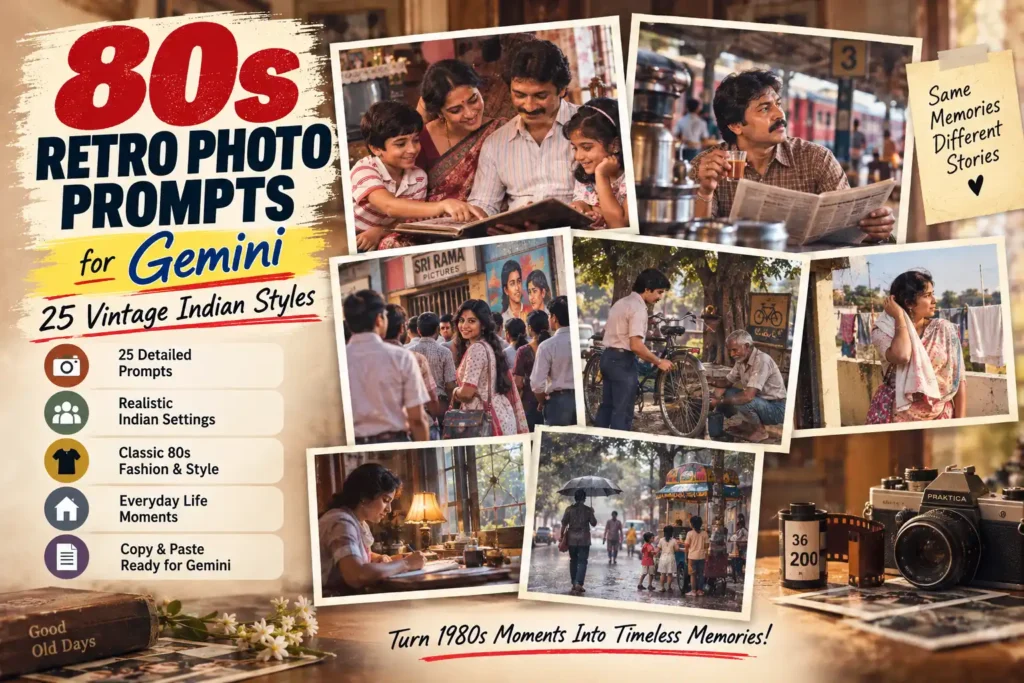
1. 80s Retro India — Early-Morning Newspaper at the Railway Tea Stall
Use my uploaded photo as the exact facial identity reference. Preserve my recognizable face, facial structure, eyes, nose, lips, skin tone, natural age appearance, hairline, hairstyle characteristics, facial asymmetry, body proportions, and important identifying details. Do not replace my identity with a generic model or make me resemble any real celebrity.Transform me into an authentic Indian everyday-life photograph from the mid-1980s.
This is NOT a Bollywood movie scene, fashion editorial, or glamorous retro portrait.
Create the feeling of an ordinary photograph somebody happened to take during an early-morning journey.
Place me at a small railway-platform tea stall shortly after sunrise.
I have enough time before the next train, so I am standing or sitting safely near the stall with a small glass or steel tumbler of hot tea and a folded newspaper.
Do not make me pose with these objects.
I am reading one section of the newspaper when the sound of an approaching train, station announcement, or sudden platform activity makes me look up.
Do not show readable newspaper headlines or depend on generated text.
Capture the exact transitional instant when my hands remain in reading position but my attention has moved toward something beyond the frame.
Dress me in believable mid-1980s Indian travel clothing appropriate to my gender, natural age, region, weather, and social context.
Avoid exaggerated retro styling. The clothing should look like something a real traveler could have worn in 1984–1987.
Build an authentic station environment: old tea counter, blackened kettle, glass jars, metal tea containers, folded newspapers, painted non-AC railway carriage farther away, porters, cloth travel bags, metal trunks, steel water containers, analog station clock, wooden or metal benches, period advertisements with indistinct lettering, and naturally dressed passengers.
Add small lived-in details: condensation or tea stains on the counter, a folded cloth beside the kettle, newspaper edges softened from handling, steam rising irregularly from fresh tea, and morning haze beyond the platform.
COMPOSITION: Photograph from the opposite side of the tea stall using approximately a 50mm documentary perspective. Let part of the kettle, glass jar, or stall frame remain softly out of focus in the foreground.
Position me away from perfect center so the direction of my gaze opens into the active platform.
LIGHTING: Low morning sunlight should enter horizontally beneath or around the platform roof. Let it strike parts of the platform and carriage while my face receives softer reflected light from the surrounding surfaces.
Do not create artificial golden glow directly on the face.
TEA AND NEWSPAPER REALISM: Preserve realistic steam, liquid level, glass or metal reflections, natural finger grip, believable newspaper thickness, folds, and scale.
PERIOD LOCK: Indian railway station, approximately 1983–1988. No smartphones, LED information boards, modern trains, trolley luggage, plastic bottled water, QR codes, earbuds, digital watches as conspicuous elements, contemporary backpacks, or current fashion.
Use restrained 35mm consumer-film characteristics: visible but controlled grain, slightly warm morning colors, modest contrast, gentle highlight roll-off, subtle optical softness, and minor exposure imperfection.
Preserve natural skin pores, realistic hair strands, anatomically correct hands, believable fabric creases, accurate railway geometry, distinct background faces, and physically consistent shadows.
The final photograph should feel like a forgotten frame from an old travel album: tea is still hot, the newspaper is unfinished, something has just happened farther along the platform, and the photograph catches the moment attention leaves the page.
No readable headlines, no text overlay, no watermark, no celebrity likeness, no duplicate people, no extra fingers, no plastic skin, no fake AI glow, and no modern objects.
2. 80s Retro India — Tailor Shop Fitting Seen Through Two Mirrors
Use my uploaded photograph as the strict facial identity anchor. Preserve my real recognizable face, natural age, skin tone, facial proportions, eyes, nose, lips, hairline, hairstyle characteristics, facial asymmetry, body proportions, and individual identifying features. Do not beautify me into another person.Create a visually unusual but completely realistic Indian photograph from a small neighborhood tailoring shop around 1982–1986.
I have come to collect or check the fit of a newly stitched or altered garment.
Choose an authentic period garment appropriate to my gender, natural age, region, and everyday social context.
Do not turn the shop into a luxury vintage boutique.
Create the photograph around TWO ordinary mirrors positioned at different angles inside the cramped shop.
One mirror shows my face in three-quarter reflection while I inspect the garment.
A smaller second mirror reveals only a limited side or back view needed to check the fit.
Do not create multiple impossible copies of my face.
I am adjusting one sleeve, shoulder seam, collar, pleat, hem, or another garment detail appropriate to the clothing.
The tailor is outside the main focal plane, perhaps measuring fabric or making a small adjustment nearby.
Do not make the tailor touch me unnaturally or dominate the image.
Create one tiny candid moment.
While checking the garment seriously, I notice in the second mirror that the tailor has accidentally left a small chalk mark, loose thread, or temporary pin marker in a harmless visible location.
I point toward it through the mirror rather than turning around completely.
The tailor follows my reflection and notices it too.
Capture the instant both people understand the same tiny issue through different mirrors.
Build a working 1980s tailoring shop: period sewing machine, wooden thread spools, folded fabrics stacked imperfectly, tailor's chalk, measuring tape, paper patterns, heavy scissors resting safely on a worktable, wooden stool, ceiling fan, cloth scraps, garment hooks, and a narrow shopfront opening onto the street.
COMPOSITION: Photograph from near the shop entrance using approximately a 50mm lens. The primary mirror should carry my recognizable face, while the secondary mirror contributes only enough information to explain the fitting problem.
REFLECTION LOCK: Every mirror must obey physical geometry. Exactly one real version of me. Reflections must match clothing, hand position, hairstyle, and body orientation. No duplicate faces, extra limbs, impossible reflection angles, or mismatched garments.
LIGHTING: Strong daylight enters from the shopfront behind or beside the camera and bounces softly onto the mirror and face. A warm incandescent bulb deeper inside may provide subtle separation.
PERIOD LOCK: Indian tailoring shop, approximately 1982–1986. No computerized sewing machines, smartphones, LED mirrors, QR payments, modern retail racks, contemporary fashion labels, digital measuring devices, or present-day décor.
Use restrained analog film grain, slightly warm colors, realistic mirror contrast, mild optical softness, and modest dynamic range.
Preserve natural skin texture, accurate hands, realistic stitching, fabric weight, thread behavior, mirror surface imperfections, and physically consistent shadows.
The final image should feel like a genuinely unusual family-album photograph from the 1980s: a simple clothing fitting becomes visually memorable because the entire interaction happens through two old mirrors.
No text, no watermark, no duplicate reflection, no extra fingers, no floating tools, no plastic skin, no artificial AI glow, and no modern objects.
3. 80s Retro India — Sunday Terrace After Washing Hair
Use my uploaded photograph as the exact identity source. Preserve my recognizable face, facial anatomy, eyes, nose, lips, natural skin tone, natural age, hairline, hair characteristics, facial asymmetry, body proportions, and distinctive identifying features. Do not automatically make me younger or transform me into a fashion model.Create an intimate Indian family-album photograph from a quiet Sunday morning around 1985–1988.
Place me on the terrace of a modest Indian home shortly after washing my hair.
Adapt the scene naturally to the gender, age, hairstyle, and appearance shown in my uploaded reference. Do not force long hair, gender-specific styling, or clothing that contradicts the reference.
I am using a faded cotton towel to remove the remaining moisture from my hair.
Do not create a beauty-commercial hair pose.
The photograph should capture an interrupted household moment.
While drying my hair, I hear activity in the lane below — perhaps a vegetable vendor, bicycle bell, neighbor calling, children beginning a game, or another ordinary Sunday sound.
I walk toward the parapet but stop at a safe distance and look down toward the unseen activity.
One hand still holds the towel.
The other may rest naturally against the parapet or hold part of the damp hair depending on the subject.
Capture the exact instant curiosity temporarily interrupts the hair-drying routine.
Dress me in ordinary mid-1980s Indian home clothing appropriate to my gender, natural age, region, and morning routine. Keep the styling modest and unglamorous.
Build a believable terrace: weathered limewashed parapet, steel bucket, washed cotton garments on a clothesline, wooden clothespins, old radio on a stool where plausible, stairwell doorway, neighboring tiled and concrete rooftops, period water-storage structures, television antennas, pigeons, mature trees, and distant lane activity.
Do not include modern rooftop clutter.
COMPOSITION: Photograph from inside the shaded terrace doorway using approximately a 35mm perspective. The darker doorway becomes a natural frame around the brighter rooftop.
Position me off-center, looking toward the lane rather than toward the camera.
Use clothesline elements carefully so no rope, wire, or pole intersects the head, neck, face, or body unnaturally.
LIGHTING: Early-morning sunlight should strike parts of the terrace wall and floor while my face remains in softer reflected illumination. Damp hair may catch small natural highlights but should never look glossy or artificially wet.
HAIR REALISM: Damp hair must form believable strands and slightly heavier sections. The towel should show realistic cotton texture and moisture behavior. No impossible floating hair or beauty-ad shine.
PERIOD LOCK: Indian residential terrace, approximately 1985–1988. No smartphones, solar panels, modern satellite dishes, contemporary plastic furniture, LED fixtures, current high-rise skyline, modern fashion, or present-day rooftop equipment.
Use restrained consumer-film grain, slightly faded warm colors, gentle highlight roll-off, mild lens softness, and authentic family-snapshot exposure.
Preserve natural skin pores, correct fingers, realistic feet, believable towel compression, fabric folds, architectural scale, and physically accurate shadows.
The final photograph should feel like somebody inside the family noticed an ordinary Sunday moment and quietly took one frame before I realized the camera was there.
No text, no watermark, no clothesline intersecting the body, no extra fingers, no plastic skin, no artificial beauty effect, and no modern objects.
4. 80s Retro India — Monsoon Afternoon at the Record and Cassette Shop
Use my uploaded photograph as the precise facial identity reference. Preserve my actual recognizable face, natural age, facial structure, skin tone, eyes, nose, lips, hair characteristics, facial asymmetry, body proportions, and important identifying details. Do not replace me with a celebrity, musician, or generic retro model.Create an original Indian street-life photograph from the late 1980s inside a small record and audio-cassette shop during a monsoon afternoon.
Do not reproduce recognizable copyrighted album artwork, celebrity portraits, song lyrics, or real movie posters.
I have entered the shop partly to escape the rain and partly to browse.
Rows of cassette cases and a smaller number of records or audio items fill simple wooden shelves.
I pick up one cassette whose cover design looks vaguely familiar.
The printed artwork must remain fictional and indistinct.
Before I can inspect it properly, the shopkeeper starts playing another cassette on a period audio system.
Something about the music is familiar.
Do not identify or reproduce any real song.
Capture the instant I stop examining the cassette in my hand and turn my attention toward the speaker or shopkeeper because I recognize the fictional melody.
My expression should show recognition before a smile fully appears.
Outside the open shopfront, heavy rain continues.
A pedestrian passes under an umbrella.
A roadster bicycle is parked beneath the awning.
Wet street reflections remain visible beyond the doorway.
Build a believable working shop: wooden cassette racks, handwritten price cards with unreadable lettering, period cassette player or stereo system, speaker cabinets, paper sleeves, counter glass, old ceiling fan, small stool, cloth used for dusting, wall clock, and stacks that are slightly imperfect rather than aesthetically arranged.
COMPOSITION: Photograph from behind one shelf using approximately a 50mm lens. Let a few cassette cases remain softly out of focus in the foreground while my face and the cassette in my hand stay readable.
The rainy shop entrance should form a bright secondary background plane.
LIGHTING: Cool monsoon daylight enters from the shopfront. Warm fluorescent or tungsten interior lighting may create a mild mixed-color effect appropriate to the era. Do not add neon lighting.
PERIOD LOCK: Indian town or city, approximately 1986–1989. No CDs as dominant merchandise where inappropriate, smartphones, digital music players, Bluetooth speakers, LED signage, QR codes, modern earbuds, current vehicles, or contemporary retail fixtures.
AUDIO OBJECT REALISM: Cassette proportions, clear plastic cases, tape reels, player controls, speaker geometry, shelf scale, and hand grip must be physically believable.
Use moderate 35mm grain, slightly muted rainy-day color, mild mixed-light color shift, realistic shadow density, and subtle optical softness.
Preserve natural skin texture, correct fingers, believable wet-weather clothing behavior, accurate cassette geometry, realistic street reflections, and distinct background people.
The final photograph should feel like a tiny late-1980s memory: I entered the shop because of the rain, picked up one cassette at random, and then another melody playing from across the room unexpectedly made me forget what I was holding.
No recognizable album art, no lyrics, no text overlay, no watermark, no celebrity likeness, no extra fingers, no duplicate person, no plastic skin, and no modern objects.
5. 80s Retro India — Late-Evening Balcony During a Neighborhood Power Cut
Use my uploaded photo as the strict facial identity anchor. Preserve my recognizable face, natural age, skin tone, facial anatomy, eyes, nose, lips, hairline, hairstyle characteristics, facial asymmetry, body proportions, and distinctive identifying features. Never replace me with a generic retro model.Create a visually atmospheric but realistic Indian photograph from an ordinary neighborhood electricity cut in the mid-1980s.
Do not place me dramatically beside a candle staring into the distance.
Instead, show how the blackout temporarily changes the neighborhood.
Place me safely on the balcony, veranda, or front step of a modest Indian home after electricity has failed across several nearby houses.
Because fans and televisions have stopped, people have gradually come outside for cooler air.
I am sitting or standing safely within the balcony while holding a simple hand fan, steel tumbler of water, book, or another period-plausible object.
Across the lane, neighbors occupy their own verandas and balconies.
Children remain safely near their families.
Someone has placed a hurricane lamp inside a doorway.
Another household uses a candle or oil lamp safely away from curtains.
The street itself is unusually dark.
Create the decisive moment when electricity briefly returns for only a second.
One distant house bulb suddenly flashes on.
Several people instinctively look toward it.
Before anybody can react fully, the power fails again.
Capture the instant BETWEEN those two states: one or two bulbs have just illuminated, my face turns toward them, and neighboring people begin noticing.
Do not light the entire neighborhood.
The visual story should be readable from the contrast between darkness, small household lamps, and the brief returning bulb.
Dress me in ordinary mid-1980s Indian evening home clothing appropriate to my gender, natural age, region, and warm weather.
Build the neighborhood with weathered plaster houses, wooden doors, barred windows, practical balconies, roadster bicycle, mature tree, simple utility poles and wires, household plants, red-oxide or cement floors, and naturally placed neighbors.
COMPOSITION: Photograph from inside the darker room looking outward through the balcony doorway using approximately a 35mm lens. Use the doorway as a strong foreground frame.
My figure occupies the near-middle plane while the lane and opposite homes create layered depth.
LIGHTING: The primary illumination should come from faint blue evening ambient light plus small warm household lamps. The momentary returning electric bulb may produce one localized brighter patch.
Do not create cinematic rim lights or artificially illuminate the face. Reflected light from the doorway and opposite walls should keep facial identity visible.
PERIOD LOCK: Indian residential neighborhood, approximately 1983–1988. No smartphones, LED emergency lights, inverter displays, modern cars, contemporary streetlights, satellite dishes of later design, current architecture dominating the scene, or modern clothing.
Use high-speed 35mm film characteristics appropriate to low light: visible but controlled grain, warm lamp halation, deep shadows, modest color accuracy, slight softness, and believable underexposure.
Preserve realistic lamp flames, window geometry, electrical bulb brightness, skin texture, hands, clothing folds, and physically consistent shadows.
The final photograph should feel like a real 1980s neighborhood memory: the power goes out, everybody comes outside, one bulb suddenly returns, every head begins turning toward it — and then nobody yet knows whether the electricity is actually back.
No text, no watermark, no unsafe flame placement, no duplicate people, no extra fingers, no plastic skin, no fake AI glow, and no modern objects.
6. 80s Retro India — The Studio Photographer Says “Don’t Move” Just Before the Flash
Use my uploaded photograph as the exact facial identity reference. Preserve my recognizable face, facial structure, eyes, nose, lips, skin tone, natural age appearance, hairline, hairstyle characteristics, facial asymmetry, body proportions, and important identifying details. Do not replace me with a generic model, beautify me excessively, or make me resemble any real celebrity.Create an authentic Indian neighborhood photo-studio experience from approximately 1983–1987.
Do NOT generate the finished formal portrait.
Instead, photograph the fascinating few seconds BEFORE the studio camera takes the picture.
I have visited a modest local photographic studio for a practical portrait, family keepsake, job application photograph, personal photograph, or another age-appropriate reason.
Dress me in clean, slightly formal but believable mid-1980s Indian clothing appropriate to my gender, natural age, region, and reason for visiting the studio.
Avoid glamorous Bollywood styling.
The photographer has already positioned me on a simple chair or standing mark.
I am trying to remain completely still.
Then the photographer steps slightly away from the camera and notices one tiny problem — perhaps a collar edge, saree fold, loose hair strand, jacket line, chair angle, or another harmless visual detail.
Instead of physically correcting it, the photographer gives a small hand gesture from beside the camera.
I try to understand the instruction without moving too much.
Capture the exact instant when my eyes shift toward the photographer's hand while the rest of my body is still attempting to maintain the formal pose.
My expression should contain concentration and slight uncertainty rather than a polished smile.
The photographer may appear only partially at the edge of the frame — perhaps a hand, shoulder, or blurred profile — because I remain the subject.
Build an authentic small 1980s Indian portrait studio: painted or cloth backdrop, sturdy wooden chair, analog camera on tripod, period flash equipment, reflector where historically plausible, curtain separating the studio from the reception area, small mirror, comb, wooden counter, envelopes for prints, and a few sample portraits displayed indistinctly on the wall.
Do not reproduce recognizable real people's portraits.
COMPOSITION: Photograph the scene from slightly beside the photographer's main camera using approximately a 50mm perspective. Allow part of the analog camera body or tripod to remain softly out of focus in the foreground.
This should feel like a candid photograph OF a formal portrait being prepared rather than the formal portrait itself.
LIGHTING: Use period-plausible studio flash or continuous tungsten lighting. Keep the setup simple and slightly imperfect. If flash is about to fire, do not create an unexplained flash burst before the shutter moment.
Preserve natural shadow falloff and avoid modern beauty-light effects.
PERIOD LOCK: Indian neighborhood photo studio, approximately 1983–1987. No digital cameras, LCD screens, LED panels, ring lights, smartphones, modern softbox systems as dominant equipment, computers, inkjet printers, QR payments, or contemporary studio furniture.
CAMERA REALISM: Analog camera geometry, tripod placement, flash equipment, cable placement, chair scale, and photographer position must be physically plausible.
Use restrained 35mm or medium-format print character, modest grain, slightly warm studio color, mild optical softness, natural skin texture, and believable period exposure.
The final image should preserve a rarely photographed part of 1980s portrait culture: not the carefully finished studio photograph, but the awkward human seconds immediately before it when the photographer says not to move and then gives one more instruction.
No text, no watermark, no celebrity likeness, no duplicate person, no extra fingers, no distorted camera equipment, no plastic skin, no modern beauty filter, and no modern objects.
7. 80s Retro India — Cinema Ticket Queue When Someone Saves Your Place
Use my uploaded photo as the strict facial identity anchor. Preserve my real recognizable face, natural age, skin tone, facial anatomy, eyes, nose, lips, hairline, hairstyle characteristics, facial asymmetry, body proportions, and distinctive identifying features. Do not transform me into an existing actor or generic retro model.Create an authentic Indian social-life photograph from outside a popular single-screen cinema in the mid-1980s.
Do not create a Bollywood movie scene.
This photograph is about ordinary people GOING to the cinema.
Place me in a long but orderly ticket queue beneath the shade of an old theatre entrance during a busy weekend matinee or evening show.
Dress me in believable 1980s Indian going-out clothing appropriate to my gender, natural age, city, weather, and social setting.
I have been waiting in the queue for some time.
A person immediately ahead of me — friend, relative, or companion whose face does not need to dominate the image — quietly keeps my place while I step only a short safe distance aside to buy tea, check something with another family member, or handle another ordinary task.
When I return, somebody farther back mistakenly thinks I am trying to enter the queue unfairly.
Do not create an argument.
The person who saved my place simply shifts aside and gestures toward the small gap where I had been standing.
I understand what happened and begin giving an embarrassed, apologetic smile toward the confused person behind.
Capture this exact social moment.
The humor should come from ordinary queue etiquette rather than exaggerated comedy.
Build an authentic theatre environment: weathered ticket windows with metal grilles, painted queue barriers, hand-painted fictional film artwork with no recognizable copyrighted stars, paper tickets, old wall lamps, ceiling fans beneath the awning, tea vendor, roadster bicycles, Ambassador or Premier Padmini-era vehicles, and period-dressed moviegoers.
Do not make generated signage or poster lettering the focal point.
COMPOSITION: Photograph from outside the queue using approximately a 70mm observational lens. Use two softly blurred waiting people in the foreground to frame me naturally within the line.
The small gap in the queue and the companion's gesture should be visually understandable without text.
LIGHTING: Use hard afternoon daylight outside the theatre with softer reflected light beneath the entrance canopy. Keep realistic contrast between sunlit pavement and shaded faces.
PERIOD LOCK: India, approximately 1983–1988. No multiplex architecture, online ticketing, smartphones, QR codes, modern movie posters, digital screens, contemporary vehicles, plastic bottled water, current clothing, or modern queue systems.
CROWD REALISM: Every background person should have a distinct face and believable age. Avoid cloned extras, repeated clothing, fused bodies, and impossible crowd spacing.
Use restrained consumer-film grain, warm-neutral period colors, modest contrast, natural skin texture, realistic paper tickets, and candid street-photography softness.
The final image should feel like a tiny social memory from the 1980s: the movie has not even started, but a misunderstanding in the ticket queue has already created the photograph people remember.
No readable copyrighted titles, no watermark, no celebrity likeness, no duplicate crowd faces, no extra fingers, no aggressive confrontation, no plastic skin, and no modern objects.
8. 80s Retro India — Bicycle Repair Under a Huge Rain Tree
Use my uploaded photograph as the exact facial identity source. Preserve my recognizable face, natural age, facial proportions, eyes, nose, lips, complexion, hair characteristics, facial asymmetry, body proportions, and important identifying details. Do not make me younger automatically or replace me with a generic nostalgic model.Create an authentic Indian roadside photograph from the mid-1980s centered around a minor bicycle problem during an ordinary journey.
Place me beside a classic roadster-style bicycle beneath the shade of a large mature rain tree, banyan, neem, or another regionally plausible roadside tree.
Choose clothing appropriate to my gender, natural age, occupation or journey, and 1980s Indian setting.
Do not create a fashion pose with the bicycle.
I have stopped because the bicycle has developed a small harmless problem such as a loose chain guard, slightly displaced bicycle chain, low tyre, loose carrier item, or another ordinary issue.
Do NOT provide repair instructions and do not depict dangerous roadside mechanical work.
A small neighborhood bicycle repair stall is located beneath or near the tree.
The mechanic is handling the repair safely.
I wait nearby holding a cloth bag, book bundle, lunch carrier, folded newspaper, or another period-plausible object connected to where I was going.
Create the decisive moment around something unrelated to the repair.
While waiting, I notice a small group of schoolchildren, workers, cattle safely passing at a distance, bus arriving farther down the road, or another ordinary local event.
My attention shifts away from the bicycle.
The mechanic finishes the simple repair and looks toward me, expecting me to notice.
I am still watching the other event.
Capture the instant the mechanic raises one hand slightly to get my attention while I begin turning back.
Do not make either person pose.
Build the repair stall authentically: simple wooden or metal tool box, hand pump, hanging bicycle tyres or tubes where appropriate, old stool, cloth shade extension, steel water tumbler, period bicycle parts, hand-painted board with indistinct lettering, and dust worn into the ground beneath years of use.
COMPOSITION: Shoot from across the roadside using approximately a 50mm perspective. Let the huge tree trunk form one side of the frame while its canopy creates natural shade over the subjects.
The bicycle should be seen clearly but must not dominate the photograph.
LIGHTING: Strong midday or afternoon sunlight falls on the road beyond the tree while both people remain in open shade. Dappled light may reach the ground and bicycle but should not create distracting random patches across the face.
BICYCLE REALISM: Correct wheel geometry, chain placement, pedals, spokes, handlebar, carrier, stand, and tyre contact with the ground. No melted or impossible bicycle parts.
PERIOD LOCK: India, approximately 1982–1988. No smartphones, modern geared bicycles as dominant objects, LED bicycle lights, contemporary repair equipment, modern vehicles dominating the road, QR payment signs, plastic bottled water, or current fashion.
Use restrained 35mm film grain, earthy period colors, modest contrast, mild atmospheric haze, natural skin pores, believable fabric folds, and documentary framing.
The final photograph should feel like an ordinary roadside delay from the 1980s: the bicycle needed attention for only a few minutes, but waiting beneath the old tree created a small moment worth remembering.
No repair tutorial, no text overlay, no watermark, no duplicate people, no extra fingers, no distorted bicycle, no plastic skin, and no modern objects.
9. 80s Retro India — Library Book Returned Years Late with Something Still Inside
Use my uploaded photograph as the exact facial identity reference. Preserve my real recognizable face, natural age, facial anatomy, eyes, nose, lips, skin tone, hairline, hairstyle characteristics, facial asymmetry, body proportions, and distinctive identifying features. Never replace me with a generic student or automatically reduce my age.Create an emotionally intriguing but realistic Indian photograph from a college, community, or public library during the mid-1980s.
Respect the natural age shown in my uploaded image. If I am older than a typical student, portray me as an adult visitor, teacher, researcher, former student, or ordinary library user rather than artificially making me young.
I have brought an old borrowed or previously owned book to the library desk.
The book has apparently been sitting unused for a long time.
When I open it before handing it over, a small forgotten item falls or slides from between the pages.
Choose one believable object: an old bus ticket, pressed leaf, small photograph with indistinct figures, folded library slip, paper bookmark, or another thin period-plausible keepsake.
Do not generate readable personal information.
I had forgotten the object was there.
Capture the exact instant recognition begins.
One hand keeps the book open.
The other carefully picks up the item.
Instead of looking toward the librarian, I stare at the object for a second longer than expected.
The librarian or library worker notices the pause but does not interrupt.
Do not explain what the object means.
The image should leave that history unresolved.
Build an authentic 1980s Indian library: wooden circulation desk, card-catalog drawers, cloth-bound and paper-bound books, manual date stamp, paper borrowing cards, wooden chairs, ceiling fans, analog wall clock, high windows, shelves showing natural wear, and quiet readers farther away.
COMPOSITION: Photograph from behind the circulation desk using approximately a 70mm lens. Allow a stack of returned books to create a soft foreground layer.
Keep my face, open book, and discovered object in a clear visual triangle.
LIGHTING: Soft daylight enters from tall side windows and mixes gently with period fluorescent or incandescent interior light. Preserve natural shadow density among the shelves.
OBJECT REALISM: The discovered item should be small, thin, naturally aged, and physically capable of remaining between book pages. Avoid theatrical treasure-map aesthetics, fake burnt edges, or excessive antique damage.
PERIOD LOCK: India, approximately 1983–1988. No computers at the circulation desk, barcode scanners, smartphones, digital catalog terminals, LED fixtures, modern library furniture, QR codes, contemporary backpacks, or current fashion.
Use restrained analog grain, slightly muted library colors, warm paper tones, mild optical softness, natural skin texture, correct fingers, believable book weight, and realistic paper handling.
The final photograph should feel like the beginning of a memory rather than the end of a library visit: an old book is being returned, something forgotten slips from its pages, and for a few seconds the present disappears from the person's face.
No readable private information, no watermark, no duplicate person, no extra fingers, no floating paper, no plastic skin, no artificial AI glow, and no modern objects.
10. 80s Retro India — Morning Bus Seen Through a Fogged Window
Use my uploaded photo as the strict facial identity anchor. Preserve my recognizable face, natural age, skin tone, facial structure, eyes, nose, lips, hairline, hairstyle characteristics, facial asymmetry, body proportions, and important identifying details. Do not transform me into a generic cinematic model.Create a visually distinctive Indian travel photograph from a cool or rainy early morning in the mid-to-late 1980s.
Place me inside a period-correct public bus beside a closed or partially closed glass window that has become lightly fogged by humidity and temperature difference.
Choose a region, season, or hill-route environment where this condensation is physically plausible.
Do not cover the entire glass with artificial heavy fog.
I am traveling quietly while most passengers are still sleepy.
Instead of wiping the whole window clean, I use the side of one finger or part of my hand to clear only a small practical viewing area in the condensation.
Do not draw hearts, words, names, or decorative symbols on the glass.
Through that small clear patch I notice the landscape outside changing — perhaps the first view of hills, mist-covered fields, a river, tea-growing slopes, forest edge, or another regionally appropriate scene.
Capture the exact instant I lean slightly closer to look through the cleared patch.
My face should also appear faintly reflected in another part of the fogged glass.
The real face and reflection must not look like two separate people.
Dress me in authentic 1980s Indian travel clothing appropriate to my gender, natural age, weather, and route. Add a shawl, sweater, light jacket, or other period-plausible layer only if climate requires it.
Build a believable bus interior: worn seat upholstery, painted metal window frame, handrail, cloth travel bag, overhead luggage rack, paper ticket, sleeping or quiet passengers, period fittings, and naturally aged surfaces.
COMPOSITION: Photograph from the seat across the aisle using approximately a 50mm lens. The fogged window should occupy a substantial part of the composition while my profile, hand, and small clear viewing patch form the storytelling center.
REFLECTION LOCK: The faint glass reflection must correspond exactly to my real face, clothing, and position. No duplicate person, extra face, mismatched hairstyle, or impossible reflection angle.
LIGHTING: Cool diffuse morning daylight enters through the fogged window and softly illuminates my profile. Keep the bus interior darker and warmer where practical fixtures are present.
CONDENSATION REALISM: Use irregular fine droplets, naturally clearer areas near touched glass, realistic finger disturbance, and subtle water trails. Do not create frost unless the climate genuinely supports it.
PERIOD LOCK: Indian bus travel, approximately 1985–1989. No smartphones, modern buses, LED displays, contemporary backpacks, plastic bottled water, earbuds, charging sockets, digital tickets, or current road infrastructure dominating the scene.
Use restrained 35mm grain, cool-muted morning colors, subtle warm interior contrast, gentle highlight roll-off, mild optical softness, and realistic motion blur in the exterior landscape.
Preserve natural skin pores, correct fingers, believable glass reflections, accurate bus geometry, fabric folds, and physically consistent shadows.
The final photograph should feel like an unusually beautiful but completely ordinary 1980s travel memory: a sleepy bus, a fogged window, one small patch cleared by hand, and the first glimpse of the landscape waiting outside.
No writing on the glass, no text overlay, no watermark, no duplicate reflection, no extra fingers, no plastic skin, no fake AI glow, and no modern objects.
11. 80s Retro India — Photo Studio Contact Sheet Where the Unplanned Frame Wins
Use my uploaded photograph as the exact facial identity reference. Preserve my recognizable face, facial structure, eyes, nose, lips, skin tone, natural age appearance, hairline, hairstyle characteristics, facial asymmetry, body proportions, and important identifying details. Do not replace me with a generic model, de-age me automatically, or make me resemble any real celebrity.Create an authentic Indian photography-studio moment from approximately 1984–1988.
Do NOT create another conventional finished studio portrait.
The photo session happened earlier.
I have now returned to the neighborhood studio to choose which photograph should be printed.
Place me beside a wooden counter while the photographer shows me a contact sheet, proof sheet, or several small period photographic proofs from the session.
The formal photographs are technically correct: straight posture, controlled expression, carefully arranged clothing.
But one small frame was apparently taken accidentally BETWEEN poses.
In that frame, I had briefly looked away from the camera because somebody outside the studio said something amusing or unexpected.
Do not render miniature faces with impossible high detail.
The proof sheet should merely suggest several consistent versions of the same person through pose and silhouette.
Create the decisive moment when I point toward the accidental frame instead of the formal one.
The photographer expected me to select another image.
Their hand is hovering over a more conventional proof.
They notice where I am pointing and look back toward me with mild surprise.
My expression should suggest that I already know which photograph feels most like me.
Build a believable 1980s studio reception area: wooden counter, paper envelopes for negatives and prints, loupe or magnifying glass where appropriate, contact sheets, film sleeves, analog camera equipment behind glass or on shelves, sample frames with indistinct people, wall clock, ceiling fan, curtain leading into the portrait room, and simple period furniture.
COMPOSITION: Photograph from the photographer's side of the counter using approximately a 50mm lens. Let the proof sheet occupy the lower foreground while my pointing hand and face remain clearly connected.
Do not make the proof sheet fill the entire frame.
PHOTO-WITHIN-PHOTO REALISM: Every miniature proof should plausibly show the same person without creating separate identities. Keep faces naturally limited in detail. Use correct contact-sheet spacing, paper thickness, mild tonal variation, and realistic handling.
LIGHTING: Soft daylight enters from the studio storefront while a warm fluorescent or tungsten practical light fills the interior. Avoid modern gallery lighting.
PERIOD LOCK: Indian neighborhood photo studio, approximately 1984–1988. No digital cameras, computer monitors, smartphones, image-editing software, inkjet printers, LED panels, memory cards, QR payments, or contemporary studio equipment.
Use restrained analog grain, warm-neutral period color, gentle print softness, modest contrast, natural skin texture, correct fingers, realistic photographic paper, and physically plausible shadows.
The final photograph should tell a subtle retro photography story: several carefully planned portraits are available, but the person chooses the one photograph nobody intended to take.
No readable personal information, no watermark, no celebrity likeness, no highly detailed duplicate miniature faces, no extra fingers, no plastic skin, and no modern objects.
12. 80s Retro India — Small-Town Barber Shop While the Radio Announces Something
Use my uploaded photograph as the strict facial identity anchor. Preserve my real recognizable face, natural age, skin tone, facial proportions, eyes, nose, lips, hairline, hair characteristics, facial asymmetry, body proportions, and distinctive identifying details. Do not change my gender presentation, invent facial hair inconsistent with the reference, or replace me with a generic retro character.Create an authentic Indian neighborhood barber-shop or hair-cutting-salon photograph from the mid-1980s, adapting the environment and grooming service appropriately to the person shown in my uploaded reference.
Do not create a luxury salon.
Do not force a traditionally male barber-shop setup onto a subject for whom another period-appropriate grooming environment would be more plausible.
I am partway through an ordinary haircut, trim, hair arrangement, or grooming visit.
The barber, hairdresser, or stylist has briefly stopped because a transistor radio or small period radio on a shelf begins broadcasting an announcement that catches everyone's attention.
Do not reproduce any real historic announcement, copyrighted broadcast, or readable radio text.
Create the decisive moment when three different lines of attention appear.
The barber or stylist looks toward the radio.
Another waiting customer looks toward the shop entrance as if expecting people outside to react.
I see both reactions through the large wall mirror and turn only my eyes toward the radio while keeping my head still because the grooming is unfinished.
The expression should be curious rather than alarmed.
Build an authentic working shop: large slightly aged mirror, period barber or salon chair, combs, brushes, scissors safely held by the professional, cotton towels, simple grooming products in period-plausible containers, wall shelf, transistor radio, ceiling fan, calendar with unreadable text, wooden waiting bench, tiled or cement floor, and open shopfront revealing part of the street.
Do not place sharp tools near eyes or in unsafe positions.
COMPOSITION: Photograph primarily through the large mirror using approximately a 50mm perspective. My reflected face should be the principal focal point, with the professional and radio positioned so the viewer can understand why everyone's attention changed.
The real back or side of my body may appear at the frame edge.
REFLECTION LOCK: Exactly one real person and one corresponding mirror reflection for each visible individual. No duplicate faces, mismatched hairstyles, impossible extra hands, or reflection geometry errors.
LIGHTING: Bright street daylight enters through the shopfront and bounces naturally into the mirror. A period fluorescent tube or warm practical bulb may supplement the interior without creating modern salon polish.
PERIOD LOCK: India, approximately 1983–1988. No smartphones, modern hair clippers as conspicuous digital equipment, LED mirrors, contemporary salon chairs, QR payments, flat screens, current branding, or present-day décor.
Preserve realistic hair behavior, correct hands, safe tool placement, natural skin pores, mirror wear, towel texture, furniture scale, and physically accurate shadows.
Use restrained 35mm grain, slightly warm period colors, modest contrast, mild mirror softness, and candid documentary framing.
The final photograph should feel like an ordinary grooming visit interrupted by one unexplained radio announcement: nobody has left their place yet, but every person's attention has shifted at once.
No readable broadcast text, no watermark, no duplicate reflections, no unsafe sharp-tool placement, no extra fingers, no plastic skin, and no modern objects.
13. 80s Retro India — Evening Grocery Shop and the Coin That Rolls Under the Counter
Use my uploaded photograph as the exact facial identity source. Preserve my recognizable face, natural age, facial anatomy, eyes, nose, lips, skin tone, hair characteristics, facial asymmetry, body proportions, and individual identifying features. Do not transform me into a generic nostalgic model.Create an authentic Indian neighborhood provision-store photograph from approximately 1982–1987.
I have stopped at a small grocery or general store during the early evening to buy a few ordinary household items.
Do not turn the shop into a stylized vintage display.
Use period-plausible goods and packaging, but avoid making real brand names or readable labels the focal point.
The shopkeeper has finished totaling the purchase manually.
I place several coins on the wooden or glass-topped counter.
One coin slips from the edge.
Do not freeze it dramatically in midair.
Capture the moment AFTER it lands and rolls beneath the counter.
I instinctively look downward.
The shopkeeper does the same.
Then a child, assistant, or another customer standing safely to one side notices exactly where the coin stopped and points toward it.
The small incident should create natural eye lines connecting three levels of the image: counter, faces, and floor.
Do not make anybody crawl dangerously into a cramped space.
The coin remains safely reachable.
Dress me in ordinary mid-1980s Indian clothing appropriate to my gender, natural age, region, and an everyday shopping errand.
Build a believable provision store: wooden shelves packed imperfectly with jars, tins, paper packets, cloth sacks, weighing scale, metal scoop, handwritten account notebook with unreadable writing, hanging household items, old ceiling fan, simple cash drawer, glass jars containing snacks or dry goods, and cloth shopping bags.
COMPOSITION: Photograph from just inside the shop using approximately a 35mm lens. Let the long counter create a diagonal line toward me.
Keep the fallen coin small but visually discoverable near the bottom of the frame. Eye directions should guide the viewer toward it.
LIGHTING: Fading outdoor daylight enters through the shopfront while one warm incandescent or fluorescent fixture illuminates the counter. Preserve believable mixed-light color rather than modern cinematic grading.
COIN AND SHOP REALISM: Correct coin scale, realistic rolling position, believable counter edge, accurate weighing-scale geometry, natural glass reflections, and physically plausible shelf depth.
PERIOD LOCK: Indian neighborhood shop, approximately 1982–1987. No smartphones, barcode scanners, digital payment terminals, QR codes, modern POS screens, contemporary plastic shopping bags as dominant elements, LED signage, or current packaging dominating the scene.
Use restrained analog grain, warm evening colors, modest contrast, mild optical softness, realistic skin texture, correct fingers, believable fabric folds, and documentary imperfection.
The final photograph should feel like an insignificant 1980s errand made memorable by one tiny accident: the shopping is finished, a coin escapes under the counter, and three strangers briefly become part of the same little problem.
No readable prices or brands, no text overlay, no watermark, no duplicate people, no extra fingers, no oversized coin, no plastic skin, and no modern objects.
14. 80s Retro India — Roadside Photo Taken While Waiting for the Level Crossing to Open
Use my uploaded photograph as the exact identity reference. Preserve my recognizable face, natural age, skin tone, facial structure, eyes, nose, lips, hairline, hairstyle characteristics, facial asymmetry, body proportions, and important identifying details. Do not replace me with a generic traveler or fashion model.Create a richly observed Indian roadside photograph from the mid-1980s at a railway level crossing.
I am traveling by bicycle, scooter, bus, car, or on foot according to what is most plausible for my natural age and styling.
The crossing gates are safely CLOSED because a train is passing.
Do not place me or the camera on the railway tracks.
Do not show dangerous gate crossing.
Like everybody else, I am simply waiting.
Build the image around the temporary roadside community created by the closed gate.
A cyclist rests one foot on the ground.
A bus passenger looks through an open window.
A tea seller takes advantage of the pause.
A family waits inside a period car.
Pedestrians stand safely behind the barrier.
I initially watch the train.
Then something on the opposite side of the tracks catches my attention through the moving gaps between train carriages — perhaps someone I recognize, a familiar building, a friend waiting with a bicycle, or another harmless visual discovery.
Do not clearly reveal the person's identity.
Capture the exact instant when a brief gap between passing carriages allows me to see the opposite side for only a fraction of a second.
My eyes track that gap.
My body remains safely behind the crossing barrier.
COMPOSITION: Photograph from the roadside queue using approximately an 85mm perspective. Let part of the crossing barrier form a strong horizontal foreground element without obscuring my face.
Use the moving train as a middle layer and the opposite side of the road as a fragmented background.
MOTION: The passing train should show controlled lateral motion blur while my face, the barrier, and nearby waiting people remain reasonably sharp.
LIGHTING: Use bright late-afternoon daylight with realistic shade from roadside trees or nearby buildings. Metal train surfaces may create brief reflected highlights but no artificial glow.
PERIOD LOCK: India, approximately 1983–1988. No smartphones, modern automatic LED crossing systems as dominant elements, contemporary cars, current motorcycles, modern helmets as conspicuous focal objects, digital railway signage, or present-day road infrastructure dominating the frame.
TRANSPORT REALISM: Correct barrier geometry, safe human placement, realistic train scale, believable vehicle spacing, and proper wheel contact with the road.
Use restrained 35mm film grain, slightly warm colors, natural motion blur, modest dynamic range, mild atmospheric haze, and candid roadside framing.
The final photograph should turn an ordinary delay into a visual story: everybody is waiting for the same train to pass, but for one second I am looking THROUGH the moving train at something nobody else has noticed.
No unsafe track behavior, no text, no watermark, no duplicate people, no distorted vehicles, no extra fingers, no plastic skin, and no modern objects.
15. 80s Retro India — Evening Letter Writing Beside an Open Window
Use my uploaded photograph as the strict facial identity reference. Preserve my real recognizable face, natural age, facial anatomy, eyes, nose, lips, complexion, hair characteristics, facial asymmetry, body proportions, and distinctive identifying details. Do not automatically make me young, romanticize me into a generic model, or alter my identity.Create a quiet Indian home photograph from the mid-1980s centered around the physical act of writing a personal letter.
Do not create the cliché of somebody staring sadly from a window holding a finished love letter.
Instead, show the actual uncertainty of composing something by hand.
Place me at a small wooden desk, dining table, veranda table, or window-side writing surface during early evening.
A sheet of paper lies in front of me.
A fountain pen or period-plausible ballpoint is in my hand.
Several earlier lines have been written, but none of the writing should be readable.
I have reached a sentence I cannot decide how to finish.
One crossed-out or restarted line may be suggested visually without generating legible words.
I stop writing.
The pen remains just above the page.
Instead of looking dramatically into the distance, I notice an ordinary event outside the open window — a postman cycling home, children finishing a street game, a neighbor closing a shop shutter, the evening bus passing, or another small period-appropriate scene.
That everyday sight unexpectedly gives me an idea for what to write next.
Capture the exact instant my attention returns from the window toward the unfinished page.
My expression should show a thought forming rather than sadness or theatrical romance.
Dress me in ordinary 1980s Indian home clothing appropriate to my gender, natural age, region, and season.
Build a believable writing environment: paper sheets, envelope, postage stamp shape without readable detail, fountain pen or period ballpoint, small ink bottle only if appropriate, desk calendar with unreadable text, reading spectacles where relevant, analog clock, transistor radio, steel tumbler, cotton curtain, wooden window, and a few household books.
COMPOSITION: Photograph from outside the edge of the writing table using approximately a 50mm perspective. Let the unfinished letter occupy the lower foreground while my face and the open window form the middle and background storytelling planes.
LIGHTING: Blue-hour daylight enters through the window while a warm table lamp or nearby tungsten household bulb illuminates the paper and one side of my face.
The two sources should mix naturally without creating orange-and-blue blockbuster grading.
PAPER AND PEN REALISM: Correct pen grip, believable ink placement, natural paper folds, realistic envelope scale, and no magically perfect calligraphy.
PERIOD LOCK: Indian household, approximately 1983–1988. No smartphones, laptops, email screens, LED desk lamps, modern stationery branding, digital clocks, contemporary furniture, or present-day objects.
Use restrained high-speed 35mm grain, warm practical-light halation, modest shadow density, gentle optical softness, natural skin texture, correct fingers, and believable fabric folds.
The final photograph should feel like a private 1980s moment whose tension comes from something modern life rarely requires: finding the right sentence when there is no delete key, no instant message, and only one sheet of paper waiting beneath the pen.
No readable letter content, no text overlay, no watermark, no extra fingers, no floating pen, no plastic skin, no artificial AI glow, and no modern objects.
16. 80s Retro India — Sunday Market Photograph Through a Shop’s Hanging Glass Bottles
Use my uploaded photograph as the exact facial identity reference. Preserve my recognizable face, facial structure, eyes, nose, lips, skin tone, natural age appearance, hairline, hairstyle characteristics, facial asymmetry, body proportions, and important identifying details. Do not replace my identity with a generic retro model or automatically make me younger.Create an authentic Indian Sunday-market photograph from approximately 1983–1988.
Do not create a conventional portrait of me standing in a colorful bazaar.
Instead, photograph an ordinary purchase through layers of real market activity.
I have stopped at a small traditional provision, beverage, household-goods, or mixed street-side shop during a crowded weekly market.
Several reusable glass bottles, jars, hanging packets, or other period-plausible shop objects occupy the near foreground.
They should partially frame the photograph without covering my face.
I am examining a small everyday item handed to me by the shopkeeper — perhaps a household object, folded cloth item, simple utensil, packet, notebook, or another period-appropriate purchase.
The shopkeeper has apparently quoted the price.
I reach toward a small cloth purse, pocket, or money pouch to pay.
Then I realize I do not have the exact change.
Before I say anything, an older customer beside me silently slides one small coin across the counter so the transaction can be completed.
Do not make this person appear wealthy or heroic.
It should look like a tiny ordinary act between strangers.
Capture the exact instant I notice the coin and turn toward the person who offered it.
My hand remains near my own money.
The older customer is already looking elsewhere or continuing their own purchase, making the kindness feel casual rather than performed.
My expression should contain mild surprise and gratitude without exaggerated smiling.
Dress me in believable mid-1980s Indian market-going clothing appropriate to my gender, natural age, region, weather, and social context.
Build an authentic market environment: wooden shop counter, reusable glass bottles, jars of dry goods, cloth sacks, manual weighing scale, metal scoops, paper packets, cloth shopping bags, roadster bicycles, vegetable baskets, canvas or cloth awnings, pedestrians, handcarts, and period-plausible shops receding into the street.
Avoid prominent readable brand names.
COMPOSITION: Photograph from inside the shop using approximately a 70mm lens. Shoot through two or three foreground glass bottles or hanging objects, allowing them to become softly blurred framing elements.
Keep my face, the small coin, the shopkeeper's hands, and the older customer's understated gesture within a clear visual path.
GLASS REALISM: Foreground bottles must refract the background naturally. Do not allow bottle distortion to create duplicate faces, extra eyes, or impossible body fragments.
LIGHTING: Bright market daylight enters from the street while the shop interior remains shaded. Reflected light from the street and pale awnings naturally illuminates my face. Glass objects may catch small highlights but must not glow.
PERIOD LOCK: India, approximately 1983–1988. No smartphones, QR payments, barcode scanners, modern POS terminals, contemporary plastic shopping bags as dominant elements, LED signage, current packaging, or modern vehicles dominating the market.
Use restrained 35mm consumer-film grain, warm earthy market colors, modest contrast, mild optical softness, natural skin texture, realistic coin scale, and believable environmental wear.
The final photograph should feel like a tiny 1980s memory whose meaning is easy to miss: a busy market, an ordinary purchase, one missing coin, and a stranger helping without waiting to be thanked.
No readable brand text, no watermark, no duplicate people, no impossible glass reflections, no extra fingers, no oversized coin, no plastic skin, and no modern objects.
17. 80s Retro India — A Postcard Arrives from a Place You Have Never Seen
Use my uploaded photograph as the strict facial identity anchor. Preserve my real recognizable face, natural age, facial anatomy, eyes, nose, lips, complexion, hair characteristics, facial asymmetry, body proportions, and distinctive identifying details. Do not de-age me or substitute a generic nostalgic model.Create a quiet Indian home photograph from the mid-1980s centered around receiving a physical postcard.
Do not make the scene a generic person smiling while reading mail.
A postman has already delivered the day's letters and left.
I am sorting through ordinary household mail near the doorway, veranda, or table when one postcard catches my attention.
The postcard comes from an Indian place I have never personally visited.
Do not use clearly readable place names, addresses, stamps, or private information.
The image printed on the postcard should remain small and period-plausible — perhaps distant hills, coastline, monument silhouette, lake, city street, or another indistinct travel image.
At first I look at the written side.
Then I turn the postcard over.
The photograph on the front makes me pause.
Create the decisive moment when I compare the tiny postcard landscape with an old wall map, calendar picture, travel book, or another harmless household reference nearby.
Do not make me point theatrically.
My eyes move from the postcard toward the reference and back again, as though I am imagining the distance for the first time.
If another household member is present, they may notice my curiosity and lean slightly closer, but the scene should remain primarily about me.
Dress me in ordinary 1980s Indian home clothing appropriate to my gender, natural age, region, and season.
Build a believable household environment: wooden doorway, letter slot or simple mail bundle where appropriate, paper envelopes, analog wall clock, transistor radio, steel tumbler, wooden table, cloth curtain, small stack of newspapers, and a wall map or travel reference with no readable detailed text.
COMPOSITION: Photograph from slightly behind one shoulder using approximately a 50mm perspective. Let the postcard occupy a small but understandable foreground position while my profile and the distant wall reference create visual depth.
POSTCARD REALISM: Correct postcard proportions, paper thickness, slightly softened corners, restrained printing quality, period stamp placement, and realistic hand grip. Do not create an oversized postcard or modern glossy travel card.
LIGHTING: Soft late-morning or afternoon daylight enters through the doorway and falls across the postcard and hands. Reflected room light naturally illuminates my face.
PERIOD LOCK: Indian household, approximately 1983–1988. No smartphones, email, laptops, modern courier packaging, QR codes, LED fixtures, contemporary travel advertising, digital maps, or present-day furniture.
Use restrained analog grain, warm paper tones, slightly faded consumer-film colors, modest contrast, mild optical softness, natural skin texture, correct fingers, and realistic paper shadows.
The final photograph should capture something specific to an era when distant places could first enter a home as a small printed card: I have not traveled anywhere, but for several seconds one postcard makes an unfamiliar place feel unexpectedly close.
No readable address, no personal information, no text overlay, no watermark, no extra fingers, no floating paper, no plastic skin, and no modern objects.
18. 80s Retro India — Morning at the Public Telephone Booth with Coins Ready
Use my uploaded photograph as the exact facial identity source. Preserve my recognizable face, natural age, facial structure, eyes, nose, lips, skin tone, hairline, hairstyle characteristics, facial asymmetry, body proportions, and important identifying details. Do not make me resemble any celebrity or generic movie character.Create an authentic Indian public-telephone moment from the late 1980s.
Do not portray a dramatic secret call.
The visual story is about the small preparation once required before making an ordinary telephone call away from home.
Place me at a period-plausible public telephone facility, small telephone counter, shop-based phone service, office reception telephone, or another historically credible late-1980s Indian setting.
Avoid using later-era PCO aesthetics if they would be anachronistic for the chosen year.
I need to make one practical call.
Before dialing, I have arranged several coins, a small paper note with a telephone number, and perhaps an address or appointment reminder beside the telephone.
Do not make the telephone number readable.
I begin dialing carefully on a rotary or other period-correct telephone.
Halfway through, I realize I may have copied one digit incorrectly.
Do not show modern caller ID or display screens.
I stop before completing the call.
One finger remains near the dial.
I compare the handwritten note with another small piece of information I am carrying.
A shopkeeper, clerk, or waiting customer notices my hesitation but does not interfere.
Capture the exact instant I decide whether to restart the call.
The expression should show practical concentration with a hint of uncertainty, not suspense or fear.
Dress me in ordinary late-1980s Indian clothing appropriate to my gender, natural age, occupation, and reason for being outside the home.
Build a believable environment: rotary or period-correct landline telephone, coiled cord, wooden counter, coins, handwritten notebook with indistinct writing, wall clock, ceiling fan, glass partition or shop shelves where appropriate, calendar, wooden stool, and street activity beyond the entrance.
COMPOSITION: Photograph from slightly outside the telephone area using approximately a 50mm lens. Keep the receiver, rotary dial, coins, my hand, and concentrated face visually connected.
Use the telephone cord as a natural line within the composition without letting it intersect the face awkwardly.
LIGHTING: Strong daylight from the street or window should illuminate the scene naturally. Interior fluorescent or tungsten lighting may add a subtle period color cast.
TELEPHONE REALISM: Correct receiver orientation, believable cord connection, proper rotary-dial geometry, natural finger position, realistic coin size, and physically plausible telephone placement.
PERIOD LOCK: India, approximately 1986–1989. No mobile phones, digital caller-ID displays, touchscreens, modern PCO branding from later decades, QR payments, LED signs, contemporary telecom equipment, or current fashion.
Use restrained 35mm grain, slightly warm-neutral color, modest contrast, mild optical softness, realistic skin pores, correct hands, believable paper texture, and documentary framing.
The final photograph should preserve an ordinary piece of pre-mobile life: coins prepared, number written on paper, telephone waiting, and one uncertain digit capable of stopping the entire call before it begins.
No readable phone number, no text overlay, no watermark, no disconnected receiver, no extra fingers, no plastic skin, and no modern objects.
19. 80s Retro India — A Sudden Breeze Turns the Newspaper into a Street Puzzle
Use my uploaded photograph as the strict identity reference. Preserve my real recognizable face, natural age, skin tone, facial anatomy, eyes, nose, lips, hair characteristics, facial asymmetry, body proportions, and distinctive identifying features. Do not replace me with a generic retro character.Create an authentic Indian street photograph from a breezy mid-1980s morning.
Place me at a modest bus stop, tea stall, park bench, railway approach road, or shaded roadside location where reading a newspaper while waiting would be natural.
I am seated or standing safely with a large folded newspaper.
Do not make newspaper headlines readable.
A sudden strong but believable breeze catches several loose inner sheets.
Avoid the cliché of dozens of papers flying dramatically through the sky.
Only two or three lightweight pages escape.
One page slides across the pavement.
Another catches against the wheel of a safely parked bicycle.
A third is stopped by the shoe of a nearby stranger.
I instinctively hold the remaining newspaper closed with one hand.
The stranger looks down, notices the page at their foot, picks it up, and holds it toward me.
At the same time, another person farther away points toward the page caught beside the bicycle.
Capture the exact instant I realize my newspaper has temporarily scattered itself among several strangers.
My expression should show embarrassed amusement rather than frustration.
Dress me in ordinary mid-1980s Indian clothing appropriate to my gender, natural age, weather, and setting.
Build an authentic streetscape: roadster bicycle, tea glasses, wooden bench, period bus or vehicles in the distance, utility poles, mature shade trees, small shops, cloth awnings, and naturally dressed pedestrians.
COMPOSITION: Use a slightly elevated 35mm perspective so the viewer can visually trace the escaped pages across the pavement.
Keep me as the principal subject while using the positions of the paper sheets to connect several people within the frame.
WIND REALISM: Every moving element must respond to the same breeze direction. Newspaper sheets should bend and flutter according to real paper physics. Clothing and tree leaves may move subtly in the same direction.
LIGHTING: Use clear morning daylight broken by tree shade or building shadows. Avoid artificial cinematic lighting.
PERIOD LOCK: India, approximately 1983–1988. No smartphones, modern buses as focal objects, current motorcycles, digital displays, contemporary street furniture, plastic bottled water, QR codes, or present-day fashion.
Use restrained analog grain, warm-neutral street colors, natural shutter character, modest dynamic range, realistic paper motion, natural skin texture, correct fingers, and candid framing.
The final photograph should feel like a spontaneous 1980s street image: one gust of wind briefly distributes a newspaper among complete strangers, and several people cooperate without needing to say much.
No readable headlines, no text overlay, no watermark, no impossible flying paper, no duplicate pedestrians, no extra fingers, no plastic skin, and no modern objects.
20. 80s Retro India — Watching an Old Photograph Develop Under Red Darkroom Light
Use my uploaded photograph as the exact facial identity anchor. Preserve my recognizable face, natural age, facial proportions, eyes, nose, lips, skin tone, hairline, hairstyle characteristics, facial asymmetry, body proportions, and important identifying details. Do not substitute my identity with a generic photographer or retro model.Create an intimate Indian photographic-darkroom scene from approximately 1983–1988.
I am not necessarily a professional photographer.
Perhaps a photographer friend, relative, studio worker, or photography-club member has allowed me to watch one of my own photographs being processed.
Do not depict unsafe chemical handling.
I remain safely beside the work area while the trained person handles photographic materials appropriately.
The emotional center is the gradual appearance of a familiar image on photographic paper.
Do not show impossible magical instant development.
The print is already at a plausible stage of the process where an image has begun becoming visible.
The emerging photograph depicts an ordinary place or moment connected to me — perhaps a family doorway, railway journey, old street, bicycle, friend seen indistinctly, or another harmless memory.
Do not create a detailed duplicate miniature face.
I lean slightly closer without touching the chemical tray.
My eyes recognize the image before every detail has fully emerged.
Capture the exact instant recognition appears on my face.
The darkroom worker notices my reaction rather than looking at the print.
This creates two different focal directions: I watch the photograph; the worker watches me.
Build a credible period darkroom: enlarger, developing trays, proper tongs, hanging negatives, timer, film canisters, contact sheets, chemical containers with indistinct labels, drying clips, workbench, ventilation, and period photographic equipment.
COMPOSITION: Photograph from across the darkroom workbench using approximately a 50mm lens. Let hanging negative strips create a soft foreground layer without crossing my eyes or face.
Keep the developing print small and plausible while my reaction remains the primary storytelling element.
LIGHTING: Respect photographic darkroom conditions. Use period-plausible safelight illumination appropriate to the process being shown. Do not flood the room with bright white light.
Facial identity must remain recognizable through realistic low-light exposure rather than artificial face glow.
DARKROOM REALISM: Correct tray proportions, tongs handling the paper, safe hand placement, plausible wet-paper behavior, and historically credible equipment. Do not show bare hands immersed in processing chemicals.
PERIOD LOCK: Indian photographic darkroom, approximately 1983–1988. No digital cameras, smartphones, computer monitors, Photoshop interfaces, inkjet printers, memory cards, LED photography panels, or modern editing equipment.
Use period high-speed film character: controlled grain, deep shadows, restrained safelight color cast, modest dynamic range, subtle optical softness, and natural skin texture.
The final photograph should feel like an image about photography itself: a memory is becoming physically visible on paper while the person who lived that memory recognizes it before the process is even finished.
No readable chemical labels, no unsafe handling, no watermark, no detailed duplicate miniature face, no extra fingers, no plastic skin, no fake holographic effects, and no modern objects.
21. 80s Retro India — Sunday Afternoon at the Neighborhood Watch-Repair Counter
Use my uploaded photograph as the exact facial identity reference. Preserve my recognizable face, facial structure, eyes, nose, lips, skin tone, natural age appearance, hairline, hairstyle characteristics, facial asymmetry, body proportions, and important identifying details. Do not replace me with a generic retro model, automatically make me younger, or make me resemble any real celebrity.Create an authentic Indian neighborhood photograph from approximately 1983–1988 centered around a tiny watch-repair shop.
Do NOT create a luxury watch advertisement.
I have brought an ordinary wristwatch, pocket watch, or small period-plausible timepiece for a simple repair or adjustment.
Adapt the watch naturally to my age, gender, clothing, and social context.
The watchmaker sits behind a narrow glass or wooden counter under a strong work lamp.
Using appropriate period tools, the watchmaker examines the mechanism while I wait on the customer side.
Do not provide repair instructions.
The interesting moment happens when the watchmaker finishes.
Instead of immediately handing the watch back, they compare its time against a large analog wall clock inside the shop.
I instinctively look toward the wall clock too.
Then another customer waiting nearby checks their own watch.
The three timepieces apparently disagree slightly.
Create the decisive instant when everybody notices the mismatch and looks from one clock to another.
The watchmaker remains professionally serious.
I begin showing restrained amusement.
The waiting customer looks uncertain about which clock to trust.
Do not make the scene exaggerated comedy.
Build a believable 1980s watch-repair shop: small glass counter, magnifying loupe, tiny screw containers, period watch straps, analog alarm clocks, wall clocks, simple tool tray, wooden drawers, handwritten repair slips with unreadable writing, stool, ceiling fan, old calendar, and a narrow shopfront opening toward the street.
Avoid prominent modern luxury-brand logos.
COMPOSITION: Photograph from slightly outside the counter using approximately a 70mm perspective. Let one or two hanging clocks remain softly out of focus in the upper foreground while my face, the watchmaker, and the large wall clock remain visually connected.
Use eye direction to create the story: watchmaker to wall clock, me to watchmaker, waiting customer to their own watch.
LIGHTING: Daylight from the shopfront provides broad ambient illumination while the watchmaker's small work lamp creates a concentrated warm pool across the counter.
Do not let the work lamp unnaturally illuminate the entire room.
TIMEPIECE REALISM: Watches and clocks must have physically plausible hands, cases, straps, glass reflections, scale, and mechanical appearance. Avoid distorted clock faces and impossible numbers becoming the focal point.
PERIOD LOCK: India, approximately 1983–1988. No smartwatches, smartphones, digital repair equipment, LED work lamps, QR payments, computer screens, modern retail displays, or contemporary fashion.
Use restrained 35mm consumer-film grain, warm-neutral colors, modest contrast, mild optical softness, natural skin pores, correct fingers, realistic metal reflections, and authentic shop wear.
The final photograph should feel like an ordinary pre-digital-life moment: one watch goes in for repair, three clocks end up disagreeing, and for a few seconds everybody in the tiny shop wonders which version of the time is correct.
No readable personal information, no text overlay, no watermark, no celebrity likeness, no extra fingers, no distorted watches, no plastic skin, and no modern objects.
22. 80s Retro India — The Ice-Cream Cart Bell Interrupts a Serious Conversation
Use my uploaded photo as the strict facial identity anchor. Preserve my real recognizable face, natural age, skin tone, facial anatomy, eyes, nose, lips, hairline, hairstyle characteristics, facial asymmetry, body proportions, and distinctive identifying details. Do not transform me into a generic youthful model or change my identity.Create an authentic Indian residential-street photograph from a warm evening in the mid-to-late 1980s.
Do not create a glamorous summer advertisement.
Place me on the veranda, front step, compound entrance, or shaded edge of a modest Indian home while having a serious but ordinary conversation with a friend, sibling, relative, neighbor, or another age-appropriate person.
Do not imply conflict or romance unless clearly appropriate to the uploaded context.
Both people are focused on the conversation.
Then the distinctive bell of a passing ice-cream or frozen-treat cart is heard farther down the street.
Do not reproduce real brand names.
The sound creates a completely different reaction in the surrounding neighborhood.
Several children farther away immediately look toward the road.
One adult calls someone from inside a house.
A child begins checking for coins.
The conversation beside me pauses.
Create the decisive moment when my companion remains serious for half a second longer while I instinctively turn toward the familiar cart sound.
Then my companion realizes why I looked away and also begins turning.
The contrast between the serious conversation and the harmless neighborhood interruption should create the photograph.
If the uploaded reference depicts an older adult, preserve that age. The attraction of the cart can be nostalgia, noticing children's excitement, or deciding to buy something for someone else rather than making every adult behave like a child.
Build a believable street: weathered compound walls, wooden gates, bicycles, mature trees, period houses, children playing safely away from traffic, simple handcart or pedal cart, cloth awnings, utility poles, and a few period vehicles farther away.
COMPOSITION: Photograph from across the lane using approximately an 85mm observational perspective. Keep me and my companion in the foreground-middle plane while the approaching cart remains smaller in the background.
Use my changed eye direction to lead the viewer toward the cart.
LIGHTING: Use warm but natural late-afternoon or early-evening daylight filtered through roadside trees. Household incandescent bulbs may begin appearing in shaded verandas.
Avoid exaggerated golden glow.
PERIOD LOCK: Indian residential neighborhood, approximately 1984–1989. No smartphones, modern packaged ice-cream branding as a focal point, LED cart lighting, contemporary vehicles, current bicycles, modern street furniture, QR payments, or present-day fashion.
Preserve realistic handcart or cycle-cart geometry, distinct background children, safe street behavior, correct hands, natural skin texture, believable clothing folds, and physically accurate shadows.
Use restrained analog grain, warm neighborhood colors, modest dynamic range, mild telephoto softness, and candid street-photography character.
The final photograph should feel like an ordinary 1980s evening remembered for an unexpected reason: an important conversation pauses because one familiar bell moves through the street and, for several seconds, everybody's attention belongs to the same approaching cart.
No readable branding, no text overlay, no watermark, no duplicate children, no unsafe traffic behavior, no extra fingers, no plastic skin, and no modern objects.
23. 80s Retro India — The Last Bus Leaves and the Tea Stall Becomes the Waiting Room
Use my uploaded photograph as the exact facial identity source. Preserve my recognizable face, natural age, facial proportions, eyes, nose, lips, complexion, hair characteristics, facial asymmetry, body proportions, and important identifying details. Never replace me with a generic traveler or artificially change my age.Create a realistic Indian small-town or rural bus-stand photograph from approximately 1983–1988.
The final scheduled bus has apparently just departed earlier than I expected or I have arrived moments too late.
Do not show me chasing the bus.
Do not create a dramatic stranded-traveler scene.
The departing bus is already safely far down the road.
I stand near the bus-stop area holding a modest cloth bag, small suitcase, books, or another period-plausible travel item.
After realizing there is no immediate transport, I move to a nearby tea stall to ask what options exist.
Do not make any timetable text readable.
The stall owner responds calmly and indicates through gesture that another local vehicle, morning bus, or practical alternative may eventually be available.
The exact information does not need to be visually explained.
Create the decisive moment when I stop worrying about the missed bus and accept a glass of tea.
Another stranded traveler is already sitting nearby, apparently having reached the same conclusion earlier.
That person silently moves a small stool or makes space on the bench for me.
Capture the instant I notice the offered seat.
The emotional tone should shift from mild frustration toward acceptance and unexpected companionship.
Build an authentic roadside bus-stop environment: modest shelter, weathered bench, tea stall, blackened kettle, glass jars, steel containers, kerosene or period cooking equipment where appropriate, roadster bicycle, cloth travel bags, old timetable board with indistinct writing, utility poles, mature trees, and a departing period bus far down the road.
COMPOSITION: Photograph from inside the tea stall using approximately a 50mm lens. Use the kettle or hanging glassware as soft foreground framing.
The offered bench space, my travel bag, and the distant road should create a visual sequence from problem to temporary solution.
LIGHTING: Use fading evening daylight outside with warm incandescent or kerosene-lamp illumination inside the stall where historically and safely appropriate.
Preserve natural low-light contrast instead of brightening every corner.
PERIOD LOCK: India, approximately 1983–1988. No smartphones, ride-hailing apps, modern buses, LED timetable boards, trolley luggage, plastic bottled water, contemporary backpacks, QR payments, or current highway infrastructure dominating the frame.
Use high-speed 35mm-film characteristics: visible controlled grain, warm practical-light halation, deep but readable shadows, restrained saturation, modest dynamic range, and gentle optical softness.
Preserve natural skin texture, correct hands, realistic luggage weight, believable tea-glass reflections, distinct secondary faces, and physically plausible road perspective.
The final photograph should feel like a travel memory created by a plan going wrong: the last bus disappears, the journey stops unexpectedly, and a roadside tea stall quietly becomes the waiting room for people who did not intend to meet.
No readable timetable, no text overlay, no watermark, no unsafe road behavior, no duplicate people, no extra fingers, no plastic skin, and no modern objects.
24. 80s Retro India — Rain Begins While a Street Photographer Is Taking Your Portrait
Use my uploaded photograph as the strict facial identity reference. Preserve my real recognizable face, natural age, facial anatomy, eyes, nose, lips, skin tone, hairline, hairstyle characteristics, facial asymmetry, body proportions, and distinctive identifying details. Do not transform me into a celebrity, generic fashion model, or artificially younger person.Create an authentic Indian street-photography moment from the mid-1980s involving a local itinerant, tourist-area, fairground, park, promenade, or public portrait photographer.
Do not create a modern professional photoshoot.
I have agreed to have one simple outdoor portrait taken.
The photographer uses period-appropriate analog equipment and has positioned me beside an ordinary environmental backdrop — perhaps park railing, public garden, promenade wall, fairground edge, town landmark area, or another plausible location.
The photographer has almost finished composing the picture.
Then the first drops of unexpected rain begin.
Do not immediately create heavy monsoon rain.
One raindrop lands on the photographer's equipment cover or hand.
Another darkens a small spot on the pavement.
I notice the photographer looking upward.
Instead of abandoning the portrait instantly, both of us hesitate for one second, silently judging whether the rain will become heavier.
Capture that exact shared uncertainty.
My formal portrait posture has already relaxed.
The photographer still has one hand near the camera.
A nearby person begins opening an umbrella.
A vendor starts pulling a cloth covering over goods.
The environmental reaction reveals that the rain is real and increasing.
Do not show the camera getting dangerously wet.
The photographer should begin protecting equipment appropriately.
Dress me in believable 1980s Indian outing clothing appropriate to my gender, natural age, location, and weather.
COMPOSITION: Photograph the scene from slightly behind and beside the photographer using approximately a 50mm perspective. Allow the analog camera and photographer's shoulder to appear softly in the foreground while my changing expression remains the main focus.
The image should feel like a photograph OF a portrait session being interrupted.
LIGHTING: Use soft overcast daylight as clouds thicken. The remaining brighter sky may create gentle directional illumination, but avoid dramatic storm lighting.
RAIN REALISM: Only early scattered droplets at first, irregular dark wet marks on pavement, realistic fabric response, consistent wind direction, and no impossible suspended wall of water.
PERIOD LOCK: India, approximately 1983–1988. No digital cameras, smartphones, LED flashes, modern tripods as conspicuous elements, contemporary umbrellas with prominent branding, current clothing, QR payments, or modern street infrastructure dominating the scene.
CAMERA REALISM: Period analog camera proportions, realistic strap, safe tripod placement if used, correct photographer grip, and believable protective response to rain.
Use restrained 35mm grain, slightly cool overcast colors, natural skin texture, mild optical softness, modest contrast, and documentary imperfection.
The final photograph should feel more interesting than the portrait the photographer intended to make: the pose disappears, everybody looks toward the sky, and the first few raindrops turn a planned photograph into an unplanned memory.
No text, no watermark, no celebrity likeness, no damaged camera, no impossible rain, no duplicate people, no extra fingers, no plastic skin, and no modern objects.
25. 80s Retro India — The Final Frame Left on a Roll of Film
Use my uploaded photograph as the exact facial identity anchor. Preserve my recognizable face, natural age, facial structure, eyes, nose, lips, skin tone, hairline, hairstyle characteristics, facial asymmetry, body proportions, and important identifying details. Never de-age, idealize, or replace me with a generic vintage model.Create a deeply nostalgic final image for this 25-photo collection built around the limitations of analog photography in late-1980s India.
Do NOT create a formal portrait.
Someone close to me is carrying a simple period consumer film camera during an ordinary outing or family day.
Choose a modest location that feels authentically lived-in rather than spectacular: old house veranda, quiet neighborhood lane, public garden bench, lakeside walkway, railway waiting area, college courtyard, bus-stop shelter, market edge after closing time, or another plausible 1980s Indian setting.
The photographer realizes there is only ONE exposure left on the roll.
Do not show a digital counter.
The photographer initially tries to save the final frame for something important.
Then an ordinary unscripted moment happens.
I am not ready for a photograph.
Perhaps I am folding a newspaper before leaving, tying a cloth bag, returning a borrowed book, helping someone move a chair, checking whether anything was forgotten, brushing dust from clothing, or turning back because somebody called my name.
Choose one simple action appropriate to my age, gender, clothing, and environment.
The photographer decides THIS ordinary moment is worth using the last frame.
Capture the instant I hear the camera shutter and look toward the photographer slightly too late.
Do not make me immediately produce a perfect smile.
My body should remain engaged in the unfinished action while my eyes have just found the camera.
The expression should contain mild surprise and familiarity with whoever took the photograph.
Include subtle evidence that the outing or day is ending: chairs being put back, shop shutter partly closing, long evening shadows, cloth bag packed, tea glasses empty, bicycle being unlocked, or people beginning to leave.
Do not make the scene sad.
COMPOSITION: Use the natural perspective of a simple 1980s consumer camera, approximately 40–50mm equivalent. Framing should be competent but imperfect.
Do not center me precisely.
Allow a small environmental element to be slightly cut by the frame edge, as often happens in spontaneous analog photographs.
LIGHTING: Use available late-afternoon or early-evening light appropriate to the selected environment. If a simple camera flash is necessary, reproduce restrained period direct-flash behavior rather than modern studio lighting.
ANALOG CHARACTER: The final photograph should visibly belong to consumer film — natural grain, slight color variation, modest sharpness, gentle highlight roll-off, occasional mild focus imperfection, realistic dynamic range, and no artificial digital HDR.
PERIOD LOCK: India, approximately 1985–1989. Every visible object, garment, vehicle, building detail, household item, camera accessory, and street element must plausibly belong to the era. No smartphones, digital cameras, LED screens, contemporary vehicles, QR codes, modern fashion, or present-day objects.
Preserve natural skin pores, realistic hair strands, correct hands and fingers, believable fabric folds, proper object scale, physically accurate shadows, and authentic environmental wear.
The final photograph should close the collection with the central idea of 1980s photography: there was no unlimited burst mode, no instant preview, and no guarantee that another photograph would be taken.
There was one frame left.
The photographer could have saved it for something impressive.
Instead, they used it on an ordinary moment involving me.
Years later, that ordinary final frame becomes the one worth keeping.
No text, no watermark, no celebrity likeness, no duplicate person, no extra fingers, no plastic skin, no fake AI glow, no digital-camera aesthetics, and absolutely no modern objects.
Bones — Early Morning Newspaper at a Railway Tea Stall
Use my uploaded photo as the exact facial identity reference. Preserve my recognizable face, facial structure, eyes, nose, lips, skin tone, natural age appearance, hairline, hairstyle characteristics, facial asymmetry, body proportions, and important identifying details. Do not replace my identity with a generic retro model, artificially beautify me, or change my natural age.Transform me into an authentic Indian everyday-life photograph from the mid-1980s, built around a quiet railway-station morning rather than a glamorous retro portrait.
Place me at a modest tea stall positioned safely on an Indian railway platform around 1984–1987.
It is very early morning.
The station has started waking up, but the heavy passenger rush has not yet begun.
I am waiting for a train and have temporarily placed my cloth travel bag or period-plausible suitcase beside the bench.
A small glass or stainless-steel tumbler of hot tea sits safely on the stall counter in front of me.
I am holding a folded morning newspaper.
Do not make the newspaper text readable.
Create the decisive moment around an interruption.
I have been reading when the distant station announcement or sound of an arriving train makes me stop halfway through turning a newspaper page.
My hands remain naturally positioned on the folded paper.
Instead of immediately looking toward the tracks, my eyes first move toward the old analog station clock as if checking whether the train is arriving on time.
Capture that exact instant.
My expression should show ordinary travel concentration and mild recognition rather than excitement or cinematic drama.
Dress me in authentic mid-1980s Indian travel clothing appropriate to my gender, natural age, region, weather, and social setting. Use believable period tailoring, fabric weight, footwear, hairstyle, and modest accessories.
Do not automatically use a saree for women or a dramatic retro shirt for men. Choose clothing that genuinely suits the person and situation.
Build the tea stall and station through small period details: blackened metal kettle, glass tea tumblers or steel cups, simple stove, glass jars with period-plausible snacks, folded newspapers, wooden counter worn smooth by years of use, cloth awning where appropriate, metal station bench, old analog clock, painted pillars, porters farther away, cloth holdalls, metal trunks, wicker baskets, and a period-correct non-air-conditioned train visible at a safe distance.
A vendor may be pouring tea for another traveler in the background.
A railway worker may walk through the scene naturally.
Nobody should stare toward the camera.
COMPOSITION: Photograph from the opposite side of the tea stall using approximately a 50mm documentary perspective.
Allow the edge of the kettle, hanging glass, or another harmless stall object to remain softly out of focus in the foreground.
Position me slightly away from the center.
Create a visual path from the newspaper in my hands to my eyes and then toward the analog station clock.
The train should remain contextual rather than dominating the frame.
LIGHTING: Use soft blue-gray early-morning ambient light entering along the platform combined with warm tungsten illumination from the tea stall.
The warm stall light should gently touch one side of my face and hands while cooler dawn light provides natural fill from the platform.
Steam from the tea and kettle should become visible only where it crosses darker areas or catches the warm practical light.
Do not create excessive atmospheric smoke.
TEA AND NEWSPAPER REALISM: Preserve believable liquid level, glass or metal reflections, subtle steam, realistic paper thickness, natural folds, finger pressure, and slight newspaper softness caused by handling.
No impossible readable generated headlines.
PERIOD LOCK: Indian railway station, approximately 1984–1987. Everything visible must plausibly belong to the period. No smartphones, digital station displays, QR codes, modern trains, trolley luggage, plastic bottled water, earbuds, contemporary backpacks, LED lighting, modern vending machines, current fashion, or present-day railway architecture dominating the scene.
RETRO PHOTOGRAPHIC CHARACTER: Reproduce the feel of a genuine Indian consumer photograph from the 1980s rather than a modern photograph with a vintage filter. Use restrained 35mm color-negative grain, slightly warm skin reproduction, mildly faded colors, modest contrast, realistic shadow density, gentle highlight roll-off, subtle optical softness toward the edges, and minor exposure imperfection.
Avoid fake sepia, heavy scratches, artificial light leaks, excessive orange tint, and decorative film damage.
Preserve natural skin pores, individual hair strands, anatomically correct hands and fingers, believable clothing folds, realistic luggage weight, accurate railway geometry, distinct background faces, physically correct shadows, and natural object scale.
The final photograph should feel like a forgotten frame found decades later inside an old family album: an ordinary traveler waiting for a morning train, tea becoming cold on the counter, newspaper paused halfway through a page, and one glance toward the station clock preserving an everyday Indian moment that could only belong to the 1980s.
No text, no watermark, no celebrity likeness, no generic fashion-model face, no duplicate people, no extra fingers, no plastic skin, no artificial AI glow, no fake antique damage, and absolutely no modern objects.
Some more you might like
1980s Indian Village Photo Prompts for Gemini – 20 Retro Looks
80s Family Photo Prompts for Gemini – 20 Indian Family Styles
80s Wedding Couple Photo Prompts for Gemini – 20 Retro Wedding Looks
80s Bollywood Photo Prompts for Gemini – 20 Indian Movie Looks
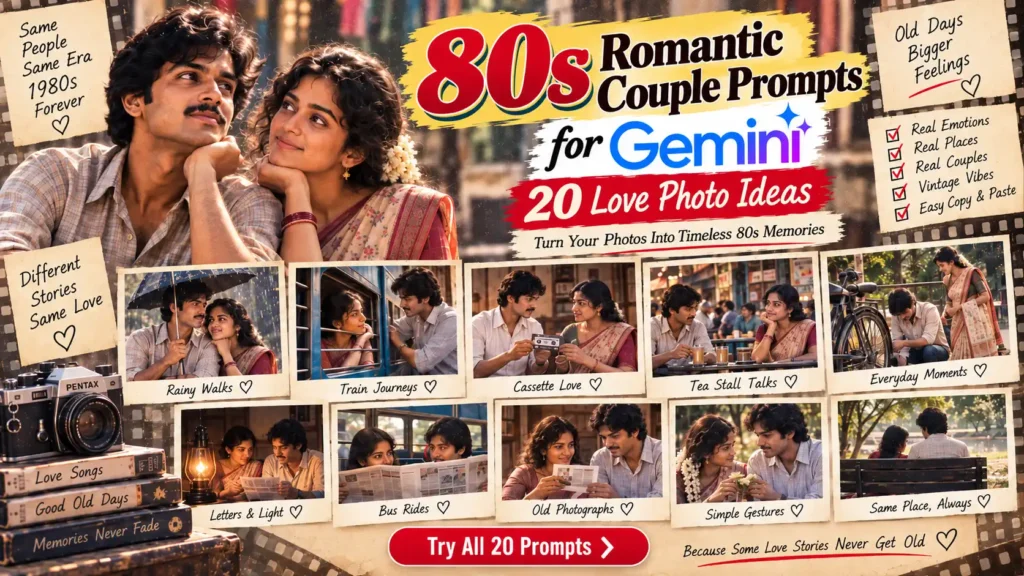
80s Romantic Couple Prompts for Gemini – 20 Love Photo Ideas

80s Trend Prompt for Gemini – 25 Latest Copy & Paste Prompts
Copied!