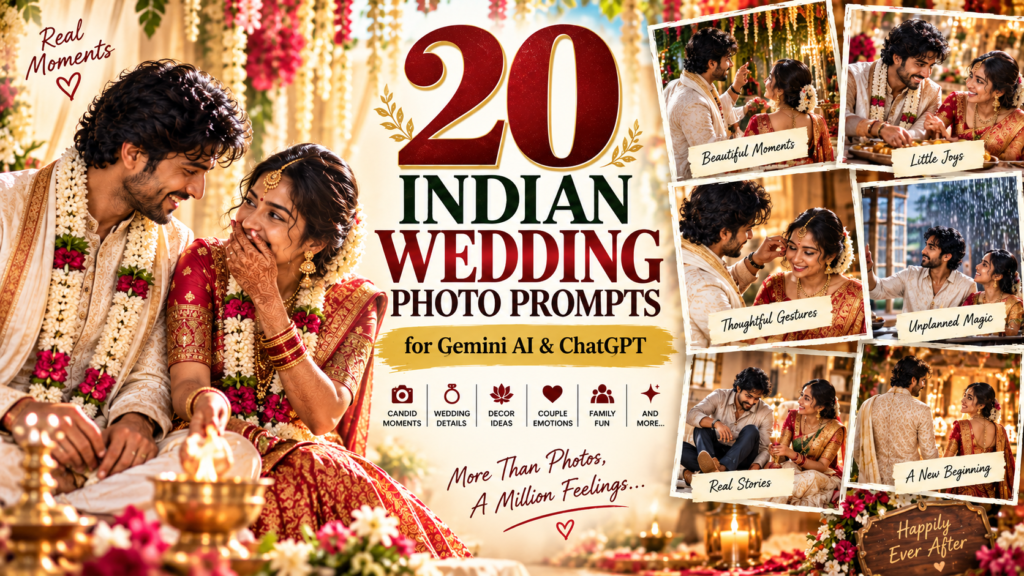
1. Indian Wedding – Five Quiet Minutes Before Everyone Arrives
Use our uploaded couple photo as the strict identity reference and create an ultra-realistic Indian wedding photograph set approximately five minutes before the venue fills with guests. Preserve both faces exactly and independently—the same facial structure, eyes, nose, lips, current natural age, skin tone, hair characteristics, body proportions and recognizable identity—with no face merging or excessive beautification. Do not infer religion, caste, ethnicity or regional background from our appearance. Dress us in elegant Indian wedding attire selected to complement our visible features without assigning a specific community unless the reference already clearly establishes that styling. Place us inside a beautifully prepared but still almost empty wedding venue, with rows of chairs, fresh flowers, soft fabric decoration and warm practical lights ready for the celebration. Do not place us on the ceremonial stage. Capture us several steps apart near the side of the hall, each finally seeing the completed venue after hours of preparation. One partner quietly points toward one tiny decoration hanging slightly crooked high in the background; the other follows the gesture, studies it seriously for a second, then both begin laughing because everything else is already perfect. Use broad natural daylight entering from the venue entrance mixed with warm decorative illumination, realistic skin, jewellery, embroidery, flowers and architectural depth. No crowd, hugging, forehead touching, flower shower, artificial fog or luxury-palace excess. The final image should feel like a private five-minute chapter of the wedding that disappears the instant the doors open.
2. Indian Wedding – The Garland That Nearly Escaped
Transform our uploaded couple photo into a lively Indian wedding candid while preserving both facial identities exactly and separately, including natural age, complexion, facial structure and body proportions. Dress us in refined wedding attire appropriate to our appearance without automatically assigning a specific regional or religious tradition. Place us safely in a decorated wedding area immediately before a ceremonial garland moment, but do not create the familiar symmetrical garland-exchange pose. Capture an unexpected harmless interruption: one lightweight flower garland has been temporarily placed over the back of a nearby chair or held loosely, and a sudden breeze from an open side of the venue causes one end to slide toward the floor. Both of us notice simultaneously and reach from opposite directions to catch it before it touches the ground. Freeze the exact second our hands secure different ends of the same garland and our eyes meet with relieved, spontaneous laughter. Keep surrounding relatives and photographers softly blurred so the couple remains dominant. Use bright natural wedding light, realistic flower weight and movement, accurate fingers, skin, jewellery and textile embroidery. No throwing flowers, jumping, staged comedy, exaggerated facial expressions or dangerous movement. The final image should turn a tiny almost-mistake into a photograph that looks more alive than the perfectly planned ceremony picture that follows.
3. Indian Wedding – Fixing One Tiny Detail Before Anyone Notices
Use our uploaded couple image as the strict identity reference and create a beautifully intimate Indian wedding photograph while preserving both faces, current natural ages, skin tones, hairstyles and body proportions exactly. Dress us in sophisticated Indian wedding attire suited naturally to each person's visible appearance. Do not infer cultural identity or assign community-specific symbols unless explicitly present in the source photo. Place us near a softly lit side corridor or preparation area of the wedding venue between formal photographs. One partner notices that a harmless decorative detail on the other's outfit—a small flower, collar edge, shawl fold, dupatta edge or equivalent fabric detail—is sitting slightly crooked. Capture the exact second they carefully correct only that clothing detail while concentrating intensely, as though this tiny imperfection matters enormously. The person being adjusted watches their partner's serious expression rather than the fixing hand and slowly begins smiling. Neither person should look toward the camera. Use gentle side-window light mixed with warm venue illumination, shallow but realistic depth, detailed fabric embroidery, natural fingers, skin pores and subtle jewellery reflections. No forehead touching, embracing, makeup application, bridal-room cliché or excessive soft-focus glow. The final photograph should communicate care through precision: in a room full of people preparing everything, one person notices the smallest thing about the other.
4. Indian Wedding – The Outfit Saved from the Decoration
Recreate our uploaded couple photograph as a dynamic but elegant Indian wedding candid while preserving both facial identities independently and with extremely high accuracy. Maintain our natural ages, complexions, facial proportions and body shapes. Dress us in beautiful wedding clothing appropriate to our visible appearance without assuming region, caste or religion. Place us walking safely through a decorated side passage of the wedding venue where flower strings and lightweight fabric decorations frame the route. Capture a small protective reaction rather than a romantic pose: one partner notices that a loose edge of the other's wedding garment is about to brush against or lightly catch on a harmless low floral decoration. Before it happens, they gently lift the fabric edge clear using fingertips without pulling the person or touching the body unnecessarily. The wearer notices what happened only afterward, looks down at the saved fabric and then toward their partner with a grateful amused smile. Compose from a slightly lower three-quarter angle so fabric movement and both faces remain visible. Use bright diffused daylight, realistic silk or woven textile physics, flowers, skin, hands and jewellery with premium photographic clarity. No dramatic rescue, tripping, falling, torn clothes, flower shower or choreographed romance. The final image should make a nearly invisible act of attention feel more meaningful than an elaborate wedding pose.
5. Indian Wedding – Trying Not to Laugh During the Serious Moment
Use our uploaded photo to create an irresistibly natural Indian wedding photograph centered on two people trying not to laugh during an otherwise serious formal moment. Preserve both faces exactly and independently, including current natural age, complexion, facial features and body proportions. Dress us in elegant wedding attire selected appropriately to our visible appearance while avoiding unsupported assumptions about religion or regional identity. Place us seated or standing safely within a formal wedding setting while family members, ceremonial details or an officiating figure remain respectfully soft and secondary in the background. Do not depict or invent a specific sacred ritual if it is not established by the reference. Someone outside the frame has quietly said something unexpectedly funny. Capture the fraction of a second before either partner fully laughs: one presses their lips together and looks deliberately forward while the other glances sideways, eyes already smiling, making the first person's composure even harder to maintain. Their shoulders and expressions should show restrained amusement without disrespecting the setting. Use clean flattering event light, realistic skin texture, expressive eyes, wedding textiles and restrained background bokeh. No exaggerated laughing, pointing, mocking gestures or slapstick. The final photograph should instantly remind viewers of the dangerous moment when looking at the one person who understands the joke makes staying serious impossible.
6. Indian Wedding – The Photograph Between the Photographs
Transform our uploaded couple photo into a premium Indian wedding candid captured during the brief pause between formal photography setups. Preserve both faces, natural ages, skin tones, body proportions and individual identities exactly. Dress us in detailed wedding attire appropriate to our visible appearance without changing cultural identity or facial characteristics. Place us near the wedding portrait area while the professional photographer remains softly visible in the distant background changing a lens, adjusting a light or checking equipment. The instant the photographer lowers the camera, both of us assume the formal session has paused. Capture what happens next: one partner immediately relaxes their shoulders and exhales dramatically after holding perfect posture for too long, while the other notices and mirrors the same exaggerated relief. Both begin laughing at how tiring it is to look perfectly composed. Photograph this moment from a second documentary-style camera at an oblique angle, with the unused formal backdrop visible only as context. Use realistic venue light, natural posture, detailed clothing, skin and hands with crisp editorial photography. No photographer blocking the couple, no brand-visible camera equipment, no staged embrace or fashion-magazine pose. The final image should feel like the best wedding photograph was taken during the ten seconds when both people believed nobody was photographing them.
7. Indian Wedding – When the Evening Breeze Entered the Hall
Use our uploaded couple photograph as the strict identity reference and create a luminous Indian wedding portrait built around natural movement rather than posing. Preserve both facial identities exactly and independently, maintaining current ages, complexions, hair characteristics and body proportions. Dress us in elegant wedding attire suited to our visible appearance and keep all cultural details respectful and non-assumptive. Place us near a large open doorway or covered courtyard edge during early evening, when warm indoor wedding lights meet cool outdoor daylight. A sudden but gentle breeze enters the venue and moves lightweight elements naturally: one person's dupatta, shawl, saree edge or garment layer lifts slightly while a few loose hair strands move; nearby hanging flower strings sway in the same direction. Do not turn this into a dramatic wind-machine fashion pose. Capture both people reacting to the same breeze—one briefly closes their eyes and smiles while the other instinctively catches a moving garment edge before it reaches the face. Use physically consistent fabric motion, hair movement, flower movement and lighting. Render skin, embroidery, jewellery and environmental detail with bright ultra-realistic photography. No flying objects, storm effects, artificial petals, backlit smoke or excessive cinematic flare. The final image should make the wedding hall feel alive, as though the weather itself entered for three seconds and became part of the photograph.
8. Indian Wedding – The One Flower Petal Nobody Planned
Recreate our uploaded couple photo as a clean, high-detail Indian wedding candid built around one tiny accidental detail. Preserve both faces exactly and separately, including natural age, complexion, facial structure and body proportions. Dress us in beautiful wedding clothing chosen to suit our visible appearance without assigning unsupported cultural identity. Place us near a floral wedding arrangement during a calm interval rather than during a flower shower. A single loose fresh petal has fallen naturally from the decoration and landed in an unexpectedly funny but harmless place—on one partner's shoulder, hair, sleeve or upper garment where they cannot easily see it. The other person notices immediately. Capture the second they point toward the petal without touching it, while the wearer misunderstands where it is and looks in completely the wrong direction. The observer tries not to laugh before finally reaching to remove only the petal. Keep the petal clearly visible enough that viewers understand the visual joke immediately. Use soft flattering daylight, realistic petal texture, skin, hair, wedding fabric and accurate hands. No artificial flower rain, confetti, giant floral wall or exaggerated expressions. The final photograph should show how one tiny misplaced petal can create a more memorable expression than thousands of perfectly arranged flowers.
9. Indian Wedding – The Family Group Photo That Refuses to Start
Use our uploaded wedding-couple photo as the strict identity reference and create a humorous but respectful Indian family-group-photo moment while preserving both couple faces exactly and independently. Keep our natural ages, complexions, body proportions and wedding appearance unchanged. Create fictional relatives and guests only as secondary background figures; do not copy or invent identities of real family members. Place us at the front-center area where a large family photograph is about to be taken, but capture the chaos before everyone is ready rather than the finished group portrait. Behind us, different people are harmlessly adjusting positions, looking toward different cameras, moving a chair slightly or calling someone from outside the frame. The couple has already been standing ready for several seconds. Capture the exact moment both of us slowly turn toward each other with the same exhausted, amused expression as we realize the photograph is nowhere close to happening. Keep the background activity visually readable but softly secondary, with no one appearing distressed. Use bright balanced event photography, realistic skin, wedding textiles, chairs and natural group spacing. No mocking elderly people, children in unsafe situations, exaggerated chaos or distorted faces. The final image should instantly communicate a universal wedding truth: arranging the family photograph can take far longer than taking it.
10. Indian Wedding – The Empty Chairs After the Ceremony
Transform our uploaded couple photo into a quiet, cinematic-but-realistic Indian wedding photograph taken during the short transition after one major part of the celebration has ended. Preserve both faces exactly and independently, maintaining natural age, skin tone, facial proportions and recognizable identity. Dress us in the same refined wedding attire, now showing only tiny believable signs of a long day such as slightly relaxed posture or one loosened nonessential accessory. Place us in a side section of the venue where rows of chairs are temporarily empty because guests have moved to another area. Decorations remain glowing, a few flower petals lie naturally on the floor and distant activity appears softly through an open doorway. Do not make the scene sad. Capture us sitting one chair apart for only a minute, both finally resting. One partner silently slides a small unopened water bottle or cup across the empty chair between us toward the other; the recipient notices, accepts it and gives a tired grateful smile. Keep the interaction practical rather than romantic. Use warm venue lights balanced with soft cooler evening light, generous negative space, realistic skin, wedding fabric, chairs and subtle fatigue. No dramatic embrace, tears, empty-abandoned-wedding mood or artificial spotlight. The final image should capture the strange calm inside a wedding day: hundreds of people may be only one room away, but for sixty seconds the entire venue seems to belong to just two tired people.
11. Indian Wedding – Both Choosing the Same Sweet
Use our uploaded couple photo as the strict identity reference and create an ultra-realistic Indian wedding candid during a quiet meal break, preserving both faces exactly and independently—the same facial structure, eyes, nose, lips, current natural age, skin tone, hair characteristics, body proportions and recognizable identity. Dress us in elegant wedding attire appropriate to our visible appearance without inferring religion, caste, ethnicity or regional background. Place us safely at a beautifully arranged wedding dining area after most formal photographs are complete. Instead of showing a feeding pose, place a small plate containing several different traditional sweets between us. Capture the exact second both partners independently reach for the same final piece at precisely the same time. Their fingertips stop just before touching the sweet, both look first at the plate and then at each other, and neither immediately withdraws their hand. One person gives an expression of completely unreasonable determination while the other begins laughing. Keep food presentation authentic but secondary to the expressions. Use bright flattering dining-area light, realistic food texture, fingers, jewellery, wedding fabric and natural skin with crisp photographic detail. No romantic feeding, cake-smearing, oversized banquet spread, brand labels or exaggerated comedy. The final photograph should turn one tiny dessert into a perfectly understandable relationship negotiation: there are many sweets on the table, but somehow both people wanted exactly the same one.
12. Indian Wedding – Seeing Ourselves Together in the Mirror
Transform our uploaded couple photograph into an elegant Indian wedding image built around one physically believable reflection while preserving both facial identities exactly and separately. Maintain our natural ages, complexions, facial proportions, hair and body shapes. Dress us in refined wedding clothing suited to our visible appearance without adding unsupported community-specific symbols. Place us in a quiet preparation corridor containing one large traditional standing or wall mirror, with soft daylight entering from the side. We are not deliberately posing in front of it. Capture the moment both partners happen to pass the mirror from slightly different directions and unexpectedly see themselves together in full wedding attire for the first time that day. Their real bodies should remain visible from a three-quarter rear or side angle while the mirror clearly and consistently shows both recognizable faces. One partner pauses first; the second notices the pause through the reflection, and both share a small surprised smile at the image in front of them. Reflection geometry, gaze direction, clothing and lighting must remain physically accurate. Use restrained natural light, realistic glass, skin, embroidery and jewellery, with subtle depth. No vanity-mirror bulbs, bridal makeup scene, duplicated faces, fantasy reflection, hugging or staged mirror selfie. The final photograph should feel like the couple briefly became spectators at their own wedding.
13. Indian Wedding – Rain Begins Outside the Hall
Use our uploaded wedding couple photo as the identity reference and create a luminous indoor wedding photograph at the exact moment unexpected rain begins outside. Preserve both faces, natural ages, skin tones, facial structures and body proportions exactly. Keep us safely inside a covered wedding venue in elegant attire appropriate to our visible appearance. Do not turn the scene into a romantic rain shoot. Place us several feet from a large open doorway or tall window while the celebration continues softly behind us. Capture the first seconds of the rainfall: one partner notices the sudden darkening outside and points toward the courtyard just as heavy drops begin striking sun-warmed stone. The second turns toward the sound, and both watch as guests in the distant covered areas react to the change in weather. A small gust carries only a fine mist near the doorway, never soaking the couple. Use cool rain light outside and warm wedding illumination inside, creating a natural two-color environment across our faces and clothing. Render individual raindrops, wet stone reflections, realistic silk or woven fabric, skin, hair and jewellery. No lightning, running through rain, umbrella romance, dramatic storm or artificial water effects. The final photograph should capture the strange excitement of weather changing in the middle of a carefully planned day—and becoming part of the wedding anyway.
14. Indian Wedding – The Footwear Mix-Up
Recreate our uploaded couple image as a playful Indian wedding candid during a safe transition between venue areas, preserving both faces exactly and independently, including current natural age, complexion, facial structure and body proportions. Dress us in elegant wedding clothing appropriate to our visible appearance without assigning unsupported cultural identity. Place us beside a clean seating or changing area where several pairs of formal footwear have been arranged neatly. Avoid depicting a sacred custom or implying any specific ritual. One partner has confidently picked up what they believe is their own footwear, only to realize the size or design is obviously wrong. Capture the exact second they hold one shoe or sandal at arm's length with a puzzled expression while the other partner has already spotted the correct pair a short distance away and points toward it, trying not to laugh. Keep all footwear clean and visually distinct, with nobody balancing unsafely or walking barefoot through hazardous areas. Use bright diffused venue light, realistic leather or textile texture, skin, fingers and detailed wedding clothing. No prank stealing, humiliation, slapstick, brand logos or exaggerated expressions. The final photograph should feel like a tiny wedding mystery solved by the one person who apparently knows where the other's belongings are better than they do.
15. Indian Wedding – The Gift Note That Makes Both Stop
Use our uploaded couple photo as the strict identity reference and create a warm Indian wedding photograph while opening one modest gift together after a quieter moment in the celebration. Preserve both facial identities, current natural ages, skin tones, hair and body proportions exactly. Keep us in our wedding attire, seated comfortably at a small side table away from the main crowd. Do not focus on expensive gifts. A simple wrapped package has been opened and contains an ordinary meaningful object kept partly obscured, along with a small handwritten card. All handwriting must remain completely unreadable. Capture the instant both partners lean toward the card and silently read it together. One person reaches the end first and looks toward the other; the second is still reading for another fraction of a second before noticing the gaze. Their expressions should move toward warmth and quiet amusement rather than tears or melodrama. Let opened paper, ribbon and the small gift remain naturally on the table. Use soft side light, realistic paper fibers, fingers, skin, jewellery and textile detail with shallow natural depth. No visible private message, money, luxury gift boxes, staged crying or embracing. The final photograph should make viewers curious about a message they will never be allowed to read, while clearly showing that both people understood why it mattered.
16. Indian Wedding – Fixing the Last Decoration Together
Transform our uploaded wedding photo into an energetic pre-ceremony candid centered on the couple helping with one final harmless detail rather than waiting to be photographed. Preserve both faces exactly and independently, maintaining natural ages, complexions, facial features and body proportions. Dress us in refined wedding attire suitable to our visible appearance. Place us near a low, safely reachable welcome table or decorative arrangement where one small floral or fabric element remains unfinished. Do not show either person climbing, stretching dangerously or handling electrical equipment. One partner holds the loose end of a lightweight decorative ribbon or flower string while the other tries to secure it to a small tabletop stand. Capture the second they step back to inspect their work and realize the decoration is now perfectly centered—but the small table itself is slightly turned. Both look from the decoration to the table and then toward each other with the same exhausted laugh. Use brilliant clean daylight, realistic flowers, ribbon tension, hands, skin and wedding fabrics with crisp editorial detail. No wedding planners portrayed negatively, giant floral installations, ladders, electrical lights or artificial posing. The final image should communicate the wonderfully impossible logic of wedding preparation: fixing one tiny thing immediately reveals another tiny thing to fix.
17. Indian Wedding – Golden-Hour Side Corridor Portrait
Use our uploaded couple photograph to create an exceptional Indian wedding portrait during golden hour without using the ceremonial stage, formal couple pose or direct camera gaze. Preserve both faces exactly and independently—the same natural ages, complexions, facial structures and body proportions. Dress us in detailed wedding attire appropriate to our visible appearance and preserve realistic fabric weight and jewellery. Place us in a long side corridor, veranda or covered walkway of the venue where low evening sunlight passes through repeating pillars and creates alternating bands of gold and shade. We are walking back toward the celebration after a short break. Capture the exact second one partner unknowingly enters a bright strip of sunlight while the other remains one step inside shade; the shaded partner notices how dramatically the light has changed the other's appearance and stops. The sunlit person turns back to understand why they stopped, producing an unplanned expression rather than a romantic pose. Compose with architectural leading lines and generous depth. Use physically accurate golden-hour exposure, luminous but preserved highlights, realistic skin, embroidery, jewellery reflections and soft background activity. No sunset silhouette, forehead touching, hand holding, artificial flare or fantasy palace corridor. The final photograph should look extraordinary because the venue, sun and two people happened to align for one second—not because the photographer manufactured a dramatic pose.
18. Indian Wedding – The First Comfortable Minute After a Long Day
Recreate our uploaded couple photo late in the wedding day when formal events are nearly complete, preserving both facial identities, current natural ages, skin tones, body proportions and recognizable features exactly. Keep us in our wedding clothing but show only believable signs of having worn formal attire for many hours. Place us in a private but ordinary side room or quiet covered veranda with two chairs and soft evening light. Avoid romantic posing. Capture both people independently making one small comfort adjustment at almost the same moment: one loosens or removes a nonessential accessory such as a watch, shawl, jacket layer or uncomfortable decorative item while the other carefully adjusts footwear, sleeve or another harmless clothing detail. They notice that both have chosen exactly the same second to finally become comfortable and exchange a deeply relieved smile. Keep all culturally significant items untouched unless clearly appropriate; choose only nonessential accessories. Use warm low evening light, realistic skin texture, subtle tiredness around the eyes, slightly relaxed hair, detailed fabric and natural hands. No undressing, bedroom intimacy, sleeping, exaggerated exhaustion or comedy. The final photograph should show the people underneath the wedding presentation slowly returning—not less beautiful, simply more themselves.
19. Indian Wedding – Both Turning Back Before Leaving
Use our uploaded wedding couple photo as the strict identity reference and create a visually powerful departure photograph without inventing a culturally specific farewell ritual. Preserve both faces exactly and independently, including natural age, complexion, facial structure and body proportions. Dress us in the same wedding attire and place us walking safely away from the main venue entrance toward a waiting vehicle or quiet outer courtyard during blue hour. Do not show crying relatives, dramatic farewells or ceremonial departure customs unless explicitly requested. The venue behind us remains warmly illuminated and softly active. Capture the exact second both partners independently turn their heads back toward the building at the same time, as though each wants one final look at the place where the entire day happened. Neither initially realizes the other has also turned. A fraction later their eyes meet across the shared backward glance and a small smile appears. Photograph from a side-rear three-quarter perspective so both recognizable faces remain visible while the glowing venue occupies the background. Use deep blue ambient evening light mixed with warm doorway illumination, realistic wedding fabric, skin, hair and architectural depth. No luxury car emphasis, flower shower, waving crowd or staged embrace. The final image should feel like the natural closing photograph of the wedding day: not looking toward the future for the camera, but both quietly looking back once before leaving.
20. Our Wedding, Our Moment – Personalized AI Wedding Prompt
Study our uploaded couple photo carefully and create one completely original Indian wedding photograph designed specifically around the two visible people rather than forcing us into a generic bride-and-groom template. Preserve both faces exactly and independently—the same facial structures, eyes, noses, lips, current natural ages, complexions, hair characteristics, body proportions and recognizable identities. Do not infer ethnicity, caste, religion, language, region, occupation or personal history from our appearance. Use only visible non-sensitive cues such as existing clothing type, hairstyle, relative height, posture, color relationships and overall visual balance. If the uploaded photo already contains clear wedding clothing or culturally specific visible styling, preserve and refine those visible elements without adding unsupported symbols. If it does not, choose broadly elegant Indian wedding styling that avoids falsely assigning a community. Design the venue, lighting and composition around the two visible people, then invent one harmless micro-event that could plausibly occur during a wedding and has not been reduced to a standard romantic pose: a tiny preparation mistake, unexpected environmental change, misplaced harmless object, shared joke, visual coincidence, practical act of care or another natural interruption. Give both people a reason to react to the same event while keeping their reactions individually believable. Do not default to hugging, kissing, forehead touching, garland exchange, flower shower, hand holding, looking into each other's eyes or standing symmetrically on a stage. Select camera height, lens perspective, lighting direction and color palette specifically to flatter both visible faces while retaining realistic skin, hands, fabric, jewellery and environmental physics. No face merging, age changes, celebrity imitation, excessive luxury, unsupported cultural symbolism or artificial cinematic spectacle. The final photograph should look less like an AI wedding prompt result and more like the one unplanned wedding photograph these two people would choose over all the formal pictures.
Some more you might like
1980s Indian Village Photo Prompts for Gemini – 20 Retro Looks
80s Retro Photo Prompts for Gemini – 25 Vintage Indian Styles
80s Family Photo Prompts for Gemini – 20 Indian Family Styles
80s Wedding Couple Photo Prompts for Gemini – 20 Retro Wedding Looks
80s Bollywood Photo Prompts for Gemini – 20 Indian Movie Looks
80s Romantic Couple Prompts for Gemini – 20 Love Photo Ideas
Copied!