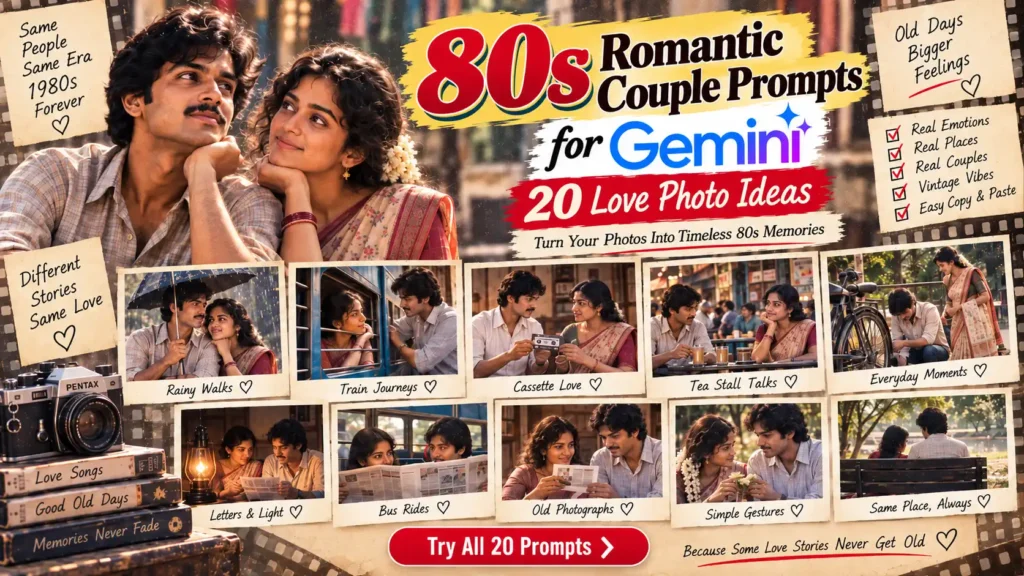
1. 80s Romantic Couple — One Umbrella, Two Different Walking Speeds
Use our uploaded couple photo as the exact facial identity reference for BOTH people. Preserve both recognizable faces faithfully — facial structure, eyes, nose, lips, skin tone, natural age appearance, hairline, facial asymmetry, body proportions, and important identifying characteristics must remain consistent.IDENTITY LOCK: Keep Person 1 as Person 1 and Person 2 as Person 2. Never swap, merge, average, duplicate, or blend their faces. Preserve their natural gender presentation and age difference shown in the uploaded reference. Do not replace either person with a generic romantic model.
Create a completely photorealistic Indian romantic couple photograph from the mid-1980s during a sudden monsoon shower.
Dress both people in authentic period-correct Indian everyday clothing appropriate to their gender, natural age, region, and relationship. Use believable cotton fabrics, modest styling, simple jewellery where appropriate, period footwear, and natural hairstyles. Avoid modern designer retro fashion.
The couple is walking home together when rain suddenly becomes heavier.
There is only one ordinary period-appropriate umbrella.
Do not create a conventional pose where both people stand perfectly centered beneath it.
Instead, create a small relationship moment.
One person naturally walks slightly faster and is holding the umbrella. After several steps, they realize the other person's shoulder is getting wet.
Capture the exact instant the umbrella holder quietly shifts the umbrella farther toward their partner, leaving their OWN outer shoulder slightly exposed to the rain.
The other person notices.
They do not dramatically hug or kiss.
Their eyes meet for only a second, and a small knowing smile appears — the romance comes from noticing the quiet act of care.
One person may carry a cloth shopping bag, books, newspaper-wrapped parcel, or another period-plausible everyday item, giving the scene a reason beyond simply “walking romantically in rain.”
Build an authentic 1980s Indian residential street: weathered plaster houses, tiled or flat roofs, roadster bicycles, utility poles, mature rain trees, small tea stall, puddles, rainwater flowing beside the road, and one distant period-correct bus or vehicle.
Compose from beneath a shop awning or veranda across the road using a 50mm documentary perspective. The umbrella should form a strong visual shape above the couple while their two differently wet shoulders reveal the story.
LIGHTING: Cool grey monsoon daylight should dominate. A warm tungsten bulb from a tea stall or house may create one small reflection in the wet road. Do not add cinematic golden backlight or fantasy rain glow.
RAIN PHYSICS: Show realistic water runoff from the umbrella edge, darker damp patches only where clothing is exposed, natural puddle disturbance, varied rain streaks, and believable wet hair. Do not make both people uniformly soaked.
PERIOD LOCK: India between 1983 and 1988. No smartphones, LED signs, modern umbrellas of obviously contemporary design, modern cars, current backpacks, contemporary rainwear, designer fashion, QR codes, or present-day street furniture.
COUPLE LOCK: Exactly two principal romantic partners. Maintain correct hand ownership, natural body spacing, clear eye direction, distinct faces, believable height relationship, and anatomically correct overlapping bodies. Do not create extra hands or duplicate either partner.
Preserve natural Indian skin texture, individual wet hair strands, accurate fingers around the umbrella handle, realistic cotton folds, physically correct reflections, and environmental wear.
Use restrained 35mm film grain, muted monsoon colors, modest dynamic range, slight motion character, and candid family-camera imperfection.
The final photograph should feel romantic because one person quietly chooses to get a little wetter so the other can stay dry — an ordinary act of affection that somebody happened to photograph in 1980s India.
No text, no watermark, no face swap, no duplicate partner, no extra fingers, no plastic skin, no artificial AI glow, and absolutely no modern objects.
2. 80s Romantic Couple — Railway Goodbye Through the Barred Window
Use our uploaded couple photo as the strict identity reference for both partners. Preserve each person's recognizable face, natural age, skin tone, facial proportions, eyes, nose, lips, hairstyle characteristics, body proportions, and distinguishing features.Never swap identities between the two people. Never copy one partner's face onto the other. Do not automatically make either person younger, more glamorous, or more conventionally attractive.
Create an emotionally restrained Indian railway farewell photograph from the mid-1980s.
Dress both partners in authentic period-correct Indian travel or everyday clothing appropriate to their natural age and gender. Keep styling modest and believable.
The train is COMPLETELY STATIONARY at the platform.
One partner is seated safely inside beside an open barred carriage window. The other stands safely on the platform outside.
They have already said goodbye.
Do not create crying, kissing through the window, dramatic reaching, or cinematic separation.
Instead, create the tiny moment AFTER the farewell appears finished.
The partner on the platform remembers one last thing and takes a small folded paper packet from a pocket or cloth bag — perhaps homemade sweets, a handwritten note, a handkerchief, or another lightweight personal item.
Capture the exact instant the small item is passed safely through the stationary window.
The receiving partner looks down at the object first, then begins looking back toward the giver with a restrained smile.
The giving partner's expression should suggest, “I almost forgot this.”
Their hands may briefly approach around the parcel, but anatomy must remain completely clear and physically plausible.
Build an authentic 1980s railway station: painted metal carriage, barred windows, analog station clock, old platform benches, roof columns, tea vendor, metal trunks, cloth travel bags, hard-sided suitcases, passengers in period clothing, and distant station signage kept unreadable.
Compose from several meters down the platform using a 70mm documentary perspective. The train window should naturally frame the seated partner's face while the standing partner, two hands, and small parcel create a compact emotional triangle.
Daylight from the platform should illuminate both faces naturally. The carriage interior may remain slightly darker.
PERIOD LOCK: Indian railway environment between 1983 and 1988. No smartphones, modern trains, LED information boards, trolley luggage, plastic bottled water, digital tickets, earbuds, contemporary backpacks, current railway architecture, or present-day clothing.
SAFETY LOCK: Train fully stopped. Nobody runs beside the train, leans dangerously outside, stands near the track edge, climbs through the window, or reaches from a moving carriage.
COUPLE LOCK: Exactly two principal romantic partners with clearly distinct identities. Maintain correct hand ownership, eye lines, natural age, height relationship, clothing, and body positioning.
Preserve realistic paper wrapping, accurate fingers, natural Indian skin pores, train-window geometry, fabric folds, metal wear, luggage texture, and physically correct shadows.
Use restrained consumer-film grain, slightly warm analog color, modest contrast, mild optical softness, and candid framing.
The final image should feel like the kind of 1980s love photograph whose meaning is understood only after looking twice: the goodbye had already happened, but one tiny forgotten item gave the couple one more reason to look at each other before departure.
No text, no watermark, no face swap, no duplicate people, no extra fingers, no unsafe railway behavior, no plastic skin, and no modern objects.
3. 80s Romantic Couple — Cassette Recorded for Only One Person
Use our uploaded couple photograph as the exact identity anchor for both people. Preserve both recognizable faces independently — facial structure, eyes, nose, lips, skin tone, natural age, hair characteristics, facial asymmetry, and important identifying details.Do not blend their identities. Do not turn them into generic retro models. Preserve the natural relationship and gender presentation visible in the reference.
Create an intimate Indian romantic photograph from the mid-1980s centered around making a personal audio cassette for a partner.
Dress both people in authentic period-correct casual Indian clothing appropriate to their natural age and gender. Keep jewellery, grooming, and styling understated.
Place the couple inside a modest living room, study room, or veranda during late afternoon.
A period-correct radio-cassette recorder sits on a small table.
One partner has privately recorded a cassette containing favorite songs, spoken messages, or another personal audio collection for the other. Do not reproduce lyrics or copyrighted text.
The cassette is already finished.
Create the photograph around the first time it is handed over.
One partner holds the cassette by its edges and extends it toward the other.
But instead of taking it immediately, the receiving partner notices a tiny handwritten label on the cassette and pauses to read it.
Keep the writing indistinct and unreadable.
The giver suddenly becomes slightly self-conscious because the label was meant to be personal.
Capture the exact moment their eyes meet after the recipient finishes looking at the label.
Do not create a hug, kiss, or exaggerated romantic pose.
Build an authentic 1980s Indian room: cassette recorder with physical buttons, compact cassettes, transistor radio, wooden table, folded newspaper, books, steel tumbler or tea glass, cotton curtains, analog clock, ceiling fan, and simple furniture.
Compose from table height using a 50–85mm intimate perspective. Place the cassette and two approaching hands in the near-middle plane while both faces remain clearly readable beyond.
LIGHTING: Soft window daylight should illuminate the cassette edge and both faces. A warm tungsten practical lamp deeper inside may create gentle background separation.
CASSETTE ACCURACY: Use realistic compact-cassette dimensions, twin reels, magnetic tape path, plastic shell, screw placement, central holes, and label position. The cassette must not resemble a VHS tape or modern digital device.
PERIOD LOCK: India between 1983 and 1989. No smartphones, streaming devices, CDs where inappropriate, Bluetooth speakers, wireless earbuds, LED lighting, laptops, modern furniture, or present-day fashion.
COUPLE LOCK: Keep both identities distinct. Correctly assign every hand and arm. Maintain natural body distance and believable eye contact. No duplicated face, third partner, fused fingers, or impossible overlapping limbs.
Preserve natural skin pores, realistic hair, fabric texture, cassette reflections, wooden furniture wear, and physically correct shadows.
Use restrained 35mm grain, warm analog color, gentle optical softness, and modest contrast.
The final photograph should communicate a form of 80s romance that required time: choosing the songs, recording them in order, writing the label, carrying the cassette, and finally giving it to one specific person.
No readable lyrics, no text as a focal element, no watermark, no duplicate partner, no extra fingers, no malformed cassette, no plastic skin, and no modern technology.
4. 80s Romantic Couple — Saree Pallu Caught on His Wristwatch
Use our uploaded couple photo as the exact facial identity reference for BOTH partners. Preserve each recognizable face faithfully — natural age, skin tone, facial structure, eyes, nose, lips, hairline, facial asymmetry, body proportions, and identifying characteristics.Do not swap or merge faces. Preserve the woman as the woman and the man as the man when that matches the uploaded reference. If the uploaded couple has another gender configuration, adapt clothing and interaction appropriately while preserving both identities.
Create a photorealistic Indian couple photograph from the mid-1980s built around an accidental clothing interaction rather than a conventional romantic pose.
Dress the woman, if applicable, in an authentic 1980s cotton or silk-cotton saree with a modest blouse, period-correct border, small bindi, simple jewellery, and natural hairstyle. Dress her partner in a believable cotton shirt and period trousers or another age-appropriate Indian outfit.
The couple is walking through the veranda or courtyard of a family home after a small function or evening visit.
They are moving in slightly different directions for only a second.
The loose outer edge of the saree pallu accidentally catches very lightly on the partner's period-correct analog wristwatch strap or simple watch buckle.
Nobody is hurt and no fabric is tightly trapped.
Capture the exact instant BOTH people notice.
The saree wearer looks down toward the caught edge.
The partner freezes the wrist completely still and uses the free hand to carefully release the fabric rather than pulling away.
Their expressions should combine mild surprise and quiet amusement.
Do not create a dramatic embrace or turn the accidental catch into an unrealistic romantic stunt.
Build a believable 1980s Indian home environment: red-oxide or terrazzo floor, wooden doors, cane chair, household plants, steel tumblers on a side table, cotton curtains, wall clock, warm practical bulb, and relatives softly visible farther inside.
Compose from slightly behind one veranda pillar with a 50mm perspective. The small point where pallu meets wristwatch should occupy the lower-middle visual plane while both faces remain clearly visible above.
LIGHTING: Use soft late-afternoon courtyard daylight or early-evening natural light mixed with restrained tungsten from inside the house.
FABRIC PHYSICS: Only the outermost loose edge of the pallu may catch gently. Maintain continuous saree border, natural shoulder drape, waist pleats, realistic cloth weight, and correct tension. Do not stretch, tear, or fuse fabric into the watch.
WATCH ACCURACY: Use a plausible small analog mechanical or quartz wristwatch appropriate to the exact mid-1980s context, with realistic strap, buckle, case, crown, dial, and wrist fit. No smartwatch proportions.
PERIOD LOCK: India between 1983 and 1988. No smartphones, smartwatches, LED lighting, modern furniture, designer sarees, contemporary shirts, current jewellery, Wi-Fi devices, or present-day household products.
COUPLE LOCK: Exactly two principal partners. Preserve distinct identities, correct hands, natural height difference, plausible body spacing, and clear ownership of the saree, wrist, and watch.
Use restrained consumer-film grain, warm natural colors, modest dynamic range, gentle print softness, and candid framing.
The final image should make romance emerge from consideration rather than posing: the fabric catches, both stop, one person waits patiently while the other is freed, and the tiny interruption becomes the photograph.
No text, no watermark, no face swap, no duplicate partner, no extra fingers, no impossible saree, no malformed watch, no plastic skin, and no modern objects.
5. 80s Romantic Couple — Library Book Passed Between Two Shelves
Use our uploaded couple photograph as the strict identity reference for both people. Preserve both recognizable faces independently, including natural age, facial proportions, eyes, nose, lips, skin tone, hair characteristics, facial asymmetry, and distinguishing features.Do not merge, duplicate, swap, beautify, or de-age either partner.
Create a quiet Indian romantic photograph from the mid-1980s inside an old college, university, or public library.
If both people are naturally college-age, portray them as students. If either person is older, adapt them naturally as lecturers, researchers, librarians, adult readers, or visitors without changing their age.
Dress both in authentic period-correct Indian clothing appropriate to gender and age. Use a saree, salwar kameez, cotton shirt, trousers, or another plausible outfit. Avoid modern campus styling.
Place the couple in two adjacent library aisles separated by a tall wooden bookshelf.
There is a narrow empty space between rows of books where one book has been removed.
One partner has found the book the other was searching for.
Instead of walking around the shelf, they quietly pass the book through the empty gap.
Capture the exact instant both hands reach the same book from opposite sides of the shelf.
Their fingers should NOT be artificially intertwined.
One person still holds the spine while the other begins taking the lower edge.
Through the same opening, their eyes unexpectedly meet.
That eye contact — framed by books — is the romantic center of the image.
Do not create kissing, hugging, or a fashion pose.
Build an authentic 1980s library: wooden shelves, uneven old books, card catalogue, wooden tables and chairs, ceiling fans, high barred windows, manual issue registers, paper library cards, and a few quiet readers in the background.
Compose from one aisle using a 70–85mm perspective. The bookshelf should fill much of the frame, with the missing-book opening becoming a natural miniature frame containing the second partner's eyes while the shared book and hands occupy the foreground.
LIGHTING: High-window daylight should create soft directional illumination across the shelf. A subtle band of light may fall on the shared book and faces. Do not create magical glowing dust.
PERIOD LOCK: Indian library between 1983 and 1988. No smartphones, laptops, tablets, barcode scanners, LED lights, modern backpacks, contemporary library furniture, digital catalogues, or present-day fashion.
BOOK AND HAND ACCURACY: Maintain correct book thickness, spine orientation, gravity, shelf spacing, hand ownership, finger count, and plausible grip. Do not fuse fingers through the shelf.
COUPLE LOCK: Preserve both distinct identities and natural ages. No face duplication, no third romantic figure, no impossible eye direction, and no mismatched clothing between views.
Use restrained 35mm grain, muted warm color, modest contrast, natural skin texture, realistic hair strands, shelf wear, and analog softness.
The final photograph should make an ordinary act — passing a book — feel intimate because the two people unexpectedly find each other's eyes through the empty space it leaves behind.
No text, no watermark, no duplicate faces, no extra fingers, no malformed book, no plastic skin, and no modern objects.
6. 80s Romantic Couple — Rooftop Radio Song and the Unfinished Clothesline
Use our uploaded couple photo as the exact facial identity reference for BOTH partners. Preserve each person's recognizable face independently — facial structure, eyes, nose, lips, skin tone, natural age appearance, hairline, facial asymmetry, body proportions, hairstyle characteristics, and important identifying details.IDENTITY LOCK: Never swap, merge, average, duplicate, or blend the two faces. Preserve each partner's natural gender presentation and age shown in the uploaded reference. Do not replace either person with a generic romantic model.
Create an intimate Indian rooftop couple photograph from the mid-1980s where romance emerges from an unfinished household task rather than a deliberate pose.
Dress both partners in authentic period-correct everyday Indian clothing appropriate to their natural age, gender, region, and relationship. If one partner wears a saree, keep the drape modest and physically correct. If one wears a shirt and trousers, use believable 1980s tailoring rather than modern retro fashion.
Set the scene on the terrace of a modest Indian home during late afternoon.
One partner has come upstairs to collect clothes from a simple clothesline before evening.
The other has arrived carrying a small portable transistor radio that has been playing downstairs.
Place the radio safely on a wooden stool or parapet ledge wide enough to support it securely.
A familiar romantic song has just begun.
Do not reproduce lyrics, song titles, album art, or copyrighted text.
Create the decisive moment: the person collecting clothes pauses halfway through removing a garment from the line.
One wooden clothespin remains in their fingers.
The other partner quietly turns the radio's volume knob a little higher.
Neither person immediately says anything.
Capture the instant their eyes meet across the clothesline because both recognize the song.
A half-folded shirt, towel, or saree remains over one partner's forearm, making it obvious that the household task has simply stopped for a few seconds.
Do not create dancing, hugging, kissing, or exaggerated romantic gestures.
Use the clothesline as a visual divider and connector between them. A lightweight garment may move gently in the breeze without obscuring either face.
Build an authentic 1980s Indian rooftop: weathered limewashed parapet, wooden clothespins, steel bucket, woven laundry basket, old stairway entrance, period television antennas, tiled and flat-roof neighboring houses, coconut trees, utility wires, and evening birds.
Compose from near the rooftop doorway using a 50mm documentary perspective. Let one softly blurred hanging garment create foreground depth while both faces and the transistor radio remain readable.
LIGHTING: Late-afternoon sunlight should strike a neighboring pale wall and bounce softly onto the couple. Avoid artificial golden glow. A light breeze should affect loose hair and lightweight fabric according to physical weight.
RADIO ACCURACY: Use a plausible mid-1980s portable transistor radio with speaker grille, tuning scale, physical knobs, antenna, and realistic size. No digital display.
PERIOD LOCK: India between 1983 and 1988. No smartphones, Bluetooth speakers, earbuds, satellite dishes, solar panels, LED lights, CCTV cameras, modern water tanks, current fashion, or contemporary rooftops.
COUPLE LOCK: Exactly two principal romantic partners. Maintain distinct faces, correct hand ownership, natural eye lines, believable body distance, and accurate age and height relationship.
Preserve natural Indian skin pores, realistic hair strands, correct fingers holding the clothespin, believable fabric physics, radio geometry, and physically accurate shadows.
Use restrained consumer-film grain, warm but natural color-negative rendering, modest dynamic range, slight optical softness, and candid framing.
The final photograph should communicate a very specific kind of 80s romance: an ordinary chore stops because one song begins, one person quietly turns up the radio, and for a few seconds neither of them needs to say why.
No text, no watermark, no face swap, no duplicate partner, no extra fingers, no floating clothes, no plastic skin, and no modern objects.
7. 80s Romantic Couple — Tea Stall: He Remembers How She Takes Her Tea
Use our uploaded couple photograph as the strict facial identity reference for BOTH people. Preserve each recognizable face independently, including facial structure, natural age, skin tone, eyes, nose, lips, hairline, hairstyle characteristics, facial asymmetry, and body proportions.Do not swap identities, copy one face onto the other, or turn the couple into generic retro actors.
Create a subtle Indian romantic photograph from the mid-1980s at a modest roadside or neighborhood tea stall.
Respect both partners' natural age and gender. Dress them in authentic period-correct everyday Indian clothing suitable for the location and weather. Keep jewellery and grooming understated.
The couple has stopped for tea during an ordinary outing or journey.
Do not show them feeding each other, sharing one cup, holding hands across the table, or posing romantically.
Create the relationship through memory.
The tea seller places two glasses or stainless-steel tumblers on the table.
Before the second partner reaches for theirs, the first partner quietly moves the correct cup toward them because they already remember which one has less sugar, more milk, stronger tea, or another simple preference.
Do not display labels or written descriptions explaining the difference.
Use a tiny visual distinction instead: one cup may have a slightly different tea color or amount, or the shopkeeper may have placed them differently.
Capture the instant the receiving partner realizes there was no need to explain the preference.
Their eyes move from the tea to their partner and a small private smile begins.
The partner who remembered the order should react casually, as though this is completely normal.
That casual familiarity is the romance.
Build an authentic 1980s tea stall: blackened kettle, steam, glass tumblers, stainless-steel vessels, biscuit jars, wooden shelves, newspaper, cloth towel, old transistor radio, roadster bicycle nearby, mature roadside trees, and period traffic softly visible beyond.
Compose from table height using a 70mm intimate documentary perspective. Place the two tea glasses in the foreground, the hand gently sliding one cup in the middle plane, and both facial reactions immediately beyond.
LIGHTING: Daylight from the open roadside should illuminate both faces naturally. Steam should become visible only where it crosses brighter light. A warm practical bulb deeper inside may add restrained color contrast.
PERIOD LOCK: India between 1983 and 1988. No smartphones, disposable branded cups, QR codes, modern refrigerators, LED lights, contemporary snack packaging, modern vehicles, current fashion, or present-day café décor.
TEA REALISM: Preserve physically correct liquid levels, glass thickness, steam behavior, reflections, saucers where appropriate, and safe hand placement around hot drinks.
COUPLE LOCK: Exactly two principal partners. Preserve distinct identities, natural age, correct hands, plausible eye contact, and non-theatrical body language.
Use restrained 35mm grain, slightly warm analog color, realistic outdoor-to-indoor contrast, and mild optical softness.
The final image should feel romantic because one person remembers a detail nobody else would consider important — how the other takes their tea.
No text, no watermark, no face swap, no duplicate people, no extra fingers, no malformed glasses, no plastic skin, and no modern objects.
8. 80s Romantic Couple — Photograph Hidden Inside His Wallet
Use our uploaded couple photo as the exact facial identity anchor for BOTH partners. Preserve both recognizable faces independently — facial anatomy, eyes, nose, lips, skin tone, natural age, hairline, facial asymmetry, body proportions, and distinctive identifying features.Never merge or exchange identities. Do not automatically make either person younger or transform them into generic romantic models.
Create a photorealistic Indian couple scene from the mid-1980s centered around discovering a tiny printed photograph kept privately inside a wallet.
Respect both partners' natural age and gender. Dress them in believable period-correct everyday Indian clothing appropriate to a modest outing, home visit, railway journey, tea stop, or another ordinary setting.
Place the couple seated beside each other on a veranda, railway waiting bench, public garden bench, or another historically plausible location.
One partner opens an old leather or imitation-leather wallet to retrieve a bus ticket, cinema ticket, small amount of money, or another ordinary item.
A tiny portrait photograph becomes visible inside one transparent or paper compartment.
It is a photograph of the OTHER partner.
Do not create a large perfectly detailed duplicate portrait inside the wallet. The tiny print should be clearly recognizable only as a small human portrait with enough resemblance to communicate the idea without becoming a second competing face.
Capture the exact instant the person whose photograph it is notices.
Their eyes move toward the wallet.
The wallet owner realizes they have been caught and instinctively begins closing it.
The other partner lightly stops the wallet from closing by touching only its outer edge with one finger or simply looks at them with an amused expression.
Do not create grabbing, hand wrestling, exaggerated embarrassment, hugging, or kissing.
The emotional center is the discovery that the photograph has apparently been carried around for a long time.
Add age to the tiny print: slightly softened edges or a small crease from being kept inside the wallet, but no fake heavy damage.
Build a believable environment appropriate to the chosen setting: old bench, cloth bag, newspaper, analog watch, steel tumbler or tea glass, wooden doorway or period public architecture, roadster bicycle, and natural 1980s surroundings.
Compose from slightly above hand level with a 70–85mm perspective. The open wallet and tiny photograph should occupy the near-middle plane while both partners' facial reactions remain clearly readable behind it.
LIGHTING: Use natural side light appropriate to the setting. The wallet interior must not glow artificially.
PERIOD LOCK: India between 1983 and 1988. No smartphones, digital photos, credit cards of modern design as focal objects, QR codes, contemporary wallets, current clothing, modern watches, LED lighting, or present-day accessories.
WALLET REALISM: Use plausible worn material, stitching, folds, currency compartment, photo slot, and physical scale. Keep fingers anatomically correct and do not fuse them into the wallet.
COUPLE LOCK: Preserve both identities exactly. The tiny photo represents the second partner but must not cause face duplication elsewhere in the scene.
Use restrained analog grain, warm natural color, mild print softness, realistic skin texture, and documentary composition.
The final photograph should contain a complete romantic discovery: one person only needed something from a wallet, the other accidentally saw what had been hidden inside, and suddenly an ordinary object reveals how often they are remembered when they are not there.
No text, no watermark, no extra fingers, no face swap, no impossible wallet, no plastic skin, and no modern objects.
9. 80s Romantic Couple — The Cinema Ticket Kept After the Movie
Use our uploaded photograph as the exact identity reference for both romantic partners. Preserve each person's recognizable face, natural age, skin tone, facial proportions, eyes, nose, lips, hair characteristics, facial asymmetry, and body proportions independently.Do not blend, swap, duplicate, or idealize their identities.
Create a realistic Indian romantic photograph from the mid-1980s immediately after an evening show at a single-screen cinema.
Dress both partners in authentic period-correct going-out clothing appropriate to their gender, age, and region. Keep the styling neat but ordinary rather than glamorous.
The film has finished and people are leaving the theatre.
The couple walks toward the exit with the crowd.
One partner is about to throw away the two used paper tickets with another small piece of paper.
The other partner notices.
Capture the exact moment they gently take ONE ticket back before it is discarded.
The first partner looks puzzled.
The second partner folds the ticket carefully and places it into a wallet, small handbag, book, or pocket.
Their eyes meet for a second.
The person who tried to discard it begins to understand why the other wants to keep it.
Do not create a kiss, embrace, or overtly sentimental gesture.
The ticket itself should remain visually small and contain no readable cinema title, seat number, or copyrighted movie information.
Build an authentic 1980s single-screen cinema exit: weathered walls, hand-painted movie artwork kept indistinct, metal railings, tungsten bulbs, old ticket counter, snack stall closing for the evening, glass soda bottles in wooden crates, roadster bicycles, period vehicles, and moviegoers dispersing naturally.
Compose from slightly behind and beside the couple using a 50mm street-photography perspective. Their hands and tiny ticket should remain visible without becoming disproportionately large, while their facial reactions are the emotional focus.
Warm tungsten cinema lights should mix with cool night or blue-hour ambient light outside. Preserve realistic mixed color temperature.
PERIOD LOCK: India between 1983 and 1988. No multiplexes, smartphones, digital tickets, LED posters, modern drink cups, contemporary motorcycles, designer clothing, current advertising, or present-day theatre architecture.
TICKET REALISM: Use thin period-plausible paper with natural folds and handling marks. Generated writing should remain unreadable.
COUPLE LOCK: Exactly two principal partners with distinct faces, correct hand ownership, believable walking positions, natural eye direction, and age-appropriate relationship behavior.
Use moderate high-speed film grain, slight tungsten halation, natural skin texture, believable clothing movement, modest dynamic range, and documentary imperfection.
The final image should suggest that the movie may eventually be forgotten, but one person has already decided the ticket from the evening should not be.
No text as a focal element, no watermark, no duplicate partner, no extra fingers, no face swap, no plastic skin, and no modern objects.
10. 80s Romantic Couple — Bicycle Chain Breaks on the Evening Ride Home
Use our uploaded couple photograph as the strict facial identity reference for BOTH people. Preserve each person's recognizable face independently — facial structure, eyes, nose, lips, skin tone, natural age appearance, hairline, hair characteristics, body proportions, and distinctive features.Do not swap faces, merge identities, de-age either partner, or replace them with generic retro models.
Create a photorealistic Indian romantic couple photograph from the mid-1980s centered around an inconvenient bicycle problem rather than a staged love pose.
Respect both partners' natural age and gender. Dress them in authentic period-correct everyday Indian clothing suitable for travelling through a neighborhood or small town.
Use a classic black roadster bicycle.
The bicycle chain has slipped while the couple is returning home.
The bicycle is completely stationary at the roadside.
One partner crouches beside the rear wheel and chain area, attempting a simple safe repair.
The other stands nearby holding a small cloth bag, books, shopping parcel, or another period-plausible item.
Do not make the standing partner merely watch.
Create the decisive moment after the crouching partner gets chain grease on their fingers.
Before they can absent-mindedly touch their shirt, face, or clothing, the standing partner notices and quickly offers an old cotton handkerchief or folded cloth.
Capture the exact second the repairer looks up toward the offered cloth.
Their expression should combine mild frustration about the bicycle and quiet amusement at being understood without asking.
The standing partner's expression should remain practical and affectionate rather than glamorous.
Do not create hand-holding, hugging, or physical contact while the repair is underway.
Build an authentic 1980s Indian roadside environment: plaster houses, compound walls, roadside trees, utility poles, small tea or provision shop, another roadster bicycle, period pedestrians, and one distant bus or car.
Compose from low near bicycle-wheel height with a 35mm documentary perspective. The wheel creates foreground depth, the greasy hand and offered cloth form the central action, and both faces remain visible on different vertical levels.
LIGHTING: Use soft late-afternoon daylight filtered through roadside trees. Reflected light from pale walls should expose faces naturally.
BICYCLE ACCURACY: Maintain plausible roadster frame, chain, sprocket, pedals, rear carrier, brakes, wheel spokes, stand, and tyre geometry. Keep fingers safely away from moving components. The wheel and pedals must be stationary during hand contact with the chain.
GREASE REALISM: Show only small realistic grease marks on fingertips and cloth. Do not exaggerate into black paint.
PERIOD LOCK: India between 1983 and 1988. No smartphones, modern bicycles, LED bicycle lights, contemporary repair tools, modern backpacks, current sportswear, present-day vehicles, QR signs, or recent street furniture.
COUPLE LOCK: Exactly two principal partners. Preserve distinct faces, correct hands, realistic body positions, natural height relationship, and clear ownership of all limbs and objects.
Use restrained 35mm grain, warm earthy analog color, modest contrast, natural skin texture, believable cotton folds, and candid framing.
The final photograph should feel romantic because affection appears as usefulness: one person is trying to fix the bicycle, the other already knows what they will need next, and an old handkerchief becomes the smallest possible love gesture.
No text, no watermark, no extra fingers, no face swap, no distorted bicycle, no unsafe repair behavior, no plastic skin, and no modern objects.
11. 80s Romantic Couple — Power Cut and the Handwritten Letter Finally Read Together
Use our uploaded couple photo as the exact facial identity reference for BOTH partners. Preserve each recognizable face independently — facial structure, eyes, nose, lips, skin tone, natural age appearance, hairline, facial asymmetry, hairstyle characteristics, body proportions, and important identifying details.IDENTITY LOCK: Never swap, merge, average, duplicate, or blend the two faces. Preserve both partners' natural gender presentation and age shown in the uploaded reference. Do not replace either person with a generic romantic model.
Create an intimate Indian couple photograph from the mid-1980s during an ordinary evening electricity cut.
Respect both partners' natural age and gender. Dress them in authentic period-correct Indian home or visiting clothes appropriate to their relationship and social setting. Keep jewellery, grooming, and styling modest.
Place the couple safely on a veranda or inside a modest living room illuminated by a kerosene hurricane lamp placed securely on a table between them.
One partner has brought a folded handwritten letter that was received earlier but has not yet been properly discussed.
Do not make the letter contain clearly readable writing.
Create the decisive moment AFTER they have begun reading it together.
One partner holds the lower corners of the unfolded letter while the other leans slightly closer from their own seat to see the page.
At one particular line, both stop.
The person holding the letter looks sideways toward their partner instead of continuing to read.
The second partner has already looked up from the page.
Their eyes meet.
The viewer should not know whether the sentence was funny, affectionate, surprising, or personally meaningful.
That unanswered question is part of the photograph.
Do not create kissing, hugging, touching foreheads, or exaggerated sentimental expressions.
Build a believable 1980s Indian home environment: wooden or cane chairs, steel tumblers, folded newspaper, transistor radio, wall clock, stopped ceiling fan, cotton curtains, wooden cupboard, matchbox safely away from the lamp, and a dark doorway to another room.
Compose from the opposite side of the table using an intimate 70mm perspective. The hurricane lamp should occupy one lower foreground corner, the letter sit in the middle plane, and the two faces form the upper emotional triangle.
LIGHTING: The hurricane lamp creates warm local side illumination and small realistic eye reflections. Faint cool evening light may enter through a barred window. Preserve deep background shadows rather than artificially exposing the entire room.
LETTER REALISM: Use thin period-plausible paper with natural folds, handling marks, and indistinct handwriting. Both hands must grip physically possible areas of the paper without duplicated fingers.
PERIOD LOCK: Indian household between 1983 and 1988. No smartphones, LED emergency lamps, inverter displays, modern furniture, flat-screen televisions, digital clocks, Wi-Fi equipment, contemporary stationery, or present-day décor.
COUPLE LOCK: Exactly two principal romantic partners. Preserve distinct faces, correct hand ownership, natural body distance, believable eye contact, and appropriate age relationship.
Use restrained high-speed film grain, warm lamp color, realistic underexposure, mild halation, natural skin texture, and analog softness.
The final photograph should feel romantic because two people have stopped reading the same sentence and started reading each other's reaction instead.
No readable personal text, no watermark, no face swap, no duplicate partner, no extra fingers, no impossible lamp light, no plastic skin, and no modern objects.
12. 80s Romantic Couple — Flower Seller Gives One Jasmine Strand Too Many
Use our uploaded couple photograph as the strict facial identity reference for BOTH people. Preserve each person's recognizable face, natural age, skin tone, facial proportions, eyes, nose, lips, hair characteristics, facial asymmetry, and body proportions independently.Never swap identities, duplicate one partner's face, or transform either person into a generic cinema-style romantic model.
Create a photorealistic South Indian couple photograph from the mid-1980s at a busy morning flower market.
Respect both partners' natural age and gender. Dress them in authentic period-correct everyday Indian clothing appropriate to the market. If one partner wears a saree, preserve correct draping and modest blouse styling. Use simple jewellery and natural grooming.
The couple has stopped to buy a small jasmine strand.
The flower seller finishes measuring it, then casually adds one tiny extra section of jasmine before handing it over.
One partner notices the extra flowers and begins reaching for coins.
The seller gestures that the small extra portion is included.
Create the romantic moment through what happens next.
The partner holding the flowers looks toward the other person as if deciding what to do with the unexpected extra strand.
The other partner notices the look and immediately understands.
Capture that silent exchange BEFORE anyone places the flowers in their hair, carries them away, or says anything.
Do not create a staged scene where one partner dramatically puts flowers onto the other.
Build an authentic 1980s flower market: imperfect jasmine strands, marigolds, roses, banana-leaf wrapping, woven baskets, traditional balance scale, metal weights, weathered wooden stalls, cloth bags, roadster bicycles, damp stone floor, and vendors naturally working.
Compose from behind several hanging jasmine strands using a 70mm perspective. Let soft foreground flowers frame both faces while the newly purchased strand and hands remain clearly visible.
Morning daylight should filter through gaps in the market roof. Use reflected light to expose both faces naturally.
FLOWER REALISM: Jasmine blossoms must vary naturally in size, orientation, freshness, and spacing. Preserve realistic cotton thread and hand grip.
PERIOD LOCK: South India between 1983 and 1988. No smartphones, QR payments, digital weighing scales, modern plastic flower packaging, LED lights, contemporary handbags, current vehicles, designer fashion, or present-day retail fixtures.
COUPLE LOCK: Exactly two principal partners with distinct faces and correct hand ownership. Do not create duplicated jewellery, merged arms, or impossible eye direction.
Preserve natural Indian skin pores, realistic hair, fabric folds, flower texture, basket fibers, environmental wear, and physically accurate shadows.
Use restrained analog grain, slightly warm colors, modest dynamic range, and documentary softness.
The final photograph should feel like a tiny private conversation without words: the seller added a few extra flowers, one partner has already decided who they are for, and the other has understood before anything happens.
No text, no watermark, no duplicate partner, no extra fingers, no plastic flowers, no face swap, no plastic skin, and no modern objects.
13. 80s Romantic Couple — Two Seats Apart on the Bus, One Shared Newspaper
Use our uploaded couple photo as the exact facial identity anchor for BOTH partners. Preserve both recognizable faces independently — facial anatomy, natural age, skin tone, eyes, nose, lips, hairline, hair characteristics, facial asymmetry, and important identifying details.Never merge or exchange identities. Do not automatically make either person younger or transform them into generic retro models.
Create a realistic Indian city-bus photograph from the mid-1980s built around two people who cannot sit directly beside each other.
Dress both partners in authentic period-correct everyday or travel clothing appropriate to their gender, age, and region.
The bus is moving normally and both people are seated safely.
The seats beside them were already occupied, leaving the couple separated by a narrow aisle or one seating position.
One partner has a large newspaper.
Instead of each person sitting independently, they have found a simple solution.
The newspaper is opened so both can read different parts from their separate seats.
Create the decisive moment when the bus makes a normal gentle turn and the newspaper shifts slightly.
Both partners instinctively grab different corners at the same time to keep it open.
Their hands do not touch.
After stabilizing the paper, they briefly look over its upper edge toward each other and begin smiling at how awkward the arrangement has become.
Keep newspaper writing unreadable.
Other passengers should behave normally and remain secondary.
Build an authentic 1980s Indian bus interior: worn period-correct seating, painted metal rails, barred or sliding windows, ticket stubs, conductor, luggage rack where appropriate, ceiling fittings, and passengers in period clothing.
Outside the windows show subtle motion blur from old storefronts, bicycles, trees, and period traffic.
Compose from farther down the aisle using a 50mm documentary perspective. The large newspaper should create a central geometric shape while each partner's face appears on a different side of it.
LIGHTING: Strong daylight through the windows should create natural directional illumination and realistic interior contrast.
PERIOD LOCK: India between 1983 and 1988. No smartphones, modern buses, LED displays, digital tickets, contemporary advertisements, modern backpacks, plastic bottled water, earbuds, current fashion, or present-day vehicles.
NEWSPAPER REALISM: Preserve thin paper behavior, fold lines, gravity, physically plausible hand placement, and slight movement caused by the bus.
COUPLE LOCK: Exactly two principal romantic partners. Preserve distinct identities, separate seats, correct arms, natural eye lines, and anatomically plausible body positions.
Use restrained consumer-film grain, slightly warm analog color, mild movement outside the windows, modest dynamic range, and candid framing.
The final photograph should make an ordinary commute romantic without making it unrealistic: they could not sit together, so they found another way to share the journey.
No readable headlines, no watermark, no face swap, no duplicate people, no extra fingers, no impossible newspaper, no plastic skin, and no modern objects.
14. 80s Romantic Couple — Her Anklet Sound Makes Him Turn Before Seeing Her
Use our uploaded couple photograph as the exact facial identity reference for BOTH partners. Preserve each recognizable face independently — facial structure, natural age, eyes, nose, lips, skin tone, hairline, hairstyle characteristics, facial asymmetry, and body proportions.Do not swap, merge, duplicate, de-age, or idealize either partner.
Create a subtle Indian romantic photograph from the mid-1980s centered around recognition through sound rather than direct visual contact.
Respect both partners' natural age and gender. If culturally and personally appropriate to the uploaded reference, dress one partner in a period-correct saree or salwar kameez with a small traditional anklet. Dress the other in authentic 1980s Indian everyday clothing. If an anklet is not appropriate to the couple, adapt the sound cue to familiar glass bangles or another culturally plausible personal detail.
Set the scene in the long veranda or courtyard passage of a modest Indian home during a family gathering.
One partner is standing near a doorway, looking in another direction while speaking with or waiting for somebody outside the frame.
The second partner approaches from farther along the veranda.
They have not yet entered the first partner's field of view.
Capture the exact instant the first partner hears the familiar anklet or bangle sound and begins turning BEFORE actually seeing who is approaching.
The second partner notices the reaction and realizes they were recognized by sound alone.
Do not create supernatural sound waves, floating music symbols, written effects, or exaggerated expressions.
The romance should come entirely from timing and facial recognition.
Keep the anklet subtle and anatomically correct. Do not make the camera voyeuristically focus on the feet; both faces remain the principal visual story.
Build an authentic 1980s Indian home: red-oxide floor, wooden pillars or doors, cotton curtains, cane chair, household plants, steel tumblers on a side table, wall clock, relatives softly visible deeper inside, and period lighting.
Compose diagonally along the veranda using a 70mm perspective. Place the turning partner in the near-middle plane and the approaching partner farther behind, with architectural lines connecting them.
Late-afternoon daylight should enter from the courtyard and softly illuminate both faces at different depths.
PERIOD LOCK: India between 1983 and 1988. No smartphones, LED lights, modern furniture, CCTV cameras, contemporary jewellery styling, designer clothing, current footwear, or present-day household décor.
COUPLE LOCK: Exactly two principal partners. Maintain clear physical separation, distinct faces, correct age, natural eye direction, and believable body movement.
Preserve realistic anklet or bangle geometry, natural skin texture, individual hair strands, authentic fabric folds, red-oxide floor wear, and physically accurate shadows.
Use restrained 35mm grain, warm natural colors, mild optical softness, and family-snapshot framing.
The final photograph should capture an intimate idea without physical contact: one person begins turning before seeing the other because a familiar tiny sound has already told them who is coming.
No text, no watermark, no duplicate partner, no extra fingers, no artificial sound graphics, no plastic skin, and no modern objects.
15. 80s Romantic Couple — The Photograph They Cannot Agree Who Should Keep
Use our uploaded couple photo as the strict identity reference for BOTH people. Preserve each person's recognizable face, natural age, skin tone, facial proportions, eyes, nose, lips, hair characteristics, facial asymmetry, body proportions, and important identifying details independently.Never swap or merge identities. Do not transform the couple into generic romantic models.
Create an intimate Indian photo-lab or home-veranda scene from the mid-to-late 1980s centered around one newly developed photograph.
Dress both partners in authentic period-correct Indian clothing appropriate to their age, gender, and setting.
A roll of film has recently been developed.
Among the prints is ONE photograph of the couple together that both particularly like.
Do not create a large perfectly detailed image inside the print. Show only a small plausible photograph containing indistinct but recognizable silhouettes of two people.
There is only one physical copy.
Create the decisive moment when both partners simultaneously reach toward the same print.
Their fingers stop at opposite edges.
Nobody pulls.
They look from the photograph toward each other.
One person begins sliding the print toward the other as if saying, “You keep it.”
At exactly the same time, the other person begins sliding it back.
Capture that unresolved movement.
Do not create tug-of-war, exaggerated comedy, kissing, or sentimental posing.
Place several other freshly developed prints and a paper photo envelope nearby, making it clear this specific photograph matters more than the others.
The setting may be a modest veranda table immediately after collecting the photographs or the counter of a neighborhood photo lab.
If using a photo lab, include analog cameras, negative sleeves, film boxes, glass counter, wooden shelves, ceiling fan, and period lighting.
If using a home veranda, include wooden or cane chairs, steel tea tumblers, transistor radio, folded newspaper, cotton curtain, and household plants.
Compose from slightly above table height using a 70–85mm perspective. The single print and two hands occupy the lower middle plane while both facial reactions remain clearly visible beyond.
LIGHTING: Use soft natural side light. If inside a photo lab, allow restrained fluorescent or tungsten mixed color. Do not make the photograph itself glow.
PRINT REALISM: Maintain plausible 1980s photo-print size, thickness, white border where appropriate, paper flex, hand placement, and slight lab color variation.
PERIOD LOCK: India between 1984 and 1989. No smartphones, digital photos, memory cards, computers, photo printers, QR codes, LED lighting, contemporary furniture, or modern camera equipment.
COUPLE LOCK: Exactly two principal partners. Preserve distinct faces, correct hands, realistic eye contact, and clear ownership of all limbs.
Use restrained analog grain, slightly warm color-negative rendering, natural skin texture, realistic paper reflections, modest contrast, and documentary softness.
The final photograph should contain a uniquely film-era romantic problem: there is no duplicate button, no instant share option, and only one physical print of a moment both people want to keep.
No text, no watermark, no face swap, no duplicate partner, no extra fingers, no malformed photo print, no plastic skin, and no modern technology.
16. 80s Romantic Couple — The First Photograph Taken After Their Small Argument
Use our uploaded couple photo as the exact facial identity reference for BOTH partners. Preserve each person's recognizable face independently — facial structure, eyes, nose, lips, skin tone, natural age appearance, hairline, facial asymmetry, body proportions, hairstyle characteristics, and important identifying details.IDENTITY LOCK: Never swap, merge, average, duplicate, or blend their faces. Preserve both partners' natural gender presentation, age, height relationship, and individual physical characteristics shown in the uploaded reference. Do not replace either person with generic romantic models.
Create a deeply natural Indian romantic couple photograph from the mid-1980s built around reconciliation without showing a dramatic apology, embrace, or staged romance.
Dress both partners in authentic period-correct Indian everyday clothing appropriate to their natural age, gender, region, and setting.
Set the scene on the shaded veranda of a modest Indian family home during late afternoon.
The couple has apparently had a small disagreement earlier.
Do not show the argument.
By the time this photograph is taken, both people are sitting on separate chairs with a modest physical gap between them.
A family member has brought two glasses or stainless-steel tumblers of tea and left them on a small table.
Neither partner has spoken yet.
Create the decisive moment around one tiny action.
One person's tea has been placed slightly too far away.
Without turning their whole body, the other partner quietly slides that cup closer across the table.
The movement is practical and almost automatic.
The receiving partner notices the hand first, then looks toward their partner.
The partner who moved the tea tries to continue looking elsewhere for half a second before their eyes finally meet.
Capture the exact instant the seriousness on both faces begins to break into restrained smiles.
Do not make either person laugh broadly. Do not show hand-holding, touching knees, hugging, kissing, or exaggerated reconciliation.
The romance should come from the fact that care has returned before either person has formally admitted the argument is over.
Build a believable 1980s home environment: cane or wooden chairs, small wooden table, steel or glass tea tumblers, folded newspaper, transistor radio, red-oxide or terrazzo floor, cotton curtain, wall clock, wooden doorway, household plants, ordinary slippers, and a quiet courtyard beyond.
Compose from inside the house looking outward with a 70mm observational perspective. Use the doorway as a natural frame. The two separate chairs establish the emotional distance, while the hand sliding the tea across the gap visually reconnects the couple.
LIGHTING: Soft late-afternoon courtyard daylight should illuminate both faces from the side. Reflected light from a pale wall should provide natural fill. A warm tungsten bulb may glow softly deeper inside the home.
TEA REALISM: Preserve physically correct glass or metal reflections, liquid level, cup weight, hand grip, and table contact. The cup should slide only a short realistic distance.
PERIOD LOCK: Indian household between 1983 and 1988. No smartphones, LED lights, flat-screen televisions, modern furniture, contemporary tea mugs, Wi-Fi equipment, current fashion, designer clothing, or present-day décor.
COUPLE LOCK: Exactly two principal romantic partners. Preserve distinct identities, correct hand ownership, believable eye direction, natural body spacing, and anatomically accurate seated posture.
Use restrained 35mm film grain, warm natural color-negative rendering, modest dynamic range, mild optical softness, and candid family-photo imperfection.
The final photograph should tell a relationship story without showing the disagreement or explaining it: two chairs are still apart, neither person has apologized yet, but one cup of tea has quietly crossed the distance between them.
No text, no watermark, no face swap, no duplicate partner, no extra fingers, no plastic skin, no artificial AI glow, and no modern objects.
17. 80s Romantic Couple — The Bus Ticket with Her Name Written on the Back
Use our uploaded couple photograph as the strict facial identity reference for BOTH people. Preserve each recognizable face independently — natural age, facial proportions, eyes, nose, lips, skin tone, hair characteristics, facial asymmetry, body proportions, and distinctive identifying features.Never swap identities, copy one face onto the other, de-age either partner, or transform them into generic romantic models.
Create an intimate Indian couple photograph from the mid-1980s centered around an ordinary paper bus ticket that has unexpectedly become personal.
Respect both partners' natural age and gender. Dress them in authentic period-correct Indian everyday clothing appropriate to a bus journey or town outing.
Place the couple safely at a modest bus stop after getting off a period-correct city or town bus.
One partner is sorting through several small items before putting them away — coins, folded bus ticket, handkerchief, or paper receipt.
The other partner notices that one old bus ticket has NOT been thrown away.
It has apparently been kept from an earlier journey.
On its reverse side is a tiny handwritten note, date, initial, or name connected to the other partner.
Do not generate readable personal information. The handwriting should remain indistinct.
Create the decisive moment when the second partner turns the ticket over and realizes something has been written on the back.
The ticket owner reaches toward it with mild embarrassment but stops before taking it away.
The person holding the ticket looks up slowly with an amused, curious expression.
Their eyes meet.
Do not create grabbing, teasing physical contact, hugging, or kissing.
The romance comes from discovering that a worthless old ticket was valuable enough for somebody to keep.
Build an authentic 1980s bus-stop environment: simple concrete or tiled shelter, worn bench, roadster bicycle, old tea stall, utility poles, mature trees, cloth travel bags, period pedestrians, and a departing bus farther down the road.
Compose from bench height using a 70mm perspective. Keep the ticket small but understandable in the near-middle plane, with both hands and facial reactions beyond it.
LIGHTING: Use soft late-afternoon daylight, with reflected illumination from the shelter wall. A tea-stall tungsten bulb may begin glowing in the background if evening is approaching.
TICKET REALISM: Use thin period-plausible paper, natural folds, faded ink marks, and believable scale. Do not make generated handwriting clearly readable.
PERIOD LOCK: India between 1983 and 1988. No smartphones, digital tickets, QR codes, modern buses, contemporary backpacks, plastic bottled water, LED signage, current vehicles, modern fashion, or present-day street furniture.
COUPLE LOCK: Exactly two principal partners. Preserve distinct faces, correct hand ownership, natural eye contact, believable age and height relationship, and physically plausible interaction with the ticket.
Preserve natural Indian skin pores, realistic fingernails, hair strands, cotton folds, paper texture, environmental wear, and physically accurate shadows.
Use restrained analog grain, slightly warm colors, modest contrast, and documentary softness.
The final image should feel like a tiny archaeological discovery inside a relationship: the journey ended long ago, the ticket should have been thrown away, but somebody wrote something on it and kept it.
No readable personal text, no watermark, no face swap, no duplicate partner, no extra fingers, no plastic skin, and no modern objects.
18. 80s Romantic Couple — She Falls Asleep During the Long Train Journey
Use our uploaded couple photo as the exact facial identity anchor for BOTH partners. Preserve each recognizable face independently — facial anatomy, eyes, nose, lips, skin tone, natural age, hairline, hairstyle characteristics, facial asymmetry, body proportions, and important identifying details.Never merge, swap, duplicate, beautify, or artificially change the age of either partner.
Create a gentle Indian romantic travel photograph from the mid-1980s inside a period-correct non-air-conditioned railway compartment.
Respect both partners' natural age and gender. Dress them in comfortable authentic 1980s Indian travel clothing appropriate to their age, region, and relationship.
Both partners are seated safely beside each other on a period-correct bench seat during a long daytime journey.
One partner has become tired and fallen asleep.
Avoid the cliché of a perfectly posed head resting romantically on the other partner's shoulder.
Instead, create a more natural situation.
The sleeping partner has gradually tilted toward the window or side of the seat in an uncomfortable position.
The awake partner notices.
Without waking them, the awake partner quietly folds a small cotton towel, shawl, scarf, or another period-plausible soft travel item and places it carefully between the sleeping partner's head and the hard window frame or seat edge as a makeshift cushion.
Capture the exact instant the adjustment is complete.
The sleeping partner remains genuinely asleep.
The awake partner briefly checks their face to make sure they are comfortable, then begins returning attention to a newspaper, book, or passing landscape.
Do not create touching of the face, kissing the forehead, exaggerated gazing, or theatrical romance.
A cloth travel bag, steel water container, newspaper-wrapped food packet, and folded ticket may sit nearby.
Build an authentic 1980s railway compartment: barred windows, painted metal frame, worn seating, overhead luggage rack, ceiling fan or period fittings, cloth bags, metal trunks, and a few passengers naturally farther away.
Outside the window show horizontally blurred fields, palm trees, utility poles, or rural landscape consistent with a moving train.
Compose from the opposite bench using a 50mm documentary perspective. Keep the improvised cushion, sleeping face, awake partner's checking expression, and window as the storytelling center.
LIGHTING: Strong daylight through the window should illuminate both faces from one side while the carriage interior remains naturally darker.
PERIOD LOCK: Indian railway travel between 1983 and 1988. No smartphones, earbuds, modern trains, LED displays, contemporary backpacks, trolley luggage, plastic bottled water, charging sockets, current fashion, or present-day railway interiors.
COUPLE LOCK: Exactly two principal romantic partners. Preserve distinct identities, natural age, correct limbs, believable seated anatomy, and clear ownership of all clothing and objects.
SLEEP REALISM: Keep the sleeping expression relaxed and anatomically natural. Eyes fully closed, jaw relaxed, no artificial beauty pose.
Preserve realistic cloth compression beneath the head, natural skin texture, hair strands, train-window geometry, fabric folds, luggage wear, and physically plausible shadows.
Use restrained consumer-film grain, slightly warm analog colors, subtle exterior motion blur, modest dynamic range, and candid framing.
The final photograph should feel romantic because one person notices discomfort the sleeping partner cannot notice for themselves and quietly fixes it without expecting acknowledgment.
No text, no watermark, no face swap, no duplicate partner, no extra fingers, no unsafe train behavior, no plastic skin, and no modern objects.
19. 80s Romantic Couple — The Wedding Photo Where They Are Looking at Each Other Instead
Use our uploaded couple photograph as the strict facial identity reference for BOTH partners. Preserve each person's recognizable face independently — facial structure, eyes, nose, lips, skin tone, natural age appearance, hairline, facial asymmetry, hairstyle characteristics, body proportions, and important identifying details.IDENTITY LOCK: Never swap, merge, duplicate, or average their faces. Preserve both partners exactly as distinct individuals.
Create an authentic Indian family-wedding photograph from the mid-1980s, but do NOT automatically portray the couple as the bride and groom.
Respect their natural age and relationship. They may be married guests, engaged partners, young spouses, or another plausible romantic couple attending a family wedding.
Dress both in elegant but historically believable 1980s Indian wedding-guest clothing appropriate to their gender, age, and region. Avoid contemporary designer fashion, oversized jewellery, modern makeup, and current wedding styling.
Place the couple among a small group of relatives being arranged for a formal wedding photograph.
The photographer has told everybody to look directly at the camera.
Everybody else does.
The couple tries to follow the instruction.
Then something tiny happens between them.
Perhaps one partner notices that the other's collar, jasmine strand, saree border, hair, or clothing is slightly out of place and quietly signals it with their eyes.
The other person understands.
Capture the exact instant BOTH partners look sideways toward each other instead of toward the photographer.
Everybody else in the group remains facing forward, unaware.
Do not show physical touching or dramatic expressions.
Their tiny shared look should become the hidden story inside an otherwise formal family photograph.
If secondary relatives are generated, every person must have a distinct face, natural age, and clear family relationship. Never duplicate either partner onto another guest.
Build a believable 1980s wedding environment: simple flower decoration, cloth backdrop, wooden chairs, brass lamps, incandescent bulbs, period textiles, modest hall or house architecture, and analog camera equipment where visible.
Compose from just beside the official photographer using a 50mm perspective, allowing part of the analog camera or tripod to appear softly in the foreground. This should feel like a candid photograph OF the formal portrait being taken rather than the official portrait itself.
LIGHTING: Use warm tungsten hall lighting mixed with daylight from an open courtyard or doorway where plausible. Preserve natural mixed color.
PERIOD LOCK: Indian wedding between 1983 and 1988. No smartphones, LED walls, digital cameras, modern designer wedding stages, contemporary fashion, current jewellery trends, plastic water bottles, modern event lighting, or present-day décor.
COUPLE LOCK: Exactly two principal romantic partners with distinct identities. Maintain correct eye lines so they are genuinely looking toward each other. Preserve natural body distance and age.
Preserve accurate hands, realistic silk and cotton folds, jewellery connections, distinct family faces, natural Indian skin texture, analog camera geometry, and physically correct shadows.
Use restrained 35mm grain, warm color-negative rendering, mild print softness, modest dynamic range, and candid imperfection.
The final photograph should reward a second look: at first it appears to be an ordinary 1980s wedding group picture, but then the viewer notices that while everybody else is looking at the camera, two people are looking only at each other.
No text, no watermark, no face swap, no duplicated relatives, no extra fingers, no plastic skin, and no modern objects.
20. 80s Romantic Couple — Years Later, the Same Bench and the Same Two People
Use our uploaded couple photo as the exact facial identity reference for BOTH partners. Preserve each person's recognizable face faithfully — facial structure, eyes, nose, lips, skin tone, natural age appearance, hairline, facial asymmetry, body proportions, hairstyle characteristics, and important identifying details.Never swap, merge, duplicate, de-age, or idealize either person.
Create a deeply nostalgic Indian romantic photograph from the late 1980s centered around returning to a place that already belongs to the couple's shared history.
Respect the natural age shown in the uploaded photograph. Do NOT artificially age or de-age either person. Build the story around their current visible age.
Place the couple at an old public garden, lakeside promenade, railway waiting area, college campus, neighborhood park, temple-tank walkway, or another period-plausible location containing a simple wooden, stone, or metal bench.
The couple has been here together before.
One partner carries a small old printed photograph showing the same bench from an earlier visit.
Do not create highly detailed duplicate younger versions of the couple inside the photograph. The small print should show only two indistinct figures and the recognizable bench or location.
Create the decisive moment when they compare the old photograph with the real place.
One partner sits on the bench holding the print.
The other remains standing beside it, leaning slightly closer to inspect the old picture.
Then both notice a small environmental detail that is still unchanged — perhaps a carved mark in the bench, old tree beside it, railing shape, lamp post, stone step, or another harmless feature.
One partner points toward the real detail.
The other looks from the old photograph to the actual object and begins smiling.
Do not create a staged recreation where they perfectly copy the old pose.
The emotional idea is stronger if the people have changed naturally while the place contains one tiny recognizable constant.
Add period-plausible outing details: cloth bag, analog camera, folded newspaper, steel flask, books, paper snack packet, roadster bicycle, or other objects appropriate to their age and setting.
Compose from slightly behind the old photograph using a 50mm perspective. Let the small print occupy one lower foreground corner, the real bench dominate the middle plane, and both partners' reactions remain clearly visible.
LIGHTING: Use gentle late-afternoon daylight filtered through mature trees. Dappled light may fall across the ground and bench while faces remain in soft open shade.
PHOTO REALISM: The old print must have plausible size, thickness, slight edge wear, and restrained fading. No fake torn edges, heavy scratches, or impossible high-resolution miniature faces.
PERIOD LOCK: Entire present scene must still belong plausibly to the 1980s. No smartphones, modern park furniture, LED lights, current vehicles, contemporary fashion, digital cameras, modern signage, or present-day architecture.
COUPLE LOCK: Exactly two principal romantic partners. Preserve both distinct identities, natural age, correct hands, realistic eye direction, and believable body spacing.
Preserve natural Indian skin texture, individual hair strands, authentic clothing folds, bench wear, environmental texture, print handling, and physically accurate shadows.
Use restrained 35mm consumer-film grain, slightly warm color-negative response, modest dynamic range, gentle optical softness, and subtle print character.
The final photograph should close the collection with a different kind of romance: not a first meeting, not a dramatic goodbye, and not a perfect pose — simply two people returning to a place that remembers an earlier version of their story.
The old photograph proves they were there before.
The unchanged bench proves the place remained.
Their faces prove time moved forward.
Their shared reaction proves the memory still belongs to both of them.
No text, no watermark, no face swap, no duplicate partner, no artificial younger versions, no extra fingers, no plastic skin, no fake AI glow, and absolutely no modern objects.
Some more you might like
1980s Indian Village Photo Prompts for Gemini – 20 Retro Looks
80s Retro Photo Prompts for Gemini – 25 Vintage Indian Styles
80s Family Photo Prompts for Gemini – 20 Indian Family Styles
80s Wedding Couple Photo Prompts for Gemini – 20 Retro Wedding Looks
80s Bollywood Photo Prompts for Gemini – 20 Indian Movie Looks

80s Trend Prompt for Gemini – 25 Latest Copy & Paste Prompts
Copied!