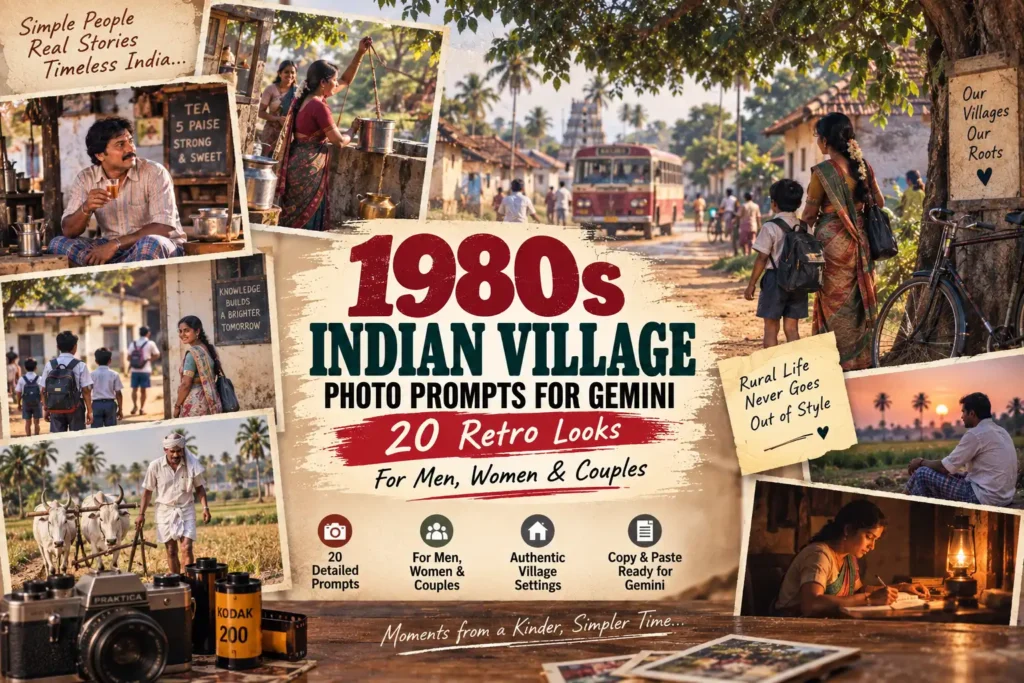
Transform my uploaded photograph into an authentic Tamil Nadu street photograph captured in 1983. Preserve my exact facial identity, facial proportions, skin tone, natural asymmetry, hairline and recognizable features. Do not beautify, reshape or replace my face.

Dress me in a slightly loose pale sandal-coloured half-sleeve cotton shirt tucked into high-waisted dark brown trousers, with a narrow leather belt, simple analog wristwatch and period-correct sandals. Give me naturally combed 1980s South Indian hair with a modest side part and a subtle moustache only if it naturally suits my existing appearance.

Place me beside a small lime-painted neighbourhood tea shop on a sunlit Tamil street. Include a stainless-steel tea boiler, glass tumblers, an old bicycle resting against a weathered wall, a wooden bench, faded hand-painted shop details and a distant period-appropriate public bus. Remove every modern object.

Do not make me pose like a model. Capture the exact candid instant when one hand rests casually on the bicycle seat and I turn slightly after hearing someone call from outside the frame.

Recreate the photograph as if captured using an ordinary manual-focus 35mm consumer camera with colour negative film: fine irregular grain, slightly warm aged colour response, soft highlight roll-off, moderate contrast, tiny focus imperfection, realistic lens softness and subtle physical print texture.

Avoid cinematic teal-orange grading, artificial portrait blur, luxury styling, modern vehicles, LED lights, plastic skin, hyper-sharp digital detail and obvious AI aesthetics. The final image must feel like a genuine forgotten family photograph physically developed in Tamil Nadu in 1983.
2. 1986 Madras Bus Stand Candid Look
Instead of a posed retro portrait, this prompt captures the subject during a small transitional moment at a busy 1980s Madras bus stand.
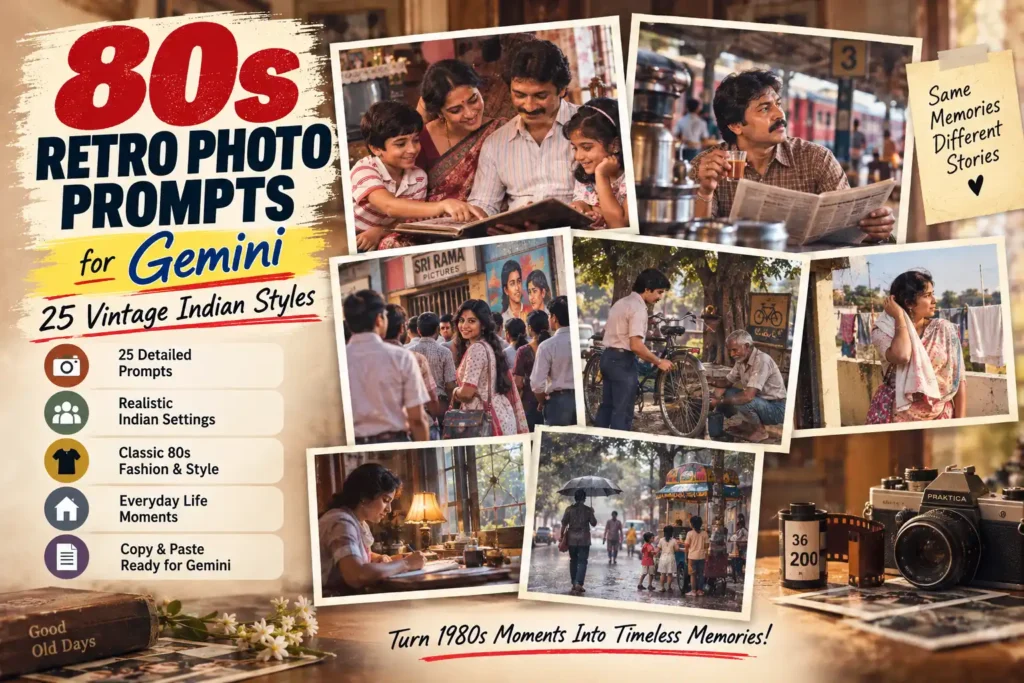
Use my uploaded photo as the exact identity reference and recreate me as a young man photographed at a busy Madras bus stand in 1986. Keep my face unmistakably mine with natural pores, realistic skin texture, original facial proportions and no beauty enhancement.

Dress me in a thin-striped cotton shirt tucked into charcoal high-waisted trousers. Fold the sleeves once naturally. Add an inexpensive analog watch, simple dark sandals and a folded Tamil newspaper held loosely in one hand.

Place me near a period-correct public bus with painted route boards, metal luggage racks, dusty windows and naturally scattered passengers. Keep background people secondary and slightly motion-softened. Include a few bicycles, old steel benches and sun-worn bus-stand walls without modern advertising.

Capture me while I am stepping away from the bus and unexpectedly turning toward the camera, not standing in a prepared pose.

Use strong late-afternoon sunlight reflecting from the dusty road and bus windows. Reproduce the visual behaviour of 1980s 35mm Indian colour film: modest grain, slightly imperfect exposure, soft edge detail, natural warm highlights and restrained shadow information.

Remove smartphones, modern buses, digital signage, contemporary clothing, luxury accessories and artificial cinematic lighting. Make the result look like a real travel photograph that survived for decades inside an old family album.
3. Old Tamil Cinema Balcony Portrait
This concept uses the atmosphere of an ageing single-screen cinema without copying a real actor, film or famous movie scene.
Reimagine my uploaded portrait as an entirely original photograph taken outside a Tamil single-screen cinema in 1982. Preserve my exact identity, facial structure, skin tone and natural expression.

Dress me in a deep maroon full-sleeve shirt with a broad but historically believable period collar, cream pleated trousers, a narrow leather belt and simple leather footwear. Give the hair subtle early-1980s Tamil masculine volume without making it theatrical.

Place me along the upper balcony corridor of an ageing cinema building with worn plaster pillars, iron railings, tungsten wall lamps, faded ticket-window details and layers of old poster paper with no recognizable film titles or copyrighted characters.

Do not imitate any real actor or movie scene. Create a completely original visual.

Show me leaning lightly against the railing while holding a folded cinema ticket between two fingers and looking toward activity on the street below.

Photograph the scene like an old Indian publicity still: mixed tungsten and ambient evening light, slight halation around bulbs, fine film grain, realistic shadow density, rich but aged maroon tones and subtle optical softness.

Avoid modern multiplex design, digital billboards, LED lights, fashion-editorial posing and overprocessed skin. The image must feel like an undiscovered 1982 Tamil cinema photograph.
4. 1984 Tamil Village Festival Morning
For a traditional South Indian setting, this prompt recreates the quieter moments of a village festival morning rather than turning the scene into an exaggerated celebration.
Transform my uploaded image into a realistic Tamil village festival-morning photograph from 1984 while preserving my exact facial identity and natural appearance.

Dress me in a clean white veshti with a very thin coloured border and a softly checked half-sleeve cotton shirt. Keep the clothing simple, believable and slightly imperfect rather than luxurious.

Set the photograph on a quiet Tamil village street shortly after sunrise. Include fresh kolam patterns, banana stems tied near the entrance of an old tiled-roof house, loose jasmine flowers, a distant temple gopuram softened by light morning haze, an old bicycle and a brass water vessel near a doorway.

Capture me naturally adjusting the fold of my veshti while glancing toward something outside the frame. Do not use a straight fashion pose.

Use soft low morning sunlight, slightly hazy atmosphere, gentle colour fading, mild cyan shift in distant shadows, warm but natural skin, fine irregular film grain and subtle age marks near the print edges.

Avoid modern festival LED decorations, smartphones, synthetic luxury clothing, extreme colour saturation and cinematic VFX. The final image should resemble a genuine personal photograph from a Tamil village festival morning in the mid-1980s.
5. 1985 Indian College Student Look
This prompt recreates an imperfect college snapshot where a tiny accidental action makes the photograph feel much less staged.
Preserve my exact identity from the uploaded image and reinterpret me as an Indian college student photographed in 1985.

Dress me in a pastel blue cotton shirt tucked into dark slightly flared trousers, canvas shoes, a modest analog wristwatch and a slim belt. Let me carry two visibly used textbooks and a thin notebook under one arm.

Place me inside an old South Indian college campus with a long veranda, weathered cream walls, tall wooden windows, large rain trees, parked period bicycles and an old notice board blurred in the background.

Capture the photograph while I am walking and one textbook begins slipping from the stack, causing my free hand to reach toward it. This small accidental movement should make the image feel unstaged.

Photograph the scene as though a college friend used an affordable 35mm camera. Use leaf-filtered daylight, uneven patches of sun, slight edge softness, moderate grain, imperfect framing and believable 1980s colour-film response.

Exclude modern backpacks, smartphones, sneakers, air-conditioned glass buildings, contemporary hairstyles and digital photographic sharpness. The result should feel like a real photograph that was kept inside an old college notebook for forty years.
6. Rainy 1987 Small-Town Portrait
Rain, wet surfaces and mixed reflections give this 80s look a completely different visual character from the usual warm vintage portrait.
Transform my uploaded portrait into a believable small-town South Indian photograph taken in 1987 immediately after a monsoon shower. Keep my exact facial identity, natural facial proportions, skin texture and original features.

Dress me in a muted olive cotton shirt with naturally damp shoulders, dark pleated trousers and simple leather sandals. Let the clothes show realistic humidity instead of fashion styling.

Place me beneath the narrow metal awning of a closed roadside shop. The street should still be wet, with rippled puddles reflecting faded buildings, an old bicycle, dripping tiled roofs and a period-appropriate car far in the background.

Capture me while I am rolling one wet shirt sleeve slightly higher and looking toward the remaining rain beyond the camera. Avoid a conventional portrait pose.

Use overcast daylight with soft facial shadows, realistic wet-road reflections, mild humidity haze on the lens, restrained colour, subtle grain and the modest tonal range of late-1980s consumer colour film.

Do not add neon lights, dramatic movie rain, modern cars, umbrellas with modern branding or cinematic colour grading. The image must look like a spontaneous photograph taken during an ordinary rainy afternoon in 1987.
7. 1984 South Indian Barbershop Photo
An old neighbourhood barbershop gives the AI several unusual period details to work with, including mirrors, mixed lighting and everyday grooming objects.
Use my uploaded photograph as the exact face reference and place me inside a modest South Indian barbershop in 1984 immediately after a haircut.

Preserve every recognizable facial characteristic. Do not smooth the skin or redesign the jaw, nose, eyes or hairline.

Give me neatly side-combed period hair and a naturally proportioned moustache only when appropriate. Dress me in a plain cream cotton shirt and dark trousers.

Create a narrow old barbershop containing a slightly spotted wall mirror, wooden shelf, steel grooming tools, talcum container, manual barber accessories, old ceramic shaving mug, slowly rotating ceiling fan and a worn barber chair.

Capture me standing in front of the mirror while using a small comb for one final adjustment. Let the mirror produce a believable partial rear reflection of me.

Light the shop using daylight entering through the doorway mixed with slightly greenish old fluorescent interior illumination. Add realistic mirror imperfections, fine grain, slight colour imbalance and gentle optical softness.

Avoid modern salon chairs, ring lights, electric styling equipment, fashionable interiors and luxury grooming products. Make the photograph look like something genuinely discovered decades later in the barber's old drawer.
8. 1981 Indian Railway Platform Traveller
This prompt builds the photograph around departure and anticipation rather than using the railway station only as a decorative background.
Convert my uploaded portrait into an authentic Indian railway-platform photograph from 1981 while preserving my exact identity and facial details.

Dress me in a light beige cotton shirt, dark high-waisted trousers, worn leather sandals and a simple analog wristwatch. Add a modest canvas shoulder bag and an old rectangular suitcase with no visible modern branding.

Place me on a railway platform beside a painted wooden bench while a period passenger train waits in the background. Include metal window bars, old station lamps, steel water containers, luggage bundles and naturally scattered travellers.

Capture the instant when I have just placed my suitcase on the ground and turn my head toward the far end of the platform after hearing the arriving train whistle.

Render the scene using the visual behaviour of ISO 200 colour film: warm morning sunlight, fine grain, slight underexposure beneath the station roof, subtle motion blur from one passing traveller, ordinary lens perspective and mild colour ageing.

Avoid polished travel photography, modern train coaches, digital display boards, trolley luggage, phones and contemporary clothing. The final photograph should feel like a personal departure memory from 1981.
9. 1983 Tamil Farmer Documentary Portrait
Instead of an artificial heroic farmer pose, this prompt focuses on an ordinary agricultural action and documentary-style photography.
Preserve my exact face from the uploaded image and recreate me as a Tamil farmer photographed in 1983 using a respectful documentary approach.

Dress me in a faded checked cotton shirt and a neatly tied veshti with believable fabric wear, slight creasing and no costume-like styling.

Place me on the narrow raised boundary of a green paddy field shortly after sunrise. Include irrigation water reflecting the sky, distant coconut trees, a simple field bicycle, moist soil and very light morning mist.

Do not make me stand heroically. Show me bending slightly while inspecting a handful of rice stalks, then naturally looking toward the camera after noticing the photographer.

Use honest natural sunlight, textured skin, earthy colours, moderate grain, realistic depth from a normal lens, slight edge fading and subtle imperfections typical of an old locally developed colour print.

Avoid fantasy farming imagery, dramatic sky effects, luxury clothing, extreme HDR and fashion-model posture. Preserve the dignity and ordinariness of a real agricultural morning in 1983.
Old local photo studios had their own unmistakable visual language. This prompt recreates the painted backdrop, direct flash and modest presentation instead of applying a generic vintage effect.
Use my uploaded image to create a formal Indian studio portrait exactly as a modest local photo studio might have produced in 1980.

Preserve my facial identity precisely, including natural asymmetry, real skin texture, original nose, eyes, jawline and hairline.

Dress me in a neatly pressed light grey full-sleeve shirt, dark trousers and a narrow period belt. Seat me on a simple wooden studio stool at a slight three-quarter angle with one hand resting naturally on my thigh.

Behind me, use a hand-painted cloth backdrop showing an intentionally soft imaginary garden landscape. The fabric backdrop must show subtle folds and painted texture instead of looking digitally perfect.

Use old studio flash positioned slightly above eye level, creating small natural catchlights and a modest subject shadow falling onto the painted backdrop. Reproduce restrained skin tones, slight chemical-print colour variation, gentle optical softness and the tonal character of a professionally developed early-1980s studio photograph.

Do not make the portrait glamorous or cinematic. Avoid luxury suits, modern seamless backgrounds, dramatic rim lighting, artificial skin smoothing, excessive bokeh, HDR, modern fashion-retouching aesthetics and digitally perfect sharpness.

The final image must convincingly resemble a genuine Indian studio photograph that spent more than forty years protected between the pages of a traditional family album.
11. 1986 Roadside Mechanic Workshop
A mechanic workshop creates a completely different 80s atmosphere through worn tools, difficult mixed lighting and a natural working moment instead of a prepared portrait.
Recreate me from my uploaded photo as a young roadside mechanic photographed in South India in 1986. Preserve my exact face, facial proportions, natural expression, skin tone and realistic skin texture without beautification.

Dress me in a faded blue cotton shirt with the sleeves rolled unevenly and dark work trousers carrying subtle, believable grease and dust marks. The clothing must look genuinely used during work rather than artificially distressed for fashion.

Place me inside a narrow roadside workshop beside a partially repaired period-appropriate commuter motorcycle. Build the environment with old metal spanners, a manual tyre pump, wooden workbench, hanging hand tools, grease containers, discarded inner tubes, a stained wall and sunlight entering through a partly raised metal shutter.

Create a believable reason for the photograph to exist. Capture the exact second when I stop working, wipe grease from my fingers using a small cotton cloth and unexpectedly glance toward the person holding the camera.

Let strong doorway sunlight fall across only part of the workshop while the deeper interior remains naturally darker. Preserve small metallic reflections, dense film shadows, slightly warm colour-negative rendering, restrained grain and modest 1980s lens performance.

Do not add staged sparks, artificial smoke, modern motorcycles, power-tool displays, LED lights, designer workwear or heroic advertising poses. The result must resemble an ordinary working-day photograph taken inside a real neighbourhood workshop in 1986.
12. 1985 South Indian Beach Memory
Rather than using the familiar cinematic beach pose, this concept captures a small accidental moment that could realistically have ended up in an old family album.
Keep my exact identity from the uploaded photograph and reinterpret me as a young man casually photographed on a South Indian beach in 1985. Preserve my facial structure, skin tone, hairline, natural asymmetry and recognizable features.

Dress me in a lightweight off-white cotton shirt with the sleeves casually folded and muted brown trousers. Let the sea breeze move the shirt fabric and hair naturally instead of creating a carefully styled appearance.

Do not create a conventional sunset portrait. Capture me walking across damp sand while holding my sandals loosely in one hand immediately after an unexpected wave reached my feet. My attention should be directed downward toward the retreating water rather than toward the camera.

In the distance, include a few wooden fishing boats, a modest vendor pushcart and small groups of visitors rendered naturally and without becoming visual distractions. Keep the coastline free from modern resorts and contemporary structures.

Photograph the scene as if recorded on 35mm colour negative film during low evening sunlight. Use warm but realistic skin tones, slightly cooler sea shadows, irregular fine grain, mild accidental lens flare, modest dynamic range and subtly imperfect handheld framing.

Avoid luxury beachwear, modern skylines, extreme orange sunsets, artificial portrait blur, fashion posing and cinematic colour grading. Make the finished image feel like an unplanned 1985 vacation photograph rediscovered inside an old family envelope.
13. 1982 Old Public Library Portrait
This quieter 80s concept uses books, window light and a split-second reading action to create a photograph that feels personal rather than staged.
Use my uploaded portrait as the exact identity reference and place me inside a quiet Indian public library in 1982. Preserve my natural face, skin texture, facial proportions, hairline and all recognizable characteristics without beautification.

Dress me in a pale checked cotton shirt tucked into brown high-waisted trousers with a simple analog wristwatch and understated period footwear.

Seat me at a long dark wooden reading table surrounded by tall ageing bookshelves, wooden card-catalog drawers, large ceiling fans and tall windows. Add an ordinary pencil, two worn books and a small folded paper bookmark while keeping book titles indistinct and generic.

Do not create a posed reading portrait. Capture the precise fraction of a second when one page of the open book is halfway through turning and my eyes briefly lift toward the camera while one fingertip still controls the moving page.

Illuminate the room mainly with directional daylight entering through the tall side windows. Allow the deeper library to fall into naturally dense but detailed shadows.

Render the photograph with the character of higher-speed early-1980s colour film: noticeable fine grain, slightly muted colours, small exposure irregularities, realistic optical softness and restrained contrast.

Remove computers, smartphones, LEDs, contemporary furniture, modern book displays and designer-library styling. The finished image should feel like a quiet personal photograph that remained forgotten between old books for decades.
14. 1984 Tamil Wedding Guest Candid
Old wedding albums contain many memorable photographs that were never formally posed. This prompt recreates one of those easily overlooked in-between moments.
Transform my uploaded photo into a candid Tamil wedding photograph genuinely captured in 1984 while preserving my exact facial identity, natural skin texture, facial proportions and recognizable appearance.

Dress me in a crisp white veshti and a soft pastel full-sleeve cotton shirt appropriate for an ordinary Tamil wedding guest. Keep the styling modest and period-correct, without excessive jewellery or luxury accessories.

Place me along the side corridor of an old marriage hall decorated with jasmine strings, banana leaves, traditional flower arrangements and warm tungsten lamps. Allow deeper wedding activity to remain naturally visible but secondary in the background.

Instead of posing for the photographer, capture me carefully carrying two stainless-steel tumblers of filter coffee. Freeze the instant when someone calls from behind and I begin turning my head while still concentrating on keeping both tumblers steady.

Recreate the distinctive photographic behaviour of an ordinary 1980s wedding camera: direct on-camera flash mixed with warm hall illumination, slightly hard flash shadows, brighter foreground exposure, natural falloff into the background, fine film grain and realistic colour-print response.

Avoid fairy-light bokeh, designer wedding décor, cinematic depth of field, contemporary clothing and modern wedding-photography aesthetics. The result should resemble one unnoticed but wonderfully human frame from a genuine 1984 Tamil family wedding album.
15. 1986 Motorcycle Roadside Stop
Instead of the common hero-with-bike composition, this prompt turns a minor roadside problem into the photographic story.
Preserve my exact face from the uploaded image and recreate me during an unplanned roadside pause on a South Indian motorcycle journey in 1986. Maintain my real facial structure, skin tone, hairline, natural asymmetry and recognizable identity.

Dress me in a rust-coloured checked cotton shirt, dark trousers and practical period footwear. Let my hair appear naturally disturbed by road wind rather than carefully styled.

Place a historically plausible 1980s commuter motorcycle beside a narrow rural road lined with tamarind trees, patches of dry grass and occasional weathered stone markers. Secure a small cloth travel bag practically to the rear of the motorcycle.

Never use the familiar pose of a man standing proudly beside his motorcycle. Instead, show me slightly crouched beside the rear wheel while inspecting a minor mechanical problem. Capture the instant I unexpectedly look upward toward the photographer while one hand remains close to the wheel.

Use strong late-afternoon sunlight producing honest hard shadows, warm roadside dust tones, fine 35mm grain, modest contrast, slight exposure imperfection and a small accidental lens flare caused by the low sun.

Remove modern helmets, contemporary motorcycles, reflective road markings, luxury riding gear and advertising-style body language. The finished image should feel like a spontaneous photograph taken by a travelling friend during a real 1986 roadside interruption.
16. 1983 Tamil Tailor Shop Portrait
This rare everyday setting moves away from the usual street, studio and cinema themes and recreates a small family-run tailoring workspace.
Turn my uploaded photograph into an unusual everyday portrait captured inside a small Tamil tailoring shop in 1983. Preserve my exact facial identity, skin tone, natural facial proportions, hairline and recognizable characteristics.

Dress me in a simple light cotton shirt tucked into dark high-waisted trousers. Keep the clothing practical and ordinary.

Construct a compact family-run tailoring workspace with a black treadle sewing machine, wooden cutting table, folded cotton fabrics, measuring tape, tailor's chalk, paper patterns, wooden shelves, thread spools and a few unfinished garments.

Do not make me stand beside the sewing machine for a conventional occupational portrait. Instead, capture an accidental moment when a long roll of fabric begins slipping from the cutting table. Show me holding one end while quickly reaching toward the falling fabric with my other hand.

Illuminate the shop using daylight entering from the open street doorway mixed with a weak overhead tube light. Preserve the slightly imperfect mixed colour temperature rather than correcting it digitally.

Reproduce modest 1980s film grain, gentle optical softness, minor white-balance irregularity, realistic shadow detail and subtle faded-print characteristics.

Exclude computerized sewing machines, boutique interiors, LED lighting, designer fashion displays and staged luxury fabrics. The final photograph should feel like genuine visual history from a small Tamil family business in 1983.
17. 1982 Rooftop Morning Family Snapshot
Not every memorable 80s photograph needs a public location. This prompt recreates an informal moment on the terrace of an ordinary family home.
Use my uploaded face without changing my identity and create an intimate Indian rooftop family photograph from 1982. Preserve my exact facial structure, skin tone, natural imperfections, hairline and age characteristics.

Dress me informally in a pale cotton shirt worn loosely over a simple white sleeveless undershirt with comfortable dark trousers. The clothing should look like ordinary home wear rather than a coordinated outfit.

Place me on the flat terrace of an old South Indian house shortly after sunrise. Include a steel water vessel, simple clothesline, weathered parapet wall, distant tiled rooftops, old television antennas and a few pigeons resting nearby.

Create a fleeting household moment rather than a portrait. Show me immediately after washing my hair, with a small cotton towel around my shoulders while one hand shakes remaining water from my hair. At that exact instant, several pigeons suddenly lift from the parapet and I glance toward the camera with mild surprise.

Capture the scene using gentle low morning sunlight, ordinary family-camera framing, fine grain, slightly faded colour response and tiny motion softness around the moving hand and birds.

Avoid dramatic skyline photography, physique enhancement, perfectly styled hair, luxury homes and modern buildings. The photograph must feel private, accidental and unmistakably like a real early-1980s family snapshot.
18. 1984 Monsoon Bicycle Journey
Here the bicycle is not a decorative retro prop. The scene is built around a small problem during a rain-soaked journey.
Transform my uploaded portrait into a believable South Indian monsoon bicycle photograph captured in 1984 while keeping my exact facial identity unchanged.

Dress me in a pale mustard cotton shirt carrying irregular dark rain patches, dark trousers rolled slightly above the ankles and simple sandals. Give me a practical old road bicycle with a rear carrier and a small cloth bag tied securely to it.

Place me along a narrow rain-washed village road bordered by banana plants, wet compound walls, small drainage channels, muddy edges and trees covered with glistening leaves.

Do not show me riding dramatically through rain. Capture the quieter moment after I have stopped because wet plant material has become caught near the bicycle wheel. Show me bending beside the bicycle while carefully freeing it, with light drizzle still visible against the darker vegetation.

Use soft grey monsoon daylight, subtle wet-road reflections, low natural contrast, fine film grain, slightly cool colour response and two or three tiny rain droplets near the edge of the camera lens.

Avoid dramatic storms, fashion rain poses, modern bicycles, sportswear, helmets and cinematic blue grading. The final photograph should feel like an ordinary 1984 journey temporarily interrupted by monsoon rain.
19. 1985 Second-Hand Bookshop Discovery
A narrow second-hand bookshop gives this prompt a tactile visual identity through paper, dust, wooden shelves and an unplanned discovery.
Preserve my exact identity from the uploaded image and recreate me outside a tiny second-hand bookshop in an Indian town in 1985. Keep my real facial proportions, skin texture, hairline and recognizable features intact.

Dress me in a muted brick-red half-sleeve cotton shirt tucked into beige pleated trousers with a thin belt and simple sandals.

Build a narrow street-side bookshop using ageing wooden shelves, uneven towers of used books, newspapers tied into bundles, worn magazines, paper price slips and a weathered cloth awning. Keep all visible titles generic or indistinct.

Do not create a conventional standing portrait. Show me crouching slightly beside a low stack after discovering an interesting old book. Capture the instant when I open it and a forgotten loose photograph slips from between the pages toward the ground, causing my eyes to follow it.

Use indirect afternoon light reflected from surrounding walls, gentle airborne dust visible only where light catches it, muted 1980s colour-film tones, fine grain, natural normal-lens perspective and modest optical softness.

Avoid picturesque luxury bookstores, modern publishing displays, digital payment signs, plastic shelving and cinematic lighting. Make the final result resemble a genuine 1985 street photograph built around an unexpected tiny discovery.
20. 1981 Rural Tamil Tea Stall Newspaper Moment
This scene uses one of the simplest possible 1980s moments: tea, a newspaper and a sudden breeze.
Use my uploaded photograph to create a realistic rural Tamil tea-stall moment from 1981 while fully preserving my real facial identity, facial proportions, natural skin and hairline.

Dress me in a faded pale-green half-sleeve cotton shirt, dark brown high-waisted trousers and ordinary sandals. Add only a simple period analog watch.

Seat me sideways on a worn wooden bench beneath the shaded roof of a small roadside tea stall. Place a stainless-steel tumbler of tea beside me and an open Tamil newspaper in my hands. Surround the stall naturally with a steel kettle, glass jars, tin biscuit container, old tabletop radio and a bicycle parked outside.

Do not make me look at the camera. Create the precise moment when a sudden breeze lifts one large corner of the newspaper and I instinctively press it back down with one hand while continuing to read.

Use diffused morning daylight, naturally deep shade beneath the stall roof, restrained colour-negative response, soft skin detail, irregular fine grain and subtle physical print texture.

Avoid glamorous retro styling, modern product packaging, smartphones, contemporary branding and exaggerated saturation. The scene should feel like an ordinary 1981 morning that nobody considered special when the photograph was taken.
This concept goes behind the photograph itself by recreating the analogue workspace where local photographs once had to be developed and printed.
Transform my uploaded image into an original 1986 photograph showing me inside the working area of a small neighbourhood Indian photography studio. Preserve my exact facial identity, natural skin texture, facial proportions, hairline, age characteristics and recognizable features without beautification or digital reshaping.

Dress me in a plain light-blue cotton shirt with the sleeves rolled casually to the forearms and charcoal trousers. Keep the clothing modest, practical and historically appropriate for someone working inside a small local photo studio.

Place me beside a narrow wooden counter containing small film canisters, paper negative envelopes, handwritten customer notes, a loupe, scissors, photographic paper packets and an old mechanical camera. Keep branding unreadable or generic.

Behind the counter, reveal the entrance to a tiny darkroom separated by a heavy light-proof curtain. Inside the darker space, show several freshly developed photographic prints hanging from clips along a thin drying line, shallow chemical trays on a work surface and a dim red safelight producing only a restrained glow.

Do not make me pose beside the equipment. Capture the exact working moment when I hold one freshly developed photograph carefully by its outer edges and tilt it slightly toward the available room light to inspect the exposure. Let my eyes remain focused on the print instead of the camera.

Use mixed lighting that would have been difficult for a 1980s film camera to balance perfectly: soft daylight entering through the studio doorway, weak warm tungsten illumination near the counter and a faint red spill escaping from the darkroom. Preserve the resulting subtle colour inconsistency rather than making everything perfectly neutral.

Reproduce genuine analogue photographic character with fine irregular grain, soft edge resolution, slightly dense interior shadows, mild highlight halation, modest colour saturation, realistic lens behaviour and tiny exposure imperfections.

Avoid modern computers, digital cameras, inkjet printers, editing monitors, smartphones, LED panels, fashionable studio interiors and exaggerated cinematic darkroom effects. The final image should feel like an extremely rare behind-the-scenes photograph documenting how ordinary neighbourhood photographs were physically developed in 1986.
22. 1982 Tamil Nadu Market Morning
This prompt turns an ordinary household shopping trip into a believable 1980s photograph, using a natural market action instead of a posed portrait.
Recreate my uploaded portrait as an early-morning Tamil Nadu market photograph from 1982 while preserving my exact facial identity, skin tone, facial proportions, hairline and natural appearance.

Dress me in a lightly striped cotton half-sleeve shirt tucked into dark high-waisted trousers with simple sandals. Give me a traditional woven shopping basket instead of a modern plastic or branded bag.

Place me inside an old open-sided vegetable market with vegetables arranged naturally in cane baskets and low ground-level displays. Include tomatoes, brinjals, green chillies, leafy vegetables, banana leaves, weighing scales, jute sacks and a damp stone or packed-earth floor. Keep vendors and customers candid and secondary.

Do not place me in the centre staring at the camera. Capture me slightly off-centre while bending toward a vegetable basket and comparing two tomatoes in one hand. Freeze the moment when I briefly look toward the photographer after noticing the shutter being raised.

Use cool early-morning shade beneath the market roof mixed with narrow shafts of warm sunlight entering through gaps. Let some vegetables catch brighter light while my face remains naturally and evenly readable.

Simulate an ordinary 1982 consumer-film photograph with modest grain, soft shadow detail, slightly faded colour response, restrained contrast, imperfect handheld framing and normal-lens perspective.

Remove plastic supermarket packaging, electronic weighing machines, digital payment signs, LED bulbs, contemporary clothing and polished commercial-market aesthetics. The final image must resemble a genuine household shopping photograph from 1982 that was never intentionally created to look artistic.
23. 1987 Evening Radio Repair Shop
Old radio-repair shops are rarely used in AI retro portraits, making this one of the more unusual concepts in the collection.
Use my uploaded photo as the precise identity reference and recreate me inside a tiny Indian radio-repair shop in 1987. Preserve my exact facial structure, skin texture, hairline, age, natural asymmetry and recognizable appearance.

Dress me in a muted beige cotton shirt with sleeves folded to the forearms and dark trousers. Keep the clothing practical and slightly creased from a normal working day.

Construct a narrow repair shop filled with historically plausible tabletop radios, wooden radio cabinets, loose insulated wires, analogue tuning dials, small screwdrivers, pliers, a soldering iron, paper repair tags and shallow wooden shelves. Keep all visible trademarks absent or indistinct.

Seat me at a small repair table, but do not create a posed occupational portrait. Capture the exact moment when I slowly turn the tuning knob of a repaired radio with one hand while tilting my head closer to the speaker, listening carefully for the station to come through clearly.

Add one subtle storytelling detail: a small dial indicator should be caught midway between two frequencies while my other hand hovers near the volume control, suggesting that the repair test is still happening.

Light the shop with warm incandescent bulbs mixed with cool blue-grey evening daylight entering through the doorway. Let the two colour temperatures coexist naturally instead of correcting them into modern perfect white balance.

Reproduce realistic mixed-colour film response, soft shadows, fine grain, mild bulb halation, modest optical sharpness and shallow but believable focus produced by an older normal lens.

Avoid sparks, futuristic electronics, modern headphones, LED strips, computer equipment and exaggerated cinematic expressions. The final image should feel like truthful documentation of an everyday profession that almost disappeared with the arrival of digital electronics.
24. 1983 South Indian Riverbank Crossing
This scene avoids the usual scenic river portrait and instead focuses on a small balancing action that makes the photograph feel genuinely accidental.
Preserve my exact facial identity from the uploaded image and create a candid South Indian riverbank photograph from 1983. Keep my real facial proportions, skin tone, hairline and natural features intact without digital enhancement.

Dress me in a simple checked cotton shirt and dark trousers rolled slightly above the ankles. Place my ordinary sandals together on a dry stone close to the bank.

Set the scene beside a shallow rural river with clear moving water, irregular smooth stones, a steel water pot, a few washed clothes drying naturally on nearby bushes, coconut trees in the distance and a narrow earthen footpath leading away from the water.

Do not create a scenic standing portrait. Show me carrying a small folded bundle of clean clothing while carefully stepping from one wet stone to another across the shallow edge of the river.

Capture the exact unstable instant when my forward foot has just reached the next stone, my body instinctively shifts to maintain balance and my eyes remain focused downward on where I am stepping. The photographer should feel almost forgotten by the subject.

Use bright late-morning sunlight reflected from the moving water, warm natural skin tones, moderate 35mm grain, slightly warm colour-negative response, mild overexposure on the brightest water reflections and ordinary handheld framing.

Avoid dramatic waterfalls, mountains, travel-ad scenery, luxury clothing, cinematic posing and digitally perfect dynamic range. The final image should feel like an ordinary rural household memory accidentally preserved on film in 1983.
25. Lost 1980s Family Album Master Prompt
The final prompt is intentionally broader. Instead of forcing one fixed scene, it instructs the AI to invent a historically believable 1980s moment while keeping the photograph grounded in ordinary life.
Transform my uploaded photograph into an entirely original Indian family photograph that appears to have been genuinely captured sometime between 1981 and 1986.

IDENTITY PRESERVATION:
Preserve my exact real-world identity with maximum fidelity: same facial structure, eyes, eyebrows, nose, lips, jawline, ears, skin tone, natural asymmetry, hairline and age characteristics. Keep realistic pores and normal skin texture. Never replace my face with a generic AI face, beautified version or celebrity-like appearance.

SCENE INVENTION:
Invent one completely believable everyday 1980s South Indian situation. Do not default to a studio portrait, heroic pose or fashionable retro photoshoot. Choose a modest real-life environment such as a neighbourhood street, small family courtyard, village bus stop, railway platform, tea stall, tailoring shop, modest home, college veranda, local market, repair shop, rural roadside or another historically plausible everyday location.

PERIOD ACCURACY:
Every visible object must belong naturally to the selected year. Use historically appropriate architecture, furniture, bicycles, public transport, household objects, tools, fabrics, signs and street materials. Remove smartphones, LED lighting, contemporary vehicles, modern plastic products, digital displays, modern logos and anything that reveals the present day.

WARDROBE:
Dress me in believable Indian menswear from the early or mid-1980s using ordinary cotton fabrics, slightly relaxed tailoring, high-waisted trousers, simple shirts or traditional South Indian clothing when appropriate. Clothing must look worn naturally by a real person, not sourced from a modern retro-fashion campaign.

HUMAN MOMENT:
Create one tiny, specific human action that explains exactly why the shutter was pressed at that second. Examples may include turning after someone calls, preventing a newspaper from blowing away, checking a bicycle wheel, adjusting a veshti fold, balancing something being carried, opening an old book, listening to a radio, stepping around rainwater or reacting to another minor everyday event.

Never make me stand motionless in the centre of the frame with generic AI-model body language. The scene must feel as if life was already happening before the photographer raised the camera.

COMPOSITION:
Use imperfect but believable amateur or local-photographer composition. Allow slightly off-centre framing, naturally cropped environmental details, ordinary eye-level or chest-level camera height and realistic spacing between subject and surroundings. Do not create symmetrical poster composition.

ANALOGUE CAMERA CHARACTER:
Simulate authentic consumer-film photography rather than a modern digital image with a vintage filter. Use realistic 35mm optical softness, irregular fine film grain, mild focus inconsistency, slightly limited dynamic range, imperfect white balance, subtle colour ageing, gentle highlight roll-off, naturally dense shadows and modest lens contrast.

Allow tiny imperfections that would naturally occur during capture or chemical printing, but do not cover the image with fake scratches, heavy dust, torn edges or exaggerated ageing effects.

EMOTIONAL DIRECTION:
The photograph should not look intentionally nostalgic. The people inside the moment should behave as if the photograph is completely ordinary and the year will continue forever. The nostalgia must come only from the viewer realizing that the captured moment belongs to a world that has already disappeared.

STRICTLY AVOID:
Modern retro-fashion styling, cinematic teal-orange grading, luxury wardrobe, dramatic rim lighting, artificial bokeh, HDR, hyper-sharp digital skin, modern architecture, smartphones, LED lights, contemporary vehicles, influencer poses, movie-poster composition, fake film borders and obvious AI aesthetics.

FINAL STANDARD:
The finished image must create the unusually convincing sensation that it is not a newly generated retro image at all. It should look like a physically developed original photograph that remained inside a forgotten family album for more than forty years and has only now been seen again.
Some more you might like