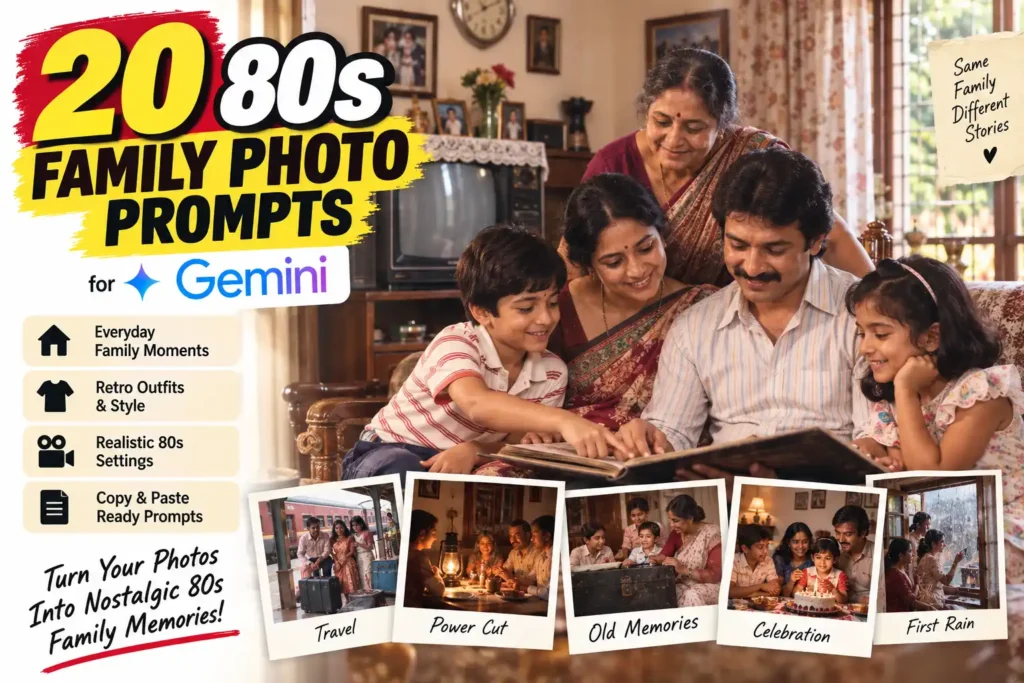
1. 1982 Sunday Morning Family Veranda Photo
This prompt starts with an ordinary Sunday morning rather than a formal family pose, using newspapers, coffee and an unexpected breeze to create the photographic moment.
Transform the people in my uploaded family photograph into an authentic South Indian family photographed on a Sunday morning in 1982.

IDENTITY:
Preserve every family member as a separate real person. Keep each person's exact facial structure, eyes, nose, lips, jawline, skin tone, natural asymmetry, hairline, body proportions and apparent age. Never merge faces, exchange facial features, make everyone look genetically identical or replace anyone with a generic AI face.

WARDROBE:
Dress each family member in simple early-1980s Indian home clothing appropriate to their age and gender. Use ordinary cotton fabrics, naturally relaxed fits and minimal accessories. Avoid matching outfits and modern retro-fashion styling.

LOCATION:
Place the family along the shaded front veranda of a modest South Indian house with red oxide flooring, lime-washed walls, a wooden doorway, cane chairs, an old wall clock visible through the doorway, a pair of ordinary sandals near the steps and a few naturally growing plants.

STORY:
Do not arrange everyone into a formal family portrait.

Create a believable Sunday morning already in progress. One adult is reading a large newspaper, another is holding a stainless-steel tumbler of filter coffee, while the remaining family members are naturally occupied nearby.

Capture the exact fraction of a second when a sudden breeze folds a large newspaper page backward. The reader instinctively reaches to control it, the person holding coffee turns toward the sound of the paper, and another family member reacts naturally to the commotion.

Nobody should be perfectly prepared for the photograph.

CAMERA:
Photograph the scene from the courtyard at ordinary standing height as though another relative unexpectedly raised a simple family camera.

Use soft morning sunlight spilling into the veranda, realistic differences between bright courtyard light and shaded faces, fine irregular 35mm grain, modest dynamic range, slightly warm colour-negative response, gentle optical softness and imperfect handheld framing.

STRICTLY AVOID:
Smartphones, LED lights, modern furniture, contemporary clothing, designer interiors, coordinated family poses, artificial bokeh, HDR, cinematic teal-orange grading, plastic skin and exaggerated fake scratches.

FINAL RESULT:
The image must feel like a completely ordinary Sunday morning photographed in 1982—an imperfect family moment that became valuable only because the years passed.
2. 1985 Parents and Child at a Railway Platform
Instead of lining the family up beside a train, this prompt captures the small confusion of preparing to board while keeping track of luggage and a child.
Use my uploaded family photograph as the exact identity reference and recreate the same parents and child during an Indian railway journey in 1985.

Preserve all three identities independently with maximum fidelity. Keep the exact facial features, skin tones, hairlines, natural body proportions and apparent ages of the adults and child. Never make the child look older, change family resemblance artificially or blend facial characteristics between people.

Dress the family in modest mid-1980s Indian travel clothing appropriate to each person. Give one adult a simple cloth shoulder bag and place an old rectangular suitcase nearby. Avoid luxury travel styling.

Set the scene on a busy but believable railway platform with an older passenger train, barred windows, painted wooden or metal benches, luggage bundles, steel water containers and naturally scattered travellers.

Do not make the family pose beside the train.

Capture the precise moment when boarding is about to begin. One parent bends to lift the suitcase, the other checks the cloth bag, and the child notices that a small paper train ticket has slipped from an adult's hand and landed near their feet.

Freeze the instant when the child points toward the fallen ticket while the parent holding the bag begins looking down to find it.

The family should be reacting to the same tiny problem rather than looking at the camera.

Use warm morning station sunlight mixed with naturally darker shade beneath the platform roof. Add slight background motion softness from travellers, fine 1985 film grain, modest contrast, realistic shadow density and ordinary family-camera composition.

Avoid modern trains, digital display boards, trolley luggage, smartphones, branded travel gear, cinematic departure scenes and artificial emotional expressions.

The final photograph should feel like a genuine 1985 family journey where the photographer accidentally captured the small moment everyone later remembered.
3. 1980 Full Family Photo Studio Before Everyone Is Ready
This prompt deliberately captures the seconds before the official studio portrait, when everyone is still adjusting themselves and the family looks more natural.
Transform my uploaded family photograph into an Indian family photo-studio session from 1980 while preserving every person's exact identity separately.

Maintain each family member's original facial structure, skin tone, hairline, age, height relationship and natural body proportions. Never duplicate faces, exchange features or beautify everyone into the same AI appearance.

Dress each person in historically believable semi-formal Indian clothing appropriate to their gender and age. The family may look slightly more carefully dressed than at home, but the outfits must not be perfectly coordinated.

Build a modest local photography studio with a hand-painted cloth backdrop showing an imaginary garden, simple wooden stools, an old curtain, mechanical camera equipment and direct studio flash.

Do not generate the finished formal portrait.

Instead, photograph the family several seconds before it.

One adult should still be adjusting a child's collar or clothing, another person should be shifting a wooden stool slightly, one family member may be looking toward the photographer for instructions, and another should still be settling into position.

Capture the exact instant when the child unexpectedly turns toward the person fixing their clothes instead of looking toward the camera.

Use straightforward early-1980s studio flash with small catchlights, modest shadows on the painted backdrop, gentle optical softness, fine grain, restrained skin tones and slight chemical-print colour variation.

Avoid modern studio backdrops, softboxes, ring lights, coordinated luxury clothing, glamour retouching and perfectly symmetrical composition.

The result should look like the photograph the studio photographer never intended to sell—the imperfect frame taken immediately before the proper family portrait.
4. 1983 Grandparents and Grandchild Courtyard Memory
This quieter family prompt uses a simple household activity to show the relationship between generations without forcing affection for the camera.
Use my uploaded photographs as identity references and recreate the grandparents and grandchild together in a South Indian household courtyard in 1983.

Preserve each person's real age exactly. Keep the grandparents' authentic facial structure, wrinkles, skin texture, grey hair or other age characteristics without making them younger. Preserve the child's exact age, face and proportions without making the child older or stylized.

Dress everyone in simple period-correct home clothing appropriate to their generation and gender.

Place them in a shaded courtyard with red oxide flooring, a woven mat, wooden doorway, brass container, low wooden stool and soft daylight entering from one side.

Do not arrange them into a smiling three-person portrait.

Seat one grandparent on the woven mat sorting a small pile of family photographs or postcards. Let the grandchild sit naturally beside them while the other grandparent remains close enough to participate.

Capture the exact moment when the child picks up one old photograph upside down and shows it enthusiastically to the grandparents. One grandparent should begin reaching to rotate the picture correctly while the other naturally looks at the child's reaction.

The emotional connection must come from shared attention to the same object, not from exaggerated hugging or staged smiles.

Use soft reflected courtyard daylight, realistic elderly and child skin texture, fine 1983 colour-film grain, modest contrast, slightly warm print tones and ordinary eye-level framing.

Avoid age reduction, beauty retouching, luxury traditional clothing, cinematic golden light, artificial family poses and modern household objects.

The final image should feel like a photograph of three generations sharing an insignificant afternoon moment that later became impossible to recreate.
5. 1986 Family Moving into a New Home
Rather than showing a finished house, this prompt captures the first day inside an almost empty home when the family’s belongings are still in boxes.
Transform my uploaded family photograph into a believable Indian family moving into a modest new home in 1986. Preserve every person's exact individual identity, facial structure, skin tone, hairline, body proportions and apparent age.

Dress the family in simple practical mid-1980s clothing suitable for a tiring moving day. Clothing should show natural creasing and minor signs of activity rather than looking styled.

Create an almost empty South Indian home with red oxide flooring, pale walls, wooden windows, a ceiling fan, one rolled sleeping mat, painted steel trunk, cardboard boxes tied with jute string, steel vessels and a few folded household fabrics.

The emptiness of the room should immediately communicate that the family has only just arrived.

Do not make everyone stand proudly inside the new house.

Create one shared moving-day mishap. Two adults are carrying a cardboard box between them while another family member is opening the steel trunk nearby.

At the exact shutter moment, the bottom flap of the cardboard box begins separating and one lightweight steel tumbler slips through the gap.

One adult should quickly move a hand beneath the box, another should react to the falling tumbler, while the remaining family member looks toward the sound.

If a child is present in the uploaded family, keep the child safely away from the falling object and let them react from nearby rather than reaching beneath it.

Photograph the scene from the open doorway as though a relative helping with the move noticed the incident.

Use bright daylight from the doorway and windows, large patches of light across the empty floor, fine 1986 grain, modest dynamic range, slight motion softness around the falling tumbler and imperfect handheld framing.

Avoid modern modular furniture, flat-screen televisions, LED lights, branded moving boxes, luxury interiors and cinematic family styling.

The final image should feel like the first photograph ever taken inside a family's new home—before the furniture arrived and before the rooms filled with years of memories.
6. 1981 Family Lunch Under a Mango Tree
This outdoor family prompt uses shade, food and a moving cloth to recreate the kind of informal meal that rarely became a perfectly composed photograph.
Use my uploaded family photograph as the exact identity reference and recreate the same family having a simple outdoor lunch in rural South India in 1981.

Preserve every family member individually: same face, skin tone, hairline, apparent age, height relationship and natural body proportions. Do not duplicate or merge faces.

Dress everyone in simple early-1980s everyday Indian clothing appropriate to their gender and age.

Place the family beneath the broad shade of a mature mango tree beside a modest village home or agricultural field. Spread a clean cotton cloth on the ground with stainless-steel containers, banana leaves, a water vessel and simple homemade food.

Do not arrange everyone into a picnic advertisement.

Show the family already eating or preparing to eat. Capture the exact instant when a stronger breeze begins lifting one large corner of the cotton meal cloth.

One adult should immediately place a hand over the cloth, another should steady a steel container, and another family member should look toward a lightweight item beginning to move.

Keep all reactions natural and practical rather than comedic.

Use intense midday sunlight outside the tree shade with soft reflected illumination beneath it. Allow the background to be slightly brighter than the family, reflecting the limited dynamic range of early-1980s consumer film.

Add fine irregular grain, earthy but realistic colours, ordinary lens softness and slightly imperfect exposure.

Avoid luxury picnic styling, modern food containers, disposable plates, branded packaging, cinematic rural landscapes and perfectly arranged family poses.

The final photograph should feel like an ordinary 1981 family lunch whose small imperfections make it believable.
7. 1984 Parents Teaching a Child to Ride a Bicycle
This prompt creates a family action photograph where balance, movement and parental attention tell the story without needing a posed group.
Transform my uploaded family photograph into an authentic 1984 South Indian family moment in which parents are helping their child learn to ride a bicycle.

Preserve every person's exact identity and age. Maintain the child's real facial features and childlike proportions. Preserve both adults independently without merging faces or altering their ages.

Dress everyone in simple historically believable mid-1980s everyday clothing appropriate to cycling practice and the local setting.

Use a small period-appropriate child's bicycle on a quiet unpaved or lightly surfaced residential lane with old compound walls, tiled houses, shade trees and no modern traffic.

The scene must be safe and gentle. The bicycle should be moving very slowly.

Do not create a posed family photograph.

Capture the precise instant when the child begins balancing independently for the first time. One parent has just released the rear of the bicycle seat but keeps both hands close enough to assist, while the second parent walks a few steps ahead encouraging the child.

The child's attention should remain on balancing and the road ahead rather than on the camera.

Let one adult show a natural surprised smile after realizing the child is briefly riding without support.

Photograph from slightly to the side at normal standing height with mild motion softness in the rotating wheels but readable faces.

Use warm late-afternoon sunlight, long natural shadows, fine 1984 colour-film grain, modest contrast and ordinary family-camera sharpness.

Avoid helmets or equipment that would be historically implausible for the chosen setting, modern bicycles, busy roads, stunt riding, cinematic sports imagery and exaggerated expressions.

The final image should feel like the accidental photograph of the exact second a family realized the child had learned to balance.
8. 1987 Family Television Antenna Evening
This distinctly analogue family moment recreates the familiar teamwork required to improve television reception before digital broadcasting.
Use my uploaded family photograph as the exact identity reference and recreate the same family inside a modest Indian home during a television evening in 1987.

Preserve each person's exact face, skin tone, hairline, natural body proportions and age. Never merge facial features, duplicate faces, change the age relationship between family members or beautify everyone into the same artificial AI appearance.

Dress every family member in simple late-1980s Indian home clothing appropriate to their gender and age. Use ordinary cotton fabrics, naturally relaxed clothing and minimal accessories. Nobody should look dressed specifically for a photograph.

Create a modest living room with a small period-appropriate television set placed on a sturdy wooden table or inside a simple cabinet. Include patterned curtains, a wall clock, cane or wooden furniture, a folded television cover, an antenna cable and ordinary household objects appropriate to 1987.

Keep anything displayed on the television abstract, indistinct and free from recognizable programmes, actors, logos or copyrighted imagery.

The television reception is unstable.

Do not arrange the family in a row watching the television.

Create a believable family teamwork moment. One adult is standing close to the television carefully adjusting a physical tuning or reception control. Another family member is near the doorway calling instructions toward someone outside or on the rooftop who is rotating the antenna.

Capture the exact fraction of a second when the television picture suddenly becomes clearer.

The person adjusting the television should freeze with one hand still touching the control. Another family member should instinctively raise a hand toward the doorway as if signalling, “Stop there,” while the others naturally react to the improved reception.

If children are present in the uploaded family photograph, keep them safely seated or standing away from the television and electrical connections. Their attention can remain on the suddenly improved screen.

Nobody should look directly at the camera.

Photograph the scene from one side of the living room as though another relative noticed the family's coordinated reaction and quickly pressed the shutter.

Use warm household tungsten illumination mixed with weak cool light from the television and remaining evening daylight from a window. Do not allow the television glow to become unrealistically powerful.

Reproduce the limitations of an ordinary 1987 consumer camera: fine visible colour-film grain, slightly imperfect white balance, naturally dense room shadows, modest lens sharpness, gentle highlight halation and small exposure inconsistencies.

Avoid flat-screen televisions, remote controls where historically inappropriate, satellite dishes, smartphones, LED lighting, streaming interfaces, modern furniture, cinematic blue lighting and exaggerated nostalgic styling.

The final photograph should instantly communicate a familiar pre-digital family experience: several people working together just to get a clear television picture, captured during an ordinary 1987 evening that nobody at the time considered special.
9. 1983 Siblings Sharing a School Desk at Home
This sibling prompt uses homework, a fountain pen and one accidental ink mark to create a small family story rather than a conventional brother-and-sister portrait.
Transform the siblings in my uploaded photograph into an authentic South Indian home-study photograph captured in 1983.

Preserve each sibling's exact individual identity, facial structure, skin tone, hairline, body proportions and apparent age. Maintain their genuine age difference. Never swap faces, make them look like twins unless they actually are twins, or artificially redesign their family resemblance.

Dress both siblings in simple period-correct home or school-study clothing appropriate to their age and gender.

Seat them together at a small wooden table near an open household window. Include school notebooks, textbooks with generic unreadable covers, a wooden ruler, pencil, eraser, fountain pen, ink bottle and a simple cloth school bag nearby.

Do not make them smile together toward the camera.

Show both siblings already concentrating on homework.

Create the exact instant when one sibling accidentally touches the uncapped fountain pen against the edge of a notebook, leaving a tiny fresh ink mark. The other sibling notices first and points toward the mark while the person holding the pen quickly lifts it away.

Their expressions should show a small natural reaction—surprise, mild annoyance or amusement—without becoming exaggerated or comedic.

Use directional late-afternoon window light, allowing the tabletop and open notebooks to receive brighter illumination while the deeper room remains naturally darker.

Reproduce authentic 1983 colour-film photography with fine irregular grain, slightly warm paper tones, modest contrast, realistic skin texture, ordinary normal-lens perspective and tiny focus imperfections.

Avoid laptops, tablets, ballpoint pens with modern branding, contemporary school bags, LED desk lamps, staged sibling affection and cinematic study-room lighting.

The final image should feel like an ordinary homework photograph that accidentally preserved the personalities of two siblings more clearly than a formal portrait could.
10. 1985 Family Birthday Before the Group Photo
This birthday prompt avoids the standard cake-cutting pose and captures the small confusion immediately before the family is ready for the photograph.
Use my uploaded family photograph as the exact identity reference and recreate the same family celebrating a birthday inside a modest Indian home in 1985.

Preserve every person's exact identity independently: same facial features, skin tone, hairline, age, height relationship and natural body proportions. Do not merge, duplicate or beautify faces.

Dress the family in slightly special but realistic mid-1980s clothing appropriate to each person's age and gender. Avoid luxury party styling and perfectly coordinated outfits.

Create a modest living room with a homemade birthday cake on a wooden table, simple paper decorations, stainless-steel plates, patterned curtains, ordinary chairs and warm household bulbs.

Keep the decorations sparse and handmade rather than professionally designed.

The photographer has asked everyone to gather around the cake, but the family is not ready yet.

Capture the exact instant when one candle unexpectedly goes out before the photograph is taken.

One family member should lean forward to shield the remaining candles from the ceiling-fan breeze. Another should be moving slightly to make room. Someone else should look toward the extinguished candle, while the birthday person naturally reacts to the interruption.

If children are present, keep them safely positioned away from open flames unless their original age and the scene make closer supervised placement appropriate.

Nobody should form a perfect line or maintain a prepared camera smile.

Use direct consumer-camera flash mixed with candlelight and warm tungsten room illumination. Preserve brighter foreground faces, natural flash shadows, darker room corners, fine 1985 grain, slight colour imbalance and modest optical sharpness.

Avoid LED birthday decorations, printed modern banners, designer cakes, smartphones, luxury interiors, professional party photography and artificial bokeh.

The final photograph should feel like the imperfect frame taken just before the proper birthday picture—the one the family eventually remembers more clearly.
11. 1981 Mother, Father and Child at a Village Fair
This family-fair scene uses a tiny paper ticket and a moving balloon to create visual energy without turning the photograph into a modern amusement-park image.
Transform the parents and child in my uploaded photograph into the same family visiting a small South Indian village fair in 1981.

Preserve all three exact identities separately. Keep each person's real facial structure, skin tone, hairline, natural proportions and apparent age. Never make the child older or replace the adults with idealized AI faces.

Dress the parents and child in modest early-1980s festival clothing appropriate to their age and gender. Use slightly brighter colours than ordinary home clothing while remaining historically believable.

Create a temporary village fair on packed-earth ground with simple food stalls, paper decorations, incandescent bulbs, a modest period-appropriate Ferris wheel or hand-operated ride and a balloon seller carrying plain colourful balloons.

Do not line the family up beneath the fair lights.

Capture the precise moment when one parent has just bought a balloon for the child. A gust of wind suddenly pulls the balloon upward while the child still holds the loose string between small fingers.

The second parent should instinctively reach toward the lower part of the string while the first parent still holds the tiny paper change or ride tickets from the purchase.

The child's eyes should follow the balloon upward. Both parents should react to the same movement rather than look toward the camera.

Use late-afternoon natural light beginning to mix with the first warm incandescent fair bulbs. Add slight realistic motion softness in the balloon, fine 1981 film grain, modest low-light detail, gentle bulb halation and imperfect family-camera composition.

Avoid modern amusement rides, cartoon balloons, LED lights, neon colours, luxury festival fashion and cinematic carnival imagery.

The final image should feel like a joyful but completely unplanned 1981 family moment where a simple balloon became the reason the shutter was pressed.
12. 1984 Family Preparing for a Temple Visit
Instead of photographing the family after everyone is perfectly dressed, this prompt captures the final few minutes of preparation at home.
Use my uploaded family photograph as the exact identity reference and recreate the same South Indian family preparing for a temple visit on a morning in 1984.

Preserve every person's individual face, skin tone, hairline, body proportions and real age. Do not merge identities, alter age relationships or beautify the family into generic characters.

Dress each family member in modest traditional 1980s South Indian clothing appropriate to their gender and age. Use restrained jewellery and natural fabrics rather than ceremonial luxury styling.

Place the family inside the front room and doorway of an old house with red oxide flooring, a wooden mirror, brass plate containing a few flowers, sandals near the entrance, a small wall shelf and bright morning daylight outside.

The family is almost ready to leave but has not yet posed.

Capture the exact moment when one adult notices that another family member's clothing fold, collar or small traditional accessory needs adjusting.

Show the first person gently correcting that detail while the second looks down toward the adjustment. Another family member should be checking the flower plate or gathering the final items needed for the visit.

If a child is present, let the child be naturally impatient near the doorway, looking outside rather than toward the camera.

The emotional quality should come from ordinary family care and preparation, not from devotional posing.

Use bright morning doorway light, softer reflected interior illumination, fine 1984 film grain, warm but natural skin response, modest contrast and slight optical softness.

Avoid supernatural glow, temple VFX, excessive jewellery, luxury silk styling, modern household interiors, LED lights and formal family poses.

The final photograph should feel like the private family moment immediately before everyone stepped outside for an ordinary 1984 temple visit.
13. 1986 Family at a Roadside Coconut Stall
A travel break becomes a family photograph here, with several people reacting to the same freshly opened coconut instead of posing beside the roadside stall.
Transform my uploaded family photograph into an authentic South Indian family travel stop at a roadside tender-coconut stall in 1986.

Preserve every family member's exact individual identity, facial proportions, skin tone, hairline, apparent age and natural body proportions. Never merge faces or make everyone look artificially similar.

Dress the family in simple mid-1980s travel clothing appropriate to each person's age and gender. Allow natural creases and small signs of a long journey.

Place them beneath a modest palm-leaf or cloth roadside shade with stacked green coconuts, wooden cutting block, steel vessel, an old bicycle, dusty road and agricultural landscape beyond.

Keep any family vehicle secondary and historically plausible if visible.

Do not arrange everyone holding coconuts toward the camera.

Capture the exact second when a freshly opened coconut is passed toward one family member and a small amount of coconut water unexpectedly spills from the opening.

The person receiving it should quickly reposition both hands. Another family member should instinctively move a cloth or hand beneath the coconut, while the remaining people react naturally.

If a child is present, keep the child safely away from the cutting tools and position them on the opposite side of the stall.

Use harsh tropical afternoon sunlight filtered through the shade, realistic green reflections from the coconuts, fine 1986 film grain, slightly warm highlights, modest dynamic range and ordinary snapshot framing.

Avoid plastic straws, branded drink cups, modern cars, luxury roadside kiosks, fashion styling and commercial beverage photography.

The final image should resemble a genuine 1986 family-road-trip photograph where the stop itself mattered less than the tiny incident everyone later remembered.
14. 1982 Family Dinner During a Power Cut
This low-light prompt uses one kerosene lamp and an ordinary family dinner to create a photographic look completely different from daylight retro images.
Use my uploaded family photograph as the exact identity reference and recreate the same family having dinner during an unexpected household power cut in 1982.

Preserve every family member's exact face, natural skin texture, skin tone, hairline, apparent age and body proportions. Never merge identities or artificially brighten and beautify faces.

Dress everyone in simple early-1980s home clothing appropriate to their age and gender.

Place the family around a modest dining table or traditional household eating area with stainless-steel plates, steel tumblers, ordinary homemade food, wooden furniture and a ceiling fan that is clearly not moving because the electricity is off.

Use one traditional kerosene hurricane lamp as the primary warm light source, with only faint cool night or evening light entering through a nearby window.

Do not arrange the family into a lamp-lit portrait.

Capture the exact moment when one adult gently moves the lamp toward the centre so everyone can see their plates more clearly.

Another family member should shift a steel tumbler out of the lamp's path while someone else naturally shields their eyes for a moment from the brighter flame.

If children are present, keep the lamp safely controlled by an adult and away from the child's reach.

The family's attention should remain on solving the practical lighting problem rather than on the photographer.

Simulate high-speed early-1980s consumer film in difficult low light: visible organic grain, deep but readable shadows, warm lamp highlights, imperfect colour balance, slight focus softness and limited dynamic range.

Avoid candles arranged decoratively, modern emergency lamps, smartphones, inverter displays, LED lights, luxury dining interiors and cinematic low-light portraiture.

The final photograph should feel technically imperfect but emotionally authentic—the kind of image that instantly recalls how a family adapted together when the electricity disappeared.
15. 1985 Family Album on the Floor
The final prompt in Part 1 turns the family album itself into the centre of the scene, creating a photograph about people looking at even older photographs together.
Transform the people in my uploaded family photograph into the same family gathered together inside a modest Indian home in 1985 while looking through an older family photo album.

Preserve every person's exact individual identity, facial structure, skin tone, natural skin texture, hairline, body proportions and apparent age. Never duplicate faces, swap features or artificially change family resemblance.

Dress everyone in simple mid-1980s home clothing appropriate to their gender and age. Avoid coordinated outfits and glamour styling.

Place the family comfortably on a woven mat over a red oxide floor near a bright side window. Include a thick old family album, several loose black-and-white and faded colour photographs, paper envelopes, a wooden cupboard and ordinary household details.

Keep all photographs inside the generated scene too small or indistinct to reproduce recognizable real people unless those identities are directly supported by the uploaded references.

Do not arrange the family facing the camera.

Create a layered family-memory moment.

One adult has opened the album across their lap or on the floor. Another family member is holding a loose photograph carefully by its edges. If a child is present, let the child point curiously toward one picture while an older family member begins turning the album slightly so everyone can see it.

Capture the exact instant when one loose photograph begins sliding from the open album and two family members notice it at the same time.

One hand should begin reaching toward the falling print while the rest of the family remains focused on the photographs rather than on the camera.

Use soft directional window daylight, realistic shadow transitions, warm but restrained skin tones, fine 1985 colour-film grain, ordinary lens softness and slightly imperfect off-centre framing.

Do not use dramatic nostalgic lighting, fake sepia overlays, heavy scratches, luxury interiors, modern photo books, smartphones or staged emotional expressions.

The final image should create a quiet visual loop: a believable 1985 family photograph showing a family looking through photographs from an even earlier time, eventually becoming another photograph inside the same family's history.
16. 1983 Siblings Waiting for the School Bus
This sibling prompt recreates the hurried minutes before school, using a loose notebook and an approaching bus to make the photograph feel naturally timed.
Transform the siblings in my uploaded photograph into the same children or young family members waiting for a school bus in South India in 1983.

IDENTITY:
Preserve each sibling's exact individual identity, facial structure, skin tone, hairline, natural body proportions and apparent age. Maintain their genuine age difference and family resemblance. Never merge faces, swap features, make them look like twins unless they actually are twins, or artificially age a child.

WARDROBE:
Dress them in historically believable early-1980s school clothing appropriate to their gender, age and setting. Use simple cloth school bags, ordinary footwear, notebooks and period-correct accessories. Avoid modern backpacks and contemporary uniform styling.

LOCATION:
Place them beside a quiet residential road with weathered compound walls, tiled-roof houses, large shade trees, a modest bus-stop marker and a period-appropriate school or public bus approaching in the distance.

STORY:
Do not make the siblings stand together smiling at the camera.

Capture the exact instant when the approaching bus becomes visible and one sibling quickly begins closing an open school bag.

At the same moment, a thin notebook that was tucked loosely beneath the other sibling's arm starts sliding toward the ground.

Show the first sibling noticing the falling notebook and reaching toward it while the second still looks toward the approaching bus.

Keep the road situation completely safe, with both siblings standing well away from moving traffic.

CAMERA:
Photograph the scene from the house-gate side at ordinary adult eye level as though a parent noticed the rushed morning moment and quickly pressed the shutter.

Use clear early-morning sunlight, long but soft shadows, fine 1983 colour-film grain, modest contrast, realistic skin texture, gentle optical softness and slight motion blur only in the approaching bus.

STRICTLY AVOID:
Modern school buses, smartphones, contemporary backpacks, branded water bottles, designer uniforms, cinematic school photography, artificial bokeh and exaggerated expressions.

FINAL RESULT:
The photograph should feel like a genuine 1983 school morning where two siblings were more worried about catching the bus and saving a notebook than being photographed.
17. 1986 Father, Mother and Child Making a Paper Boat
This rainy-day family prompt stays indoors and turns a simple sheet of paper into the shared focus of all three family members.
Use the parents and child in my uploaded photograph as exact identity references and recreate them inside a modest South Indian home during monsoon weather in 1986.

Preserve all three people's exact individual faces, skin tones, hairlines, body proportions and apparent ages. Keep the child unmistakably the same child and preserve each parent's separate identity. Never merge or beautify faces.

Dress everyone in simple mid-1980s home clothing appropriate to their age and gender.

Place the family on a woven mat near an open wooden doorway or veranda where soft grey monsoon daylight enters. Include a few sheets of plain paper, a steel tumbler, old newspaper pages and a shallow rain puddle visible safely outside the doorway.

Do not create a posed parent-and-child portrait.

Show one parent teaching the child to fold a simple paper boat while the second parent watches and helps hold one corner of the paper flat.

Capture the exact instant when the child makes an incorrect fold and enthusiastically presses it down before the parent can stop them.

One parent should begin lifting the mistaken fold while the child looks closely at what happened, and the second parent should show a small natural amused reaction.

Keep all hands anatomically believable and clearly associated with the correct person.

Use diffused monsoon daylight, soft household shadows, fine 1986 film grain, restrained colour, realistic skin texture, modest lens sharpness and ordinary family-camera framing.

Avoid smartphones, plastic toys as visual distractions, luxury interiors, cinematic rain effects, exaggerated parental affection and perfect studio lighting.

The final photograph should feel like an ordinary rainy afternoon when making one paper boat became enough entertainment for the whole family.
18. 1982 Grandmother Serving Food to the Family
This multi-generation scene builds its emotion around an ordinary act of serving food rather than asking the family to perform affection for the camera.
Transform the family members in my uploaded photograph into the same multi-generation South Indian family sharing a household meal in 1982.

IDENTITY AND AGE:
Preserve every person's exact individual identity, skin tone, facial structure, hairline and apparent age. Preserve the grandmother's authentic wrinkles, grey hair and other age characteristics without making her younger. Keep any children at their real age and proportions.

Dress everyone in simple early-1980s home clothing appropriate to their generation and gender.

Place the family in a traditional eating area with red oxide flooring or a modest dining space, banana leaves or stainless-steel plates, steel tumblers, simple homemade food and brass or steel serving vessels.

Do not make the grandmother stand centrally as a formal family matriarch portrait.

Capture her naturally serving a small portion of food to another family member.

Freeze the exact second when a lightweight serving spoon begins sliding from the edge of one vessel after she places it down.

An adult family member should notice and reach toward the spoon while the grandmother continues concentrating on serving. Other family members should remain naturally engaged with the meal.

If children are present, keep hot vessels safely controlled by adults and away from children's reach.

Use soft side daylight mixed with ordinary household ambient light, natural elderly skin detail, fine early-1980s grain, slightly warm print response, modest contrast and believable family-camera perspective.

Avoid luxury dining setups, excessive jewellery, beauty retouching, cinematic grandmother imagery, modern tableware and staged smiles.

The final photograph should communicate family care through an ordinary action—the kind repeated thousands of times but photographed perhaps only once.
19. 1985 Family Packing for a Long Train Journey
Rather than photographing the journey itself, this prompt captures the crowded preparation at home before the family has even left for the station.
Use my uploaded family photograph as the exact identity reference and recreate the same family preparing at home for a long Indian railway journey in 1985.

Preserve every family member's individual facial identity, skin tone, hairline, age, body proportions and natural family resemblance. Never merge faces or alter age relationships.

Dress everyone in comfortable, practical mid-1980s travel clothing appropriate to their gender and age.

Place the family inside the front room of a modest home with an open painted steel trunk, old rectangular suitcase, cloth shoulder bags, folded clothes, stainless-steel water containers, paper train tickets and a few food packets wrapped traditionally in paper or cloth.

Do not arrange everyone around the luggage for a travel portrait.

The family is actively packing.

Capture the exact moment when one adult attempts to close an overfilled suitcase while another realizes that a folded piece of clothing is still trapped across the edge.

Show one person pressing the suitcase lid carefully downward while the other quickly pulls the fabric free before it is caught.

Another family member should be checking the paper tickets or counting the bags, while any child present watches or holds a lightweight safe item.

Use bright doorway and window daylight, natural room shadows, fine 1985 colour-film grain, slightly warm tones, modest dynamic range and imperfect handheld composition.

Avoid wheeled modern suitcases, branded luggage, smartphones, printed boarding passes, modern travel accessories and cinematic departure styling.

The final photograph should feel like the chaotic hour before a real 1985 family journey—when getting everyone and everything to the railway station was already part of the adventure.
20. 1987 Family Listening to a Cassette Recording
This prompt uses a home-recorded cassette to give the family a single shared point of attention and a distinctly late-1980s analogue character.
Transform my uploaded family photograph into the same family gathered around a portable cassette recorder inside an Indian home in 1987.

Preserve every person's exact individual identity, facial proportions, skin tone, hairline, body proportions and apparent age. Do not merge faces, make family members artificially similar or redesign their expressions.

Dress everyone in simple late-1980s home clothing appropriate to their age and gender.

Place a period-appropriate portable cassette recorder on a low wooden table. Add one generic audio cassette, handwritten paper label, a few family photographs, steel tumbler and ordinary household furniture.

Keep all cassette labels fictional or unreadable.

The family is listening to a voice or family recording made earlier.

Do not make them pose around the cassette player.

Capture the exact moment when the tape reaches a familiar voice or funny remembered moment. Different family members should react naturally in different ways: one person begins smiling, another leans slightly closer to hear, while another looks toward the family member associated with the memory.

At the same instant, let the cassette player's mechanical counter or tape mechanism remain visibly active so the source of everyone's attention is clear.

Keep reactions subtle and believable. Do not turn the scene into exaggerated laughter.

Use warm household tungsten light mixed with fading evening window light, fine 1987 film grain, slightly imperfect colour balance, modest optical sharpness and naturally dense shadows.

Avoid smartphones, Bluetooth speakers, CDs as the main technology, LED lights, modern headphones and staged nostalgic acting.

The final image should feel like a photograph of a family listening to a memory before digital files made voices permanently available.
21. 1983 Family at a Village Photo Fair Booth
This unusual concept recreates a temporary fairground photography booth, but captures the family immediately after the formal picture rather than repeating another studio pose.
Use my uploaded family photograph as the exact identity reference and recreate the same family visiting a temporary photography booth at a South Indian village fair in 1983.

Preserve each person's exact face, skin tone, hairline, apparent age, height relationship and natural body proportions. Never duplicate or merge family members.

Dress everyone in modest festival clothing appropriate to the early 1980s and to each person's age and gender. Avoid matching outfits.

Construct a temporary photo booth using a painted cloth backdrop, wooden bench, simple curtain, old camera on a tripod, incandescent bulb and a small table containing paper photo envelopes.

The official family portrait has already been taken.

Do not make the family continue posing.

Capture them immediately afterward as everyone relaxes.

One adult should be helping a child step safely down from the slightly raised wooden photo platform. Another family member is collecting a small paper receipt or claim slip from the photographer.

At the exact shutter moment, the light cloth backdrop behind them should move slightly in the evening breeze, revealing just enough of the rough fairground structure to show that the beautiful background was only painted fabric.

Use fading daylight mixed with warm incandescent illumination, mild bulb halation, fine 1983 grain, modest low-light sharpness and natural colour imbalance.

Avoid digital cameras, instant digital prints, luxury studio props, LED lights, perfect backdrop compositing and formal family poses.

The final image should feel like a rare behind-the-scenes photograph revealing how an ordinary 1983 family fair portrait was actually made.
22. 1986 Parents and Children Planting a Small Tree
This outdoor family scene is built around cooperation and muddy hands, giving the photograph a different texture from celebrations and travel memories.
Transform the family in my uploaded photograph into the same parents and children planting a young tree beside their South Indian home in 1986.

IDENTITY:
Preserve every person's exact individual facial identity, skin tone, hairline, apparent age and body proportions. Keep children unmistakably their real ages. Never merge faces or redesign family resemblance.

Dress everyone in simple practical mid-1980s home clothing suitable for light gardening. Clothing may carry small realistic soil marks but must not look artificially distressed.

Place the family in a modest yard with packed earth, an old compound wall, metal water vessel, simple hand tools, a small prepared planting hole and one healthy young native tree or sapling.

Keep the activity safe and age appropriate. Adults should control any heavy or sharp tools.

Do not arrange everyone around the sapling smiling at the camera.

Capture the exact moment after the sapling has been placed into the soil.

One adult should hold the young tree upright while another pushes loose soil gently around its base. If children are present, let them safely pour a small amount of water from a lightweight vessel or use their hands to pat loose soil at a safe distance from tools.

Create one tiny imperfect detail: the water should begin flowing slightly away from the intended spot, causing one family member to quickly shape the soil with a hand to guide it back toward the roots.

Use clear morning sunlight, natural soil texture, realistic skin detail, fine 1986 grain, modest contrast, slightly warm colour response and ordinary family-camera composition.

Avoid modern garden equipment, designer landscaping, coordinated clothing, environmental-advertisement poses, cinematic sun rays and artificial HDR.

The final photograph should feel like an ordinary 1986 family activity whose significance grew slowly with the tree itself.
23. 1981 Family Preparing Deepavali Oil Lamps
This festival prompt focuses on the preparation before celebration, using clay lamps, cotton wicks and family cooperation rather than fireworks or a posed festive portrait.
Use my uploaded family photograph as the exact identity reference and recreate the same South Indian family preparing traditional oil lamps for Deepavali in 1981.

Preserve every family member's exact individual face, skin tone, hairline, apparent age and natural body proportions. Never merge identities, alter children's ages or beautify everyone into generic festival characters.

Dress the family in modest, historically believable festive clothing appropriate to the early 1980s and to each person's gender and age. Use traditional colours and restrained jewellery without luxury styling.

Place the family along the front veranda of an old house before sunset. Include red oxide flooring, a simple kolam near the entrance, small unlit clay lamps, cotton wicks, a safe oil container, brass plate and wooden doorway.

The lamps are being prepared, not yet displayed as a finished decoration.

Do not create a formal Deepavali family portrait.

Capture the exact moment when one adult carefully arranges cotton wicks while another moves prepared lamps into a neat row.

If children are present, keep oil handling and any flame completely under adult control. Let a child safely pass an unlit empty clay lamp or watch the preparation.

Create a small natural interruption: one empty lamp begins wobbling on an uneven patch of floor and a family member gently steadies it with two fingers.

Use soft late-afternoon natural light before the lamps are lit, warm but realistic skin tones, fine 1981 colour-film grain, modest optical softness and natural veranda shadows.

Avoid fireworks, unsafe flames near children, LED decorations, electric string lights, luxury festive styling, cinematic temple glow and modern packaged decorations.

The final image should feel like a genuine 1981 family photograph showing the quiet preparation that happened before the festival became bright and busy.
24. 1984 Family Caught in the First Monsoon Rain
This prompt captures the family’s practical reaction to sudden rain rather than turning the monsoon into a dramatic cinematic backdrop.
Transform my uploaded family photograph into an authentic South Indian family moment during the sudden first monsoon rain of 1984.

Preserve each person's exact identity, facial structure, skin tone, hairline, natural body proportions and apparent age. Maintain all real age relationships and never merge faces.

Dress everyone in simple mid-1980s everyday clothing appropriate to their gender and age.

Place the family in the front yard and veranda of a modest home with a clothesline holding several nearly dry clothes, a metal bucket, tiled roof, wet earth and plants beginning to shine under the rain.

The rain has started unexpectedly.

Do not make the family stand together enjoying the rain for the camera.

Capture the practical scramble to rescue the drying clothes.

One adult should be pulling clothing quickly from the line while another gathers the removed pieces into their arms. Another family member should hold the doorway open or move a lightweight household item away from the rain.

If children are present, keep them safely beneath the veranda or close to an adult rather than running on slippery ground.

Freeze the exact instant when one wooden clothes peg releases unexpectedly and a light piece of fabric begins dropping. One adult should react naturally and reach toward it before it reaches the wet ground.

Use soft grey monsoon daylight, realistic wet surfaces, tiny rain streaks visible against darker areas, fine 1984 film grain, restrained saturation, slight humidity haze and modest shutter-speed motion softness.

Avoid dramatic lightning, dangerous flooding, fashion rain poses, modern plastic laundry systems, cinematic blue grading and artificial rain VFX.

The final photograph should feel like a genuine family snapshot of everyone reacting together to weather that arrived a few minutes earlier than expected.
25. 1985 Grandfather Repairing a Toy with Grandchildren
This multi-generation prompt centres on patience and curiosity, with a small repair bringing grandfather and grandchildren naturally into the same photographic moment.
Use my uploaded family photograph as the exact identity reference and recreate the same grandfather and grandchildren together inside a modest South Indian home in 1985.

IDENTITY AND AGE:
Preserve every person's exact individual identity with maximum fidelity. Keep the grandfather's real facial structure, skin tone, wrinkles, grey hair, hairline, hands and authentic age characteristics. Do not make him younger or beautify away signs of age.

Preserve each grandchild's exact face, skin tone, hair, body proportions and real childhood age. Never make the children older, merge their faces, swap features or artificially exaggerate family resemblance.

WARDROBE:
Dress the grandfather in simple historically believable mid-1980s home clothing appropriate to his gender and age. Dress the grandchildren in ordinary period-correct children's clothing using natural fabrics and simple patterns.

Avoid coordinated family outfits and costume-like retro styling.

LOCATION:
Place them on a woven mat over a red oxide floor near a bright wooden window inside an ordinary family home.

Include a small wooden box containing simple household repair items, a folded newspaper, old spectacle case, steel tumbler and one modest period-appropriate mechanical toy with no recognizable branding.

The toy should be something simple enough to repair safely by hand, such as a small wooden-wheeled toy vehicle with a loose wheel. Do not use electrical parts, sharp exposed components or hazardous tools around the children.

STORY:
Do not make the grandfather hold the repaired toy toward the camera.

The repair is still happening.

Show the grandfather seated comfortably on the mat, holding the toy carefully while aligning its loose wheel or simple axle.

The grandchildren should sit close enough to watch but remain safely clear of any tool being used.

Capture the exact instant when a tiny safe wooden washer or wheel piece begins rolling slowly across the red oxide floor after slipping from beside the toy.

One grandchild notices it first and points toward the moving piece.

The grandfather should pause the repair and look over his spectacles or toward the floor, while the second grandchild begins moving a hand toward the piece only if it is safe and within easy reach.

The scene should communicate curiosity, patience and shared attention without anyone deliberately displaying affection for the camera.

CAMERA:
Photograph from slightly above the children's seated eye level, as though another family member quietly noticed all three concentrating on the repair.

Use directional late-afternoon window light, allowing the grandfather's hands, the toy and the children's expressions to remain clearly readable while the deeper room stays naturally softer.

Reproduce genuine 1985 colour-film photography with fine irregular grain, slightly warm skin response, realistic elderly and child skin texture, modest contrast, normal-lens perspective, gentle optical softness and imperfect family-camera framing.

STRICTLY AVOID:
Modern electronic toys, batteries, smartphones, plastic toy packaging, dangerous repair tools near children, luxury interiors, age reduction, beauty retouching, cinematic grandfather imagery, staged hugging, artificial bokeh, HDR and exaggerated nostalgic filters.

FINAL RESULT:
The photograph should not look like a portrait of a grandfather with his grandchildren. It should look like a real 1985 photograph of a grandfather patiently repairing something while two children watch closely—the kind of ordinary skill-sharing moment that quietly becomes a family memory decades later.
26. 1982 Family Washing an Old Car Before a Journey
This family prompt turns a practical pre-journey chore into the photographic story, using water, reflections and different family actions instead of a posed car portrait.
Transform my uploaded family photograph into an authentic Indian family scene from 1982 in which everyone is preparing a period-appropriate family car for an upcoming journey.

IDENTITY:
Preserve every family member's exact individual face, skin tone, hairline, body proportions and apparent age. Never merge faces, exchange facial features, alter children's ages or redesign family resemblance.

WARDROBE:
Dress everyone in simple early-1980s home clothing appropriate to their gender and age. The clothes should look suitable for a practical household chore and may become slightly damp during the activity.

LOCATION:
Place a historically plausible Indian family car safely parked inside a modest house compound or quiet private yard. Keep vehicle branding unobtrusive.

Include a metal bucket of clean water, cotton cleaning cloths, an old compound wall, shaded veranda, garden plants and a hose only if historically and locally appropriate.

Do not place anyone in the road.

STORY:
The family is washing the car together before a long journey.

Do not line everyone up beside the vehicle.

Show one adult wiping the side window, another cleaning a different safe exterior area and other family members naturally helping.

If children are present, give them only safe lightweight tasks such as holding a damp cloth or wiping a low, non-hazardous exterior surface while supervised by an adult.

Capture the exact instant when water running down one freshly cleaned window reveals a small patch that was accidentally missed.

One family member should point toward the missed spot while the person holding the cloth turns to see it. Another person may naturally react with a small smile.

Use bright morning sunlight, realistic reflections on wet paint and glass, fine 1982 film grain, modest dynamic range, gentle optical softness and ordinary family-camera composition.

STRICTLY AVOID:
Modern cars, pressure washers, branded cleaning products, unsafe child positioning, luxury detailing equipment, advertising-style car photography, HDR reflections and cinematic poses.

FINAL RESULT:
The final image should feel like a genuine 1982 family photograph taken before the journey even started—when preparing the car together was already part of the trip.
27. 1986 Mother and Children Folding Dried Clothes
This quiet home scene turns a repetitive household routine into a visually believable family memory through fabric, movement and one playful mistake.
Use the mother and children in my uploaded family photograph as exact identity references and recreate them together during an ordinary household afternoon in 1986.

Preserve the mother's exact facial identity, natural skin texture, hairline, body proportions and apparent age. Preserve every child's exact face, real childhood age, skin tone, hair and proportions. Never merge faces or make the children look older.

Dress everyone in simple mid-1980s home clothing appropriate to their gender and age.

Place them on a clean woven mat over a red oxide floor near a veranda or bright window. Surround them naturally with a small pile of sun-dried cotton clothes, a simple clothes basket, wooden cupboard and ordinary household details.

Do not make them sit together smiling at the camera.

The mother is folding dried clothes while the children help with simple safe pieces of fabric.

Capture the exact moment when one child confidently folds a small piece of clothing in completely the wrong direction and places it proudly on the finished pile.

The mother should notice the unusual fold and begin reaching toward it with a small natural amused expression.

If another child is present, let them compare the strangely folded item with a correctly folded one rather than looking at the camera.

Allow a light veranda breeze to move only the edge of one loose cloth, adding subtle motion without making the scene dramatic.

Use soft afternoon daylight, realistic cotton texture, fine 1986 colour-film grain, warm but restrained skin tones, modest lens sharpness and slightly imperfect framing.

Avoid modern laundry appliances as the focus, plastic designer storage systems, coordinated family clothing, staged laughter, glamour lighting and cinematic domestic imagery.

The final photograph should feel like an ordinary household chore remembered not because the clothes were folded, but because of the tiny family interaction that happened while doing it.
28. 1984 Family Visiting Grandparents by Bus
This travel prompt focuses on the moment the family recognizes their destination from the bus window, creating anticipation without a staged arrival scene.
Transform my uploaded family photograph into the same family travelling by public bus to visit grandparents in South India in 1984.

IDENTITY:
Preserve every person's exact individual facial identity, skin tone, hairline, age and natural body proportions. Keep children at their real ages and preserve genuine family resemblance without artificially increasing it.

WARDROBE:
Dress everyone in modest, historically believable mid-1980s travel clothing appropriate to their gender and age. Add simple cloth bags and a small safe parcel or food container appropriate to a family visit.

BUS:
Place the family inside a period-appropriate public bus with painted metal window frames, worn seats, overhead luggage racks and open or sliding windows.

Keep the bus safely in motion on a normal route. Everyone must remain properly seated or securely positioned.

STORY:
Do not make the family pose inside the bus.

Capture the exact instant when one family member recognizes a familiar landmark outside the window and realizes they are almost at the grandparents' stop.

That person should point naturally through the window while another adult leans slightly—not dangerously—to see what they are indicating.

If children are present, let them turn excitedly toward the window while remaining safely seated.

At the same moment, one adult should begin gathering a cloth bag from the seat, showing that the family is preparing to get off soon.

Keep the exterior landmark generic and believable: a familiar village junction, old tree, small shop or temple-side road rather than a famous tourist site.

Use moving daylight through the bus windows, slight background motion softness, fine 1984 grain, modest colour saturation, natural interior shadows and imperfect snapshot composition.

Avoid modern buses, smartphones, digital ticket machines, luxury luggage, cinematic travel expressions and artificial motion effects.

The final image should feel like the precise 1984 moment when a family journey changed from “still travelling” to “we're almost there.”
29. 1983 Family Making a Festival Kolam Together
This festival scene avoids the finished decorative portrait and instead captures the family while the kolam is still incomplete and everyone is contributing differently.
Use my uploaded family photograph as the exact identity reference and recreate the same South Indian family making a traditional kolam together outside their home on a festival morning in 1983.

Preserve every family member's exact individual face, skin tone, hairline, natural body proportions and apparent age. Never merge identities, alter children's ages or replace anyone with a generic AI person.

Dress everyone in modest, historically believable traditional or festive clothing appropriate to their gender and age. Use natural fabrics and restrained accessories.

Place the family at the entrance of an old house with red oxide steps, lime-washed walls, wooden doorway, banana leaves or other subtle period-appropriate festival preparation and a clean ground surface suitable for the kolam.

The kolam must still be visibly incomplete.

Do not arrange the family around a finished design for a portrait.

Show one experienced adult carefully drawing part of the main pattern while another family member holds a small bowl containing kolam powder.

If children are present, let them safely contribute to a simple outer section under adult supervision.

Capture the exact instant when one child accidentally makes a line slightly longer than intended.

The adult creating the main pattern should pause and look toward the unexpected line while another family member naturally begins showing how it can be incorporated into the design rather than treating it as a disaster.

Keep the kolam original and geometrically plausible without reproducing a distinctive copyrighted design.

Use clear early-morning sunlight, soft long shadows, bright but natural festival colours, fine 1983 colour-film grain, realistic ground texture, modest optical softness and ordinary family-camera framing.

Avoid LED decorations, luxury festive clothing, excessive jewellery, supernatural glow, perfectly computer-generated kolam geometry and posed festival smiles.

The final photograph should feel like a genuine family preparation moment where the imperfect line became part of both the kolam and the memory.
30. Lost 1980s Family Album Master Prompt
The final prompt is intentionally flexible. It asks the AI to invent a completely new family moment while enforcing identity preservation, period accuracy, natural interaction and authentic analogue photography.
Transform the people in my uploaded photograph into an entirely original Indian family photograph that appears to have been genuinely captured sometime between 1981 and 1987.

IDENTITY — ABSOLUTE PRIORITY:
Preserve every family member as a distinct real person.

For each individual, retain the exact facial structure, eyes, eyebrows, nose, lips, jawline, ears, skin tone, natural asymmetry, hairline, body proportions and apparent age visible in the uploaded reference.

Preserve genuine family resemblance exactly as it already exists, but never artificially increase it.

Never merge faces, duplicate one person's face onto another, swap facial features, make siblings identical, make adults younger, make children older or replace anyone with a generic AI-generated family member.

FAMILY STRUCTURE:
Respect the number of people and their apparent age relationships in the uploaded image.

Do not invent additional relatives unless specifically requested.

If children are present, all actions, objects and positioning must remain age appropriate and physically safe.

1980s WORLD:
Invent one believable everyday Indian family situation from the early or mid-1980s.

Do not default to a formal portrait.

Possible environments include a modest family home, veranda, courtyard, railway platform, public bus, village road, school morning, family meal, festival preparation, photo studio, market visit, rooftop, grandparents' home, roadside travel stop or another historically plausible setting.

Choose only ONE coherent environment and ONE photographic moment.

PERIOD ACCURACY:
Every visible object must belong naturally to the selected year.

Use historically plausible clothing, furniture, household vessels, luggage, bicycles, vehicles, architecture, printed materials, appliances, tools and public infrastructure.

Remove smartphones, digital screens, LED lighting, contemporary vehicles, QR codes, modern packaging, present-day fashion, modern modular interiors and any object that reveals the current era.

WARDROBE:
Dress each person independently according to age, gender, role, location and activity.

Use ordinary cotton clothing, traditional South Indian clothing, simple children's wear or modest semi-formal outfits when appropriate.

Do not dress the entire family in matching colours or coordinated modern family-photo outfits.

Clothing must look naturally worn by people living in the 1980s, not selected for a retro-themed photoshoot.

THE SHUTTER MOMENT:
This is the most important creative rule.

Invent one small, specific, believable event that explains exactly why the shutter was pressed at that fraction of a second.

Examples include a newspaper page catching the wind, a ticket falling, a child noticing a loose object, a cloth slipping from a pile, a cassette needing attention, a family member correcting another's clothing, an object beginning to roll, rain arriving unexpectedly, a bus approaching, a household task going slightly wrong or another original everyday interruption.

Do not mechanically reuse these examples when a more original situation fits the chosen environment.

Every family member does not need to react identically.

Instead, create natural reaction chains: one person notices first, another reacts a fraction later, another remains occupied with the original activity.

This timing difference is essential for photographic realism.

BODY LANGUAGE:
Never arrange everyone shoulder-to-shoulder looking at the camera unless the chosen concept specifically requires a formal family photograph.

Use natural distances, overlapping attention, imperfect posture, realistic hand placement and activity-specific body language.

Children should behave like children of their actual age. Elderly family members should retain age-appropriate posture and movement.

EMOTION:
Do not manufacture emotion.

Avoid forced hugging, exaggerated laughter, theatrical sadness, perfect smiles and sentimental acting.

Let affection appear indirectly through ordinary behaviour: helping, waiting, teaching, serving, correcting, sharing, watching or reacting together.

CAMERA POSITION:
Imagine where a real family photographer could physically have been standing.

Use ordinary eye-level, seated-level, doorway, veranda or slightly off-centre viewpoints.

Do not use impossible drone views, cinematic crane angles or perfectly symmetrical poster composition.

ANALOGUE PHOTOGRAPHY:
Simulate a real consumer camera and colour-negative film from the selected 1980s year.

Use fine irregular film grain, modest dynamic range, realistic optical softness, slightly imperfect focus, naturally dense shadows, gentle highlight roll-off, mild white-balance inconsistency and subtle colour ageing.

Allow small framing imperfections and realistic motion softness when someone or something is moving.

Do not simply cover a modern-looking digital photograph with a vintage filter.

AGEING:
Keep physical ageing extremely subtle.

A genuine old photograph does not need heavy scratches, torn borders, excessive dust, extreme sepia or fake film burns.

The historical illusion should come from the scene and photography itself.

SAFETY:
Keep children away from roads, open flames, hot vessels, sharp tools, electrical hazards and unsafe machinery unless safely supervised and positioned at an appropriate distance.

Do not create physically impossible or dangerous family interactions merely to make the image dramatic.

STRICTLY AVOID:
Generic AI faces, face merging, age changes, modern technology, influencer poses, luxury styling, coordinated family outfits, cinematic teal-orange grading, artificial bokeh, HDR, hyper-sharp plastic skin, fantasy effects, excessive nostalgia filters, celebrity imitation and obvious AI aesthetics.

FINAL STANDARD:
The finished image must not feel like people in 2026 dressing up as a 1980s family.

It must feel like the family genuinely existed inside that specific 1980s moment.

The strongest result should initially make a viewer wonder whether the image is AI-generated at all—because the faces remain authentic, the period details agree with one another, the family is occupied with real life rather than posing, and the shutter captures one tiny event that could never happen in exactly the same way twice.

The final photograph should feel like something discovered after decades inside a family album: technically imperfect, historically believable and emotionally powerful precisely because nobody in the photograph knew the moment would one day become a memory.
Some more you might like