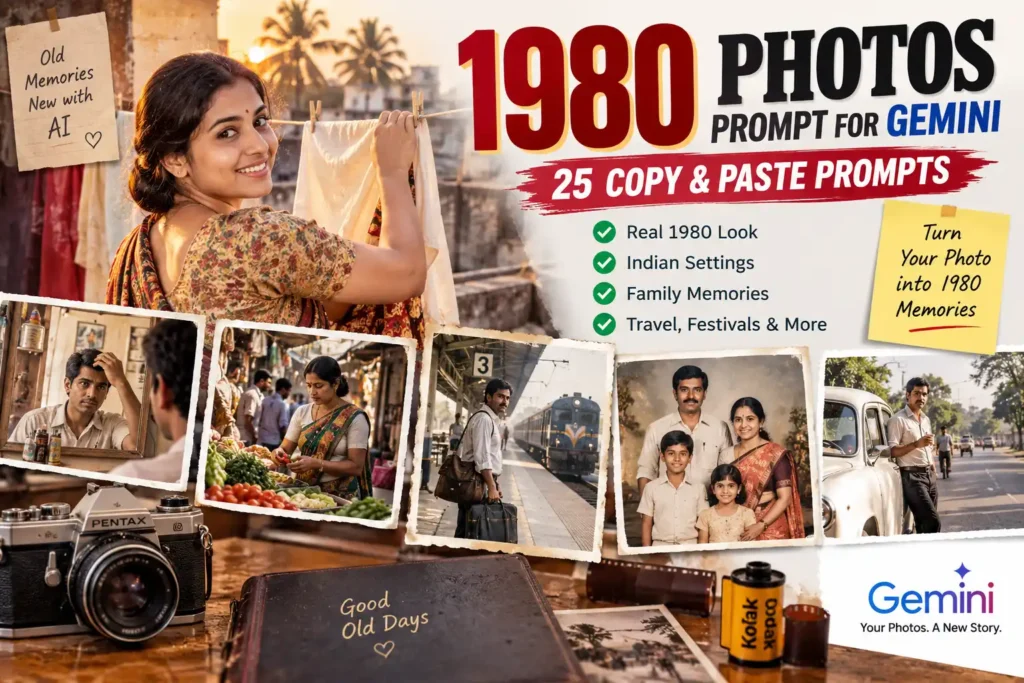
1. 1980 Indian Studio Portrait with Hand-Painted Backdrop
Use my uploaded photo as the exact facial identity reference. Preserve my recognizable face faithfully — facial structure, eyes, nose, lips, skin tone, natural age appearance, hairstyle compatibility, and important identifying characteristics must remain consistent. Do not replace my identity with a generic attractive model.Transform me into an authentic Indian studio portrait photographed around 1980.
Dress me in realistic Indian clothing appropriate to my gender and natural age shown in the uploaded photo. For a woman, use a graceful period-correct saree with a modest blouse, simple gold-toned earrings, thin bangles, a small bindi, and naturally styled hair. For a man, use a neatly pressed light-colored collared shirt with period-correct trousers, simple grooming, and an understated wristwatch. Do not exaggerate the retro styling.
Place me inside a modest neighborhood photography studio with a slightly faded hand-painted scenic backdrop showing soft trees, distant hills, and painted clouds. Include a patterned curtain pushed partly to one side, a simple wooden stool, terrazzo or worn mosaic flooring, and subtle signs of a working local studio rather than a luxury set.
Instead of a modern fashion pose, show me sitting slightly angled on the stool with both hands resting naturally, looking just beside the camera as though the photographer has asked me to remain still for one final exposure. Keep the expression calm, slightly serious, and believable for a formal family photograph of that period.
Use soft frontal studio illumination from a large diffused tungsten source with gentle fill, creating natural facial shadows rather than modern beauty lighting. Simulate a professionally printed 1980 color photograph with slightly warm skin tones, restrained saturation, mild film grain, subtle print softness, and realistic highlight roll-off.
PERIOD LOCK: Everything visible must plausibly belong to an Indian photography studio around 1980. No smartphones, LED lights, digital cameras, modern fashion, contemporary furniture, current accessories, or modern photographic equipment.
Natural skin pores, realistic hair strands, correct hands and fingers, believable fabric folds, authentic body proportions, no plastic skin, no text, no watermark. The final image must look like a genuine 1980 Indian studio photograph preserved carefully inside an old family album, not a modern portrait with a vintage filter.
2. 1980 Indian Family House Veranda Photo
Use my uploaded photograph as the strict facial identity reference. Keep my real recognizable face, facial proportions, eyes, nose, lips, skin tone, natural age, hairline, and distinctive characteristics unchanged.Recreate me in an authentic Indian home photograph taken around 1980 on the veranda of a modest family house.
Dress me in simple period-appropriate Indian everyday clothing suitable for my gender and age. Avoid glamorous styling. Clothing should have realistic cotton texture, slightly imperfect ironing, natural folds, and the practical appearance of something genuinely worn at home.
Place me beside an old wooden pillar on a shaded veranda with a red-oxide or worn cement floor. Include a cane chair, an old folded newspaper resting on its arm, a stainless-steel tumbler, a pair of ordinary slippers near the doorway, a cloth bag hanging from a wooden hook, and a partially open wooden door revealing a dim interior. Add believable greenery outside such as hibiscus, curry-leaf plants, coconut foliage, or other regionally plausible household plants.
Capture an unplanned moment rather than a formal pose. I have just stepped outside after hearing someone arrive at the gate and am looking toward that person outside the frame. One hand rests lightly against the wooden pillar while my body is still angled toward the doorway, creating the feeling that the photograph interrupted an ordinary morning.
Compose from courtyard level using the perspective of a 35mm family camera. Allow a few foreground leaves to partially frame one edge of the image. Bright outdoor daylight should bounce from the courtyard into the shaded veranda and softly illuminate my face while the interior behind remains naturally darker.
PERIOD LOCK: India around 1980. No modern plastic chairs, smartphones, CCTV cameras, LED fixtures, contemporary footwear, modern vehicles, satellite dishes, current packaging, or present-day home décor.
Give the image authentic consumer-film characteristics: slightly muted colors, gentle grain, imperfect white balance, realistic skin texture, natural shadows, modest dynamic range, and slight print aging. It should feel like a real photograph someone found between the pages of an old family album.
3. 1980 Black Roadster Bicycle Street Memory
Use my uploaded photo as the exact facial identity source. Preserve my recognizable face, skin tone, natural age, facial anatomy, eyes, nose, lips, hairstyle characteristics, and all important identifying details. Do not transform me into a generic retro model.Create a candid Indian street photograph set precisely around 1980 featuring me with a classic black roadster bicycle.
Dress me in practical period-correct Indian clothing appropriate to my gender and age rather than a costume. Use authentic early-1980 styling, fabrics, footwear, grooming, and accessories.
Show me walking the bicycle slowly rather than riding it, having just stopped near a tiny neighborhood shop after purchasing something. A small brown-paper parcel or cloth shopping bag hangs naturally from the bicycle handlebar while one hand holds the handle and the other adjusts the parcel before continuing home.
Build a believable 1980 Indian street around me: weathered plaster houses, wooden doors, tiled roofs where regionally suitable, hand-painted shop boards kept too distant for readable generated text, glass jars inside a small provision shop, a manually operated weighing scale, stacked metal containers, an old road sign, another roadster bicycle parked against a wall, and one or two period-appropriate pedestrians farther away.
Compose from across the narrow road at roughly waist height with a natural 50mm documentary perspective. Do not make me stare at the camera. Capture the exact instant I notice somebody familiar farther down the street and begin to react.
Use soft late-afternoon sunlight filtered between buildings, with one sunlit wall acting as natural reflected fill onto my face. Add gentle wheel and background motion only where physically appropriate.
PERIOD LOCK: India, approximately 1980. No motorcycles or cars introduced much later, smartphones, helmets of modern design, LED signage, modern storefronts, contemporary packaging, QR codes, plastic advertising banners, modern streetlights, or present-day fashion.
Maintain realistic bicycle geometry, correct wheel spokes, accurate hands gripping the handlebar, believable fabric folds, natural skin pores, subtle film grain, slightly faded color-negative rendering, and ordinary family-photo imperfection. The result should look like an accidentally beautiful street photograph from 1980 rather than a retro-themed photoshoot.
4. 1980 Indian Train Window Journey Photograph
Use my uploaded photograph as the exact identity reference. Preserve my real face accurately, including facial structure, eyes, nose, lips, skin tone, natural age, hairstyle characteristics, and recognizable individual features. Do not de-age me unless the uploaded reference itself shows a younger person.Recreate me during an authentic Indian train journey around 1980.
Place me beside an open barred train window inside a period-correct non-air-conditioned railway compartment. Dress me in believable travel clothing from that era appropriate to my gender and age, with practical styling rather than glamorous retro fashion.
Capture a quiet journey moment: I am seated beside the window holding a small stainless-steel tumbler or simple paper-wrapped snack while looking outside at the passing landscape. A folded cloth travel bag rests nearby, and the edge of an old newspaper is visible beside me. My expression should suggest that I have become absorbed in something outside rather than intentionally posing.
Outside the window show blurred green fields, scattered palm trees, utility poles of the period, and a distant rural station structure passing naturally. Inside include worn vinyl or period-correct bench seating, metal luggage racks, a simple suitcase or holdall, barred windows, ceiling fans appropriate to older railway coaches, and a few indistinct passengers farther down the compartment.
Compose from the opposite seat using a 50mm perspective. Focus primarily on my face and the hand nearest the window while the passing landscape receives natural horizontal motion blur. Strong daylight enters through the window from one side and gradually falls into the darker compartment, producing physically believable exposure.
PERIOD LOCK: Indian railway environment around 1980. No smartphones, modern backpacks, laptops, earbuds, contemporary plastic water bottles, LED coach displays, modern railway interiors, modern luggage, charging sockets, or present-day clothing.
Use realistic window-bar shadows, natural skin texture, accurate hands, correct reflections, believable train wear, gentle analog grain, restrained color saturation, and slight exposure imperfections. Make the final result resemble a genuine travel photograph from 1980 that has survived for decades in a family collection.
5. 1980 Indian Cinema Queue Evening Photo
Use my uploaded image as the exact facial identity reference. Preserve my recognizable face, facial proportions, natural age, skin tone, eyes, nose, lips, hair characteristics, and distinctive identity. Never substitute a generic model.Create a realistic Indian evening photograph outside a busy single-screen cinema around 1980.
Dress me in authentic going-out clothing appropriate to my gender and age in 1980 India. Keep the appearance neat but believable for an ordinary person going to see a film, not a modern retro-fashion interpretation.
Capture me shortly before the show while standing near the cinema entrance holding two small paper tickets. I have just turned away from the ticket counter because I am searching the arriving crowd for the person who is supposed to join me. My eyes should be directed beyond the camera and my expression should combine anticipation with mild concern rather than a posed smile.
Create a richly believable background: weathered cinema façade, portions of huge hand-painted movie artwork, tungsten bulbs around the entrance, metal queue railings, a small snack stall, glass soda bottles in wooden crates, old bicycles parked nearby, paper notices on walls, and naturally dressed moviegoers moving through the scene. Avoid requiring any generated text to be readable.
Use a slightly low 35mm street-photography perspective, allowing the cinema façade and painted poster artwork to rise behind me. Warm tungsten bulbs from the entrance should mix naturally with the remaining cool-blue evening light outside. Let moving people farther behind show subtle motion blur while my face and tickets remain sharp.
PERIOD LOCK: Indian single-screen cinema around 1980. No multiplex architecture, digital posters, LED displays, smartphones, modern branding, contemporary drink bottles, modern motorcycles, current hairstyles, or present-day fashion.
Add realistic 35mm film grain, mild mixed-light color cast, natural skin texture, correct fingers holding the tickets, slightly imperfect focus toward frame edges, and believable shadow depth. The image should feel like a rare candid photograph captured before a movie night in 1980.
6. 1980 South Indian Village Tea Stall Photograph
Use my uploaded photo as the exact facial identity reference. Preserve my real recognizable face, facial structure, eyes, nose, lips, skin tone, natural age appearance, hair characteristics, and distinctive details. Do not replace me with another person.Transform me into an authentic candid photograph taken at a small South Indian roadside tea stall around 1980.
Dress me in modest period-correct everyday clothing appropriate to my gender and age. Keep fabrics, tailoring, hairstyle, footwear, jewellery if appropriate, and accessories historically plausible and understated.
Show me sitting sideways on a simple wooden bench outside the tea stall with a small glass or stainless-steel tumbler of hot tea in one hand. Capture the instant I pause before taking another sip because the shopkeeper or someone outside the frame has said something amusing. The expression should be a restrained spontaneous smile rather than a camera-ready pose.
Build the tea stall with believable working details: blackened metal kettle producing real steam, glass tumblers, biscuit jars, simple wooden shelves, hanging banana bunches if locally plausible, an old transistor radio, newspaper sheets, a small cash box, weathered timber, a roadster bicycle leaning nearby, and an uneven roadside with dust and scattered leaves.
Frame the scene from inside the darker tea shop looking outward so shelves and a kettle become soft foreground layers. Use approximately a 35mm perspective. Bright overcast or late-afternoon daylight outside should illuminate my face, while one warm tungsten bulb inside creates a subtle secondary glow.
PERIOD LOCK: South India around 1980. No plastic disposable cups, modern snack packets, smartphones, LED lights, QR payment signs, contemporary refrigerators, modern motorcycles, digital advertising, or present-day furniture.
Render steam realistically, preserve correct glass reflections, natural skin pores, anatomically accurate fingers, believable clothing wrinkles, gentle analog grain, muted earthy colors, and the imperfect composition of documentary photography. The finished image should feel like a small piece of everyday 1980 life, not a designed vintage set.
7. 1980 Indian Wedding House Behind-the-Scenes Memory
Use my uploaded photograph as the strict identity reference. Keep my recognizable facial identity, natural age, skin tone, facial proportions, eyes, nose, lips, hairline, and individual characteristics faithful to the original. Do not automatically make me young or transform me into a bride or groom unless that relationship is evident in the uploaded reference.Create an authentic Indian wedding-house photograph from around 1980, focusing on a candid family moment away from the main ceremony.
Dress me in culturally appropriate festive clothing suitable for my gender, natural age, and role as a family member attending the wedding. Use historically plausible textiles, tailoring, jewellery, grooming, and hairstyle without excessive modern wedding glamour.
Place me in the side courtyard or back veranda where relatives are preparing items for the function. Capture me midway through helping: perhaps carrying a stack of banana leaves, arranging flowers, holding a stainless-steel vessel, or passing something to a relative just outside the frame. At that exact moment somebody says something funny and I begin trying not to laugh.
Show realistic wedding-house activity behind me: large cooking vessels, flower garlands being assembled, banana leaves, brass and stainless-steel utensils, folded cotton towels, wooden doors, relatives working naturally, simple festive decorations, and only a distant glimpse of the ceremony area.
Use foreground framing through hanging flower strands or the edge of a doorway. Photograph with a 35mm documentary perspective. Daylight from the courtyard should be the dominant light, mixed gently with warm incandescent interior bulbs.
PERIOD LOCK: Indian wedding around 1980. No LED decoration, smartphones, digital cameras, disposable modern catering products, contemporary wedding stages, modern plastic water bottles, current designer fashions, or excessive present-day jewellery styling.
Preserve distinct faces for every visible person, natural relationships, correct hands, realistic metal reflections, believable flower texture, fabric weight, mild perspiration appropriate to the busy environment, analog film grain, and imperfect family-photo framing. The final image should feel like an overlooked photograph from a real 1980 wedding album.
8. 1980 Indian Monsoon Bus Stop Photograph
Use my uploaded photo as the exact facial identity anchor. Preserve my real recognizable face, natural age, skin tone, facial structure, eyes, nose, lips, hair characteristics, and identifying features. Do not create a generic young model.Create a realistic Indian monsoon photograph set around 1980 at a small roadside bus shelter.
Dress me in practical period-correct Indian clothing suitable for my gender and age, slightly affected by humid rainy weather but not unrealistically soaked. Use an old-fashioned umbrella or cloth bag only if appropriate to the scene.
Show me standing beneath the shelter after a sudden downpour has become heavier. Instead of posing, capture me leaning slightly forward and looking down the road to see whether the expected bus is finally approaching. One hand holds a folded newspaper, cloth bag, or umbrella while a few drops blown by the wind have reached the edge of my clothing.
Create a believable environment with an aged concrete or tiled bus shelter, wet road, muddy shoulder, rainwater flowing through shallow roadside channels, old utility poles, lush vegetation, one roadster bicycle sheltered against the wall, and a distant period-correct bus barely emerging through the rain.
Compose from the opposite end of the shelter with a 50mm perspective. Let the roof and bench create leading lines toward me. The open rainy landscape should provide cool soft illumination while the shelter interior remains naturally darker. Reflections on the wet road must correspond physically to the sky and nearby objects.
PERIOD LOCK: India around 1980. No smartphones, modern buses, contemporary advertisements, plastic raincoats of obviously recent design, LED route displays, current road markings where inappropriate, modern vehicles, or present-day clothing.
Use realistic rain streaks, damp hair behavior, natural skin, accurate hands, believable wet-fabric weight, physically correct puddles and reflections, subtle film grain, low-contrast monsoon colors, and mild atmospheric haze. Do not turn the scene into a glamorous rain photoshoot. It should resemble an extraordinary frame captured during an otherwise ordinary 1980 journey.
9. 1980 Indian Home Radio Listening Moment
Use my uploaded photograph as the exact identity reference. Preserve my recognizable face, facial geometry, eyes, nose, lips, skin tone, natural age, hair characteristics, and unique identifying details. Keep me unmistakably the same person.Recreate a quiet Indian home moment around 1980 centered around listening to a transistor radio.
Dress me in simple period-appropriate home clothing suitable for my gender and age. Avoid polished fashion styling; the scene should feel private, comfortable, and lived-in.
Place me beside an open wooden window or on the floor near a low table during an early evening. An authentic portable transistor radio sits nearby. Capture the moment I stop what I am doing because a familiar song, important announcement, cricket commentary, or unexpected voice has just begun on the radio. My attention should be directed toward the radio, with a subtle expression of recognition rather than toward the camera.
Build a modest household environment: woven mat, wooden furniture, stainless-steel tumbler, folded newspaper, old spectacles if age-appropriate, simple wall clock, fabric curtains, a ceiling fan, wooden cupboard, and a partially completed household activity such as folded clothes, flower sorting, or handwritten notes. Keep generated writing visually unimportant.
Use a 50mm intimate photographic perspective from slightly behind another household object so the scene feels observed rather than staged. Warm evening daylight should enter through the window and strike part of my face, while a tungsten bulb deeper in the room produces a gentle warm background.
PERIOD LOCK: Indian home around 1980. No television models from later decades, smartphones, digital clocks, LED bulbs, remote controls, modern appliances, contemporary furniture, Wi-Fi devices, or current packaging.
Accurately render the transistor radio, natural hand anatomy, realistic skin pores, believable household wear, physically correct shadows, restrained film grain, warm color-negative response, and slight softness typical of an enlarged family print. Make it feel as though the photograph preserved a small moment whose emotional importance became clear only years later.
10. 1980 Indian Rooftop Clothesline Sunset Memory
Use my uploaded photo as the exact facial identity reference. Preserve my recognizable face, natural age, facial structure, eyes, nose, lips, skin tone, hair characteristics, and important identifying details. Do not replace my identity with a generic retro model or automatically make me younger.Recreate me in an authentic Indian rooftop photograph taken around 1980 during the final minutes of evening sunlight.
Dress me in simple period-correct Indian home clothing appropriate to my gender and natural age shown in the uploaded reference. Keep the styling ordinary and believable rather than fashionable or glamorous. Use realistic cotton fabric, slightly imperfect folds, period-appropriate hairstyle, footwear, jewellery, and accessories only where naturally suitable.
Create a story rather than a pose. I have come to the rooftop to collect dry clothes before evening. A few garments have already been folded over one arm while I reach toward the clothesline for the final piece. At that exact moment, someone from a neighboring terrace calls out to me, causing me to turn halfway toward the voice with a spontaneous expression of recognition.
Surround me with a believable 1980 Indian residential rooftop: weathered limewashed parapet walls, old wooden clothespins, cotton sarees, shirts and towels hanging unevenly on a simple clothesline, a galvanized or steel bucket near the stairway entrance, a small woven basket containing folded clothes, neighboring tiled and flat-roof houses, television antennas appropriate to the period, coconut trees rising between buildings, and distant birds returning home.
Use the hanging clothes as natural foreground layers instead of placing me directly in the center. Photograph from approximately waist height with a 35mm perspective so one softly out-of-focus garment partially enters the foreground while my face remains clearly visible farther into the frame.
The low evening sun should enter from behind the neighboring buildings and illuminate only the edges of some clothes, my hair, and one shoulder. Reflected warm light from a pale rooftop wall should naturally expose my face. Do not create artificial golden glow across the entire image. Allow different garments to respond differently to the breeze, with believable cloth weight and movement.
PERIOD LOCK: Everything visible must plausibly belong to an Indian residential neighborhood around 1980. No smartphones, satellite dishes, modern solar panels, contemporary plastic water tanks, LED fixtures, CCTV cameras, modern high-rise skylines, current fashion, present-day vehicles, or recent household products.
Preserve natural skin pores, individual hair strands, anatomically correct hands and fingers, realistic cloth physics, physically believable shadows, accurate perspective, and subtle environmental wear. Add restrained 35mm consumer-film grain, slightly faded warm colors, mild highlight softness, and the imperfect framing of a photograph taken quickly by a family member.
The final image should feel like an ordinary evening from 1980 that accidentally became a beautiful family memory, not a modern golden-hour photoshoot with a vintage filter.
11. 1980 Indian Barber Shop Mirror Portrait
Use my uploaded photo as the exact facial identity reference. Preserve my recognizable face, facial structure, eyes, nose, lips, skin tone, natural age appearance, hairline, and important identifying characteristics. Do not replace my identity with a generic model or artificially make me younger.Recreate me inside an authentic neighborhood Indian barber shop around 1980.
Dress me in believable period-correct everyday clothing appropriate to my gender and natural age. If the grooming activity shown would not naturally suit the person in the uploaded photo, adapt it into a simple hair-combing, trimming, or getting-ready moment without changing my identity or gender.
Create the photograph mainly through the large rectangular barber-shop mirror. I am seated in an old barber chair while the barber has momentarily stepped aside to pick up a tool. Instead of posing, capture me examining the freshly adjusted hairstyle in the mirror, touching one small section of hair with a natural expression of curiosity or quiet satisfaction.
Build a genuinely working 1980 barber shop around the reflection: aged mirror edges, wooden counter, traditional combs, metal scissors, shaving brush and mug where appropriate, glass bottles, folded cotton towels, manual grooming tools, an old wall calendar whose writing does not need to be readable, a slowly rotating ceiling fan, wooden shelves, and a partially open shopfront revealing the street outside.
Use a layered mirror composition. Part of my real shoulder or the back of the chair may appear softly in the foreground while my reflected face remains the primary focus. Keep the reflection geometrically correct with no duplicated face, impossible hands, reversed inconsistencies, or extra people.
Natural daylight from the open storefront should provide the main illumination, while a simple warm bulb near the mirror creates subtle secondary warmth. Do not use modern beauty lighting.
PERIOD LOCK: Indian neighborhood barber shop around 1980. No electric trimmers of obviously modern design, LED mirror strips, smartphones, modern salon chairs, contemporary cosmetics, current posters, QR codes, modern hair products, or luxury salon interiors.
Preserve natural skin texture, realistic hair strands, accurate hands, believable mirror reflections, subtle shop wear, gentle film grain, restrained color saturation, and slight analog softness. The final result should resemble a fascinating candid photograph from a real 1980 neighborhood rather than a styled vintage fashion shoot.
12. 1980 Indian Market Shopping Morning
Use my uploaded photograph as the exact facial identity source. Keep my recognizable face, eyes, nose, lips, facial proportions, natural skin tone, age appearance, hairstyle characteristics, and distinctive features faithful to the reference.Transform me into an authentic candid photograph taken inside a busy Indian vegetable market around 1980.
Dress me in simple, practical, period-correct clothing appropriate to my gender and age. Avoid glamorous styling. The clothing should look naturally worn during an ordinary morning shopping trip.
Show me beside a vegetable vendor while holding an old cloth shopping bag or woven basket. Capture the instant I inspect a vegetable in one hand while the vendor is weighing another purchase on a traditional balance scale. My attention should remain on the purchase rather than the camera.
Create a richly detailed but believable market: vegetables arranged in woven baskets and wooden crates rather than perfect modern displays, banana leaves, sacks, old balance scales with metal weights, weathered shop shutters, hanging produce, bicycles outside, uneven stone or packed-earth flooring where plausible, and naturally moving shoppers in authentic period clothing.
Use an environmental 35mm documentary perspective from slightly behind another vegetable stall. Let a basket or hanging produce become a soft foreground frame while I remain clearly visible deeper in the scene.
Morning sunlight should enter from openings between market roofs, creating irregular patches of illumination on produce and floor. Reflected light from the surroundings should expose my face naturally without artificial glow.
PERIOD LOCK: Indian market around 1980. No smartphones, QR payment signs, modern digital weighing scales, contemporary plastic packaging, supermarket displays, LED lights, current branding, modern shopping bags, or recent vehicles.
Keep every visible person's face distinct. Render realistic vegetables with natural imperfections, correct hands and fingers, believable cloth texture, environmental dust, accurate shadows, moderate analog grain, slightly warm consumer-film colors, and documentary imperfection. Make the photograph feel like a real piece of everyday Indian life accidentally preserved on film.
13. 1980 Indian School Annual Day Backstage Photo
Use my uploaded photo as the exact facial identity reference. Preserve my recognizable face, facial anatomy, eyes, nose, lips, skin tone, natural age, hair characteristics, and identifying details. Respect the age shown in my uploaded reference.Create an authentic Indian school annual-day backstage photograph set around 1980.
If my uploaded photo shows a child or teenager, place me naturally as a student participant. If it shows an adult, portray me as a teacher, parent, organizer, or former student helping backstage. Never de-age an adult simply to fit the school setting.
Capture the hectic few minutes before a stage performance. I am standing beside a heavy cloth stage curtain while adjusting one final costume detail, holding a simple paper program, helping a child with a costume, or waiting for my cue depending on my natural age. Someone has just peeked through the curtain toward the audience, causing me to turn with a mixture of nervousness, excitement, and concentration.
Include believable backstage details: painted cardboard scenery, wooden props, rope lines, folded costumes, simple chairs, metal trunks, handwritten paper labels kept too small to require readable text, tungsten stage bulbs, curtain folds, and other participants waiting naturally rather than posing.
Compose from behind a partially opened curtain using a 35mm perspective. The curtain should create a dark foreground edge while a narrow glimpse of the brightly illuminated stage appears beyond. Warm stage light should spill sideways onto part of my face while the backstage area remains naturally dim.
PERIOD LOCK: Indian school function around 1980. No LED stage screens, wireless headsets, smartphones, digital projectors, modern plastic stage props, contemporary school uniforms, current sound equipment, or modern event lighting.
Maintain age-appropriate styling, natural skin texture, correct hands, realistic cloth and cardboard materials, distinct background faces, subtle high-speed film grain, slight tungsten color cast, and imperfect low-light exposure. The result should resemble an unexpectedly intimate photograph from an old school album rather than a modern retro production.
14. 1980 Indian Tailor Shop Fitting Memory
Use my uploaded photograph as the strict facial identity reference. Preserve my actual recognizable face, natural age, skin tone, eyes, nose, lips, facial proportions, hairstyle characteristics, and important identifying features. Do not replace me with a fashion model.Recreate me inside a small Indian tailoring shop around 1980 during a garment fitting.
Dress me in an authentic period-correct outfit suitable for my gender and age. The garment should appear newly stitched but not unrealistically luxurious.
Instead of a conventional portrait, capture the fitting through a tall slightly aged mirror. I am checking the length of a sleeve, adjusting a collar, straightening a saree blouse fit, examining a trouser hem, or making another gender-appropriate adjustment while the tailor stands partly outside the main frame holding a measuring tape.
Create a convincing working tailor shop: an old mechanical sewing machine, wooden table marked by years of use, large metal scissors, tailor's chalk, measuring tapes, thread spools, folded fabric stacks that are not perfectly aligned, paper patterns, cloth scraps on the floor, wooden stool, ceiling fan, and daylight entering from the open storefront.
Use a 50mm mirror composition where my reflected face is the focal point while part of my actual shoulder appears near one edge. Make every reflection physically correct. No duplicated body, extra hands, incorrect garment reflection, or mismatched face.
Street daylight reflected through the shopfront should illuminate the mirror and my face. A simple tungsten bulb deeper inside may add restrained warmth.
PERIOD LOCK: Indian tailoring shop around 1980. No computerized sewing machines, smartphones, LED lights, contemporary fashion posters, modern retail racks, digital payment signs, current accessories, or present-day interior design.
Render realistic fabric weight, stitching, hands, fingers, mirror imperfections, skin pores, hair strands, mechanical sewing-machine geometry, gentle analog grain, and slightly muted film color. The image should feel like a real fitting remembered because somebody happened to bring a camera that day.
15. 1980 Indian River Ferry Journey Photograph
Use my uploaded photo as the exact identity anchor. Preserve my recognizable face, natural age, facial structure, eyes, nose, lips, skin tone, hair characteristics, and distinctive personal features without converting me into a generic cinematic character.Create a realistic Indian river-ferry journey photographed around 1980.
Dress me in practical period-correct travel clothing appropriate to my gender, age, region, and weather. Keep the appearance ordinary and functional.
Place me aboard a simple passenger ferry or wooden river boat carrying local travelers across a broad Indian river. I am seated near the side with a cloth travel bag beside me. Capture the moment a strong river breeze suddenly catches part of my clothing or hair and I instinctively secure it with one hand while looking toward the approaching opposite bank.
Include period-plausible passengers carrying cloth bags, baskets, metal containers, or small luggage. Add worn wooden or painted-metal boat surfaces, rope coils, life-saving equipment appropriate to the vessel and era where historically plausible, distant palms or riverside houses, another small boat far away, and subtle wake behind the ferry.
Compose from near deck level using a 35mm environmental perspective. A rope or railing may cross the foreground diagonally to create depth without obscuring my face. Keep the horizon natural and boat geometry physically believable.
Use broad soft daylight reflected from the river surface. Allow subtle reflected light beneath the face and realistic highlights on moving water. Avoid dramatic artificial sunset unless physically appropriate.
PERIOD LOCK: India around 1980. No smartphones, modern speedboats, contemporary life jackets where historically inappropriate, plastic tourist furniture, modern luggage, current fashion, LED navigation equipment, or present-day waterfront architecture.
Render realistic water physics, boat wear, wind-driven fabric, accurate hands, natural skin texture, correct passenger proportions, atmospheric distance, subtle 35mm grain, restrained colors, and documentary framing. The photograph should feel like a genuine journey remembered through one surviving frame.
16. 1980 Indian Kitchen Morning Filter Coffee Moment
Use my uploaded photograph as the exact facial identity reference. Preserve my real recognizable face, skin tone, natural age, facial structure, eyes, nose, lips, hairstyle characteristics, and distinguishing features. Do not make me younger or replace my face.Create an intimate South Indian home-kitchen photograph set around 1980 during an ordinary early morning.
Dress me in simple home clothing appropriate to my gender and natural age, using believable period-correct cotton fabric and modest styling.
Capture me preparing or receiving traditional filter coffee. If appropriate to my age and role, show me carefully transferring hot coffee between a stainless-steel tumbler and dabarah, or holding the freshly prepared coffee while listening to somebody speaking from the next room. Do not exaggerate the pouring height or turn it into a staged demonstration.
Build an authentic lived-in kitchen: stainless-steel and brass vessels, traditional coffee filter, old wooden shelves, spice containers of the era, stone or period-correct counter surfaces, cotton kitchen towel, simple stove appropriate to the household and period, a barred window, and evidence that breakfast preparation has already begun.
Photograph through the kitchen doorway with a natural 50mm perspective. Let one hanging utensil or doorframe create a soft foreground layer. Morning sunlight should enter through the small window and illuminate steam from the coffee while reflected light keeps my face naturally visible.
The steam should behave physically, becoming visible mainly where it crosses the light. Metal vessels must show believable reflections rather than mirror-like AI distortions.
PERIOD LOCK: South Indian household around 1980. No induction cooktop, microwave, modern modular cabinets, smartphones, LED lights, contemporary coffee machines, plastic packaged products, digital appliances, or current kitchen décor.
Preserve realistic skin, correct hands, accurate stainless-steel geometry, natural steam, believable fabric folds, household wear, gentle analog grain, warm film response, and subtle exposure imperfections. Make the final image resemble a deeply familiar family photograph rather than a commercial coffee advertisement.
17. 1980 Indian Village Festival Ferris Wheel Night
Use my uploaded photo as the exact facial identity source. Preserve my recognizable face, facial proportions, eyes, nose, lips, skin tone, natural age, hair characteristics, and identifying details. Keep me clearly the same person.Create a vibrant but realistic Indian village or small-town festival photograph around 1980 at the beginning of night.
Dress me in authentic festive clothing appropriate to my gender and age without making the styling excessively luxurious. Use period-correct textiles, hairstyle, jewellery where appropriate, and footwear.
Place me near a manually operated or period-appropriate small fairground Ferris wheel, but do not create a conventional centered portrait. Capture the instant I have just stepped away from a game or snack stall and turn because the Ferris wheel starts moving behind me. I may be holding a small paper-wrapped snack, simple toy, flower, or other culturally plausible fair item depending on my age.
Create an authentic fair environment with hand-painted wooden stalls, incandescent bulbs strung overhead, simple mechanical rides, cloth canopies, families walking naturally, period clothing, dusty ground, food vendors, balloons of plausible design, and distant temple or village architecture only if appropriate to the setting.
Use a slightly low 35mm perspective. Keep my face relatively sharp while the moving Ferris wheel behind creates a small amount of natural motion blur. Warm incandescent bulbs should illuminate parts of the scene while the remaining deep-blue evening sky provides cool ambient fill.
Do not turn the fair into a modern carnival with neon spectacle.
PERIOD LOCK: India around 1980. No LED strips, smartphones, modern amusement rides, digital signage, contemporary plastic merchandise, current fashion, modern sound systems, or present-day branding.
Maintain natural low-light skin tones, correct fingers, realistic bulbs, physically plausible ride structure, distinct background people, modest high-speed-film grain, slight halation around bright bulbs, and authentic shadow density. The final image should feel like an exciting 1980 fair memory captured on a family camera.
18. 1980 Indian Post Office Letter Moment
Use my uploaded photograph as the exact facial identity reference. Preserve my recognizable face, natural age, skin tone, eyes, nose, lips, facial structure, hairstyle characteristics, and distinctive features. Do not change my identity.Recreate me inside or immediately outside an Indian post office around 1980 during a meaningful but understated everyday moment.
Dress me in realistic period-correct clothing appropriate to my gender and age. Avoid costume-like retro styling.
Show me holding a recently received inland letter, envelope, postcard, or postal document. Instead of posing with it, capture the exact moment I recognize the sender's handwriting or understand who the letter is from. My eyes remain on the paper while my expression changes subtly — surprise, relief, curiosity, restrained happiness, or quiet concern rather than exaggerated drama.
Build an authentic postal environment: weathered wooden counter, pigeonhole sorting shelves, ink pads, rubber stamps, twine, paper forms, old weighing scale, metal grille, wooden benches, canvas mailbags, ceiling fan, and postal notices whose text remains too distant to become an AI-generated focal point.
Use a 50mm observational perspective from slightly behind one side of the counter or doorway. A postal worker may appear softly in the background continuing ordinary work.
Daylight from a high window or open entrance should fall across the letter and one side of my face. Interior tungsten light can remain dim and warm, producing believable mixed exposure.
PERIOD LOCK: Indian post office around 1980. No computers, smartphones, barcode scanners, digital displays, modern courier packaging, QR codes, contemporary office chairs, LED lights, or present-day postal equipment.
Render paper naturally with folds and handling marks, but do not generate prominent readable personal information. Preserve correct fingers gripping the letter, natural skin pores, realistic counter wear, analog film grain, slightly faded colors, and quiet documentary composition. Make the image feel as though the viewer has discovered one frame from a larger personal story.
19. 1980 Indian Monsoon Courtyard Laundry Rescue
Use my uploaded photo as the strict identity reference. Preserve my exact recognizable face, natural age, facial structure, eyes, nose, lips, skin tone, hair characteristics, and distinguishing features. Never replace me with a generic model.Create a spontaneous Indian home photograph around 1980 during the first sudden minutes of a monsoon shower.
Dress me in ordinary period-correct home clothing appropriate to my gender and age. Keep the outfit practical, modest, and naturally affected by the weather.
The scene begins after rain unexpectedly starts while clothes are drying in an open courtyard. Capture me moving quickly across the courtyard gathering clothes from a low clothesline. Several dry garments are already bundled imperfectly against my body while I reach for one final piece and begin laughing or reacting because the rain has suddenly become heavier.
Do not make this a romantic rain portrait. The appeal should come from recognizable everyday chaos.
Build a believable home courtyard with red-oxide, stone, or worn cement flooring, traditional drain channel, wooden doors and windows, metal bucket, simple clothesline, cotton garments, tiled roof edge where appropriate, potted household plants, and rainwater beginning to spill from the roof.
Photograph from beneath the sheltered veranda with a 35mm perspective so the darker roof edge creates a foreground frame. Keep my face sharp enough to recognize while one moving garment and rain receive slight motion blur.
Soft grey daylight from the overcast sky should illuminate the courtyard. Reflected light from wet walls and floor should naturally brighten the lower shadows. Avoid fake face glow.
PERIOD LOCK: Indian home around 1980. No modern washing machines visible, plastic laundry baskets of obviously recent design, smartphones, CCTV, LED lights, contemporary water tanks, modern synthetic décor, or present-day clothing.
Render wet footprints, increasingly darkened fabric where rain has reached it, correct water splashes, natural hair response, accurate hands and fingers, believable cloth weight, physically correct reflections, subdued monsoon colors, and gentle film grain. The final photograph should feel like an ordinary household mishap that became an unexpectedly joyful 1980 family memory.
20. 1980 Indian Photo Booth Family Fair Portrait
Use my uploaded photo as the exact facial identity reference. Preserve my real recognizable face, facial structure, natural age, skin tone, eyes, nose, lips, hair characteristics, and important identifying features without excessive beautification.Recreate a charming temporary portrait booth at an Indian exhibition, local fair, or community event around 1980.
Dress me in authentic period-correct outing clothes appropriate to my gender and age. Keep the styling believable for an ordinary person who unexpectedly decides to have a photograph taken while visiting the fair.
Place me inside a simple temporary photographer's booth containing a painted cloth backdrop with an idealized garden, decorative columns, distant hills, and soft painted clouds typical of inexpensive portrait photography of the era. Let the lower edge of the backdrop remain subtly visible rather than making the fake scenery appear like a real landscape.
Include a plain wooden chair, patterned floor mat, fabric curtain separating the booth from the fair, a small table containing the photographer's equipment, and a glimpse through the curtain opening of warm fairground bulbs and passing visitors outside.
Capture the slightly awkward but endearing instant immediately before the formal portrait. I have sat down and arranged myself for the camera, but somebody outside the booth unexpectedly calls my name. My eyes shift slightly toward the sound while the rest of my body remains in the photographer's carefully arranged pose. The resulting expression should feel spontaneous and personal rather than professionally modeled.
Compose the image as though photographed using a period-appropriate medium-format or 35mm portrait camera positioned on a tripod at chest height. Keep the framing slightly more generous than a modern portrait so the chair, painted backdrop, floor, and edges of the temporary booth remain visible.
Use a large diffused tungsten lamp positioned slightly above and beside the camera as the primary portrait light. Allow weak warm illumination from the fair outside to enter through the curtain gap. Shadows should remain soft but physically believable, without modern beauty-light perfection.
PERIOD LOCK: Indian exhibition or community fair around 1980. No digital cameras, smartphones, LED lights, modern photography umbrellas, contemporary plastic chairs, current fashion, modern amusement-park branding, QR codes, digital displays, or recent photographic equipment.
Preserve natural skin pores, realistic hair, correct hands and fingers, believable clothing folds, subtle imperfections in the painted cloth backdrop, realistic chair geometry, restrained analog grain, slightly warm color-negative rendering, and the mild softness of an old photographic print.
The final result should look like a genuine paid portrait somebody brought home from an Indian fair in 1980, with the temporary studio itself becoming part of the memory rather than a modern photograph artificially given a vintage filter.
21. 1980 Indian College Canteen Candid Photograph
Use my uploaded photograph as the exact facial identity reference. Preserve my recognizable face, facial proportions, eyes, nose, lips, skin tone, natural age, hairstyle characteristics, and distinctive features. Respect the age shown in my reference. If I am clearly older than college age, portray me naturally as a lecturer, staff member, visitor, or parent rather than artificially making me young.Create an authentic Indian college canteen photograph around 1980.
Dress me in plausible period-correct clothing appropriate to my gender, age, and role. Avoid exaggerated retro fashion and modern styling.
Capture an ordinary social moment rather than a posed portrait. I am seated at the edge of a long wooden table with a stainless-steel tumbler or glass of tea and a simple snack in front of me. Someone seated just outside the frame has apparently said something unexpected, and I have stopped midway through folding a newspaper, reaching for the tea, or opening a notebook to respond.
Build a genuinely used campus canteen: long wooden benches, worn tables with years of marks, stainless-steel tumblers, glass tea cups where appropriate, simple snack plates, an old wall clock, ceiling fans, large barred windows, handwritten menu boards kept too distant to require readable text, a service counter, students or staff in plausible 1980 attire, and bicycles visible through the open entrance.
Photograph from the opposite end of the same table using a 50mm documentary perspective. Let an abandoned tea glass or notebook become a softly blurred foreground element while my face remains the visual focus.
Strong daylight from the canteen windows should illuminate one side of my face. Interior shadows should remain slightly deep, reproducing the exposure limitations of consumer film rather than artificially balancing every part of the room.
PERIOD LOCK: Indian college environment around 1980. No laptops, smartphones, earbuds, modern backpacks, disposable coffee cups, contemporary beverage bottles, LED lighting, current campus furniture, digital menu boards, or modern clothing.
Maintain realistic skin texture, correct hands, natural social body language, believable food and utensils, distinct background faces, modest grain, slightly imperfect focus, and authentic color-negative character. Make the image feel like an unplanned campus photograph that later became personally important.
22. 1980 Indian Railway Station Luggage Waiting Moment
Use my uploaded photo as the exact facial identity anchor. Preserve my real recognizable face, natural age, skin tone, facial structure, eyes, nose, lips, hair characteristics, and important identifying features. Do not turn me into a generic traveler.Create an authentic Indian railway-station photograph set around 1980.
Dress me in practical period-correct travel clothing appropriate to my gender and age. Use historically plausible footwear, hairstyle, textiles, and accessories. Do not give me modern luggage or fashionable travel styling.
Place me on a railway platform beside a hard-sided suitcase, old holdall, or cloth travel bag. Instead of simply waiting on a bench, capture the instant a train begins arriving farther down the platform. I have just stood up or leaned forward slightly, one hand reaching instinctively toward the luggage while my attention moves toward the approaching train.
Create believable station details: old wooden or metal benches, analog station clock, period railway signs whose text does not need to be generated clearly, luggage carts, steel columns, old platform lamps, vendors with simple containers, passengers carrying trunks and cloth bags, and a period-correct locomotive or passenger coach approaching through light atmospheric haze.
Use a long environmental composition from slightly down the platform, approximately a 50–70mm perspective, allowing repeating roof supports to create strong depth. Position me away from the center so the eye travels from my luggage toward me and then toward the arriving train.
Daylight entering from the open track side should create directional illumination, while the roof keeps part of the platform in softer shade. Allow a faint amount of train movement without blurring my face.
PERIOD LOCK: Indian railway station around 1980. No LED information boards, smartphones, modern backpacks, wheeled trolley suitcases, contemporary bottled water, digital clocks, modern trains, charging stations, current advertisements, or recent platform furniture.
Render luggage wear, train geometry, metal surfaces, accurate hands, realistic skin, natural clothing folds, atmospheric platform dust, restrained film grain, and slightly faded colors. The photograph should feel like the beginning of a journey whose destination the viewer does not know.
23. 1980 Indian Photo with Ambassador Car Roadside Stop
Use my uploaded photograph as the strict facial identity reference. Preserve my recognizable face, natural age, skin tone, facial proportions, eyes, nose, lips, hairstyle characteristics, and distinctive personal features. Do not transform me into a modern fashion model.Create a realistic Indian road-trip photograph around 1980 featuring a period-correct Hindustan Ambassador-style car only if historically and geographically plausible.
Dress me in ordinary travel clothing appropriate to my gender and age in 1980. Keep the styling modest, practical, and naturally wrinkled from travelling.
Do not create a luxury-car pose. Instead, show the car stopped beside a quiet road because the travelers have paused for tea, directions, or a short rest. I am standing near an open passenger door holding a stainless-steel tumbler, folded road map, cloth bag, or small paper-wrapped snack while looking toward somebody speaking from outside the frame.
Make the vehicle look genuinely used: slight road dust around the lower body, period-correct steel wheels and hubcaps, believable glass reflections, simple interior upholstery, mechanical door handles, and luggage visible naturally through the window where appropriate.
Surround the scene with a plausible 1980 Indian roadside environment: mature trees, milestone or simple road marker without prominent generated lettering, modest tea stall in the distance, roadster bicycle, fields or low hills depending on the region, utility poles, and a road surface showing ordinary wear.
Compose from slightly behind the front corner of the car using a 35mm perspective, allowing the car body to create a strong foreground line leading toward me. Keep my face more important than the vehicle.
Use soft late-afternoon side light. The pale car body may bounce natural reflected light toward my face while tree shadows break irregularly across the road.
PERIOD LOCK: India around 1980. No modern cars, alloy wheels, LED lights, smartphones, GPS devices, contemporary highways, current road signage, plastic takeaway cups, modern petrol-station branding, or recent clothing.
Preserve accurate vehicle proportions, correct reflections, natural skin, anatomically correct hands, realistic road dust, believable fabric, mild analog grain, restrained saturation, and slight family-camera imperfection. The result must feel like a real roadside travel memory, not an automobile advertisement.
24. 1980 Indian Electricity-Cut Candlelight Home Photo
Use my uploaded photo as the exact facial identity reference. Preserve my recognizable face, natural age, facial structure, skin tone, eyes, nose, lips, hair characteristics, and important identifying details. Do not excessively smooth or beautify my face.Recreate an intimate Indian household photograph around 1980 during an unexpected evening electricity cut.
Dress me in comfortable period-correct home clothing suitable for my gender and natural age.
Place me at a simple table or on a floor mat after the lights have suddenly gone out. A candle, kerosene hurricane lamp, or period-appropriate emergency light source has just been lit. Capture the small moment immediately afterward: I am shielding the flame while adjusting its position, searching for something on the table, or looking toward another family member in the darkness.
Include believable household details revealed gradually by the weak light: stainless-steel tumbler, matchbox, folded newspaper, spectacles if age-appropriate, wooden furniture, wall clock, simple curtains, a switched-off ceiling fan, old radio, books or household items, and a dark doorway leading to another room.
Do not illuminate the entire house. Most of the background should disappear naturally into shadow.
Compose close enough for emotional intimacy using a 50mm perspective, with the practical flame placed off-center and slightly below face level. Allow the flame to illuminate the nearest side of my face and hands while a tiny amount of blue evening light enters from a barred window in the distance.
Keep flame exposure physically believable. Do not create magical orange glow around every object.
PERIOD LOCK: Indian home around 1980. No smartphones, LED emergency lamps, inverter displays, flat-screen televisions, modern appliances, contemporary furniture, digital clocks, or present-day packaging.
Render flame, glass, metal reflections, skin texture, eye highlights, hands, shadows, and low-light grain realistically. Slight underexposure and warm film color cast are desirable. The final photograph should feel like a quiet family moment preserved during a routine power cut, not a staged cinematic candle portrait.
25. 1980 Indian Family Album Sunday Afternoon Portrait
Use my uploaded photograph as the exact facial identity reference. Preserve my real recognizable face faithfully — facial structure, eyes, nose, lips, skin tone, natural age appearance, hair characteristics, and distinctive personal details must remain consistent. Do not replace me with an idealized retro model.Create the ultimate authentic Indian family-album photograph from a quiet Sunday afternoon around 1980.
Dress me in comfortable, neatly worn period-correct Indian clothing appropriate to my gender and age. The outfit should look like something chosen because a relative unexpectedly decided to take a photograph, not clothing prepared for a professional shoot.
Place me inside a modest family living room near an open wooden window. Instead of sitting perfectly for the camera, capture the seconds between formal photographs. I have just relaxed from the previous pose and am turning toward a family member who has said something from beside the photographer. My shoulders loosen, one hand remains resting on the chair, and a small genuine expression begins to appear before I can pose again.
Build the room from ordinary 1980 household details: cane or wooden chair, patterned fabric cushion, wooden cabinet, transistor radio, folded newspaper, wall clock, family photographs in simple frames kept visually small, embroidered or cotton curtain, terrazzo or red-oxide floor, stainless-steel tumbler on a side table, ceiling fan, and an open doorway revealing another naturally dim room.
Include one subtle clue that life was happening immediately before the photograph — a half-finished cup of tea, reading glasses resting on the newspaper, a partly folded piece of clothing, or another age-appropriate household activity. Keep the room organized but unmistakably lived in.
Compose from the height of a seated family photographer using the natural perspective of a 50mm lens. Do not center everything perfectly. Allow the window edge or nearby furniture to create slight asymmetry characteristic of real family photography.
Soft afternoon daylight should enter through the window and bounce from a pale wall onto my face. Interior tungsten light may contribute a faint warm tone farther behind, but natural daylight remains dominant.
PERIOD LOCK: Every visible element must plausibly belong to an Indian household around 1980. No smartphones, flat-screen TVs, LED bulbs, Wi-Fi devices, modern furniture, contemporary plastic décor, current fashion, digital clocks, recent appliances, or other objects from later decades.
Use authentic analog photographic character rather than a simple vintage filter: natural skin pores, individual hair strands, correct hands and fingers, realistic fabric folds, physically believable shadows, moderate consumer-film grain, restrained dynamic range, slightly warm and gently faded colors, subtle lens softness, and minor print-age characteristics without damaging facial clarity.
The final image should be so believable that it appears to have been genuinely photographed in 1980, printed at a neighborhood photo lab, placed inside a family album, and rediscovered more than four decades later. No text, no watermark, no fake AI glow, no plastic skin, no modern objects.
Some more you might like
1980s Indian Village Photo Prompts for Gemini – 20 Retro Looks
80s Retro Photo Prompts for Gemini – 25 Vintage Indian Styles
80s Family Photo Prompts for Gemini – 20 Indian Family Styles
80s Wedding Couple Photo Prompts for Gemini – 20 Retro Wedding Looks
80s Bollywood Photo Prompts for Gemini – 20 Indian Movie Looks
80s Romantic Couple Prompts for Gemini – 20 Love Photo Ideas
Copied!