Understanding the main goal of generative AI has become important for students, parents, educators, professionals, and policymakers in 2026. Generative Artificial Intelligence is no longer limited to research labs. It is now used in education, healthcare, design, science, media, and many everyday tools. However, many people misunderstand what generative AI is truly designed to achieve.
This guide explains what generative AI is, what is the main goal of generative AI, why it exists, how it should be used, when it is useful, and when it should be approached carefully. The explanation is simple, neutral, and factual so that anyone can understand it clearly.
What Is Generative AI (Simple Meaning)
Generative AI is a type of artificial intelligence designed to create new content rather than only analyze or classify existing data.
This content can include:
- Text
- Images
- Audio
- Video
- Code
- Data simulations
Unlike traditional AI systems that only predict or label outcomes, generative AI produces new outputs based on learned patterns.
📊 Main Goal of Generative AI – Quick Overview (2026)
| Key Point | Simple Explanation |
|---|---|
| Main Goal | To generate useful, meaningful, and context-aware content that supports human tasks. |
| How It Helps | Reduces repetitive work and assists with creation, learning, and problem exploration. |
| Human Role | Humans guide, review, and make final decisions on all outputs. |
| What It Is Not | Not a replacement for human judgment, responsibility, or ethical decision-making. |
| Best Use Areas | Education, research, creative work, data understanding, and productivity support. |
| Important Limitation | Outputs may contain errors and must always be verified by humans. |
Table of Contents
What Is the Main Goal of Generative AI?
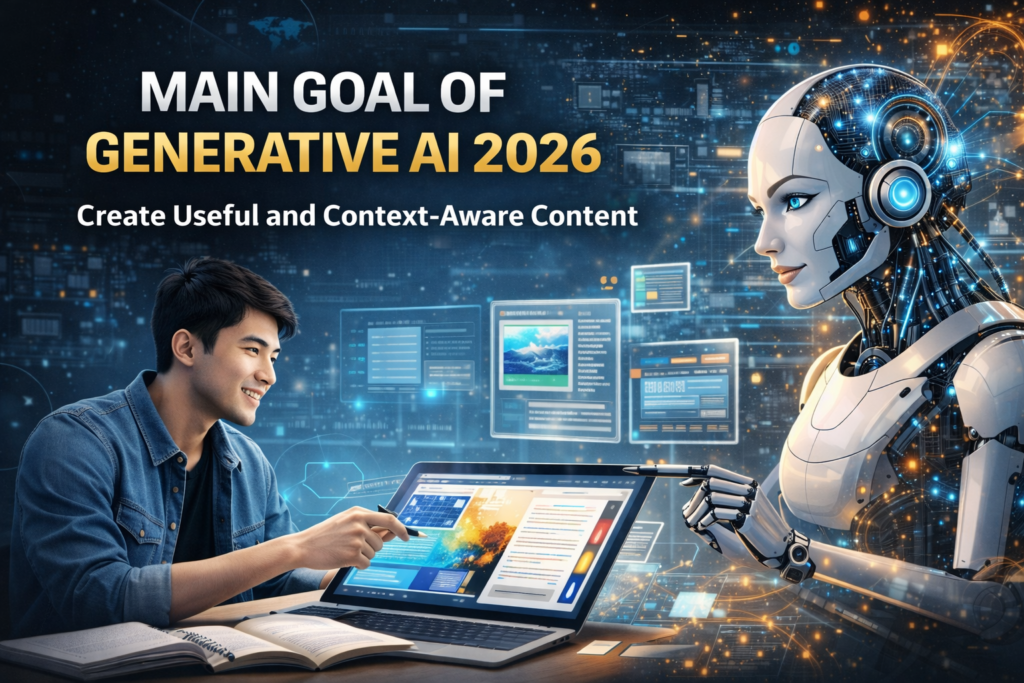
The main goal of generative AI is to generate useful, realistic, and context-aware content that supports human tasks, while reducing repetitive effort and expanding creative and analytical capabilities.
In simple words, generative AI aims to:
- Assist humans, not replace them
- Create meaningful outputs from existing knowledge
- Improve efficiency, creativity, and problem-solving
- Support learning, research, and innovation
Generative AI is a tool designed to augment human intelligence, not to act independently without oversight.
Why Generative AI Was Created
Generative AI was developed to address key limitations in traditional computing systems.
Traditional systems:
- Follow fixed rules
- Cannot create new ideas
- Depend heavily on manual input
Generative AI was created to:
- Learn patterns from large datasets
- Produce flexible and adaptive outputs
- Help humans handle complex information
- Reduce time spent on repetitive creation tasks
The goal was support, not automation without responsibility.
Core Objectives Behind Generative AI
1. Content Creation Support
One major objective is to help humans create drafts, ideas, and prototypes faster. This includes writing assistance, visual concepts, and structured outputs that humans can refine.
2. Knowledge Accessibility
Generative AI helps transform complex information into simpler explanations. This supports education, training, and skill development.
3. Problem Exploration
By generating multiple possibilities, generative AI helps researchers and professionals explore solutions more efficiently.
4. Human Productivity Enhancement
Generative AI is designed to reduce workload, not remove human decision-making. It handles repetitive parts so humans can focus on judgment and creativity.
What Generative AI Is Not Designed For
To understand the main goal clearly, it is important to know what generative AI is not meant to do.
Generative AI is not designed to:
- Replace human responsibility
- Make final legal or ethical decisions
- Act without human supervision
- Guarantee correctness in all outputs
Its purpose is assistance, not authority.
How Generative AI Achieves Its Goal
Generative AI systems are trained on large datasets to identify relationships between inputs and outputs. Using this learning, they can generate new content that follows similar patterns.
However, the goal is not originality for its own sake, but usefulness, clarity, and relevance within a given context.
Main Goal of Generative AI in Education
In education, the main goal of generative AI is to:
- Support personalized learning
- Explain difficult topics clearly
- Provide practice materials
- Assist teachers in preparation
It is not intended to replace learning effort or academic integrity. Human understanding remains essential.
Main Goal of Generative AI in Healthcare
In healthcare, generative AI aims to:
- Assist medical documentation
- Support research simulations
- Improve patient communication
- Analyze complex data patterns
It does not replace medical professionals or clinical judgment.
Main Goal of Generative AI in Research and Science
For research, generative AI helps by:
- Exploring hypotheses
- Simulating scenarios
- Summarizing large datasets
- Supporting early-stage experimentation
The goal is faster exploration, not final conclusions.
Main Goal of Generative AI in Creative Fields
In creative work, generative AI:
- Helps generate ideas
- Supports design drafts
- Assists in visualization
- Reduces repetitive manual work
Human creativity, taste, and values remain central.
Ethical Purpose of Generative AI
A critical part of the main goal of generative AI is ethical and responsible use.
This includes:
- Avoiding harmful outputs
- Respecting privacy
- Preventing misinformation
- Supporting fairness and transparency
Generative AI is designed to work within ethical boundaries, not outside them.
Benefits When Used as Intended
When aligned with its core goal, generative AI offers:
- Time efficiency
- Better accessibility to knowledge
- Enhanced creativity
- Improved decision support
- Wider learning opportunities
These benefits appear only when humans remain actively involved.
Risks When the Goal Is Misunderstood
Problems arise when generative AI is treated as:
- A replacement for thinking
- A source of absolute truth
- An independent authority
Misuse leads to:
- Over-reliance
- Reduced critical thinking
- Ethical concerns
- Incorrect decisions
Understanding the true goal prevents misuse.
When Generative AI Should Be Used
Use generative AI when:
- You need help drafting or exploring ideas
- You want simplified explanations
- You are handling large information volumes
- You plan to review and refine outputs
When Generative AI Should Be Avoided
Avoid generative AI when:
- Decisions require absolute accuracy
- Ethical judgment is critical
- Human empathy is essential
- Independent verification is not possible
Human oversight is always required.
My Practical Recommendation (Based on Observation)
After observing how people use generative AI, one conclusion is clear:
Those who treat generative AI as a thinking partner benefit the most.
Those who treat it as a replacement for thinking face problems.
The most effective users:
- Ask clear questions
- Verify outputs
- Apply human judgment
- Understand limitations
Common Misunderstandings About Generative AI
- “Generative AI thinks like humans” – incorrect
- “Generative AI always knows the answer” – incorrect
- “Generative AI replaces skills” – incorrect
- “Generative AI is only for experts” – incorrect
Clarity removes fear and unrealistic expectations.
Long-Term Perspective for 2026 and Beyond
In 2026, the role of generative AI continues to expand, but its main goal remains unchanged: to assist humans in creating, learning, and problem-solving responsibly.
Technology evolves, but human judgment remains central.
📌 Should You Use Generative AI? (Quick Decision Check)
| Your Situation | Recommended Approach |
|---|---|
| You want help generating ideas or drafts | Yes, use generative AI as a support tool |
| You plan to review and verify all outputs | Yes, responsible use is appropriate |
| You expect perfectly accurate answers every time | No, generative AI is not suitable alone |
| You need ethical judgment or emotional understanding | No, human decision-making is essential |
| You want to improve productivity without replacing thinking | Yes, generative AI fits this purpose |
The main goal of generative AI is to generate helpful, relevant, and context-aware content that supports human creativity, learning, and decision-making. It is designed to assist, not replace; to support, not control; and to enhance, not diminish human responsibility.
Understanding this goal helps individuals, families, educators, and institutions use generative AI wisely and safely in 2026.