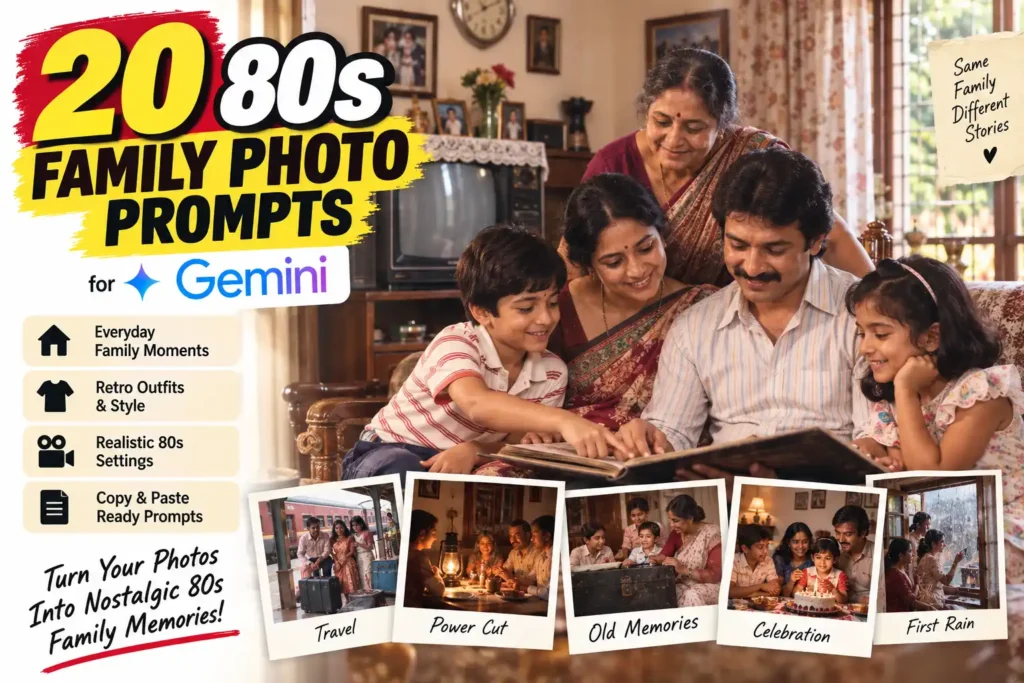
1. 80s Indian Family — Sunday Morning When Everyone Ends Up in One Room
Use our uploaded family photograph as the exact identity reference for EVERY family member shown. Preserve each person's recognizable face independently — facial structure, eyes, nose, lips, skin tone, natural age appearance, hairline, hairstyle characteristics, facial asymmetry, height relationship, and important identifying features.FAMILY IDENTITY LOCK: Never swap, merge, average, duplicate, or blend faces between family members. Preserve each person's natural age and gender presentation. Adults must remain adults, elderly members must retain their natural age, and children must remain age-appropriate. Do not replace anyone with generic models.
Create an authentic Indian family photograph from a relaxed Sunday morning in the mid-1980s.
Do NOT arrange everybody shoulder-to-shoulder looking at the camera.
Instead, create the feeling that several members of the family have gradually ended up in the same living room while doing different ordinary things.
One adult is reading part of a folded newspaper.
Another family member is sorting vegetables, folding washed clothes, repairing a small household item, combing a child's hair, organizing schoolbooks, or doing another culturally and age-appropriate Sunday task.
A child may be sitting on the floor with a simple period toy, drawing book, comic, or school notebook.
An older family member may be seated comfortably nearby, listening to the radio or quietly observing the room.
Choose activities according to the actual ages and number of people in the uploaded reference. Do not force roles that contradict their visible age or relationship.
Create one small event that connects everybody.
A radio, ceiling fan breeze, child, pet where appropriate, or harmless household incident suddenly causes several family members to look toward the same place for different reasons.
Perhaps a stack of newspapers begins sliding from a stool and one child instinctively catches it.
Perhaps the radio suddenly plays something familiar and two generations react differently.
Perhaps a child proudly shows something they have just drawn.
Capture the moment BEFORE everyone fully reacts.
Some family members notice immediately while others are still occupied with their tasks.
This uneven reaction should make the photograph feel spontaneous.
Build a believable 1980s Indian living room: cane or wooden chairs, simple sofa where appropriate, patterned cotton curtains, CRT television or radio cabinet, analog wall clock, ceiling fan, wooden shelves, steel tumbler, folded newspaper, family photographs with indistinct secondary faces, schoolbooks, terrazzo or red-oxide flooring where regionally plausible, and ordinary signs of a lived-in home.
Do not overload the room with stereotypical vintage props.
COMPOSITION: Photograph from a doorway or adjoining room using approximately a 35mm documentary perspective. Allow a doorframe or piece of foreground furniture to create depth. Family members should occupy different distances from the camera instead of forming one flat row.
LIGHTING: Soft morning sunlight enters through one side window or open doorway. Reflected light from pale walls should naturally illuminate faces. Keep the deeper room slightly subdued rather than making every person equally bright.
PERIOD LOCK: Indian household, approximately 1983–1988. No smartphones, flat-screen televisions, LED fixtures, modern toys, contemporary furniture, Wi-Fi equipment, current packaging, digital clocks, or present-day fashion.
FAMILY REALISM: Preserve correct hand ownership, natural eye direction, believable body spacing, distinct faces, age-appropriate posture, realistic child proportions, proper parent-child or family body language, and physically plausible interaction with objects.
Use restrained 35mm consumer-film grain, slightly warm colors, modest contrast, mild optical softness, natural skin texture, believable fabric folds, and candid family-photo imperfection.
The final photograph should feel like an ordinary Sunday that nobody considered important when it happened — several family members doing different things in one room, one tiny event briefly connecting them, and decades later the photograph becoming valuable precisely because nothing extraordinary was happening.
No text, no watermark, no swapped faces, no duplicated family members, no extra fingers, no incorrect ages, no plastic skin, no artificial AI glow, and no modern objects.
2. 80s Indian Family — The Photograph Taken Before the Train Journey Begins
Use our uploaded family photo as the strict identity reference for EVERY person. Preserve each family member's recognizable face separately — facial proportions, eyes, nose, lips, complexion, natural age, hair characteristics, body proportions, height relationships, and individual identifying details.Never swap parents, children, siblings, grandparents, or other family members. Never duplicate one person's face onto another body. Respect the actual ages shown in the uploaded reference.
Create an authentic Indian family travel photograph from the mid-1980s at a railway station BEFORE a long journey begins.
Avoid the cliché of arranging the entire family in a straight line beside the train.
Instead, capture the busy minutes while everyone is preparing to board.
The family has several period-plausible pieces of luggage: cloth holdalls, metal trunk, woven basket, small suitcase, steel water container, food parcel wrapped appropriately for the era, or other believable travel items.
Assign actions naturally according to age.
One adult may be checking paper tickets.
Another may be making sure the luggage is together.
An older relative may already be seated safely on a station bench.
A child may be watching the arriving train, holding an adult's hand, or carefully guarding one small bag.
Do not make children handle heavy luggage.
Create the decisive family moment around a harmless last-minute discovery.
Just before boarding, somebody realizes that a small important travel item — perhaps the food parcel, water container, child's sweater, book, or another ordinary object — is sitting several feet away on the bench where the family had been waiting.
One family member notices first and points toward it.
Others follow the gesture with different expressions: relief, amusement, mild disbelief, or recognition.
Capture that exact instant rather than showing everybody running.
Nobody should be on the railway tracks.
Nobody should hang from a train.
The train should be stationary or safely positioned for boarding.
Build an authentic mid-1980s Indian station: painted non-air-conditioned carriage, barred windows, metal station benches, analog clock, porters, paper tickets, cloth bags, metal trunks, old platform lamps, newspaper stall, period advertisements without requiring readable text, and naturally dressed travelers.
COMPOSITION: Photograph from several meters down the platform using approximately a 70mm perspective. Use one luggage item or softly blurred passerby in the foreground to create depth. Keep the forgotten object, pointing family member, and the rest of the family's reactions visually connected.
LIGHTING: Use diffused morning daylight entering beneath the platform roof. Reflected light from the train carriage and platform surfaces should naturally illuminate faces. Avoid artificial cinematic glow.
PERIOD LOCK: Indian railway station, approximately 1983–1988. No smartphones, digital tickets, QR codes, trolley luggage, modern trains, LED displays, contemporary backpacks, plastic bottled water, earbuds, charging points, or current fashion.
FAMILY LOCK: Preserve every family member as a distinct individual. Maintain natural parent-child, sibling, spouse, and grandparent body language where applicable. Keep children physically smaller according to their actual age and adults anatomically proportional.
Preserve realistic luggage weight, correct hands, believable paper tickets, cloth folds, natural Indian skin texture, distinct background faces, accurate railway geometry, and physically consistent shadows.
Use restrained analog grain, slightly warm consumer-film colors, modest dynamic range, mild print softness, and spontaneous family-album framing.
The final photograph should feel like a real family travel memory from the 1980s: everyone thought they were finally ready to board, then one person noticed the single item everybody had forgotten.
No unsafe railway behavior, no text, no watermark, no face swapping, no duplicated relatives, no extra fingers, no distorted luggage, no plastic skin, and no modern objects.
3. 80s Indian Family — Power Cut Dinner Around One Kerosene Lamp
Use our uploaded family photograph as the exact facial identity anchor for every visible family member. Preserve each person's recognizable face independently, including natural age, facial anatomy, skin tone, eyes, nose, lips, hairline, hairstyle characteristics, facial asymmetry, body proportions, and distinguishing features.Do not swap identities, duplicate faces, de-age adults, age children, or turn family members into generic models.
Create an intimate Indian family-album photograph from an ordinary electricity cut during the mid-1980s.
The family was preparing for or already eating dinner when the power suddenly failed.
Do not portray the blackout as frightening.
By the time this photograph is taken, a kerosene hurricane lamp or another historically plausible household lamp has been placed safely on the dining table or nearby stable surface.
The family continues the meal.
Create the emotional center around the unusual lighting changing an ordinary dinner.
A child notices that their hand creates a large shadow on the wall and begins experimenting with it.
Another child, sibling, parent, or grandparent notices.
One family member quietly tries to create a recognizable harmless shadow shape with their hand.
Someone else begins suppressing a laugh.
An older family member may continue eating while watching the improvised entertainment with restrained amusement.
Adapt these roles to the actual number and ages of people in the uploaded family photo.
Do not force young-child behavior onto teenagers or adults.
The family should remain seated or positioned naturally around the meal rather than turning toward the camera.
Build a believable 1980s Indian dining environment: simple wooden or laminate table, stainless-steel plates and tumblers, serving vessels, cotton kitchen cloth, wall calendar with unreadable text, switched-off ceiling fan, dark CRT television or radio cabinet farther away, wooden doorway, barred window, matchbox placed safely near the lamp, and household items disappearing gradually into darkness.
Food should resemble an ordinary family meal appropriate to the household rather than decorative restaurant plating.
COMPOSITION: Photograph from beyond one empty chair using approximately a 50mm perspective. Let the chair edge remain softly blurred in the foreground. Keep the lamp, several family reactions, and the wall shadow visible without forcing everyone into the same focal plane.
LIGHTING: The kerosene lamp is the dominant practical source and should produce warm directional illumination that decreases naturally with distance. Faint cool residual evening light may enter through a distant window.
Do not artificially expose every corner of the room.
SHADOW REALISM: Hand shadows must correspond physically to the position of the lamp, hands, and wall. Do not create impossible shadow directions or extra fingers in silhouettes.
PERIOD LOCK: Indian household, approximately 1983–1988. No smartphones, LED emergency lamps, flat-screen TVs, induction cooktops, modern appliances, contemporary packaging, Wi-Fi devices, or current décor.
FAMILY REALISM: Preserve each person's distinct identity, natural age, correct hands, realistic seated anatomy, proper family spacing, believable food handling, and age-appropriate interaction.
Render physically accurate lamp glass, flame scale, stainless-steel reflections, food scale, fabric folds, skin texture, and deep natural shadows.
Use subtle high-speed 35mm grain, warm lamp color cast, restrained saturation, modest dynamic range, and the imperfect framing of a photograph taken quickly by another family member.
The final image should feel like a forgotten family photograph whose emotional value comes from adaptation: the electricity disappeared, dinner continued, and one child's shadow accidentally turned an inconvenience into the moment everybody remembered.
No text, no watermark, no duplicate relatives, no swapped faces, no extra fingers, no impossible shadows, no plastic skin, no artificial glow beyond the real lamp, and no modern objects.
4. 80s Indian Family — Wedding House Kitchen Where Three Generations Work Together
Use our uploaded family photograph as the precise identity reference for EACH family member. Preserve every recognizable face separately — facial structure, eyes, nose, lips, complexion, natural age, hair characteristics, body proportions, height relationships, and distinctive identifying details.IDENTITY AND AGE LOCK: Never merge, swap, average, or duplicate faces. Preserve natural generations correctly. Grandparents or older adults must remain their visible age, parents and adults must remain adults, and children must remain age-appropriate. Do not convert the family into generic wedding models.
Create a candid mid-1980s Indian family photograph during preparations for a wedding or large family function.
Do NOT place the family on the wedding stage.
Do NOT automatically make anyone the bride or groom.
Instead, photograph the practical back area of a family home where several generations are helping with preparation.
Choose culturally coherent South Indian or other Indian regional details based on the visual setting; do not randomly combine unrelated wedding traditions.
Assign different tasks according to natural age and ability.
An older family member may sit comfortably sorting flowers, betel leaves, cloth items, or another culturally appropriate lightweight task.
Adults may organize stainless-steel tumblers, serving vessels, banana leaves where regionally appropriate, gifts, folded cloth, or food-preparation items.
A child may carry only something light and safe, count harmless objects, watch the adults, or try to imitate a simple task.
Create one small intergenerational moment.
A younger family member performs a task in an unexpectedly familiar way.
An older relative notices that the gesture resembles another family member.
Instead of explaining this with text, show the older person's reaction — a brief pause, restrained smile, or glance toward another adult who notices the same resemblance.
The younger person remains unaware and continues the task.
This should become the hidden story of the photograph.
Build a genuinely busy but organized 1980s wedding-house environment: large traditional cooking vessels where appropriate, stacked stainless-steel tumblers, cotton towels, flowers, banana leaves or regional serving materials, wooden shelves, brass items where culturally relevant, simple incandescent bulbs, open back doorway, and fragments of festive decoration visible farther away.
Avoid disposable modern catering products.
COMPOSITION: Photograph through a natural gap between stacked vessels, doorway, or hanging cloth using approximately a 35mm documentary perspective. Arrange family members at different depths according to their tasks rather than lining them up.
Use one foreground metal vessel to create depth, but reflections must remain physically plausible and must not duplicate family members incorrectly.
LIGHTING: Bright daylight enters through the back doorway and windows while warm incandescent household light remains deeper inside. Metal surfaces should reflect these sources accurately.
Preserve natural warmth, mild perspiration, and believable working conditions rather than glamorous wedding lighting.
PERIOD LOCK: Indian family wedding preparation, approximately 1983–1988. No smartphones, LED decorative strings, induction equipment, disposable modern catering products, contemporary mineral-water bottles, digital cameras, QR codes, modern designer wedding styling, or current appliances.
Preserve distinct identities, natural age differences, correct hand ownership, safe child behavior, realistic jewellery attachment, believable textile weight, accurate metal reflections, and natural skin texture.
Use gentle consumer-film grain, warm color-negative rendering, modest contrast, slight optical softness, and candid family-album imperfection.
The final photograph should initially appear to show ordinary wedding preparation. On closer inspection, the emotional center should be the older family member quietly recognizing a familiar family gesture in the youngest generation.
No text, no watermark, no bride-or-groom assumption, no duplicated relatives, no face swapping, no extra fingers, no unsafe child behavior, no plastic skin, and no modern objects.
5. 80s Indian Family — The Annual Family Photo That Refuses to Become Formal
Use our uploaded family photo as the exact identity reference for EVERY person shown. Preserve each family member's recognizable face independently — natural age, facial proportions, eyes, nose, lips, skin tone, hairline, hairstyle characteristics, facial asymmetry, height relationship, body proportions, and important identifying details.Never swap, merge, duplicate, average, or beautify family members into generic people. Preserve real generational differences and relationship-appropriate body language.
Create an authentic mid-to-late-1980s Indian family photograph built around the attempt to take a formal annual family picture.
The family has deliberately gathered in the front room, veranda, courtyard, or garden area of a modest family home because someone owns or has borrowed a camera.
At first, everybody is trying to cooperate.
Chairs have been moved into place.
Older family members are seated comfortably.
Adults and older children are arranged around them.
Younger children are positioned safely near parents or relatives.
However, do NOT create the successful formal photograph.
Create the photograph taken a few seconds BEFORE it.
One small harmless problem prevents the family from becoming perfectly posed.
Perhaps a young child keeps looking toward somebody outside the frame.
Perhaps one person's chair makes a small noise and everybody reacts.
Perhaps a breeze repeatedly moves one curtain or garment into the wrong place.
Perhaps the camera operator gives contradictory instructions from outside the frame.
Perhaps a family member quietly says something that makes one person begin laughing while everybody else is still trying to remain serious.
Choose ONE natural incident appropriate to the actual family composition.
Capture the chain reaction at different stages.
One person has already started laughing.
Another is trying not to laugh.
One older family member remains completely composed.
A child is looking in the wrong direction.
Another adult is attempting to restore order with a restrained gesture.
Nobody should appear to be performing exaggerated comedy.
Dress the family in realistic 1980s Indian clothing appropriate to their gender, natural age, region, and the fact that they intentionally prepared for a family photograph. Clothing can be slightly nicer than everyday wear but should not look like wedding attire unless context requires it.
Build a believable family-home setting: wooden or cane chairs, veranda pillars or living-room furniture, cotton curtains, household plants, analog wall clock, framed family pictures, radio or CRT television where appropriate, terrazzo or red-oxide floor, ordinary slippers temporarily placed aside, and subtle signs that furniture was rearranged for the photograph.
COMPOSITION: Position the camera as though another family member or friend is actually taking the picture using a period consumer camera. Use approximately a 50mm perspective from natural standing height.
Keep the composition almost formal but imperfect.
One person may be slightly out of ideal position.
A chair may not align perfectly.
A child's attention may be outside the frame.
These imperfections are essential.
LIGHTING: Use strong but soft natural daylight from the veranda, doorway, or large window. If a period camera flash is appropriate, use restrained direct fill rather than modern studio lighting. Preserve believable shadow direction and natural facial exposure.
PERIOD LOCK: Indian family home, approximately 1984–1989. No smartphones, digital cameras, flat-screen televisions, LED fixtures, modern furniture, contemporary clothing, current toys, Wi-Fi devices, or present-day household products.
FAMILY LOCK: Maintain every person's distinct face, natural age, correct height relationship, believable parent-child or sibling spacing, proper hand ownership, realistic seated and standing anatomy, and age-appropriate expressions.
Use authentic family-snapshot characteristics: restrained consumer-film grain, slightly warm color response, mild flash or exposure imperfection where appropriate, modest sharpness, natural skin texture, and gentle print softness.
The final photograph should feel more valuable than the perfect formal picture supposedly taken afterward. Nobody is fully ready, several people are reacting differently, and the family looks alive rather than arranged.
It should feel like the photograph relatives would rediscover decades later and prefer over the carefully posed version because this imperfect frame shows how the family actually behaved together.
No text, no watermark, no swapped identities, no duplicated family members, no incorrect age changes, no extra fingers, no distorted children, no plastic skin, no artificial AI glow, and no modern objects.
6. 80s Indian Family — Grandmother’s Trunk Opens and Everyone Finds Their Own Memory
Use our uploaded family photograph as the exact identity reference for EVERY family member shown. Preserve each person's recognizable face independently — facial structure, eyes, nose, lips, skin tone, natural age appearance, hairline, hairstyle characteristics, facial asymmetry, height relationship, body proportions, and important identifying details.FAMILY IDENTITY LOCK: Never swap, merge, average, duplicate, or blend faces between family members. Preserve natural generations correctly. Older adults must retain their real visible age, adults must remain adults, teenagers must remain teenagers, and children must remain age-appropriate.
Create an intimate Indian family photograph from the mid-1980s built around opening an old household storage trunk that has not been properly explored for years.
Do not turn this into a formal family portrait.
Place the family in a quiet bedroom, storeroom, veranda corner, or interior room of a long-lived Indian family home.
An older family member has opened a sturdy old metal or wooden trunk while searching for one practical household item.
Instead, several forgotten family objects appear inside.
Keep the contents ordinary and believable rather than turning the trunk into an antique treasure chest.
Possible items include neatly folded old clothing, children's school notebooks, a small cloth pouch, spectacles case, old postcards with unreadable writing, a faded ribbon, simple toy, family photograph envelope, handkerchief, old book, sewing materials, or another period-plausible household keepsake.
Assign reactions according to the actual ages and relationships visible in the uploaded photograph.
One adult discovers an object clearly connected to their own childhood.
An older relative immediately recognizes it.
A younger family member does not understand why the object matters and examines it with genuine curiosity.
Create the decisive moment around one tiny discovery.
Perhaps an adult lifts a very small old school item or childhood possession from the trunk.
Before the adult can explain it, the older family member begins smiling because they remember it immediately.
The younger generation looks back and forth between the object and the adult, trying to imagine that grown family member as a child.
Do not create dramatic crying or exaggerated nostalgia.
The emotion should come from three generations experiencing the SAME object differently.
Build a believable 1980s Indian home environment: aged metal or wooden trunk, cotton bedding folded nearby, wooden cupboard, simple mirror, ceiling fan, barred window, stitched cloth bags, sewing basket where appropriate, family photographs kept safely in an envelope, terrazzo or red-oxide floor, and natural signs of long household use.
Do not fill the scene with random vintage props.
COMPOSITION: Photograph from low seated height using approximately a 50mm perspective. Let the open trunk occupy one lower foreground corner while family members naturally gather around it at different heights.
Do not make everybody look into the trunk simultaneously.
The adult holding the discovered object, the older relative recognizing it, and the younger person's curiosity should form a triangular storytelling composition.
LIGHTING: Soft afternoon daylight enters through a nearby window or doorway and falls across the open trunk. The trunk interior should remain slightly darker than the surrounding room while reflected light naturally illuminates faces.
Allow small particles of household dust to become visible only inside a genuine sunbeam rather than covering the entire room with artificial atmosphere.
OBJECT REALISM: Old objects should show believable age through mild fading, folds, edge wear, or handling marks. Avoid extreme artificial scratches, sepia staining, torn edges, and exaggerated antique effects.
PERIOD LOCK: Indian household, approximately 1983–1988. No smartphones, modern plastic storage boxes as dominant objects, LED fixtures, digital photographs, contemporary toys, modern packaging, current fashion, or present-day electronics.
FAMILY REALISM: Preserve distinct identities, correct age relationships, realistic hand ownership, natural sitting and kneeling anatomy, believable child proportions, and culturally appropriate family interaction.
Use restrained 35mm consumer-film grain, slightly warm color-negative rendering, modest dynamic range, gentle optical softness, natural skin texture, realistic hair strands, and authentic fabric folds.
The final photograph should contain three different versions of time in one frame: the oldest generation remembers the object, the middle generation once owned it, and the youngest generation is discovering that the adults around them were children once too.
No readable private text, no watermark, no face swapping, no duplicate relatives, no artificial younger duplicates of adults, no extra fingers, no plastic skin, no fake AI glow, and no modern objects.
7. 80s Indian Family — Monsoon Laundry Rescue Becomes a Family Chain
Use our uploaded family photograph as the strict identity reference for EACH family member. Preserve every person's recognizable face independently — natural age, facial anatomy, skin tone, eyes, nose, lips, hair characteristics, facial asymmetry, body proportions, and distinctive identifying features.Never swap identities, duplicate family members, alter ages, or transform the family into generic models.
Create a lively but completely believable Indian family moment from the mid-1980s when unexpected monsoon rain interrupts an ordinary household afternoon.
Do not create a generic family standing beautifully in the rain.
The family is inside or near a modest house when somebody notices that washed clothes are still drying outside on the terrace, veranda, courtyard, or clothesline.
The first heavy drops begin.
Different family members spontaneously form an unplanned chain to bring the clothes inside before the rain becomes stronger.
Keep everybody in safe household areas. No dangerous rooftop edges, slippery running, or risky climbing.
Assign tasks according to actual age.
One adult removes garments from the clothesline.
Another receives them from the doorway.
An older family member may hold a dry basket or direct where items should be placed.
A child may safely carry one lightweight towel or collect fallen wooden clothespins from a dry protected area.
Create the decisive moment around one garment that the wind unexpectedly pulls away from the transfer.
It does NOT fly dramatically into the sky.
Instead, a lightweight towel, shirt, or cloth slips from one person's hands and begins dropping toward the floor.
Two family members instinctively reach for it at the same time.
One catches it.
The other stops halfway.
Their eyes meet and both begin laughing.
Meanwhile another family member remains completely focused on rescuing the remaining laundry.
The photograph should contain several simultaneous reactions rather than everybody performing for the camera.
Build a believable home environment: cotton clothesline, wooden or period-plausible clothespins, metal or cane laundry basket, weathered terrace or courtyard wall, tiled or cement floor, open wooden doorway, steel bucket, neighboring rooftops or garden plants, and the first darkened wet patches appearing on the ground.
COMPOSITION: Photograph from inside the protected doorway looking outward using approximately a 35mm lens. The doorway should naturally frame the family activity.
Use hanging clothes in the foreground and middle plane to create depth without covering faces.
The viewer should be able to visually follow the chain from clothesline to doorway to basket.
LIGHTING: Use soft gray monsoon daylight. The exterior should be brighter than the interior, allowing reflected wet-weather light to illuminate faces naturally.
Do not add golden sunlight during active overcast rain unless a physically plausible break in the clouds is visible.
RAIN AND FABRIC REALISM: Early rain should appear as scattered droplets and expanding wet patches rather than an instant tropical wall of water. Dry garments should remain light while newly wet sections gain realistic weight and darker tone.
All clothing and hair movement must follow the same wind direction.
PERIOD LOCK: Indian household, approximately 1983–1988. No smartphones, modern synthetic laundry baskets as conspicuous focal objects, contemporary rooftop solar equipment, LED fixtures, modern high-rise skyline, current clothing designs, or present-day household products.
FAMILY LOCK: Maintain distinct faces, natural age differences, correct hands, clear ownership of limbs and garments, realistic child behavior, safe footing, and believable family cooperation.
Use slightly muted monsoon colors, restrained 35mm grain, modest contrast, realistic wet-surface reflections, natural skin texture, and candid family-album framing.
The final photograph should feel like a tiny family emergency that became funny before anybody realized it: rain starts, everyone helps without being asked, one piece of laundry nearly escapes, and the resulting photograph preserves the family's instinctive teamwork rather than a pose.
No text, no watermark, no duplicated relatives, no face swapping, no extra fingers, no floating clothes, no unsafe rooftop behavior, no plastic skin, and no modern objects.
8. 80s Indian Family — One Television, Three Generations, Three Different Reactions
Use our uploaded family photo as the exact facial identity anchor for EVERY family member shown. Preserve each person's recognizable face independently — facial structure, eyes, nose, lips, skin tone, natural age, hairline, hairstyle characteristics, facial asymmetry, body proportions, height relationships, and distinguishing details.Do not merge faces, swap ages, duplicate relatives, or automatically make everyone young.
Create an authentic Indian family evening from the late 1980s centered around a shared CRT television.
Do NOT create a family sitting in a perfect row staring blankly at the screen.
The television is showing something important or entertaining to the household, but the actual copyrighted program must NOT be reproduced or visible in recognizable detail.
Keep the CRT screen either mostly outside the camera's direct view or showing only indistinct period-plausible light and shapes.
The real subject is how different generations react to the SAME unseen television moment.
Arrange the family naturally according to age and comfort.
An older family member may occupy a chair.
Adults may sit on a sofa, wooden chair, or floor mat depending on the household.
Children may sit closer to the television but at a reasonable safe distance.
One person has apparently seen this type of story or event before and anticipates what is about to happen.
Another is completely absorbed.
A younger family member becomes excited a fraction of a second before everybody else.
Create one visually understandable chain reaction.
A child suddenly turns toward an adult as if asking, “Did you see that?”
The adult is still looking at the television.
An older relative has already noticed the child's reaction and begins smiling at the child rather than at the screen.
Another family member reaches absent-mindedly toward a snack plate without taking their eyes off the television.
The photograph should reveal family relationships through where everyone is looking.
Include ordinary viewing-night details: CRT television in a wooden cabinet or on a sturdy stand, lace or embroidered television cover if culturally plausible, physical control buttons, period remote only if historically appropriate, ceiling fan, thermos or steel tumblers, newspaper, simple snack plate, floor mat, patterned curtains, analog wall clock, and warm household lighting.
Do not turn the room into a museum of 1980s objects.
COMPOSITION: Position the camera near the television but slightly to one side, looking back toward the family using approximately a 35–50mm perspective.
Allow only a dark blurred edge or faint reflection of the television in the near foreground.
This angle should make all family reactions visible while preserving the feeling that the camera occupies the television's side of the room.
LIGHTING: The CRT may contribute a faint cool fluctuating glow to faces closest to it, but it must NOT illuminate the entire room.
Use a warm tungsten ceiling or wall fixture as the main exposure source, creating believable mixed color temperatures.
PERIOD LOCK: Indian household, approximately 1986–1989. No flat-screen TVs, streaming devices, smartphones, Wi-Fi routers, LED lighting, modern game consoles, contemporary remotes, current furniture, or modern snack packaging.
FAMILY REALISM: Every family member must retain a distinct identity, natural age, correct body scale, realistic seated posture, proper eye direction, and clear relationship to surrounding people.
Accurately render CRT glass curvature, furniture wear, fabric texture, realistic hands, snack handling, skin pores, and physically consistent shadows.
Use moderate high-speed 35mm film grain, warm household color response, slight mixed-light imperfection, modest dynamic range, and candid framing.
The final image should feel like a real late-1980s family memory in which the television program itself has become irrelevant. What matters is the pattern of reactions: one screen, several generations, and each person experiencing the same moment differently.
No recognizable copyrighted television content, no text, no watermark, no duplicated family members, no swapped faces, no extra fingers, no plastic skin, and no modern objects.
9. 80s Indian Family — The Child Finds the Parents’ Old Wedding Photograph
Use our uploaded family photograph as the exact identity reference for EVERY person shown. Preserve each family member's recognizable face independently — facial anatomy, eyes, nose, lips, complexion, natural age, hair characteristics, facial asymmetry, body proportions, and distinctive identifying details.Never swap identities, merge faces, duplicate people, or change anyone's current natural age.
Create an intimate Indian family photograph from the late 1980s built around a child discovering an older family photograph.
If the uploaded family does not contain a young child, adapt the discovery role naturally to the youngest family member rather than inventing an unrelated child.
The family is spending an ordinary afternoon at home.
Someone has taken out a small envelope or album containing older printed photographs while reorganizing a cupboard, shelf, or drawer.
The youngest family member picks up one small wedding photograph showing the parents, grandparents, or another appropriate adult family pair from years earlier.
Do NOT create highly detailed younger duplicates inside the small photograph.
The old print should contain only enough visual information to suggest a wedding portrait: two indistinct younger figures, period clothing shapes, simple backdrop, and photographic tone.
The child studies the print and then looks directly at the CURRENT adult standing or sitting nearby.
The child is trying to reconcile the younger figure in the photograph with the familiar adult they know now.
Create the decisive moment when the child holds the photograph beside the adult's face or points between the print and the real person with genuine curiosity.
The adult understands what the child is comparing and begins laughing or smiling.
Another family member may lean closer and immediately recognize the photograph.
An older relative may watch with the particular amusement of someone who remembers the original day.
Do not make anyone cry dramatically.
The emotional strength should come from a child discovering that family members had entire lives before the child's own memories began.
Build a believable late-1980s home environment: wooden cupboard or shelf, family album, paper photograph envelope, printed photographs of plausible size, cotton table cover, simple chairs, wall clock, household radio or CRT television farther away, curtains, and ordinary afternoon clutter.
COMPOSITION: Photograph from slightly above table height using approximately a 50mm lens. Let the small old photograph occupy the lower-middle foreground while the child's questioning expression and the current adult's reaction remain clearly visible beyond it.
Do not make the miniature photograph unnaturally huge.
PHOTO-WITHIN-PHOTO REALISM: The old wedding print should have plausible thickness, restrained fading, mild edge wear, and limited detail. Do not use fake torn edges, extreme scratches, sepia clichés, or a perfectly rendered second portrait.
LIGHTING: Use soft daylight from a nearby window. Let it fall across the photograph and child's hands first, then gently illuminate the adults through reflected room light.
PERIOD LOCK: The PRESENT scene is still within the late 1980s. Any older photograph must look plausibly earlier than the present scene without introducing modern objects. No smartphones, digital photo frames, flat-screen TVs, LED lights, modern albums, current fashion, or present-day décor.
FAMILY LOCK: Preserve the current natural ages of all uploaded people. Do not accidentally turn the adults in the room into their younger wedding versions. Maintain correct child-adult scale, hand ownership, and natural eye direction.
Use restrained 35mm grain, warm-neutral family-film colors, modest contrast, realistic paper texture, natural skin pores, accurate fingers, believable clothing folds, and gentle print softness.
The final photograph should contain two family timelines without requiring text: a tiny old print shows that the adults once looked different, while the child's expression reveals the instant they understand that their parents or elders existed long before they knew them.
No readable personal text, no watermark, no detailed duplicate younger faces, no face swapping, no duplicated relatives, no extra fingers, no plastic skin, no artificial AI glow, and no modern objects.
10. 80s Indian Family — The Last Mango Is Quietly Passed Around the Table
Use our uploaded family photograph as the strict facial identity reference for EACH family member shown. Preserve every person's recognizable face separately — natural age, facial proportions, eyes, nose, lips, skin tone, hair characteristics, facial asymmetry, height relationships, body proportions, and important identifying features.Never swap faces, duplicate relatives, alter ages, or replace the family with generic models.
Create a warm, visually distinctive Indian family photograph from a summer afternoon in the mid-1980s.
Do not build the scene around a festival, wedding, journey, television, or formal portrait.
Place the family around a simple dining table, kitchen table, veranda floor setting, or shaded courtyard after an ordinary family meal.
A plate contains the final few slices of a ripe seasonal mango.
Only ONE especially good final slice remains.
Nobody openly claims it.
Create a small chain of family behavior around that last piece.
One person quietly pushes the plate toward another family member.
That person notices and pushes it toward somebody else.
A parent may direct it toward a child.
The child may then unexpectedly offer it to a grandparent or another family member instead of immediately taking it.
Adapt the chain naturally to the actual ages and relationships in the uploaded family.
Capture the exact instant the final recipient realizes that the mango slice has traveled around the family and arrived in front of them.
Some family members are watching the plate.
One is watching the recipient.
Another pretends not to be paying attention while clearly suppressing a smile.
Do not make everyone laugh at the same time.
The emotional idea is everyday generosity expressed without dialogue.
Build a believable summer household environment: stainless-steel plate, realistic mango slices and peel, steel tumblers, cotton hand towel, simple wooden or laminate table or traditional floor setting as appropriate, ceiling fan, open shaded doorway, bright courtyard beyond, newspaper, household containers, and subtle evidence of a hot afternoon.
Do not turn the meal into a luxury food photograph.
COMPOSITION: Shoot from table height using approximately a 50mm perspective. Keep the final mango slice visible but not oversized.
Use hands and eye lines to create a circular visual path around the family: plate to giver, giver to next person, and finally to recipient.
The viewer should understand the small story without any caption.
LIGHTING: Strong summer daylight remains outside the shaded room or veranda. Soft reflected light from the courtyard naturally illuminates faces and the table. A ceiling fan may create subtle movement in loose hair or lightweight fabric, but avoid excessive wind.
FOOD REALISM: Mango flesh must have believable fibrous texture, natural moisture, irregular hand-cut shape, realistic peel thickness, and proper scale. Stainless-steel reflections must correspond to actual surroundings.
PERIOD LOCK: Indian household, approximately 1983–1988. No smartphones, modern packaged drinks, contemporary tableware as focal objects, LED fixtures, flat-screen televisions, current furniture, plastic bottled water, or present-day fashion.
FAMILY REALISM: Preserve distinct identities, natural ages, correct hand ownership, realistic food handling, age -appropriate body spacing, natural eye direction, believable seated posture, and relationship-appropriate generosity. Children must interact with food safely and naturally.

Use restrained 35mm consumer-film grain, warm summer color response, modest dynamic range, mild optical softness, natural Indian skin texture, believable perspiration appropriate to the weather, and candid family-album imperfection.

The final photograph should feel like a completely ordinary 1980s family afternoon whose meaning becomes clear only after looking at the hands and faces: one last mango slice is quietly passed from person to person because everyone would rather give it to somebody they love than take it themselves.

No text, no watermark, no swapped identities, no duplicated family members, no extra fingers, no distorted hands, no incorrect ages, no plastic skin, no artificial AI glow, no oversized food, and no modern objects.
11. 80s Indian Family — School Results Arrive and the Child Reads the Parents First
Use our uploaded family photograph as the exact identity reference for EVERY family member shown. Preserve each person's recognizable face independently — facial structure, eyes, nose, lips, skin tone, natural age appearance, hairline, hairstyle characteristics, facial asymmetry, body proportions, height relationships, and important identifying details.FAMILY IDENTITY LOCK: Never swap, merge, average, duplicate, or blend faces between family members. Preserve each person's natural age and gender presentation. If the uploaded family does not contain a school-age child, adapt this scene to the youngest family member for whom the situation is age-appropriate rather than artificially making an adult into a child.
Create an authentic Indian family photograph from the mid-1980s centered around a school examination result arriving home.
Do NOT make this a staged celebration with everyone holding marksheets toward the camera.
The youngest school-age family member has just returned home carrying a folded report card, progress report, or examination paper.
Do not make any marks, grades, school names, or personal information readable.
The child already knows the result.
The interesting moment is that they are trying to understand how the adults will react.
Place the family in the front room, veranda, dining area, or courtyard of a modest Indian home.
One parent or adult opens the folded report.
Before that adult says anything, the child watches their FACE instead of the paper.
Another parent or older family member watches the first adult.
A grandparent or sibling may watch the child.
Create a chain of eye directions in which almost nobody is looking at the same object.
The adult reading the report should begin with a serious concentrated expression.
Then one tiny facial change — softened eyes, a restrained smile, raised eyebrow, or small nod — reveals the result is better than the child feared.
Capture the exact instant the child notices that change.
Do not create exaggerated jumping, cheering, crying, or trophy-like celebration.
If the result is good, show quiet family pride.
If you choose a mixed or imperfect result, keep the reaction supportive and believable rather than humiliating the child.
Dress everyone in ordinary period-correct Indian home, work, or school clothing appropriate to their actual ages. If a school uniform is visible, keep it generic and historically plausible without logos or readable school identity.
Build a believable 1980s home environment: wooden or cane chairs, schoolbag appropriate to the era, textbooks, pencil box, steel tumbler, folded newspaper, wall calendar with unreadable text, analog clock, ceiling fan, radio or CRT television farther away, simple curtains, and naturally used household furniture.
COMPOSITION: Photograph from slightly behind the child's shoulder using approximately a 70mm perspective. Let the child's shoulder and edge of the report remain in the near foreground while the adult reader's face becomes the first focal point.
The viewer should then discover another family member watching the child.
LIGHTING: Use soft late-afternoon daylight entering through an open doorway or window. Reflected light from the veranda or pale walls should illuminate faces naturally. Avoid dramatic spotlighting.
PAPER REALISM: The report must have believable paper thickness, folds, handling marks, and printed structure without legible private information. Fingers must hold it naturally without covering impossible areas.
PERIOD LOCK: Indian household, approximately 1983–1988. No smartphones, online results, laptops, modern school backpacks, QR codes, digital watches as conspicuous objects, LED lights, flat-screen televisions, or present-day school accessories.
FAMILY REALISM: Preserve correct ages, natural parent-child body language, distinct identities, realistic hand ownership, believable eye direction, proper school-age proportions, and restrained emotional reactions.
Use gentle 35mm consumer-film grain, slightly warm colors, modest contrast, natural skin texture, mild print softness, and the imperfect framing of a genuine family photograph.
The final image should tell the result without allowing the viewer to read a single mark: the child watches the parent, another family member watches the child, and one tiny change in expression tells everybody what the paper means.
No readable grades, no school name, no watermark, no face swapping, no duplicated relatives, no incorrect ages, no extra fingers, no plastic skin, and no modern objects.
12. 80s Indian Family — Everyone Falls Asleep in Different Ways During the Afternoon
Use our uploaded family photograph as the strict facial identity reference for EACH family member. Preserve every person's recognizable face independently — natural age, facial anatomy, eyes, nose, lips, skin tone, hair characteristics, facial asymmetry, body proportions, height relationships, and distinctive identifying features.Never merge identities, duplicate relatives, de-age adults, age children, or transform family members into generic models.
Create an unusually quiet Indian family photograph from a hot mid-1980s summer afternoon.
Do not arrange the family for a portrait.
Lunch has finished.
The ceiling fan turns steadily.
The house has become so quiet that several family members have unintentionally fallen asleep in different parts of the same room.
Adapt positions to each person's actual age and physical comfort.
An older adult may sleep safely in a cane chair with proper back support.
Another adult may have fallen asleep while reading a newspaper or book, which now rests naturally against their lap.
A child may be asleep on a floor mat with an open drawing book or harmless toy nearby.
Another family member may still be awake, quietly trying to move through the room without disturbing anybody.
Do not place babies or small children in unsafe sleeping positions.
Create the decisive moment around the ONE person who remains awake.
That family member notices something small and funny about the sleeping room — perhaps the newspaper slowly slipping from an adult's hand, spectacles beginning to slide safely onto the lap, a child's toy positioned in an amusing but harmless way, or two sleeping relatives unconsciously adopting similar postures.
The awake family member begins suppressing a smile.
Do not wake the others.
The photograph should feel almost silent.
Add subtle evidence of the hot afternoon: cotton curtains moving slightly under fan-generated airflow, steel water jug, half-closed wooden shutters, bright sun outside the doorway, folded hand fan, newspaper, simple floor mat, and ordinary household items.
COMPOSITION: Photograph from the cooler shadow of an adjoining doorway using approximately a 35mm lens. Use the doorway as a natural frame and allow sleeping family members to occupy different depths across the room.
Do not place every face on the same horizontal line.
The awake person's expression should be discoverable only after the viewer first notices the peaceful sleeping family.
LIGHTING: Harsh summer sunlight should remain primarily outside. Inside, use soft reflected daylight bouncing from the courtyard or veranda. The room should feel shaded and cooler, with natural pockets of shadow.
A ceiling fan may create slight motion blur in the blades while people remain sharp enough to recognize.
SLEEP REALISM: Closed eyes, relaxed facial muscles, natural neck position, safe body posture, believable clothing compression, and no beauty-pose sleeping expressions.
PERIOD LOCK: Indian household, approximately 1983–1988. No smartphones beside sleeping people, modern air conditioners as dominant objects, LED lights, flat-screen televisions, current toys, contemporary furniture, digital tablets, or modern drink bottles.
FAMILY LOCK: Preserve natural ages, distinct identities, correct body scale, anatomically safe resting positions, and clear ownership of every limb.
Use restrained 35mm grain, warm-neutral afternoon color, modest contrast, mild optical softness, natural skin texture, and candid family-album framing.
The final photograph should feel valuable because nobody knew a photograph was being taken. It captures the rare moment when an entire busy household becomes quiet at once — except for one family member who is awake enough to notice how peaceful and slightly funny everybody looks.
No text, no watermark, no swapped faces, no duplicated relatives, no unsafe child sleeping position, no extra limbs, no plastic skin, no artificial AI glow, and no modern objects.
13. 80s Indian Family — First Rain of the Season Brings Everyone to the Same Window
Use our uploaded family photograph as the exact facial identity anchor for EVERY family member. Preserve each person's recognizable face independently — facial proportions, eyes, nose, lips, complexion, natural age, hairline, hairstyle characteristics, facial asymmetry, body proportions, height relationships, and individual identifying details.Never swap faces, duplicate relatives, change ages, or replace family members with generic models.
Create an authentic mid-1980s Indian family moment during the first substantial rain after a long hot period.
Do NOT place the family outside posing in rain.
The family is inside their home when the sound of rain suddenly becomes strong enough to pull people away from different activities.
One person reaches the window first.
Others gradually arrive.
Adapt the behavior to age.
A child may stand safely near the window grille watching water hit the courtyard.
An adult may hold the window shutter or move a curtain away.
An older relative may remain seated slightly farther back while looking outside.
Another family member may arrive from the kitchen or another room still holding a harmless household item from whatever they were doing.
Create the decisive moment around the smell, sound, or visual surprise of the first rain rather than dramatic weather.
A strong gust suddenly pushes a fine spray through part of the open window.
The child or nearest family member instinctively steps back and laughs.
Another person quickly pulls one shutter partly inward.
A third person remains looking outside as though they do not want to lose even one second of the rain.
Capture these DIFFERENT reactions simultaneously.
Nobody should look at the camera.
Outside, show believable early-rain details: dry courtyard turning dark in irregular patches, dust settling, leaves moving, water beginning to flow from a roof edge, one bicycle being moved under shelter by someone in the distance, and the hazy reduction of visibility beyond the house.
Do not create flooding or dangerous storm conditions.
Build the interior with wooden or metal-framed barred window appropriate to the home, cotton curtains, simple furniture, ceiling fan switched off or slowed if the weather has cooled, steel tumbler, newspaper, household plants, and ordinary period décor.
COMPOSITION: Photograph from deeper inside the room using approximately a 35mm lens. The family should form an irregular cluster near the window rather than a line.
Use the bright rain-filled exterior as a natural visual backdrop while keeping facial exposure believable.
LIGHTING: Cool gray monsoon daylight entering through the window is the dominant source. Reflected light from wet courtyard surfaces may softly brighten lower parts of the room. Do not add golden sunlight or artificial blue cinematic lighting.
RAIN REALISM: Rain direction, curtain movement, leaves, spray, and clothing movement must respond consistently to the same wind. Interior surfaces should remain mostly dry except near the open window.
PERIOD LOCK: Indian household, approximately 1983–1988. No smartphones recording the rain, modern aluminum-glass interiors where inappropriate, LED fixtures, contemporary furniture, modern vehicles dominating outside, current clothing, or present-day electronics.
FAMILY REALISM: Preserve distinct identities, correct ages, safe child placement, natural hand ownership, believable eye direction toward the weather, and realistic family spacing.
Use slightly muted monsoon colors, restrained analog grain, modest dynamic range, realistic wet-surface reflections, mild optical softness, and natural skin texture.
The final photograph should feel like the first rain temporarily interrupted the entire household. Different generations abandon different tasks and gather at one window, not because anything extraordinary happens, but because some ordinary experiences are still worth stopping everything to watch together.
No text, no watermark, no duplicated relatives, no face swapping, no extra fingers, no unsafe window behavior, no plastic skin, and no modern objects.
14. 80s Indian Family — Father or Mother Repairs a Toy While Everyone Gives Advice
Use our uploaded family photograph as the strict identity reference for every visible family member. Preserve each person's recognizable face separately — facial structure, natural age, skin tone, eyes, nose, lips, hair characteristics, facial asymmetry, body proportions, height relationships, and distinctive identifying features.Never assume a specific parent role unless supported by the uploaded family. Assign the repair task naturally to an appropriate adult family member. Never swap identities, duplicate people, or change anyone's age.
Create a warm and humorous Indian family photograph from the mid-1980s centered around repairing a simple child's toy or harmless household play object.
If no child is present in the uploaded family, adapt the object to a simple family possession appropriate to the youngest member rather than inventing unrelated children.
Choose a period-plausible mechanical or simple battery-operated toy, wooden toy, small wheeled toy, doll accessory, spinning toy, or another safe object appropriate to the child's age.
Do not depict dangerous electrical repair, exposed mains electricity, soldering around children, sharp tools in children's hands, or complicated repair instructions.
The toy has stopped working or one harmless part has come loose.
An adult sits at a table or on the veranda floor trying to understand the problem.
The comedy comes from everybody else offering advice.
One family member points toward one part.
Another insists on a different explanation through body language.
A child watches with complete seriousness.
An older relative may observe from a chair with an expression suggesting they already know how this will end.
Create the decisive instant when the adult finally discovers the embarrassingly simple harmless problem — perhaps a wheel or cover was slightly misaligned, a removable piece was backwards, or another non-technical issue.
Do not explain repair steps.
The adult looks at the object.
Then at the family.
The child immediately understands from the adult's expression that the toy is going to work again.
Capture the child's reaction BEFORE the toy is even tested.
Build an authentic home environment: wooden or laminate table, period toy pieces, small cloth for parts, simple household screwdriver kept only in the adult's possession if needed, newspaper beneath the object, cane chair, steel tumbler, radio, wall clock, ceiling fan, and ordinary family clutter.
COMPOSITION: Shoot from table height using approximately a 50mm perspective. Let the toy occupy the lower foreground while the adult's hands and several family reactions create layers behind it.
Do not let hands overlap confusingly. Every hand must have a clearly identifiable owner.
LIGHTING: Use broad morning or afternoon window light with reflected illumination from pale walls. Keep the scene domestic and natural rather than using dramatic workshop lighting.
PERIOD LOCK: Indian household, approximately 1983–1988. No smartphones used for repair instructions, modern electronic toys, lithium batteries, LED toys, contemporary tools as focal objects, tablets, flat-screen televisions, or present-day packaging.
FAMILY LOCK: Preserve natural ages, distinct identities, age-appropriate child behavior, correct hands, realistic body spacing, and believable parent-child or elder-family interaction.
Use restrained consumer-film grain, warm-neutral colors, modest contrast, natural skin texture, realistic toy scale, believable plastic/wood/metal surfaces, and candid snapshot imperfection.
The final photograph should feel like a familiar family scene rather than a repair tutorial: one tiny broken toy becomes a household committee meeting, everybody has an opinion, and the child is the first person to realize from the adult's face that the problem has finally been solved.
No technical instructions, no unsafe tools in children's hands, no text, no watermark, no duplicated relatives, no face swapping, no extra fingers, no plastic skin, and no modern objects.
15. 80s Indian Family — The Birthday Candle Goes Out Before the Photograph Is Taken
Use our uploaded family photograph as the exact facial identity reference for EACH family member. Preserve every recognizable face independently — natural age, facial proportions, eyes, nose, lips, skin tone, hairline, hairstyle characteristics, facial asymmetry, body proportions, height relationships, and important identifying details.Never swap identities, duplicate family members, artificially make adults younger, or change children's ages.
Create an authentic Indian home birthday photograph from the mid-to-late 1980s.
Do NOT create a modern elaborate birthday party.
Keep the celebration small, domestic, and believable.
Choose the birthday person naturally from the uploaded family composition. Do not automatically make the youngest child the birthday person if another age works better.
Place the family around a small homemade or period-plausible bakery cake on a dining table, low table, or other safe household surface.
Decorations should be simple: a few paper streamers, flowers, handmade paper decoration, balloons used sparingly where historically plausible, and ordinary household furniture.
The family is trying to take ONE photograph before the candle is blown out.
Everybody has finally gathered.
The camera operator is apparently ready.
Then, just before the shutter is pressed, a ceiling-fan breeze, open-window draft, or another physically plausible small gust extinguishes the candle by accident.
Do not have a person blow it out.
Capture the exact instant everyone realizes what happened.
The birthday person looks down at the thin trail of smoke with surprise.
One family member looks toward the ceiling fan or window.
Another immediately begins laughing.
Someone reaches safely toward the matchbox or spare candle but has not yet relit it.
A child, if present, may look confused because the expected birthday moment happened without anybody doing it.
Do not make every person react identically.
CANDLE SAFETY: The cake remains on a stable surface. Adults handle matches or relighting. Children remain at a safe distance from flame. No loose clothing, hair, paper decorations, or curtains should contact the candle.
COMPOSITION: Photograph from the position of the family camera using approximately a 50mm perspective. The arrangement should look almost like a conventional birthday portrait, except everybody's attention has suddenly shifted away from the camera toward the extinguished candle or source of the breeze.
The thin smoke trail should be visible but subtle.
LIGHTING: Use warm household tungsten light combined with direct or bounced period camera flash if appropriate. Do not make the extinguished candle responsible for lighting faces.
Preserve slight flash imperfection and realistic household shadows.
PERIOD LOCK: Indian home birthday, approximately 1984–1989. No smartphones, LED birthday signs, modern themed decorations, contemporary fondant cakes, digital cameras, plastic bottled drinks, current party props, or present-day fashion.
FAMILY REALISM: Preserve distinct identities, natural ages, correct hands, believable body spacing, realistic cake scale, safe child behavior, natural expressions, and accurate eye direction.
Use authentic 1980s family-snapshot qualities: restrained film grain, slightly warm color cast, modest flash falloff, gentle print softness, natural skin texture, and small exposure imperfections.
The final photograph should feel better than the birthday picture the family originally intended to take. Everyone was ready for the formal candle photograph, the breeze ruined the plan, and the accidental frame captures several genuine family reactions at once.
No text, no watermark, no swapped faces, no duplicated relatives, no extra fingers, no unsafe flame behavior, no plastic skin, no artificial AI glow, and no modern objects.
16. 80s Indian Family — Festival Morning When Grandfather Teaches the Youngest Child One Small Tradition
Use our uploaded family photograph as the exact identity reference for EVERY family member shown. Preserve each person's recognizable face independently — facial structure, eyes, nose, lips, skin tone, natural age appearance, hairline, hairstyle characteristics, facial asymmetry, body proportions, height relationships, and important identifying details.FAMILY IDENTITY LOCK: Never swap, merge, average, duplicate, or blend faces. Preserve natural generations correctly. Older adults must retain their visible age, adults must remain adults, teenagers must remain teenagers, and children must remain age-appropriate.
Create an authentic Indian family photograph from a quiet festival morning in the mid-1980s.
Choose ONE culturally coherent Indian festival tradition appropriate to the selected region and household. Do not mix unrelated customs merely because they are visually attractive.
Do NOT create a formal family prayer portrait with everybody facing the camera.
The larger festival preparation is already happening elsewhere in the house.
Build this photograph around one tiny tradition being passed from an older generation to the youngest family member.
Adapt the roles to the uploaded family. If there is no grandfather, use an appropriate grandmother, parent, or oldest family member. If there is no small child, use the youngest person for whom the interaction remains natural.
The older family member is demonstrating a simple, safe action — perhaps arranging flowers, folding a small decorative cloth, placing a harmless offering item correctly, preparing a simple entrance decoration, organizing leaves or festival objects, or another culturally appropriate task.
The younger family member watches carefully and then tries to copy the action.
Do not make the child's first attempt perfect.
Create the decisive moment when the child places or arranges one small item slightly differently from the traditional method.
The older person notices.
Instead of immediately correcting it, they pause and smile.
A parent or another adult nearby has also noticed and looks toward the older relative to see what they will do.
Then the older family member gently guides the child's hand or adjusts the object together with them.
Keep the interaction warm and instructional rather than ceremonial or theatrical.
Other family members should continue their own preparation in the background — carrying flowers, folding clothing, arranging vessels, or moving through the home naturally.
Build a believable period household: traditional entrance or prayer area appropriate to the selected region, brass or steel vessels where culturally suitable, cotton textiles, fresh flowers, wooden doorway, simple oil lamps placed safely, floor decoration materials where appropriate, household shelves, and warm signs of morning activity.
Do not overcrowd the image with religious symbols.
COMPOSITION: Photograph from low seated height using approximately a 50mm perspective. Keep the older person's hands and the younger person's attempt in the lower-middle plane while their facial reactions remain visible above.
Use another family member softly in the background to establish the generational connection without distracting from the teaching moment.
LIGHTING: Soft early-morning daylight should enter through the doorway or courtyard. If oil lamps are present, they should contribute only subtle warm local highlights rather than unrealistically illuminating the entire room.
CULTURAL REALISM: All objects, clothing, gestures, and ritual details must belong plausibly to the same regional tradition. Do not combine decorative elements from unrelated festivals.
PERIOD LOCK: Indian household, approximately 1983–1988. No smartphones, LED decorative lights, modern plastic festival décor, digital cameras, contemporary designer clothing, QR codes, modern appliances as focal objects, or present-day packaging.
FAMILY REALISM: Preserve distinct identities, correct age relationships, gentle and anatomically accurate hand guidance, safe child behavior, believable clothing drape, natural skin texture, and relationship-appropriate body language.
Use restrained 35mm consumer-film grain, warm-natural color response, modest contrast, mild optical softness, and candid family-album imperfection.
The final photograph should not merely document a festival. It should preserve the smaller thing happening inside the celebration: an older family member teaching something they once learned from somebody older, while the youngest generation makes its first imperfect attempt.
No readable text, no watermark, no swapped faces, no duplicated relatives, no extra fingers, no unsafe flame interaction, no plastic skin, no artificial divine glow, and no modern objects.
17. 80s Indian Family — The Family Photograph Taken Through the Reflection of an Old Dressing Mirror
Use our uploaded family photograph as the strict facial identity reference for EACH family member. Preserve every person's recognizable face independently — natural age, facial anatomy, eyes, nose, lips, complexion, hair characteristics, facial asymmetry, body proportions, height relationships, and distinctive identifying features.Never swap identities, duplicate relatives, merge faces, change ages, or replace family members with generic people.
Create an unconventional Indian family photograph from the mid-1980s in which most of the family is seen through ONE large old dressing mirror rather than directly.
Do not create a formal mirror selfie. There are no phones and nobody is intentionally photographing themselves.
The family is preparing to leave the house together for an ordinary outing, family function, visit, cinema trip, temple visit, or another period-plausible destination.
Different people are completing their final preparations around the same bedroom or dressing area.
One adult adjusts a collar, saree pleat, shawl, hair, or other clothing detail appropriate to their gender and age.
Another family member helps a child with footwear, hair, button, or clothing.
An older relative waits nearby, already prepared.
Someone else searches briefly for a harmless missing item such as spectacles, handkerchief, small purse, comb, or folded paper.
Create the decisive moment around the mirror.
The missing object has actually been visible in the mirror reflection all along — perhaps resting on a stool, tucked beside a folded cloth, or sitting on the dressing table behind the person searching.
Another family member notices it FIRST through the mirror.
They do not immediately point.
Instead, their eyes shift toward the reflected object and then toward the person searching.
Capture the exact instant the searching family member follows that eye direction and realizes where the object is.
Keep reactions restrained and familiar.
BUILD THE ROOM: aged wooden dressing table, large period mirror, comb, metal hairpins, simple powder container, folded clothing, stool, wooden cupboard, cotton bedspread, wall clock, ceiling fan, cloth travel bag, and ordinary signs of a family preparing to leave.
COMPOSITION: Photograph from behind and slightly to one side of the family using approximately a 50mm lens.
The mirror reflection should contain the primary view of several faces, while only portions of their real bodies appear around the edges of the frame.
Do not force every family member into the mirror if the geometry would be impossible.
REFLECTION LOCK: Mirror geometry must be physically correct. Every reflected person must correspond to exactly one real family member. Clothing, hairstyle, body orientation, hands, and object placement must match between reality and reflection.
No duplicate faces, impossible extra people, reversed identity errors, or floating reflected objects.
LIGHTING: Natural daylight enters from a window positioned consistently relative to the mirror. Reflected daylight should illuminate faces softly. A warm household bulb may remain deeper inside the room but should not create conflicting shadow directions.
PERIOD LOCK: Indian household, approximately 1983–1988. No smartphones, modern vanity mirrors, LED strips, contemporary cosmetics displays, digital watches as conspicuous objects, current luggage, flat-screen televisions, or present-day décor.
FAMILY REALISM: Preserve distinct faces, natural ages, correct hand ownership, realistic parent-child assistance, believable mirror depth, proper clothing folds, natural skin pores, and physically plausible eye direction.
Use restrained analog grain, warm-neutral 1980s color-negative rendering, modest dynamic range, slight mirror imperfections, and gentle optical softness.
The final photograph should reward a second look. At first it appears to show a family getting ready. Then the viewer realizes one family member has found the missing object without turning around — simply by noticing it inside the mirror.
No text, no watermark, no face swapping, no duplicated relatives, no impossible reflections, no extra fingers, no plastic skin, no artificial AI glow, and no modern objects.
18. 80s Indian Family — The Long Bus Journey Where Everyone Shares One Window
Use our uploaded family photo as the exact identity anchor for EVERY family member shown. Preserve each recognizable face independently — facial proportions, eyes, nose, lips, skin tone, natural age, hairline, hairstyle characteristics, facial asymmetry, body proportions, height relationships, and important identifying details.Never merge faces, duplicate family members, alter ages, or transform the family into generic travel models.
Create an authentic mid-1980s Indian family travel photograph inside a period-correct long-distance or town bus.
Do not create a conventional posed family picture inside the bus.
The journey has already lasted several hours.
Some family members are tired.
One person is reading.
Another is looking outside.
A child may be holding a small snack packet wrapped in paper or looking at passing scenery.
An older relative may be resting comfortably.
Assign behavior according to the actual ages in the uploaded family.
Then something interesting appears outside the window — perhaps a distant waterfall after rain, a large river crossing, an unusually long train moving parallel to the road, a hill suddenly emerging from clouds, an elephant far away in a safe plausible context, or another memorable but realistic sight appropriate to the chosen region.
Do not make the outside event fantastical.
Only ONE family member notices it first.
That person quietly points.
A second family member leans slightly to see.
Then another.
Within seconds, several generations are trying to look through the same limited window space without pushing or behaving unnaturally.
Capture the moment BEFORE everybody manages to see clearly.
One child has the best view.
An adult behind them is trying to look over a shoulder.
An older relative remains seated but turns toward the window.
Another family member is still asking through their expression what everyone has noticed.
The family should appear connected by shared curiosity rather than posing.
Build an authentic 1980s bus interior: painted metal window frames, sliding or open windows where appropriate, worn vinyl or fabric seats, metal handrails, overhead luggage rack, cloth travel bags, steel water container, paper tickets, ceiling vents or fans where historically plausible, and naturally spaced passengers.
Outside, show period-correct roads, landscape, utility poles, villages, fields, or regional scenery.
COMPOSITION: Photograph from across the aisle and slightly behind using approximately a 35mm documentary perspective. Let the bus window create a bright geometric opening while the family forms an irregular cluster around it.
Keep enough exterior detail visible for the viewer to understand that something has attracted their attention, but the family reactions remain the true subject.
LIGHTING: Strong daylight enters through the bus window and illuminates faces from one side. The bus interior remains naturally darker. Reflected light from pale seat surfaces or clothing may provide subtle fill.
MOTION REALISM: The family and bus interior remain reasonably sharp while the landscape outside carries realistic horizontal motion blur appropriate to a moving vehicle.
PERIOD LOCK: Indian bus travel, approximately 1983–1988. No smartphones, modern buses, digital ticket machines, LED displays, contemporary backpacks, plastic bottled water, earbuds, modern road infrastructure dominating the frame, or current fashion.
FAMILY LOCK: Preserve distinct identities, natural ages, correct limbs, believable seated anatomy, safe behavior inside the moving bus, and clear ownership of every hand and object.
Use restrained 35mm consumer-film grain, slightly warm analog colors, subtle exterior motion blur, modest dynamic range, and candid family-travel framing.
The final photograph should feel like a family memory nobody planned to photograph: hours of an ordinary journey suddenly become memorable because one person notices something outside and, within seconds, the entire family is trying to share one small bus window.
No unsafe leaning outside the bus, no text, no watermark, no duplicated relatives, no swapped faces, no extra fingers, no plastic skin, and no modern objects.
19. 80s Indian Family — Everyone Tries to Recognize a Relative in an Old Group Photograph
Use our uploaded family photograph as the strict identity reference for EVERY current family member. Preserve each person's recognizable face independently — natural age, facial structure, eyes, nose, lips, complexion, hair characteristics, facial asymmetry, body proportions, height relationships, and important identifying details.Never swap identities, duplicate relatives, de-age current adults, or generate highly detailed younger copies of the present family.
Create a deeply engaging Indian family photograph from the late 1980s built around one much older group photograph.
The family is gathered casually after somebody discovers an old black-and-white or faded color family group photograph inside an album, envelope, cupboard, or trunk.
The old picture contains many relatives from an earlier generation.
Do NOT render every historical face in sharp detail.
The old print should contain small, plausible, indistinct human figures with enough variation to look like a genuine historical family group photograph but without creating detailed duplicate identities.
The current family begins trying to identify who is who.
One older family member knows most of the people.
Adults recognize some.
The youngest generation recognizes almost nobody.
Create the decisive moment around one surprising identification.
A younger family member points to a small figure in the old photograph because they think the person looks strangely familiar.
An older relative realizes the child has accidentally identified the younger version of someone CURRENTLY sitting in the room.
Do not generate a detailed younger duplicate inside the print.
Instead, make the resemblance suggestive through broad hairstyle, posture, clothing shape, or facial outline.
The older relative points from the old print toward the present-day adult.
The younger family member immediately looks up at that adult in disbelief.
The adult reacts with mild embarrassment or amusement.
Another family member begins laughing because the resemblance suddenly becomes obvious.
Keep the scene affectionate rather than mocking.
Build a believable family setting: open album, paper photograph envelope, old prints of different sizes, wooden table, reading spectacles, tea tumblers, cupboard, analog clock, radio, cotton table cover, simple chairs, and ordinary evening household surroundings.
COMPOSITION: Photograph from slightly above and beside the table using approximately a 50mm lens. Let the old group photograph occupy a meaningful but realistically sized foreground position.
Use pointing hands and eye lines to guide the viewer from the old photograph to the present adult and then to the younger family member's reaction.
PHOTO REALISM: The historical print must have believable thickness, slight curl, restrained fading, minor edge wear, and realistic photographic density. Avoid fake burnt edges, extreme scratches, artificial sepia overload, or perfectly detailed miniature faces.
LIGHTING: Use soft window light or warm early-evening household illumination. If reading spectacles are present, reflections must remain physically accurate and must not obscure eyes unnecessarily.
PERIOD LOCK: The CURRENT family scene remains in the late 1980s. No smartphones, digital photo albums, laptops, flat-screen TVs, LED lighting, contemporary furniture, modern photo prints, or present-day clothing.
FAMILY REALISM: Preserve current natural ages and identities. Maintain realistic pointing hands, natural eye directions, distinct facial reactions, proper body spacing, and believable family familiarity.
Use restrained analog grain, slightly warm family-film colors, modest contrast, natural skin pores, paper texture, mild optical softness, and candid framing.
The final photograph should show how family resemblance travels through time without creating an artificial before-and-after portrait: one small face in an old group photograph makes the youngest generation suddenly look at a familiar adult as though seeing them for the first time.
No readable names, no watermark, no highly detailed artificial younger duplicates, no face swapping, no duplicated current relatives, no extra fingers, no plastic skin, and no modern objects.
20. 80s Indian Family — Everyone Has Left the Courtyard Except the Camera Finds Them Returning
Use our uploaded family photograph as the exact facial identity reference for EVERY family member shown. Preserve each person's recognizable face faithfully and independently — facial structure, eyes, nose, lips, skin tone, natural age appearance, hairline, hairstyle characteristics, facial asymmetry, body proportions, height relationships, and distinctive identifying details.Never swap, merge, duplicate, de-age, artificially age, or idealize any family member.
Create a final deeply nostalgic Indian family photograph from the late 1980s that closes the collection without using another conventional family portrait.
Set the scene in the courtyard, veranda, front room, ancestral-house passage, or another ordinary shared space that has clearly been important to the family.
A family gathering has just finished.
For most of the day this space was crowded.
Now chairs are slightly displaced, one steel tumbler remains on a table, a folded newspaper has been left behind, children's harmless play items are being collected, and the room or courtyard is gradually becoming quiet.
The family has already begun leaving the space one by one.
Do NOT arrange them for a final group photograph.
Then somebody realizes one small family object has been forgotten — perhaps an old photo album, spectacles case, child's book, cloth bag, shawl, key pouch, or another harmless everyday possession.
One family member returns to retrieve it.
Another person notices and comes back to help.
A child follows because they think everyone is returning.
An older relative pauses at the doorway.
Within a few seconds, almost the entire family has unintentionally drifted back into the same space.
Nobody is standing in a formal arrangement.
Create the decisive moment when they collectively realize they have somehow gathered together again.
One person is bending slightly to collect the forgotten object.
Another holds the doorway.
A child looks between the adults.
An older relative begins smiling.
Someone farther away turns back after hearing the others.
The emotional idea is that the family photograph happens AFTER the family gathering is supposedly over.
Do not make everybody look toward the camera.
Do not create dramatic hugging or sentimental crying.
Build the environment with believable evidence of the completed gathering: slightly moved cane or wooden chairs, empty steel tumblers, folded cloth, a few flower petals where contextually appropriate, newspaper, children's book or toy, household slippers, open wooden doors, cotton curtains, analog wall clock, and late-day shadows stretching across the floor.
COMPOSITION: Photograph from deep inside an adjoining room or passage using approximately a 35mm lens. Use the doorway as a natural frame around the courtyard or family room.
Allow family members to occupy different distances and orientations.
The arrangement should look accidental but visually balanced.
One empty chair may remain prominent in the foreground as evidence that the gathering is ending.
LIGHTING: Use gentle late-afternoon light entering across the courtyard or veranda. Some family members may stand in soft open shade while warm sunlight touches the floor, wall, or edge of clothing.
Do not illuminate every face identically.
PERIOD LOCK: Indian household, approximately 1985–1989. No smartphones, modern furniture, LED lights, contemporary toys, current fashion, plastic bottled water, digital cameras, Wi-Fi equipment, or present-day architecture dominating the scene.
FAMILY LOCK: Exactly preserve the uploaded family composition. Do not invent unnecessary relatives. Maintain distinct identities, natural ages, correct height relationships, realistic hand ownership, believable parent-child and intergenerational spacing, and anatomically accurate movement.
Use restrained 35mm consumer-film grain, warm late-afternoon color-negative response, modest dynamic range, gentle optical softness, natural skin texture, authentic environmental wear, and slightly imperfect family-snapshot framing.
The final photograph should close the collection with a
Some more you might like

80s Wedding Couple Photo Prompts for Gemini – 20 Retro Wedding Looks
80s Bollywood Photo Prompts for Gemini – 20 Indian Movie Looks

80s Romantic Couple Prompts for Gemini – 20 Love Photo Ideas

80s Trend Prompt for Gemini – 25 Latest Copy & Paste Prompts

80s Saree Prompt for Gemini – 20 Indian Retro Looks

80s Look Prompt for Boys in Gemini – 20 Retro Indian Photos
Copied!
