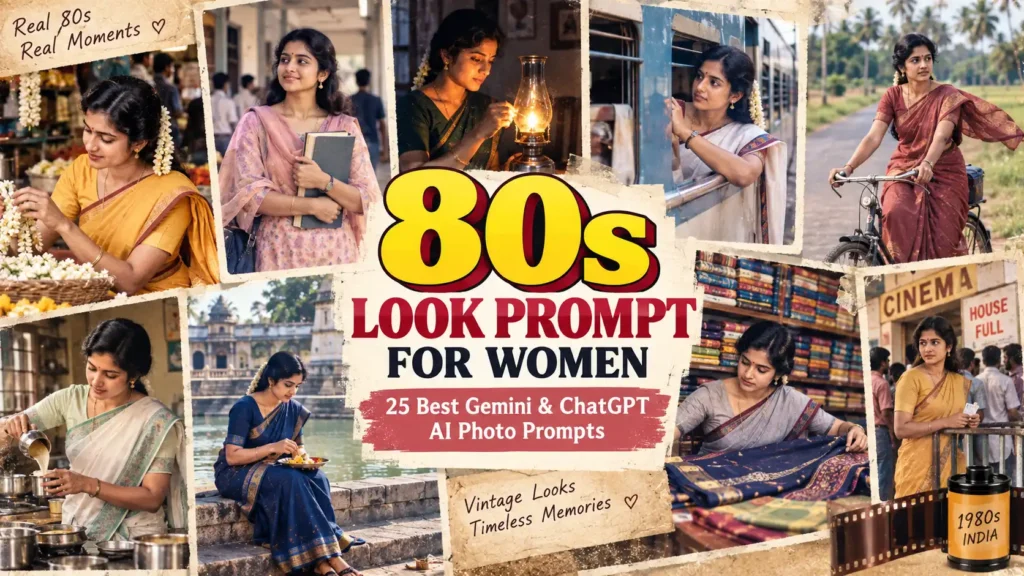
1. 1983 Tamil Nadu Flower Market Morning
This prompt avoids the usual posed saree portrait and instead captures an ordinary early-morning market moment filled with flowers, movement and natural 1980s street light.
Transform my uploaded photograph into an authentic Tamil Nadu flower-market photograph captured in 1983. Preserve my exact facial identity, facial proportions, eyes, nose, lips, skin tone, hairline, natural asymmetry and recognizable features. Do not beautify, reshape or replace my face.

Dress me in a simple soft turmeric-yellow cotton saree with a narrow maroon border and a modest matching blouse appropriate to everyday 1980s Tamil Nadu. Keep the saree drape practical rather than glamorous. Style my hair in a naturally tied low braid with a small amount of fresh jasmine, without modern salon styling or exaggerated makeup.

Place me inside a busy early-morning flower market with cane baskets filled with jasmine, kanakambaram and marigolds, old weighing scales, banana-leaf bundles, wet stone flooring and small vendors arranging flowers by hand.

Do not create a model pose. Capture the exact instant when I lift one jasmine garland to inspect its freshness while a loose strand unexpectedly slips from the basket and falls across my wrist. My attention should remain on the flowers rather than the camera.

Use cool dawn shade mixed with narrow warm shafts of morning sunlight entering between market roofs. Reproduce genuine early-1980s colour-negative photography with fine irregular grain, modest dynamic range, gentle optical softness, slightly imperfect white balance and natural colour fading.

Avoid luxury jewellery, modern handbags, LED lights, digital payment boards, synthetic fashion sarees, artificial bokeh and cinematic colour grading. The final image must feel like a real 1983 market photograph found decades later inside an old family album.
2. 1985 Madras College Veranda Portrait
This concept recreates a quiet college moment instead of using the usual standing-campus portrait.
Use my uploaded photo as the exact identity reference and recreate me as a college student photographed in Madras in 1985. Preserve my real facial structure, skin tone, natural facial texture, hairline and recognizable identity without smoothing or beauty enhancement.

Dress me in a modest pastel peach cotton salwar kameez with a thin printed dupatta, flat sandals and a simple analog wristwatch. Keep the clothing historically believable and understated.

Place me along a long old college veranda with weathered cream walls, tall wooden windows, ceiling fans, rain trees outside and several period bicycles parked in the distance.

Do not make me stand facing the camera. Show me walking slowly while holding two textbooks and a notebook against my chest. Capture the precise instant when a sudden breeze lifts one end of my dupatta and I instinctively use one hand to bring it back into place while still holding the books.

Photograph the scene as if a friend used an affordable 35mm camera: leaf-filtered sunlight, uneven patches of brightness, mild edge softness, fine grain, slightly muted colours and imperfect amateur framing.

Remove smartphones, modern backpacks, contemporary footwear, glass buildings, trendy makeup and polished fashion photography. The result should feel like a real college memory preserved between the pages of an old notebook since 1985.
3. 1982 Tamil Home Courtyard Hair-Drying Moment
This prompt creates a private family-album feeling using an ordinary household moment instead of a public location.
Transform my uploaded portrait into an intimate Tamil household photograph captured in 1982 while preserving my exact real-world identity, facial structure, natural skin tone, hairline and age characteristics.

Dress me in a simple pale-green cotton saree with a narrow woven border and a plain blouse suitable for an ordinary morning at home. Use no heavy jewellery. Add only small traditional earrings and a tiny bindi if appropriate to my original appearance.

Place me inside the open courtyard of an old South Indian house with red oxide flooring, lime-washed walls, a brass water vessel, a wooden doorway, a clothesline and filtered sunlight falling through the open roof area.

Create a completely natural domestic action. Show me immediately after washing my hair, gently squeezing water from the lower end of my long wet hair using a thin cotton towel. At the exact shutter moment, a few droplets should fall toward the floor while I briefly glance toward someone entering through the doorway.

Use soft late-morning ambient light with realistic indoor shadow depth, slightly warm skin tones, modest colour-negative grain, gentle optical softness and restrained contrast.

Avoid fashion poses, salon-styled hair, luxury interiors, modern plastic buckets, LED lighting, glossy sarees and cinematic beauty lighting. The finished image should resemble a private 1982 family photograph that was never intended for anyone outside the household.
4. 1984 Tamil Wedding Kitchen Candid
Rather than posing inside the wedding hall, this prompt moves behind the celebration into the busy preparation area.
Use my uploaded photograph as the exact identity reference and recreate me during a Tamil wedding in 1984. Preserve my real face, natural skin texture, facial proportions, eyes, nose, lips and hairline exactly.

Dress me in a rich but believable deep-rust silk-cotton saree with a narrow traditional border, modest gold-toned earrings and a small jasmine arrangement in my hair. Keep jewellery restrained and historically plausible for a family member helping at the wedding.

Place me not in the decorated wedding stage but inside the busy side kitchen of an old marriage hall. Include large brass and steel vessels, banana leaves stacked for serving, steaming rice containers, filter-coffee tumblers and several helpers moving naturally in the background.

Capture the instant when I hold a stack of clean banana leaves against one hip while using my free hand to prevent the top leaf from sliding to the floor. I should be smiling slightly toward someone outside the frame rather than posing toward the photographer.

Use direct on-camera flash mixed with warm tungsten hall light and natural spill from a side doorway. Reproduce realistic 1980s wedding-film characteristics: brighter foreground exposure, darker background falloff, fine grain, slightly warm colour printing and mild flash shadow.

Avoid modern catering equipment, LED decorations, designer wedding aesthetics, excessive jewellery, artificial skin smoothing and cinematic bokeh. The final image should feel like one unnoticed but deeply believable frame from a real 1984 Tamil wedding album.
5. 1981 Rural Bus Stop in Light Rain
This scene uses rain, an old bus shelter and a small practical action to create a completely different 80s mood.
Preserve my exact identity from the uploaded image and recreate me as an adult woman waiting at a rural Tamil Nadu bus stop during light monsoon rain in 1981.

Dress me in a muted indigo cotton saree with a thin off-white border, practical blouse and simple sandals. Keep the saree slightly darkened in a few places from rain. Style my hair in a low braid with no modern fashion treatment.

Place me beneath a small weathered concrete bus shelter beside a wet rural road. Include a faded route board, puddles, banana plants, an old bicycle, distant tiled houses and a period-appropriate bus barely visible approaching through the rain.

Do not make me pose. Capture the exact moment when wind pushes light rain under the shelter and I use one hand to pull the saree pallu slightly closer around my shoulder while holding a cloth shopping bag in the other hand.

Use soft grey monsoon daylight, wet-road reflections, restrained colour saturation, subtle film grain, slight humidity haze and natural low contrast typical of an ordinary consumer camera in rainy weather.

Avoid dramatic storm clouds, glamorous rain photography, modern umbrellas, synthetic handbags, contemporary buses, neon lighting and cinematic blue grading. The result must feel like an ordinary 1981 travel photograph taken while waiting for the bus.
6. 1986 Old Tailoring Class Portrait
This prompt explores a rare 1980s learning environment built around sewing, cloth and concentration.
Transform my uploaded image into a realistic photograph of me attending a small women's tailoring class in South India in 1986. Preserve my exact face, facial proportions, natural skin texture, hairline, age and recognizable identity.

Dress me in a modest cream salwar kameez with tiny printed motifs and a muted green dupatta. Keep makeup minimal and period appropriate.

Place me inside a narrow community tailoring room with several black treadle sewing machines, wooden stools, folded fabrics, chalk marks, measuring tapes, pattern paper and an old wall clock. Keep other learners secondary and naturally occupied.

Do not create a seated portrait. Capture the instant when I am guiding a piece of fabric beneath the sewing-machine foot and the upper thread suddenly loosens. Show my expression changing slightly as I notice it while one hand remains on the fabric.

Light the room with strong daylight entering from high windows mixed with weak old fluorescent illumination. Preserve realistic mixed colour temperature, soft film shadows, fine grain, moderate contrast and slightly imperfect focus.

Avoid modern electric sewing machines, fashion-school interiors, ring lights, designer outfits, glamour makeup and staged classroom poses. The final photograph should feel like a genuine 1986 learning moment documented by someone visiting the class.
7. 1983 Village Well Morning
Here the portrait is built around water, movement and a traditional village routine rather than a decorative rural background.
Use my uploaded portrait as the exact identity reference and recreate me during an ordinary village morning in Tamil Nadu in 1983. Preserve my exact facial identity, skin tone, facial structure, hairline and natural appearance.

Dress me in a simple brick-red cotton saree with a narrow mustard border and a plain matching blouse. Keep jewellery minimal with only small earrings and thin bangles.

Place me beside an old stone-lined village well under partial shade from a large neem tree. Include a coiled rope, brass water pot, rough stone platform, damp earth, an old tiled house and a few distant coconut trees.

Do not make me stand elegantly with the pot. Capture the exact instant after I have drawn water and am transferring the rope from one hand to the other while the brass pot swings very slightly above the well platform.

My attention should be on controlling the movement of the vessel rather than on the camera.

Use bright early-morning sunlight broken by tree shade, realistic highlights on brass, natural skin texture, moderate 35mm grain, mild warm colour response and slightly imperfect exposure between sun and shade.

Avoid fantasy village styling, excessive jewellery, pristine costumes, dramatic backlight, modern plastic containers and cinematic rural imagery. The final image should resemble a truthful 1983 household photograph captured during a routine morning task.
8. 1985 Indian Railway Window Departure
This railway prompt focuses on the emotional moment before departure without turning the scene into a cinematic farewell.
Convert my uploaded photograph into an authentic Indian railway departure photograph from 1985 while preserving my exact facial identity, natural skin texture, facial proportions and hairline.

Dress me in a modest soft-rose cotton saree with a narrow printed border, simple earrings and an ordinary analog wristwatch. Keep my hairstyle practical with a low braid or neatly tied hair appropriate to the period.

Seat me beside the barred window of an older Indian passenger train just before departure. Include the metal window frame, blue-grey coach interior, a cloth travel bag, stainless-steel water container and a busy platform outside with passengers and porters naturally blurred.

Do not create a dramatic crying farewell. Capture the quieter second when I reach one hand through the open barred window to receive a small paper packet from someone standing on the platform. My eyes should remain on the packet rather than the camera.

Use late-afternoon station light mixed with darker coach interior exposure. Reproduce genuine colour-film behaviour with fine grain, mild underexposure inside the carriage, warm outdoor highlights, slight motion softness and natural lens contrast.

Avoid modern train interiors, trolley luggage, smartphones, cinematic tearful expressions, luxury wardrobe and artificial portrait blur. The final image should feel like one ordinary but emotionally valuable 1985 departure photograph from a family album.
9. 1982 Old Book Lending Library
This prompt uses an old neighbourhood lending library and a tiny paper detail to make the image feel visually unique.
Preserve my exact identity from the uploaded photo and recreate me inside a small neighbourhood lending library in India in 1982. Keep my real facial proportions, skin tone, eyes, nose, lips, hairline and natural features unchanged.

Dress me in a muted teal cotton saree with a narrow printed edge and a simple blouse. Add only small earrings and a modest bindi if appropriate.

Build a narrow old lending library with dark wooden shelves, paper membership cards, handwritten issue registers, stamped due-date slips, stacks of used books and a slowly rotating ceiling fan. Keep visible book titles generic or indistinct.

Do not create a conventional reading pose. Capture the exact moment when I open a borrowed book at the counter and a small old library slip falls from between the pages. My eyes should follow the falling paper while one finger still holds my place in the book.

Use side-window daylight mixed with dim interior ambient light, producing naturally dense shadows, fine grain, slightly muted colours, realistic optical softness and modest 1980s film contrast.

Avoid computers, barcode scanners, modern furniture, designer libraries, contemporary book covers and cinematic lighting. The result should feel like a quiet 1982 neighbourhood memory accidentally documented on film.
10. 1984 Tamil Seaside Evening with Jasmine
Instead of a glamour beach portrait, this prompt captures a simple wind-driven moment involving hair, jasmine and the sea.
Use my uploaded image as the exact identity reference and recreate me on a Tamil Nadu seaside in 1984. Preserve my exact facial identity, skin tone, natural hairline, facial proportions and realistic skin texture.

Dress me in a soft lavender cotton saree with a narrow dark border and a plain blouse. Style my hair in a long braid decorated lightly with jasmine. Keep accessories minimal and period appropriate.

Place me on a modest public beach during early evening with damp sand, a few distant fishing boats, ordinary families far behind and a wooden snack cart blurred in the background.

Do not create a posed sunset portrait. Capture the exact second when a strong sea breeze loosens one small section of jasmine from my braid and I turn slightly while reaching back with one hand to secure it before it falls.

Let the saree pallu and a few loose hair strands respond naturally to the same wind.

Use soft low evening sunlight, slightly cool sea shadows, warm but restrained skin colour, mild 35mm grain, natural lens flare near one edge and imperfect handheld framing.

Avoid luxury beachwear, modern skyline, orange cinematic sunset, dramatic fashion poses, artificial bokeh and glamour makeup. The final image should look like a believable 1984 family photograph taken during an ordinary evening by the sea.
11. 1987 Radio Song Listening Moment
This indoor concept is built around the small anticipation of tuning an old radio and hearing a favourite song begin.
Transform my uploaded photograph into an intimate 1987 South Indian home photograph while preserving my exact facial identity, natural skin texture, facial proportions, hairline and recognizable features.

Dress me in a simple pale maroon house saree with tiny printed motifs and a plain blouse. Keep the hairstyle casual and practical, with no elaborate accessories.

Place me beside a wooden table inside a modest living room containing an old tabletop radio, lace-covered shelf, steel tumbler, printed curtain, wall clock and a few framed family photographs kept indistinct.

Do not make me sit facing the camera. Capture the exact moment when I slowly turn the radio tuning dial and suddenly recognize the beginning of a favourite song. Let a very small natural smile begin to appear while my head turns slightly toward the speaker.

Use late-afternoon window light mixed with warm interior tungsten illumination. Preserve realistic colour imbalance, fine grain, soft shadow transitions, gentle halation around the bulb and modest lens sharpness.

Avoid modern electronics, Bluetooth speakers, LED lights, luxury interiors, cinematic expressions and excessive nostalgia props. The image should feel like an ordinary 1987 household moment whose emotional value became visible only many years later.
12. 1981 Traditional Photo Studio with Hand-Painted Backdrop
This studio prompt deliberately recreates the visual imperfections of local portrait photography instead of producing a modern retro fashion image.
Use my uploaded photograph to recreate a formal Indian women's studio portrait exactly as a modest local photo studio might have produced in 1981. Preserve my exact facial identity, natural facial asymmetry, skin texture, eyes, nose, lips and hairline.

Dress me in a deep bottle-green saree with a fine traditional border and a simple fitted blouse appropriate to the early 1980s. Add small gold-toned earrings, a thin chain and a modest bindi. Keep jewellery restrained.

Seat me on a simple wooden studio chair at a slight three-quarter angle. Place one hand naturally over the other rather than using a modern fashion pose.

Behind me, use a hand-painted cloth backdrop depicting an intentionally soft imaginary garden with vague trees, a painted balustrade and distant sky. The fabric must show tiny folds, brush texture and imperfect alignment.

Use direct studio flash positioned slightly above camera height, producing small eye catchlights, a modest shadow on the painted background and naturally brighter facial exposure.

Reproduce an old professionally developed colour print with gentle optical softness, slight chemical colour variation, fine grain, modest contrast and natural skin texture.

Avoid dramatic beauty lighting, modern seamless backdrops, designer sarees, excessive jewellery, artificial skin smoothing and cinematic retouching. The final result must convincingly resemble an original Indian studio photograph that remained protected inside a family album since 1981.
13. 1983 Tamil Village Post Office Afternoon
This prompt recreates a rarely seen 1980s moment: writing and posting a personal letter at a small village post office.
Transform my uploaded photograph into an authentic Tamil Nadu village post-office photograph captured in 1983. Preserve my exact facial identity, eyes, nose, lips, facial proportions, natural skin texture, skin tone, hairline and recognizable features. Never beautify, reshape or replace my face.

Dress me in a muted terracotta cotton saree with a narrow cream woven border and a simple matching blouse. Style my hair in a practical low braid with only small earrings and thin bangles. Keep the appearance appropriate to an ordinary afternoon rather than a special occasion.

Place me outside a tiny old village post office with sun-faded lime walls, a weathered wooden doorway, a simple red letter box, a wooden writing ledge, paper envelopes, an old wall notice and a bicycle resting beneath the veranda. Keep all readable wording generic and historically plausible.

Do not make me pose beside the letter box. Capture the exact moment when I have finished writing an address on an envelope and a sudden breeze begins lifting the loose postage receipt from the wooden ledge. One hand should instinctively reach to stop the paper while the sealed envelope remains in my other hand.

Let the composition feel slightly accidental, as if a family member standing several steps away raised an ordinary camera at exactly that second.

Use dry late-afternoon sunlight entering diagonally beneath the veranda, with warmer exterior highlights and naturally cooler shade around my face. Simulate early-1980s colour-negative film with fine irregular grain, modest dynamic range, slight colour fading, soft optical detail and small exposure inconsistencies.

Avoid modern courier branding, smartphones, plastic parcel bags, digital displays, contemporary fashion, glamour makeup, artificial bokeh and cinematic colour grading. The final image should feel like a forgotten 1983 photograph connected to a personal letter whose story is known only to the people in the photograph.
14. 1986 Madras Terrace Before a Sudden Summer Rain
Instead of photographing the rain itself, this concept captures the few hurried seconds when the first drops arrive and clothes have to be rescued from the terrace.
Use my uploaded photo as the exact identity reference and recreate me on the terrace of a modest Madras home in 1986, during the first unexpected drops of a summer rain. Preserve my real face, facial structure, skin tone, hairline, natural asymmetry and age exactly.

Dress me in a simple powder-blue cotton saree with tiny white woven motifs and a practical blouse. Keep my hair loosely braided and my appearance completely ordinary, with no elaborate jewellery or fashion styling.

Build an authentic flat-roof terrace with a weathered parapet, metal clothesline, freshly washed cotton clothes, an aluminium bucket, old television antenna, neighbouring tiled and concrete rooftops and dark rain clouds beginning to gather beyond the houses.

Create action rather than a portrait. Capture the instant when the first large raindrops begin landing and I hurriedly pull two nearly dry pieces of clothing from the line. One cloth should still be caught by a wooden peg, causing it to stretch slightly as I reach toward it.

Allow a few raindrops to darken small spots on the terrace floor while the distant neighbourhood remains brighter beneath the last sunlight.

Photograph the moment with the limitations of an ordinary 1986 family camera: changing natural light, slightly uncertain exposure, modest shutter speed, tiny motion softness in the moving fabric, realistic grain and restrained colour.

Avoid dramatic lightning, cinematic storm clouds, fashion poses, modern apartment towers, plastic designer laundry baskets and digitally perfect rain effects. The finished image should feel like a genuine household photograph taken seconds before everyone rushed downstairs.
15. 1982 Small-Town Bangle Shop Reflection
Glass reflections, colourful bangles and a tiny selection gesture give this prompt a visual character completely different from the other 80s scenes.
Preserve my exact identity from the uploaded photograph and recreate me inside a small South Indian bangle shop in 1982. Maintain my real facial proportions, eyes, nose, lips, skin texture, complexion, hairline and natural appearance.

Dress me in a subdued magenta cotton saree with a thin navy woven border and a plain blouse. Use a small bindi, simple earrings and minimal existing jewellery so the new bangles remain the visual detail of the moment.

Construct a narrow traditional shop with cylindrical stacks of glass bangles arranged by colour, old wooden shelves, a slightly aged counter mirror, cardboard storage boxes and soft daylight entering from the street.

Do not make me display bangles toward the camera. Capture me while testing a small group of deep-blue glass bangles on one wrist. Freeze the instant when I raise my wrist slightly toward the old mirror to compare the colour against my saree.

Use the mirror only as a secondary compositional layer. It should reveal a believable partial reflection from another angle, with minor age marks and imperfect reflection clarity rather than digital mirror perfection.

Illuminate the scene using reflected street daylight mixed with a weak warm bulb inside the shop. Reproduce realistic 1982 film response with rich but restrained glass colours, gentle grain, slightly imperfect white balance, soft highlights and natural shadow density.

Avoid luxury jewellery-store lighting, gold-heavy styling, modern display cabinets, LED strips, glamour poses and excessive colour saturation. The result should resemble a genuine small-town shopping photograph from 1982 rather than a modern jewellery advertisement.
16. 1985 Tamil Nadu Sugarcane Juice Stall
This outdoor prompt uses harsh midday light, moving machinery and a simple refreshment stop to recreate an everyday 1980s street photograph.
Use my uploaded image as the exact identity reference and recreate me stopping at a roadside sugarcane juice stall in Tamil Nadu in 1985. Preserve my exact facial identity, natural skin texture, facial proportions, hairline and recognizable features.

Dress me in a soft off-white cotton saree with a narrow leaf-green border and a modest blouse. Keep my hairstyle practical with a low braid and minimal jewellery.

Place me beside a simple roadside sugarcane cart with stacked fresh sugarcane stalks, a period-appropriate manual or mechanically driven crushing machine, steel tumblers, a small metal container, cut lime and a faded cloth shade above the stall. Keep all branding absent.

Do not create a drinking pose. Capture the unusual instant immediately before the juice is handed to me: the vendor outside the main focus is pouring fresh juice between two steel tumblers to cool it while I use one hand to move a loose strand of hair away from my face after a passing vehicle creates a brief gust of wind.

Let one tall sugarcane leaf cross the extreme foreground slightly out of focus, creating natural depth as though the photographer was standing beside the cart rather than carefully composing the scene.

Use strong midday Indian sunlight, hard but truthful shadows, reflected green light from the sugarcane, slightly warm 1985 colour-film response, fine grain and ordinary handheld-camera sharpness.

Avoid modern disposable cups, electric branding, stainless luxury carts, beauty lighting, staged smiles and commercial beverage photography. The image should feel like an unimportant roadside stop that accidentally became a memorable family photograph.
17. 1987 Evening Power-Cut Lamp Moment
This prompt deliberately removes normal electric lighting and uses a sudden household power cut to produce one of the most distinctive images in the collection.
Transform my uploaded photograph into an intimate South Indian household photograph from 1987 captured during an unexpected evening power cut. Preserve my exact facial identity, facial proportions, natural skin texture, complexion, hairline and recognizable features without beautification.

Dress me in a modest dark-teal cotton house saree with a small repeating print and a plain blouse. Keep my hair casually braided and accessories minimal.

Place me inside a modest 1980s living room with a wooden window, patterned curtain, cane chair, old wall clock, switched-off ceiling fan, small bookshelf and a dark tabletop radio. Every electric light in the room must clearly be off because of the power failure.

Create the story around the instant light returns to the room in another form. Show me standing beside a wooden table while carefully lighting a traditional kerosene hurricane lamp with a match. Capture the exact second after the wick catches: the tiny flame has just grown bright enough to illuminate my fingers and lower face while the used match is still glowing faintly.

Keep the room substantially darker than the flame-lit area, but preserve enough shadow information to reveal the period environment. Add a trace of natural blue evening light through the window for realistic colour contrast.

Simulate high-speed 1980s consumer film used in difficult low light: visible but organic grain, slightly soft focus, warm lamp highlights, deep shadows, restrained colour information and mild exposure uncertainty.

Do not turn the scene into a cinematic candle portrait. Avoid glamorous lighting, modern emergency lamps, smartphones, inverter indicators, LED bulbs, dramatic VFX and artificially perfect facial illumination. The final photograph should feel technically imperfect yet emotionally authentic, like a rare family snapshot taken during an ordinary 1987 power cut.
18. 1984 Temple Tank Steps After Morning Prayer
This traditional setting focuses on a quiet action after prayer rather than placing the subject in a generic devotional pose.
Use my uploaded photograph as the exact identity reference and recreate me beside a traditional Tamil temple tank in 1984 after an ordinary morning visit. Preserve my exact face, natural skin tone, facial proportions, hairline and recognizable identity.

Dress me in a muted crimson cotton saree with a narrow mustard woven border and a conservative blouse. Add small traditional earrings, thin bangles, a modest bindi and a short natural jasmine strand in my braid. Do not use bridal jewellery.

Place me on old stone steps descending toward a calm temple tank. Include weathered stone surfaces, subtle water reflections, a few floating leaves, distant temple architecture and one brass plate containing a few flowers. Keep the environment peaceful and historically believable.

Do not make me stand with folded hands facing the camera. Capture the exact moment after prayer when I am stepping upward from the lower stone level while carefully using one hand to prevent the edge of my saree from touching the damp step. In my other hand, hold the small brass flower plate naturally at waist level.

Let my gaze remain directed toward the next stone step rather than the photographer.

Use clear early-morning sunlight reflected softly from the tank water, realistic highlights on brass, warm stone tones, natural skin texture, fine 35mm grain and slightly faded 1980s colour rendering.

Avoid supernatural glow, divine VFX, luxury temple fashion, dramatic devotional posing, modern railings, LED lighting and cinematic colour grading. The final image should look like a personal 1984 temple-visit photograph rather than religious promotional artwork.
19. 1983 Kitchen Window Filter Coffee Morning
This close household scene recreates the texture of an old Tamil kitchen through stainless steel, steam, window light and a small everyday mistake.
Preserve my exact facial identity from the uploaded image and recreate me inside a modest Tamil household kitchen in 1983. Maintain my real face, skin texture, facial proportions, complexion, hairline and natural features exactly.

Dress me in a simple burnt-orange cotton saree with a narrow cream border and plain blouse. Keep my hair tied practically for household work and use only minimal everyday jewellery.

Construct an authentic kitchen with a dark stone counter, stainless-steel filter coffee maker, brass and steel vessels, small spice containers, an old wooden window, a cotton kitchen cloth and morning sunlight entering from one side. Avoid modern modular cabinetry.

Create a precise everyday action. Show me pouring hot filter coffee from one stainless-steel tumbler into a dabarah to cool it. Capture the fraction of a second when the stream lands slightly off-centre and I instinctively adjust my wrist to prevent the coffee from spilling.

Allow a small curl of natural steam to cross the side light without hiding my face. My eyes should remain concentrated on the pouring coffee rather than looking at the camera.

Photograph the scene from slightly outside the kitchen doorway using a normal lens, creating the impression that another family member noticed the moment and quickly took the picture.

Use directional morning window light, subtle metallic reflections, realistic 1980s colour-negative grain, warm highlights, naturally dense kitchen shadows and slight focus softness.

Avoid contemporary coffee machines, induction stoves, modern cabinets, designer cookware, beauty posing and cinematic food photography. The final image should feel like a genuine 1983 household memory where the smell of morning coffee almost seems preserved in the photograph.
20. 1986 Record Shop Listening Counter
Music becomes the centre of this unusual prompt, with the photograph capturing the first reaction to a record rather than a standard portrait.
Transform my uploaded image into an original photograph taken inside a small Indian music and record shop in 1986. Preserve my exact facial identity, natural skin texture, facial proportions, eyes, nose, lips, hairline and recognizable appearance.

Dress me in a muted mustard salwar kameez with a deep-brown dupatta, simple earrings and an ordinary analog wristwatch. Keep the styling modest and historically appropriate.

Create a narrow shop containing vinyl records in wooden compartments, audio cassettes behind the counter, paper sleeves, a period turntable, small speakers and handwritten category cards. Keep all album artwork and names fictional, generic or unreadable.

Do not make me pose holding a record toward the camera. Capture me at a small listening counter immediately after the shopkeeper has started playing a record. One hand should lightly hold the edge of an open record sleeve while my expression shows the subtle first recognition of a song I know.

Add a tiny storytelling detail: the paper inner sleeve should be beginning to slide from the outer cover, and my other hand should instinctively move underneath to catch it.

Use warm shop lighting mixed with brighter street daylight from the entrance, creating believable mixed exposure. Simulate 1986 consumer colour film with fine grain, soft highlights, modest saturation, slight optical softness and natural shadow density.

Avoid modern headphones, CDs where historically inappropriate to the specific shop concept, digital screens, LED lighting, recognizable copyrighted album art, fashion poses and music-video aesthetics. The finished image should resemble a rare personal photograph taken during an ordinary visit to a neighbourhood record shop.
21. 1982 Village School Teacher Blackboard Moment
This prompt uses chalk dust, window light and classroom activity to create a professional 1980s portrait without turning it into a formal staff photograph.
Use my uploaded photograph as the exact identity reference and recreate me as an adult teacher inside a modest Tamil Nadu school classroom in 1982. Preserve my exact facial structure, skin tone, natural skin texture, hairline and recognizable identity.

Dress me in a simple navy-blue cotton saree with a narrow off-white border and a conservative blouse. Add a small bindi, simple earrings and an inexpensive analog wristwatch. Keep the appearance practical for a normal teaching day.

Construct an old classroom with lime-washed walls, a large blackboard, wooden desks and benches, open high windows, a ceiling fan and a simple teacher's table. Any writing visible on the blackboard should be generic and unobtrusive.

Do not make me stand formally beside the blackboard. Capture me during teaching while I am erasing one section with a traditional duster. Freeze the instant when a small cloud of chalk dust catches a beam of sunlight from the side window and I turn slightly toward a student outside the frame who has asked a question.

Keep students either outside the frame or softly secondary so the image remains centred on the photographic moment rather than identifiable children.

Use bright window daylight with naturally darker classroom corners, visible but delicate chalk particles, moderate film grain, restrained colour and realistic 1982 lens softness.

Avoid smart boards, whiteboards, projectors, modern school furniture, glamour makeup, staged teacher poses and cinematic classroom lighting. The final image should feel like a candid photograph from an ordinary school day in 1982.
22. 1985 Saree Shop Fabric Selection
Rather than simply displaying a beautiful saree, this prompt captures the physical act of choosing fabric inside an old textile shop.
Preserve my exact identity from the uploaded photograph and recreate me inside a traditional South Indian textile shop in 1985. Keep my facial proportions, skin tone, natural texture, hairline and recognizable features unchanged.

Dress me in a modest pale-grey cotton saree with a narrow burgundy border so the fabrics being examined remain visually distinct from what I am already wearing. Add only simple everyday jewellery.

Place me seated naturally near a low textile counter surrounded by neatly folded cotton sarees stacked inside old wooden shelves. Include brown paper wrapping, cotton string, a wooden cash drawer and a slowly rotating ceiling fan. Avoid modern branding.

Do not make me pose while holding a saree toward the camera. Instead, capture the exact moment when I spread part of a deep indigo handloom saree across the counter to inspect its woven border, while a second folded saree beneath it begins slipping slowly toward the edge.

Show one hand lightly smoothing the fabric surface while the other instinctively reaches to stop the lower saree from falling. My eyes should remain focused on the weave and border, not on the camera.

Add subtle authentic shop details: slightly uneven wooden shelving, faint chalk inventory marks, paper tags tied with cotton thread, a measuring stick resting against the counter and soft layers of fabric colour receding into the background.

Use bright daylight entering from the open shopfront mixed with warm interior illumination. Let the foreground fabric catch richer light while the deeper shelves remain slightly darker, creating natural depth without artificial blur.

Reproduce believable mid-1980s colour-film photography with fine irregular grain, restrained saturation, realistic fabric texture, moderate lens softness, gentle highlight roll-off and slightly imperfect colour balance.

Avoid luxury showroom interiors, glass display walls, LED lighting, designer-brand aesthetics, excessive jewellery, fashion-model posing and modern catalogue photography. The final image should feel like an ordinary but visually rich 1985 shopping moment preserved on film.
23. 1983 Cinema Ticket Queue in Madras
This prompt captures the energy of an old single-screen cinema through waiting, paper tickets and crowd movement rather than copying a movie-poster look.
Use my uploaded image as the exact identity reference and recreate me outside a busy single-screen cinema in Madras in 1983. Preserve my exact face, natural skin texture, facial proportions, hairline and recognizable appearance.

Dress me in a modest mustard-yellow cotton saree with a narrow dark-green border and a plain blouse. Keep jewellery simple and period appropriate, with a small bindi and naturally braided hair.

Place me in a side queue near an old ticket window framed by worn painted walls, iron railings, torn paper-poster layers, incandescent bulbs and hand-painted show-time boards. Keep all film names, faces and posters fictional or unreadable.

Do not make me stand still looking at the camera. Capture the instant when the queue moves forward unexpectedly and I use one hand to keep a folded paper ticket safely inside a small cloth purse while stepping around another person's fallen paper stub on the ground.

Keep surrounding people softly secondary and naturally arranged, with just enough motion to suggest the crowd without stealing focus.

Use warm early-evening light mixed with tungsten bulbs near the cinema entrance. Reproduce realistic 1983 colour-film behaviour with fine grain, mild halation around bulbs, modest shadow detail, slightly warm highlights and natural handheld framing.

Avoid modern multiplex design, digital screens, celebrity posters, LED signage, glamorous red-carpet styling and cinematic bokeh. The finished image should resemble a real memory from an ordinary cinema outing in 1983.
24. 1986 Village Bicycle Ride with Saree Pallu in the Wind
This prompt creates motion through an everyday rural bicycle ride, but avoids turning it into an action shot or modern lifestyle image.
Transform my uploaded photograph into an authentic South Indian village bicycle photograph from 1986 while preserving my exact facial identity, facial proportions, skin tone, natural hairline and recognizable features.

Dress me in a practical dusty-rose cotton saree with a narrow cream border and a plain blouse suitable for everyday travel. Keep the saree drape secure and historically believable. Tie my hair in a low braid with minimal jewellery.

Place me on a simple period-correct ladies' bicycle travelling along a narrow village road bordered by paddy fields, low stone edges, coconut trees, irrigation channels and a few distant tiled-roof houses.

Do not create a dramatic cycling pose. Capture the precise moment when a stronger side breeze lifts the loose end of my saree pallu and I briefly use one hand to secure it closer to my shoulder while the bicycle continues moving slowly.

Keep my posture balanced and practical, with my eyes directed toward the road ahead rather than the camera.

Photograph the scene from slightly behind and to one side, as though another family member riding or walking nearby quickly took the picture. Allow a little natural wheel motion softness and a small foreground blur from roadside grass.

Use clear late-afternoon sunlight, realistic long shadows, warm but restrained 1986 colour-film rendering, fine grain, ordinary lens sharpness and modest dynamic range.

Avoid modern sports bicycles, helmets, designer sarees, dramatic flying fabric, fashion-editorial posing, drone perspectives and cinematic colour grading. The final photograph should feel like a real rural journey accidentally preserved on film.
25. Lost 1980s Women’s Family Album Master Prompt
The final prompt is intentionally flexible. It asks the AI to invent a completely original 1980s moment while keeping the woman’s identity, period accuracy and analogue-photo realism at the centre.
Transform my uploaded photograph into an entirely original Indian women's family photograph that appears to have been genuinely captured sometime between 1981 and 1987.

IDENTITY:
Preserve my exact real-world identity with maximum fidelity: same facial structure, eyes, eyebrows, nose, lips, jawline, ears, skin tone, natural asymmetry, hairline and age characteristics. Keep realistic pores and normal skin texture. Never replace my face with a generic AI woman, celebrity-like face or beautified version.

SCENE:
Invent one believable everyday 1980s South Indian situation that has not been used as a generic retro portrait. Choose a real-life environment such as a flower market, college corridor, textile shop, post office, household kitchen, village road, temple tank, lending library, railway carriage, tailoring room, terrace, old cinema queue, radio room or another historically plausible location.

Do not build the image around glamour. Build it around ordinary life.

WARDROBE:
Choose historically believable women's clothing appropriate to the selected location and year. Use cotton sarees, simple salwar kameez, practical blouses, modest jewellery, small bindis, natural braids, jasmine or other details only when they fit the scene.

Avoid bridal styling unless the scene specifically requires it. Never use modern designer fashion disguised as vintage clothing.

HUMAN ACTION:
Create one very specific small action that explains why the photograph was taken at that exact second.

Possible actions include catching a slipping fabric, securing jasmine in the wind, turning a radio dial, preventing paper from blowing away, adjusting a saree fold before stepping over water, examining a woven border, carrying banana leaves, receiving a railway packet, lighting a lamp during a power cut, turning a book page or reacting to another ordinary event.

Do not make me stand motionless in the middle of the frame with a generic smile.

PERIOD WORLD:
Every visible object must belong naturally to the chosen year. Use historically plausible household items, furniture, shops, public transport, tools, packaging, architecture, signs, textiles and street details.

Remove smartphones, modern cars, LED lighting, digital screens, contemporary plastic packaging, modern branding, present-day appliances and anything that breaks the historical illusion.

CAMERA:
Recreate genuine consumer-film photography rather than a modern digital portrait with a retro filter.

Use ordinary 35mm camera behaviour: fine irregular grain, slightly imperfect focus, modest dynamic range, naturally dense shadows, gentle highlight roll-off, subtle colour ageing, slight white-balance inconsistency and realistic optical softness.

Allow tiny exposure imperfections and natural handheld framing. Do not overuse scratches, torn-paper overlays, fake dust or heavy sepia effects.

LIGHT:
Use lighting that genuinely belongs to the selected environment: harsh market sun, soft monsoon daylight, mixed tungsten and window light, direct wedding flash, cool dawn shade, household lamp light or another historically realistic source.

Never beautify the light into a modern commercial portrait setup.

COMPOSITION:
Use believable family-camera composition rather than poster design. Allow slightly off-centre framing, small foreground obstructions, natural background activity, imperfect spacing and subtle motion softness when the action requires it.

EMOTION:
The subject should behave as if the moment is completely ordinary and nobody knows that decades later the photograph will become nostalgic.

The emotional power should come from authenticity, not from exaggerated sadness, glamour, nostalgia or cinematic acting.

STRICTLY AVOID:
Modern retro fashion campaigns, luxury styling, cinematic teal-orange grading, HDR, artificial bokeh, hyper-sharp skin, beauty retouching, modern architecture, LED lighting, smartphones, present-day vehicles, influencer poses, fantasy effects, celebrity imitation and obvious AI aesthetics.

FINAL RESULT:
The final image must look so historically and photographically convincing that a viewer should initially believe it is a genuine original photograph discovered inside an old South Indian family album after more than forty years.
Some more you might like