1. 80s Trend — One Photo, Two Eras Through an Old Dressing Mirror
Use my uploaded photo as the exact facial identity reference. Preserve my recognizable face faithfully — facial structure, eyes, nose, lips, skin tone, natural age appearance, hairline, facial asymmetry, body proportions, and important identifying characteristics must remain consistent. Do not replace me with a generic attractive model, automatically make me younger, or beautify away my natural features.Create a photorealistic Indian 1980s transformation designed around an unusual mirror composition rather than a conventional retro portrait.
Respect my natural age and gender shown in the uploaded reference. Adapt clothing accordingly: authentic 1980s Indian everyday fashion such as a period-correct saree, salwar kameez, cotton shirt, trousers, kurta, veshti, or another culturally plausible outfit. Do not force one clothing type onto every person.
Place me inside a modest Indian home in approximately 1985, standing before an old wooden dressing mirror.
The entire GENERATED scene — including both me and my reflection — belongs to the 1980s. Do not literally show my modern clothing or create a split modern/retro body.
Instead, tell the transformation story through objects.
On the dressing table sits a small old printed photograph or photo envelope, suggesting that this portrait itself might someday become a memory. I have just picked it up and am comparing the tiny photograph with my reflection.
Capture the instant I notice some familiar detail in the old print and begin to smile.
Use the mirror to show my face clearly while my real shoulder and back appear softly in the foreground. Keep reflection geometry exact: same identity, same age, same outfit, same hand position, same hairstyle, and physically correct orientation.
Build an unmistakably mid-1980s Indian room: wooden dressing table, small comb, analog wristwatch, transistor radio, steel tumbler, cotton curtain, wall clock, wooden cupboard, red-oxide or terrazzo floor, and a partially open doorway.
Compose with a 50mm documentary perspective. The small printed photograph, my reflected eyes, and the real hand holding the print should form the three main visual anchors.
Natural window light should illuminate the reflected face from one side. A warm tungsten practical bulb deeper inside may provide restrained color contrast.
PERIOD LOCK: Everything visible must plausibly belong to India between 1983 and 1988. No smartphones, flat-screen TVs, LED bulbs, Wi-Fi devices, modern furniture, digital clocks, contemporary fashion, modern cosmetics, or recent household products.
Preserve natural Indian skin pores, individual hair strands, accurate hands and fingers, believable textile physics, correct mirror reflections, realistic environmental wear, and physically accurate shadows.
Use restrained 35mm film grain, gentle color-negative warmth, modest dynamic range, slight optical softness, and subtle lab-print character rather than heavy sepia or fake scratches.
The final image should feel like a photograph that collapses memory and identity into one believable 1980s frame — visually fresh enough for a current AI photo trend while remaining historically authentic. No text, no watermark, no duplicated face, no impossible reflection, no plastic skin, and no modern objects.
2. 80s Trend — Indian Bus Window Freeze-Frame Memory
Use my uploaded photograph as the strict facial identity reference. Preserve my real recognizable face, natural age, skin tone, facial proportions, eyes, nose, lips, hair characteristics, body proportions, and distinctive identifying features. Do not replace me with a generic retro model.Transform me into an authentic Indian city-bus passenger photographed during the mid-1980s.
Respect my natural age and gender. Dress me in practical period-correct Indian travel clothing appropriate to the person in my uploaded image. Use believable textiles, grooming, footwear, and accessories rather than exaggerated costume styling.
Place me beside an open window of a period-correct non-air-conditioned city bus during late afternoon.
Create a story-in-one-frame moment.
The bus has stopped briefly. A street photographer, friend, or family member outside apparently calls my name just as the bus is preparing to move again.
I turn toward the window, but instead of posing fully, capture the unfinished movement: shoulders remain oriented toward the aisle while my face has turned toward the voice.
A paper bus ticket remains loosely held between two fingers.
Outside the window, a cyclist begins moving in one direction while pedestrians cross in another, creating several layers of subtle motion around my relatively sharp face.
Build an authentic 1980s Indian street beyond the window: hand-painted storefronts kept too distant for readable generated text, bicycles, period buses and cars, old utility poles, tea stall, pedestrians in period clothing, and weathered buildings.
Inside show worn seating, painted metal rails, ticket stubs, conductor farther down the aisle, and another passenger naturally out of focus.
Compose from outside and slightly below the bus window using approximately a 50mm perspective. The metal window frame should create a strong frame-within-a-frame around my face.
Use a shutter character that keeps my face and nearest hand sharp while allowing restrained movement in the street and bus surroundings.
Late-afternoon sunlight should strike the exterior bus body and bounce softly into the window. Do not add artificial cinematic face glow.
PERIOD LOCK: India between 1983 and 1988. No smartphones, LED route boards, modern buses, QR ticketing, contemporary advertisements, modern backpacks, earbuds, current fashion, or present-day vehicles.
Preserve realistic window geometry, correct fingers, natural eye direction, believable fabric folds, skin pores, hair strands, painted-metal wear, physically accurate reflections, and environmental depth.
Use subtle consumer-film grain, slightly warm analog colors, mild motion character, modest dynamic range, and imperfect documentary framing.
The final image should feel like somebody captured one perfect fraction of a second from an ordinary 1980s bus journey — immediately recognizable as a retro Indian memory rather than a person merely wearing vintage clothes. No text, no watermark, no extra fingers, no distorted bus, no plastic skin, and no modern objects.
3. 80s Trend — The Photo Lab First-Reveal Reaction
Use my uploaded photo as the exact facial identity anchor. Preserve my recognizable face, facial anatomy, natural age, skin tone, eyes, nose, lips, hairline, hairstyle characteristics, and important identifying details. Do not transform me into a generic model or alter my age unnecessarily.Create a photorealistic Indian photo-lab scene from the mid-to-late 1980s centered around something people using instant digital photography rarely experience today: seeing developed film photographs for the first time.
Dress me according to my natural age and gender in authentic period-correct Indian everyday clothing. Keep styling modest and believable.
Place me at the glass counter of a neighborhood photo-development shop.
A shopkeeper has just returned a paper envelope containing prints from a roll of film I submitted several days earlier.
Capture the exact moment I pull out the FIRST photograph.
My eyes immediately lock onto the print. My expression begins changing because the photograph has turned out better, stranger, or more emotionally meaningful than expected.
Do not make me hold the picture toward the camera.
Let the viewer see only enough of the small print to understand that it contains a family, travel, celebration, or everyday memory. Keep faces inside the print tiny and indistinct.
Several unseen prints remain inside the envelope, creating anticipation about what I will discover next.
Build an authentic photo shop: glass counter, analog cameras, film canisters and boxes, paper photo envelopes, negative sleeves, wooden shelves, sample portraits kept visually small, ceiling fan, wall calendar, and a darkroom curtain or doorway farther behind.
Compose from the shopkeeper's side of the counter using a 50mm perspective. The print occupies the lower foreground, my hands sit immediately behind it, and my facial reaction becomes the dominant focal point.
Daylight from the storefront should illuminate the print and one side of my face. Interior fluorescent or tungsten fixtures may introduce slightly imperfect mixed color.
PERIOD LOCK: Indian photo lab between 1984 and 1989. No smartphones, digital cameras, memory cards, computers, inkjet printers, photo kiosks, LED lights, QR payments, or modern camera equipment.
PHOTO REALISM: Keep print dimensions, paper thickness, negative strips, film sprocket holes, envelope scale, fingers, and glass reflections physically plausible.
Preserve natural skin texture, individual hair strands, authentic clothing folds, subtle shop wear, and realistic shadows.
Use restrained 35mm grain, warm color-negative response, mild optical softness, modest dynamic range, and realistic lab-print color.
The image should capture the emotional core of the current retro-photo trend without looking like a template: the excitement is not merely “looking 80s,” but experiencing photography as people actually experienced it before instant previews existed. No text, no watermark, no extra fingers, no duplicated faces, and no modern technology.
4. 80s Trend — Doordarshan Antenna Family Signal Hunt
Use my uploaded photograph as the exact facial identity reference. Preserve my recognizable face, natural age, skin tone, facial structure, eyes, nose, lips, hair characteristics, and important identifying features. Do not replace me with a generic character or automatically de-age me.Create a culturally recognizable Indian household scene from the mid-1980s centered around adjusting a rooftop television antenna.
Respect my age and gender and dress me in authentic period-correct home clothing appropriate to the uploaded reference.
Place me safely on the flat rooftop of a modest Indian home beside a period-correct television antenna.
A family member downstairs is trying to tell me whether the television picture has improved.
Capture the exact moment I rotate the antenna only a few centimeters and then freeze, leaning my head toward the stairway opening to hear the response.
My expression should combine concentration, mild frustration, and amusement.
A second family member may appear safely in the rooftop doorway using hand gestures to communicate what somebody downstairs is saying. Their face must remain clearly distinct from mine.
Through the open rooftop-room doorway, show only a tiny glimpse of a period-correct CRT television displaying indistinct broadcast imagery. Do not reproduce recognizable copyrighted programming, logos, or readable text.
Build the rooftop with weathered parapet walls, old coaxial cable, clothesline, steel bucket, neighboring TV antennas, tiled and flat-roof houses, coconut foliage, utility wires, and evening birds.
Both feet must remain safely on the rooftop floor. No climbing onto parapets, chairs, antenna structures, or unstable objects.
Compose with a 35mm perspective so the antenna forms a strong diagonal across the upper frame while my hands and facial reaction remain clearly visible.
Use fading blue evening daylight as the main source. A warm tungsten bulb inside the stairway entrance creates a small secondary pool of light.
PERIOD LOCK: Indian residential setting between 1983 and 1988. No satellite dishes, DTH equipment, smartphones, flat-screen TVs, digital antennas, solar panels, LED lighting, CCTV cameras, Wi-Fi equipment, modern water tanks, or contemporary skyline.
Render the antenna, cable connections, hands, body balance, clothing, skin texture, rooftop wear, and shadows accurately.
Use high-speed analog film grain, subtle tungsten halation, realistic shadow density, restrained color, and documentary imperfection.
The final image should instantly communicate a real 1980s Indian memory even at thumbnail size: somebody on the terrace is searching for the perfect TV signal while the family waits downstairs. No text, no watermark, no unsafe behavior, no extra fingers, and no modern objects.
5. 80s Trend — Cassette Pencil-Rewind Close Portrait
Use my uploaded photo as the strict facial identity reference. Preserve my recognizable face faithfully — facial structure, eyes, nose, lips, skin tone, natural age appearance, hairline, facial asymmetry, and important identifying characteristics. Do not replace me with a generic retro model or artificially beautify my face.Create a highly recognizable but visually premium Indian 1980s cassette-memory photograph.
Respect my natural age and gender. Dress me in understated period-correct casual Indian clothing appropriate to the uploaded reference. Avoid neon synthwave styling, exaggerated Western retro costumes, and modern fashion.
Place me beside a small table or desk inside a modest Indian bedroom or living room.
A favorite audio cassette has developed a small amount of loose tape.
Instead of using the cassette player, I am carefully rotating one reel manually with a simple pencil — a familiar practical trick of the cassette era.
Capture the exact second I realize the tape has finally become properly tensioned.
One hand holds the cassette close enough to inspect it while the other turns the pencil carefully. My eyes focus on the cassette reel, and a subtle expression of satisfaction appears.
Do not make me look toward the camera.
Beside me place a period-correct cassette player or radio-cassette recorder, two or three cassette cases, folded newspaper, handwritten notebook whose text remains unreadable, mechanical or analog clock, and a cup or steel tumbler.
Keep the environment uncluttered enough that the cassette-and-pencil action is immediately understandable.
Use an intimate 50–85mm composition from table height. Make my face, fingers, pencil, cassette reels, and small length of magnetic tape the critical sharp plane.
LIGHTING: Soft daylight from a nearby window should illuminate the cassette edge and my face. A warm tungsten lamp farther behind may create gentle background separation.
CASSETTE ACCURACY: Use realistic compact-cassette proportions, two visible reels, magnetic tape path, plastic shell thickness, screw positions, and central holes compatible with the pencil. The tape must not float or form impossible loops.
PERIOD LOCK: India between 1983 and 1989. No smartphones, CDs where historically inappropriate, wireless headphones, Bluetooth speakers, LED lights, laptops, modern audio systems, contemporary furniture, or current fashion.
Preserve correct fingertips, natural fingernails, realistic cassette reflections, skin pores, hair strands, clothing wrinkles, and physically accurate shadows.
Use restrained 35mm grain, warm analog color, mild lens softness, and modest contrast.
The final photograph should make a viewer who remembers cassettes recognize the action instantly, while younger viewers understand the visual curiosity even without explanation. It should feel nostalgic because of authentic behavior, not because of fake sepia. No text, no watermark, no extra fingers, no malformed cassette, no plastic skin, and no modern objects.
6. 80s Trend — Rainy College Corridor with a Shared Newspaper
Use my uploaded photograph as the exact facial identity reference. Preserve my real recognizable face, natural age, facial proportions, eyes, nose, lips, skin tone, hair characteristics, and identifying features. If my reference is clearly older than college age, adapt me naturally as a lecturer, staff member, visitor, or adult without de-aging me.Create an authentic Indian monsoon campus photograph from the mid-1980s.
If age-appropriate, dress me in believable period-correct college clothing suited to my gender: modest salwar kameez, saree, cotton shirt and trousers, or another authentic outfit. Use a cloth shoulder bag, books, or notebooks instead of modern backpacks.
Heavy rain has temporarily trapped several people beneath a long college veranda.
Instead of simply showing everyone waiting, create a small shared-information moment.
I am holding one side of a large newspaper while another student or colleague holds the opposite side. We are both reading the same interesting article, examination notice, sports result, or news item.
At the exact moment of the photograph, a strong gust blows rain beneath the veranda and folds one upper corner of the newspaper over itself.
Both of us react instinctively to save the paper, producing natural overlapping movement without losing anatomical accuracy.
Keep any newspaper text unreadable and non-specific.
Behind us show weathered college walls, high wooden doors, old notice boards, parked roadster bicycles, puddles, mature rain trees, and students moving deeper into shelter.
Compose from farther down the veranda with a 35mm perspective. Repeating pillars create depth while the open newspaper forms a strong geometric shape in the middle of the frame.
Grey monsoon daylight from the courtyard should illuminate faces softly. Wet-floor reflections must correspond physically to the architecture and sky.
PERIOD LOCK: India between 1983 and 1988. No smartphones, laptops, modern backpacks, LED lighting, contemporary campus signage, modern bicycles, current fashion, or digital devices.
Preserve distinct faces, correct hands holding the newspaper, realistic wet-paper behavior, natural skin texture, damp clothing where appropriate, believable puddles, and accurate reflections.
Use subdued monsoon colors, moderate analog grain, natural contrast, and documentary composition.
The final image should feel like a real 80s campus memory where people shared both shelter and information physically — something visually different from a standard retro college portrait. No text as a focal element, no watermark, no duplicate faces, no extra fingers, and no modern objects.
7. 80s Trend — Sunday Terrace Haircut Between Brothers
Use my uploaded photo as the exact facial identity anchor. Preserve my recognizable face, natural age, skin tone, facial anatomy, eyes, nose, lips, hairline, hair characteristics, and important identifying details. Do not replace me with a generic model or alter my age.Create an intimate Indian family photograph from the mid-1980s showing a simple at-home haircut or hair-trimming moment between family members.
Respect my natural age and gender. Adapt the relationship appropriately: siblings, father and son, mother and child, older relative and younger family member, or another clearly non-romantic family relationship.
If only my photograph is uploaded, preserve my identity only for the main subject and create every secondary person with a completely distinct face and appropriate age.
Set the scene on a shaded veranda or terrace on a quiet Sunday morning.
I am seated safely on a wooden chair with a cotton cloth draped around my shoulders while an older or similarly aged family member carefully uses a comb and scissors for a simple trim.
Create the decisive moment after a small lock of cut hair lands unexpectedly on my nose.
The scissors have already moved safely away.
I wrinkle my nose or try not to sneeze while the family member pauses and begins laughing.
Do not show scissors near the eyes, face, or moving hands.
Add a small rectangular mirror propped safely nearby, metal comb, water bowl, folded newspaper used to collect cut hair, wooden stool, radio, steel tumbler of tea, and household plants.
Compose from slightly behind the mirror so a partial physically correct reflection adds another view of the reaction without duplicating identities.
Morning shade should provide soft facial light while brighter courtyard sunlight appears farther behind.
PERIOD LOCK: Indian household between 1983 and 1988. No electric clippers of modern design, smartphones, LED lights, contemporary salon products, modern plastic chairs, current hairstyles, or present-day household décor.
Preserve realistic scissors, safe hand positions, individual hair strands, natural skin pores, cotton cloth folds, mirror geometry, and distinct family faces.
Use restrained analog grain, slightly warm color-negative rendering, mild softness, and family-snapshot framing.
The final photograph should turn an ordinary home haircut into a funny, instantly relatable 80s family memory without relying on costumes or exaggerated expressions. No text, no watermark, no extra fingers, no duplicated faces, no unsafe scissors position, no plastic skin, and no modern objects.
8. 80s Trend — The Last Seat in a Crowded Cinema Balcony
Use my uploaded photograph as the exact facial identity reference. Preserve my recognizable face faithfully — facial structure, eyes, nose, lips, skin tone, natural age appearance, hairline, facial asymmetry, body proportions, and important identifying characteristics. Do not replace me with a generic movie-star face or artificially change my age.Create a photorealistic Indian single-screen cinema interior from the mid-1980s.
Respect my natural age and gender. Dress me in authentic period-correct going-out clothing appropriate to the uploaded reference: saree, salwar kameez, cotton shirt and trousers, kurta, or another culturally plausible outfit.
The movie has not started yet.
I have entered the dim balcony or upper seating section slightly later than everyone else and am carefully moving along a row while searching for the one empty seat reserved for me.
Create the decisive moment when somebody already seated realizes I cannot see the seat number clearly and silently points toward the empty chair farther along.
I pause, lean slightly to follow their gesture, and finally notice it.
My expression should show recognition and mild embarrassment at having made half the row wait.
People nearest me naturally lift their knees or adjust their position to make room, but nobody should appear exaggerated or annoyed.
One hand holds a small paper ticket while the other carefully steadies me on the top edge of an empty or nearby seat where physically appropriate. Do not create unsafe movement.
Build a believable 1980s Indian theatre interior: rows of worn upholstered or wooden cinema seats, simple aisle lights or tungsten wall lamps, ceiling fans where appropriate, decorative plasterwork, heavy curtains, balcony railing, paper tickets, and a faint projector beam only if physically plausible.
The movie screen should not display recognizable copyrighted content. It may remain blank, curtained, or show only indistinct pre-show light.
Compose from several seats ahead using a 50mm perspective looking diagonally back through the row. Foreground seat backs should create repeating shapes leading toward my face and the single empty seat.
Warm tungsten practical lighting should create small pools of illumination while most of the auditorium remains naturally dim. Preserve realistic shadow density instead of artificially brightening every face.
PERIOD LOCK: Indian single-screen cinema between 1983 and 1988. No smartphones, multiplex seats, LED aisle strips, digital projectors as visible equipment, modern drink cups, contemporary fashion, current advertisements, or present-day theatre architecture.
Preserve distinct audience faces, correct ticket-holding fingers, believable seat geometry, natural skin texture, authentic fabric folds, realistic low-light exposure, and physically plausible depth.
Use high-speed 35mm film grain, subtle tungsten warmth, mild halation around practical bulbs, modest contrast, and slight handheld imperfection.
The final photograph should feel like the awkward but funny ten seconds before an 80s cinema show begins — everybody is seated, one chair is still empty, and the person whose ticket belongs to it has finally found the row. No text, no watermark, no duplicate people, no extra fingers, no plastic skin, and no modern objects.
9. 80s Trend — The Alarm Clock Stopped, but the Milkman Arrived
Use my uploaded photo as the strict facial identity reference. Preserve my real recognizable face, natural age, facial proportions, eyes, nose, lips, skin tone, hair characteristics, and distinctive identifying features. Do not transform me into a generic retro model or automatically make me younger.Create an authentic early-morning Indian household photograph from the mid-1980s built around an ordinary chain of events.
Respect my natural age and gender. Dress me in comfortable period-correct home clothing appropriate to the reference, with naturally untidy just-awakened hair rather than styled retro grooming.
My mechanical alarm clock has stopped during the night.
I am still asleep or have only just awakened when the familiar sound of the milkman's bicycle bell or knock at the front gate unexpectedly becomes the real alarm.
Capture the moment immediately after I wake.
I am standing or sitting near the bed or doorway, still visibly sleepy, holding the stopped mechanical alarm clock in one hand while looking toward the front of the house with sudden realization.
The clock should show a plausible but non-critical time; do not make generated numbers the main focal point.
Farther through the open doorway or window, reveal only a small glimpse of a period-appropriate milk delivery scene: bicycle, metal milk cans, or a household member heading toward the gate. Keep all secondary people indistinct and naturally positioned.
Add believable morning details: rumpled cotton bedsheet, folded clothes on a chair, steel tumbler, newspaper waiting outside or near the veranda, slippers shifted beside the bed, wooden cupboard, wall calendar, ceiling fan, and pale dawn light entering through barred windows.
Compose from the hallway or doorway using a 35–50mm documentary perspective. Let the stopped alarm clock occupy a small foreground position while my sleepy facial reaction remains the clear focal point.
Use cool early-morning daylight as the primary source, with a warm household bulb still switched on in one room if appropriate.
PERIOD LOCK: Indian household between 1983 and 1988. No smartphones, digital alarms of later design, LED bulbs, modern beds, flat-screen televisions, Wi-Fi devices, contemporary milk packaging, modern furniture, or present-day clothing.
Render the mechanical alarm clock plausibly, with twin bells or another period-correct design, physical hands, winding knobs, glass face, and realistic scale.
Preserve natural sleepy eyes, realistic skin texture, individual hair strands, correct fingers, believable bedding folds, and physically accurate shadows.
Use restrained film grain, cool dawn colors mixed with subtle tungsten warmth, modest dynamic range, and authentic family-snapshot imperfection.
The final image should contain an entire recognizable 80s morning story: the alarm failed, the house overslept, the milkman arrived anyway, and somebody has just realized what happened. No text, no watermark, no malformed clock, no extra fingers, no plastic skin, and no modern objects.
10. 80s Trend — Wedding Photographer Counting Down While Everyone Fixes Something
Use my uploaded photograph as the exact facial identity anchor. Preserve my recognizable face, natural age, skin tone, facial anatomy, eyes, nose, lips, hair characteristics, body proportions, and important identifying details. Do not replace me with a generic bride, groom, or wedding model.Create a candid Indian family wedding photograph from the mid-1980s focused on the chaotic seconds BEFORE a formal group picture.
Respect my natural age, gender, and plausible family role. Do not automatically portray me as the bride or groom. Dress me in period-correct wedding-guest clothing appropriate to my age and region.
Place me among a small group of relatives who have just been arranged by the photographer for a family photograph.
But nobody is actually ready.
Capture the exact moment immediately before the photographer takes the picture.
One relative is straightening another person's collar. An older woman is adjusting a child's hair. Somebody is moving a chair by a few centimeters. Another person is trying to make room. I am halfway through fixing my own sleeve, saree pallu, shirt cuff, or another age- and gender-appropriate clothing detail while reacting to the photographer asking everyone to look forward.
Nobody should yet be perfectly posed.
The humor comes from the contrast between the formal photograph everyone is trying to create and the beautifully disorganized reality occurring one second earlier.
Keep every person's face distinct, with clear age differences and believable family body language.
Build a plausible 1980s wedding environment: simple decorated wall or mandapam edge, fresh flowers, wooden chairs, brass lamps, cloth backdrop, incandescent bulbs, period clothing, and analog camera equipment.
Do not overload the scene with contemporary luxury wedding décor.
Compose from just beside the photographer using a 35–50mm perspective. Let part of the period camera or tripod appear softly in the extreme foreground, establishing why everyone is trying to arrange themselves.
Use warm indoor tungsten lighting mixed with daylight from an open hall or courtyard where appropriate.
PERIOD LOCK: Indian wedding between 1983 and 1988. No smartphones, LED walls, digital cameras, contemporary wedding stages, modern designer clothing, plastic water bottles, current jewellery trends, modern event lighting, or present-day décor.
Preserve accurate hands adjusting clothing, natural age differences, realistic silk and cotton folds, correct jewellery connections, distinct faces, physically plausible seating, and natural skin texture.
Use restrained analog grain, warm color-negative character, mild print softness, and slightly imperfect framing.
The final image should feel like the photograph that was never supposed to be kept — the one taken just before the “proper” family picture, when everyone was still fixing something. No text, no watermark, no duplicate faces, no extra fingers, no plastic skin, and no modern objects.
11. 80s Trend — First Salary Day at the Family Textile Shop
Use my uploaded photo as the exact facial identity reference. Preserve my recognizable face faithfully — facial structure, eyes, nose, lips, skin tone, natural age appearance, hairline, facial asymmetry, body proportions, and important identifying characteristics. Do not replace my identity with a generic attractive model, artificially make me younger, or modernize my appearance.Create a deeply human Indian photograph from the mid-1980s centered around a first-salary or first-earned-money memory.
Respect the natural age and gender shown in my uploaded reference. If I am old enough to work, portray the moment as buying something for my family after receiving an early salary. If I am younger, adapt it naturally to saved pocket money, scholarship money, or another age-appropriate source without aging me artificially.
Dress me in neat but modest period-correct Indian clothing appropriate to my gender, age, occupation, and region.
Place me inside a neighborhood textile shop filled with folded cotton sarees, shirts, dhotis, dress materials, or other plausible fabrics of the era.
I am not shopping for myself.
The shopkeeper has placed two affordable pieces of fabric or clothing on the wooden counter because I am trying to decide which one to take home for a parent or another family member.
Create the decisive moment AFTER I have almost chosen.
I open a small paper salary envelope or wallet and carefully count the remaining notes and coins.
Then I look back toward the slightly more expensive option.
My expression should communicate a very specific private calculation: “Can I still afford this one?”
Do not make me appear poor, distressed, wealthy, or heroic. The emotional value should come from choosing a meaningful gift within an ordinary budget.
The shopkeeper notices my hesitation and waits without pressuring me.
A brown-paper wrapping sheet and cotton string are already prepared beside the merchandise, suggesting that the decision is only seconds away.
Build an authentic 1980s Indian textile shop: floor-to-ceiling wooden shelves, folded fabrics stacked with small natural irregularities, glass counter section, manual ledger, metal cash box, ceiling fan, wall calendar kept unreadable, simple fluorescent or tungsten fixtures, wooden stool, and an open storefront revealing bicycles and pedestrians.
Compose from slightly behind one corner of the counter with a 50mm observational perspective. Place the two choices in the foreground, my counting hands in the middle, and my face beyond them.
Daylight from the storefront should illuminate the fabric texture and one side of my face. Interior practical lighting may produce a mild period-appropriate mixed color cast.
PERIOD LOCK: Indian textile shop between 1983 and 1988. No smartphones, QR codes, card terminals, digital POS systems, LED lights, contemporary branded shopping bags, modern designer textiles as focal items, current fashion, or recent retail interiors.
Preserve realistic currency handling without making denominations or serial numbers prominent, correct fingers, believable textile weight, natural Indian skin texture, individual hair strands, shop wear, and physically accurate shadows.
Use restrained 35mm grain, slightly warm consumer-film rendering, modest dynamic range, gentle optical softness, and documentary framing.
The final photograph should feel like an old family story compressed into one frame: the money has been earned, the gift has not yet been chosen, and the person's eyes reveal that the decision matters far more than the price. No text, no watermark, no extra fingers, no plastic skin, no fake currency emphasis, and no modern objects.
12. 80s Trend — Bicycle Dynamo Light Fails on the Way Home
Use my uploaded photograph as the strict facial identity reference. Preserve my real recognizable face, natural age, facial proportions, eyes, nose, lips, skin tone, hair characteristics, body proportions, and distinctive identifying features. Do not replace me with a generic retro model or automatically change my age.Create an authentic Indian early-evening photograph from the mid-1980s centered around a classic roadster bicycle with a wheel-driven dynamo lamp.
Respect my natural age and gender. Dress me in practical period-correct Indian clothing suitable for cycling or walking with a bicycle. Avoid contemporary sportswear, modern shoes, and costume-like retro styling.
I am returning home around dusk when the bicycle headlamp suddenly stops working.
For safety, the bicycle is completely stationary at the roadside.
Capture me crouching beside the front wheel, turning it slowly by hand while checking whether the small dynamo roller is making proper contact with the tyre.
The visual story should occur at the exact moment the lamp suddenly flickers back to life.
My eyes move immediately toward the tiny headlamp with a surprised, satisfied expression while one hand remains safely away from the spokes and moving parts.
Do not show dangerous finger placement inside a moving wheel.
A small cloth bag or book bundle may remain secured to the rear carrier, suggesting where I have been.
Build a believable 1980s Indian residential road: old plaster houses, compound walls, mature roadside trees, utility poles, bicycles, one distant period vehicle, small provision shop, and a few warm household bulbs beginning to appear as daylight fades.
Compose from low near front-wheel height using a 35mm perspective. Let the circular wheel dominate one side of the foreground while my face appears clearly through open space beside it. The small illuminated bicycle lamp should form a third visual anchor.
LIGHTING: Blue dusk ambient light should remain the main exposure. The bicycle lamp produces only a tiny local pool of light and must never illuminate my entire face or road. Warm tungsten light from distant homes may create subtle background contrast.
BICYCLE ACCURACY: Use a classic black Indian roadster bicycle with mechanically plausible frame geometry, chain, pedals, rod or cable brakes as appropriate, steel rims, rear carrier, headlamp, wiring, and tyre-driven dynamo.
PERIOD LOCK: India between 1983 and 1988. No LED bicycle lights, modern mountain bikes, smartphones, reflective sports clothing, contemporary helmets as decorative additions, modern cars, LED streetlights, current storefronts, or present-day accessories.
Preserve accurate hand placement, natural body balance, realistic metal wear, tyre texture, wiring, skin pores, hair strands, clothing wrinkles, and physical shadows.
Use high-speed 35mm film grain appropriate to dusk, restrained colors, slight tungsten halation in distant lights, modest contrast, and natural analog softness.
The final photograph should turn a nearly forgotten piece of everyday 80s technology into a visual story: the light failed, the journey paused, the wheel turned, and the lamp has just come alive again. No text, no watermark, no extra fingers, no distorted bicycle, no unsafe repair behavior, and no modern objects.
13. 80s Trend — One Umbrella, Four People, Sudden Monsoon
Use my uploaded photo as the exact facial identity anchor. Preserve my recognizable face, facial anatomy, natural age, skin tone, eyes, nose, lips, hair characteristics, and important identifying details. Do not replace my identity with a generic model or alter my natural age.Create a lively Indian monsoon photograph from the mid-1980s built around spontaneous group behavior rather than a conventional rain portrait.
Respect my natural age and gender. Dress me in authentic period-correct everyday Indian clothing appropriate to the reference.
A sudden downpour has begun while I am walking with two or three family members, friends, classmates, or colleagues.
There is only one ordinary umbrella available.
Instead of arranging everybody neatly beneath it, capture the realistic first few seconds of confusion.
One person holds the umbrella. I am trying to move farther beneath it while simultaneously pulling a cloth bag, notebook, paper parcel, or another rain-sensitive item toward the dry center.
Another person is only partly sheltered and laughing at the uselessness of the arrangement.
One person's shoulder has already become damp.
Everybody's body language should respond differently to the same rain rather than forming a symmetrical group pose.
Keep relationships clear and age-appropriate. If only my photograph is uploaded, preserve my identity only for the principal subject and create every secondary person with a distinct face.
Place us on a narrow Indian street or college road with an old tea stall, tiled or plaster buildings, roadster bicycles, utility poles, mature trees, puddles, and period-correct traffic farther away.
Compose from beneath another awning or shop entrance using a 35mm documentary perspective. Let the umbrella create a strong circular or diagonal shape above the group while wet-road reflections extend below.
Cool overcast daylight should dominate. One warm tungsten bulb from the tea shop may reflect subtly in the road.
RAIN PHYSICS: Show varied droplet trajectories according to wind, darker patches on exposed cotton fabric, realistic runoff from the umbrella edge, natural puddle disturbance, and believable wet hair. Do not create perfectly frozen decorative rain everywhere.
PERIOD LOCK: India between 1983 and 1988. No smartphones, modern compact umbrellas as obviously contemporary designs, LED signage, current vehicles, contemporary backpacks, modern rainwear, QR codes, or present-day fashion.
Preserve distinct faces, correct hands around the umbrella handle, realistic overlapping bodies, natural skin texture, fabric behavior, puddle reflections, and accurate shadows.
Use moderate high-speed film grain, muted monsoon color, subtle motion blur on moving rain, and documentary imperfection.
The final image should feel like a photograph taken before anyone had time to pose — four people discovering in real time that one umbrella was never going to be enough. No text, no watermark, no duplicate faces, no extra fingers, no plastic skin, and no modern objects.
14. 80s Trend — Video Cassette Rental Shop: Only One Copy Left
Use my uploaded photograph as the exact facial identity reference. Preserve my recognizable face faithfully — facial structure, eyes, nose, lips, skin tone, natural age appearance, hairline, facial asymmetry, and important identifying characteristics. Do not replace me with a generic movie fan or artificially alter my age.Create a photorealistic Indian video-cassette rental or electronics shop scene appropriate to the later 1980s.
Respect my natural age and gender. Dress me in believable period-correct casual Indian clothing without modern fashion styling.
Place me inside a compact shop lined with VHS cassettes and period video equipment.
I have arrived hoping to rent a particular movie cassette.
Do not reproduce copyrighted movie posters, titles, recognizable characters, or readable cover artwork. Use generic period-plausible cassette sleeves with indistinct artwork.
Create the decisive moment when the shopkeeper reaches toward the shelf and discovers there is exactly one copy remaining.
At almost the same time, another customer at the opposite side of the counter notices the same cassette.
The shopkeeper pauses with the VHS cassette halfway between shelf and counter.
I look toward the cassette.
The other customer looks toward it.
Then we briefly look toward each other.
The photograph should capture that tiny silent negotiation before anybody speaks.
Do not create hostility. Expressions should communicate amused competition and uncertainty.
Build an authentic later-1980s rental environment: wooden shelves, VHS cases, CRT television, period VCR, handwritten rental ledger, paper membership cards kept unreadable, glass counter, ceiling fan, wired electronics, fluorescent or tungsten practical lighting, and an open storefront.
Compose from behind a row of cassette cases using a 50mm perspective. The single VHS cassette should occupy the central middle plane, with my face on one side and the other customer's distinct face on the opposite side.
PERIOD LOCK: Use a historically plausible later-1980s Indian video-rental context. No DVDs, streaming devices, smartphones, flat-screen televisions, barcode scanners, QR codes, modern gaming systems, LED strips, contemporary store furniture, or current fashion.
VHS ACCURACY: Preserve realistic cassette dimensions, tape windows, reels, label placement, plastic texture, case scale, and hand grip.
Keep every face distinct. Preserve natural skin texture, accurate fingers, realistic CRT reflections, shelf depth, fabric folds, and shop wear.
Use moderate high-speed film grain, slightly imperfect mixed-light color, restrained contrast, and analog softness.
The final image should feel like a tiny pre-streaming-era drama: there is one cassette, two customers want it, and nobody yet knows who is taking it home. No readable copyrighted titles, no watermark, no duplicate faces, no malformed VHS cassette, no extra fingers, and no modern technology.
15. 80s Trend — Old Photo Booth Curtain Opens Too Early
Use my uploaded photo as the strict facial identity reference. Preserve my real recognizable face, natural age, facial proportions, eyes, nose, lips, skin tone, hair characteristics, and distinctive identifying features. Do not replace me with a generic studio model or modernize my appearance.Create a playful but realistic Indian temporary photo-booth or neighborhood-studio photograph from the mid-1980s.
Respect my natural age and gender. Dress me in period-correct Indian clothing appropriate to an ordinary family outing, exhibition, fair, or studio visit.
Place me inside a small temporary portrait booth with a hand-painted cloth backdrop, wooden stool, patterned floor covering, simple tungsten portrait lamp, curtain entrance, and analog camera on a tripod.
The photographer has just finished arranging my formal pose.
But before the exposure is made, somebody waiting outside mistakenly pulls the booth curtain open.
Capture the exact instant bright fairground or street daylight suddenly enters from one side.
I turn my eyes toward the unexpected opening while my body remains in the carefully arranged formal pose.
The photographer, partly visible behind the camera, pauses before pressing the shutter.
A family member outside may be visible only as a partial silhouette or hand holding the curtain. Keep all secondary identities distinct.
The contrast between the artificial painted studio scene and the real bustling world suddenly revealed outside should become the main visual idea.
Through the opening show a fragment of period-correct India: bicycles, fair stall, pedestrians, or neighborhood street depending on the booth location.
Compose from slightly beside the photographer with a 50–70mm portrait perspective. Let the curtain divide the frame into two visual zones — controlled studio on one side and accidental real life on the other.
LIGHTING: Warm tungsten studio light should illuminate me from the front, while cooler daylight entering through the suddenly opened curtain creates natural side light. Preserve this imperfect mixed color rather than correcting it digitally.
PERIOD LOCK: India between 1983 and 1988. No digital cameras, smartphones, LED panels, modern studio umbrellas, ring lights, contemporary furniture, current fashion, digital printers, or present-day fair infrastructure.
Preserve painted-backdrop texture, correct curtain physics, analog camera geometry, natural skin pores, realistic hands, clothing folds, and physically accurate mixed shadows.
Use restrained film grain, warm analog character, gentle lens softness, and modest dynamic range.
The final image should look more interesting than the official portrait that was supposed to be taken: the booth was ready, the pose was ready, but the curtain opened one second too early and real life entered the frame. No text, no watermark, no duplicated face, no extra fingers, no plastic skin, and no modern objects.
16. 80s Trend — The Train Leaves While the Family Still Has One More Thing to Give
Use my uploaded photo as the exact facial identity reference. Preserve my recognizable face faithfully — facial structure, eyes, nose, lips, skin tone, natural age appearance, hairline, facial asymmetry, body proportions, and important identifying characteristics. Do not replace my identity with a generic attractive model, artificially make me younger, or modernize my appearance.Create a deeply human Indian railway farewell photograph from the mid-1980s, built around the final seconds before departure rather than a conventional train-window portrait.
Respect my natural age and gender. Dress me in authentic period-correct Indian travel clothing appropriate to the uploaded reference: saree, salwar kameez, cotton shirt and trousers, kurta, veshti, or another culturally plausible outfit. Keep the styling practical for travel rather than glamorous.
The train is STILL COMPLETELY STATIONARY at the platform and departure is imminent.
Place me safely inside the carriage beside an open barred window.
My luggage has already been stored and I believe the goodbye is finished.
Then a family member on the platform suddenly remembers one last small item — a newspaper-wrapped food parcel, fruit, handkerchief, folded letter, or another lightweight journey item.
Capture the exact moment the family member passes it safely through the stationary train window.
One of my hands reaches toward the parcel while the other still holds the window bar or an existing travel item naturally. My expression changes from farewell seriousness into a familiar amused reaction that says, “You remembered one more thing.”
The older relative outside should look focused on making sure I receive the parcel safely rather than posing.
If only my photo is uploaded, preserve my identity only for me. Every relative must have a distinct face, natural age difference, and unmistakable family body language.
Create another small layer of story: farther down the platform, a railway employee or conductor is preparing for departure, so everybody understands there are only seconds left without showing unsafe rushing.
Build an authentic 1980s Indian station: painted metal carriage, barred windows, analog clock, platform roof supports, wooden or metal benches, steel luggage trolley, cloth bags, hard-sided suitcases, tea vendor, passengers in period clothing, and station signage kept too distant to require readable generated text.
Compose from platform height using a 50mm documentary perspective. Let the carriage window become a frame around my face while the two hands and parcel meet in the center.
Keep all bodies safely separated from the track. Nobody should run beside, board, exit, or reach from a moving train.
LIGHTING: Daylight from the open platform should illuminate both faces and the parcel naturally. The carriage interior may remain somewhat darker, creating authentic depth.
PERIOD LOCK: Indian railway station between 1983 and 1988. No smartphones, LED information boards, modern trains, trolley luggage, plastic bottled water, contemporary backpacks, digital tickets, current railway uniforms, modern advertisements, or present-day accessories.
Preserve correct hands during the exchange, realistic parcel wrapping, train-window geometry, natural Indian skin texture, authentic fabric folds, luggage wear, and physically accurate shadows.
Use restrained consumer-film grain, slightly warm color-negative rendering, modest dynamic range, gentle optical softness, and candid framing.
The final photograph should feel like the final five seconds before a long 1980s journey: the farewells were supposedly over, the train is almost ready, and the family still found one more thing to send along. No text, no watermark, no unsafe railway behavior, no extra fingers, no duplicate faces, no plastic skin, and no modern objects.
17. 80s Trend — The Electricity Returns in the Middle of a Candlelight Dinner
Use my uploaded photograph as the strict facial identity reference. Preserve my real recognizable face, natural age, facial proportions, eyes, nose, lips, skin tone, hair characteristics, body proportions, and distinctive identifying features. Do not replace me with a generic retro character or automatically alter my age.Create an authentic Indian household photograph from the mid-1980s during a routine evening electricity cut.
Respect my natural age and gender. Dress me in comfortable period-correct home clothing appropriate to the uploaded reference.
Place me with one or two family members around a simple dining table or floor meal arrangement illuminated primarily by a kerosene hurricane lamp or candle.
The family has already adapted to the blackout and continued dinner normally.
Create the photograph at the exact instant electricity unexpectedly returns.
A period-correct ceiling bulb has JUST switched back on.
Everybody reacts differently.
I instinctively look upward toward the bulb.
One family member reaches toward the hurricane lamp as if preparing to lower or extinguish it safely.
Another person briefly squints at the sudden brightness.
The switched-off ceiling fan has not yet visibly accelerated, preserving the fraction-of-a-second timing.
Do not make everybody perform the same surprised expression.
Build a believable lived-in room: stainless-steel plates and tumblers, simple food, wooden table or woven mat, enamel or steel serving containers, cotton kitchen cloth, wall clock, ceiling fan, wooden cupboard, transistor radio, and dark doorway to another room.
Create a sophisticated lighting transition.
The warm hurricane lamp remains lit and illuminates faces from below and one side, while the newly restored tungsten ceiling bulb introduces a second source from above.
The two physically different light directions should coexist naturally in the same frame.
Do not make the room uniformly bright or add cinematic glow.
Compose from the empty side of the table with a 35–50mm perspective. The lamp should occupy one foreground corner, my upward reaction the middle plane, and the newly illuminated bulb or ceiling area remain visible above.
PERIOD LOCK: Indian household between 1983 and 1988. No LED emergency lamps, smartphones, inverter displays, flat-screen televisions, modern modular furniture, contemporary appliances, digital clocks, Wi-Fi devices, or present-day décor.
Preserve realistic flame behavior, glass reflections, stainless-steel highlights, natural skin texture, correct hands, distinct family faces, believable food scale, and physically accurate dual-source shadows.
Use high-speed 35mm grain, warm tungsten color, natural shadow density, slight halation around the practical bulb, modest dynamic range, and authentic low-light imperfection.
The final photograph should capture a uniquely recognizable pre-inverter household moment: everyone has accepted the darkness, dinner continues, and suddenly the electricity returns before anybody is ready for it. No text, no watermark, no duplicate faces, no extra fingers, no plastic skin, no impossible lighting, and no modern objects.
18. 80s Trend — The Roadside Photographer Makes an Instant Family Portrait
Use my uploaded photo as the exact facial identity anchor. Preserve my recognizable face, facial anatomy, natural age, skin tone, eyes, nose, lips, hair characteristics, body proportions, and important identifying details. Do not replace me with a generic model or change my age unnecessarily.Create an unusual Indian travel photograph from the mid-1980s centered around meeting a small independent photographer at a tourist location, exhibition, park, promenade, or public attraction.
Respect my natural age and gender. Dress me in authentic period-correct outing clothing appropriate to the uploaded reference.
I have stopped at a modest photographer's setup where visitors can have a portrait taken against the REAL destination rather than a studio backdrop.
Do not create the finished formal portrait.
Show the preparation happening seconds before it.
The photographer is standing beside a tripod-mounted analog camera, trying to decide where I should stand.
He gestures a few steps to one side because a tree, monument, fountain, hill, lake, old building, or another environmental feature is accidentally appearing directly behind my head in his composition.
I follow his direction but misunderstand slightly and move the wrong way.
Capture the instant the photographer raises his hand again to correct me while I realize the mistake and begin laughing.
A family member or friend may stand nearby holding my bag or waiting for their turn.
Build a believable small photography setup: period analog camera, sturdy tripod, camera bag, light meter where appropriate, paper claim slip or receipt book kept unreadable, simple stool, sample photographs displayed modestly, and perhaps a cloth shade or umbrella used only for practical shelter rather than modern studio lighting.
Compose from behind and slightly beside the photographer so part of the camera and his gesturing hand appear in the foreground while I remain the clear subject beyond.
The destination should remain visually important enough to explain why somebody wanted a photograph there.
Use natural daylight only unless the setting historically justifies a simple flash. Avoid modern shallow-depth fashion photography; retain enough environmental focus to establish place.
PERIOD LOCK: India between 1983 and 1988. No digital cameras, smartphones, selfie sticks, modern photography umbrellas, LCD screens, contemporary tourist barriers, QR payment boards, current fashion, or present-day camera bags.
CAMERA REALISM: Any visible camera must have plausible analog controls, lens, film-era body shape, tripod connection, and scale.
Preserve distinct faces, correct photographer hand gestures, natural skin pores, realistic clothing, environmental wear, and physically accurate shadows.
Use restrained analog grain, slightly warm consumer-film colors, mild optical softness, and documentary imperfection.
The final image should feel like a photograph ABOUT getting photographed in the 1980s — the pose is not ready, the photographer is still arranging the frame, and the accidental misunderstanding becomes more memorable than the official picture. No text, no watermark, no malformed camera, no extra fingers, no duplicate faces, and no modern objects.
19. 80s Trend — The Sunday Market Purchase That Will Not Fit on the Bicycle
Use my uploaded photograph as the exact facial identity reference. Preserve my recognizable face faithfully — facial structure, eyes, nose, lips, skin tone, natural age appearance, hairline, facial asymmetry, body proportions, and important identifying characteristics. Do not replace me with a generic retro model, exaggerate my expression, or alter my natural age.Create a photorealistic Indian Sunday-market photograph from the mid-1980s centered around an everyday packing problem.
Respect my natural age and gender. Dress me in authentic practical period-correct Indian clothing appropriate to shopping and travelling by bicycle.
Place me beside a classic black roadster bicycle outside a busy neighborhood market.
I have bought several ordinary household items.
Most purchases fit inside a cloth bag or can be secured safely to the rear carrier.
But one awkward lightweight item — perhaps a rolled woven mat, small empty basket, bundle of flowers, carefully wrapped household object, or another period-plausible purchase — clearly does not fit the way I expected.
Do not use an oversized dangerous load.
Capture the exact moment I step back from the bicycle after trying one arrangement and realize it will not work.
One hand remains on the carrier strap or rope while the other rests on the awkward item.
My expression should show practical concentration rather than comedy.
A vendor or family member nearby looks at the bicycle and begins suggesting a different arrangement with a simple hand gesture.
Create the visual puzzle so the viewer can understand the problem immediately and perhaps imagine the solution before I do.
Build an authentic 1980s market edge: woven baskets, vegetables, cloth sacks, wooden crates, hand-painted storefronts kept unreadable, traditional weighing scale, roadster bicycles, period pedestrians, utility poles, and modest traffic farther away.
Compose from low near rear-carrier height using a 35mm perspective. The bicycle, rope, purchase, my hands, and facial reaction should form a clear visual sequence.
Use bright but softened morning daylight, with market awnings creating irregular shade and reflected light.
BICYCLE AND LOAD REALISM: Keep the roadster frame, carrier, rope, stand, wheel spokes, brakes, and luggage physically plausible. Nothing should obstruct the wheels, chain, steering, or safe riding position.
PERIOD LOCK: India between 1983 and 1988. No smartphones, modern bicycles, bungee cords of contemporary styling, plastic shopping bags as dominant items, QR codes, digital scales, modern supermarkets, current vehicles, LED signage, or present-day fashion.
Preserve correct fingers, realistic rope tension, cloth-bag weight, natural skin texture, believable fabric folds, bicycle wear, produce imperfections, and physically accurate shadows.
Use restrained 35mm grain, earthy analog colors, modest contrast, and candid framing.
The final image should make an ordinary 80s errand visually interesting: the shopping is finished, the bicycle is ready, but one final object has turned the trip home into a small engineering problem. No text, no watermark, no extra fingers, no distorted bicycle, no unsafe load, no plastic skin, and no modern objects.
20. 80s Trend — Family Photo Timer and the Empty Chair
Use my uploaded photo as the strict facial identity reference. Preserve my real recognizable face, natural age, facial proportions, eyes, nose, lips, skin tone, hair characteristics, body proportions, and distinctive identifying features. Do not replace my identity with a generic family-photo model or artificially alter my age.Create a lively Indian family photograph from the mid-1980s built around the attempt to take a self-timed group portrait using an analog camera.
Respect my natural age and gender and place me in a plausible family role. If only my photograph is uploaded, preserve my identity only for the main subject and create every relative with a completely distinct face, appropriate age, and clear family body language.
Set the scene in the courtyard, veranda, terrace, garden, or front room of a modest Indian family home during a gathering.
An analog camera has been placed securely on a tripod or stable support.
The self-timer has already been activated.
Everybody else is waiting in position.
But I am still beside the camera.
Capture the exact moment I realize the timer is running and hurry SAFELY back toward the group without running dangerously.
An empty chair or obvious gap has been left for me.
One relative gestures urgently toward the gap.
Another is trying not to laugh.
A child has already stopped looking at the camera.
An older relative remains patiently posed, unaware of the chaos.
I am halfway between the camera and my place, with a natural expression of “Will I make it in time?”
Do not show me tripping, jumping, or performing unsafe movement.
The camera itself should appear in the foreground or at one edge, allowing the viewer to understand instantly why the group is waiting.
Build a believable family environment: cane or wooden chairs, red-oxide or cement floor, wooden doorway, household plants, simple decorations if the gathering requires them, steel tumblers, cloth bags, wall clock, and period clothing.
Compose from a viewpoint slightly beside the self-timer camera rather than pretending this is the resulting group photograph. This is a second observer's candid photograph of the attempt.
Use a 35mm environmental perspective so the camera, moving subject, empty place, and waiting family all remain readable.
Natural daylight should provide the main illumination. If indoors, use window light mixed with restrained tungsten practical light.
PERIOD LOCK: Indian family environment between 1983 and 1988. No smartphones, digital cameras, wireless remotes, LED lights, contemporary furniture, modern fashion, current plastic décor, or present-day electronics.
CAMERA REALISM: Use a plausible analog camera with a mechanical or period-appropriate self-timer system. Keep tripod geometry, lens orientation, controls, and scale correct.
Preserve distinct family faces, natural age differences, accurate hands, believable body movement, realistic clothing folds, skin texture, and physically correct shadows.
Use consumer-film grain, warm natural colors, mild optical softness, and family-snapshot imperfection.
The final photograph should capture the wonderfully imperfect reality behind an 80s family portrait: the timer has started, everybody is ready, one seat is empty, and the person who pressed the shutter is still trying to get into the picture. No text, no watermark, no duplicate faces, no extra fingers, no distorted camera, no unsafe movement, and no modern objects.
21. 80s Trend — The School Reunion Name Nobody Remembers at First
Use my uploaded photo as the exact facial identity reference. Preserve my recognizable face faithfully — facial structure, eyes, nose, lips, skin tone, natural age appearance, hairline, facial asymmetry, body proportions, and important identifying characteristics. Do not replace my identity with a generic attractive model, automatically make me younger, or alter my recognizable features.Create a photorealistic Indian school or college reunion-style encounter set in the mid-to-late 1980s.
Respect the natural age and gender shown in my uploaded photograph. The scene must not de-age me into a schoolchild. If my reference shows an adult, portray me naturally as an adult returning to an old school or college for a function, alumni gathering, community event, teacher visit, or another plausible reason.
Dress me in authentic period-correct Indian clothing appropriate to my age, gender, and social setting.
Place me beneath the long shaded veranda of an old Indian educational building with weathered walls, high wooden classroom doors, barred windows, old notice boards, wooden benches, mature courtyard trees, and several period-correct bicycles parked nearby.
Create the story around an unexpected recognition.
Another adult of approximately my generation is walking toward me from the opposite direction.
We both slow down.
Neither person immediately recognizes the other.
Capture the exact fraction of a second when recognition finally happens.
My expression should transition from polite uncertainty into sudden familiarity. The other person's expression should independently show the same realization, but not as an exaggerated open-mouth surprise.
One of us may make a small pointing gesture or begin raising a hand as though about to say the other's name.
Do not show a handshake or embrace yet. Preserve the unresolved second BEFORE the greeting.
Create one subtle clue connecting the location to the past: through an open classroom doorway, reveal old wooden desks or a blackboard, while an adult teacher or staff member passes farther behind.
If only my photograph is uploaded, preserve my identity only for the main subject. The old acquaintance must have a completely distinct face, hairstyle, and body type.
Compose from farther down the veranda using a 50–70mm perspective. Repeating pillars and doorways should lead toward the two approaching people, with a clear physical gap still remaining between them.
Use soft daylight reflected from the courtyard. A patch of brighter sun may illuminate the far end of the corridor while both faces remain in flattering but natural open shade.
PERIOD LOCK: Indian educational environment between 1983 and 1989. No smartphones, modern backpacks, LED lighting, CCTV cameras, digital notice boards, contemporary school furniture, current fashion, modern cars, or recent campus architecture.
Preserve distinct faces, realistic eye direction, natural age texture, correct hands, believable clothing folds, worn building surfaces, bicycle geometry, and physically accurate shadows.
Use restrained 35mm grain, slightly warm color-negative rendering, modest dynamic range, mild optical softness, and documentary imperfection.
The final photograph should contain an entire human story without requiring text: two people have walked past hundreds of strangers over the years, but in this old corridor something familiar has suddenly returned. The viewer should feel the instant BEFORE somebody says, “Do you remember me?”
No text, no watermark, no duplicate faces, no artificial de-aging, no extra fingers, no plastic skin, and no modern objects.
22. 80s Trend — The Tailor Finds Money Forgotten Inside an Old Shirt Pocket
Use my uploaded photograph as the strict facial identity reference. Preserve my real recognizable face, natural age, facial proportions, eyes, nose, lips, skin tone, hair characteristics, body proportions, and distinctive identifying features. Do not replace me with a generic retro model or artificially alter my age.Create an authentic Indian neighborhood tailoring-shop photograph from the mid-1980s built around an unexpected discovery during an ordinary clothing alteration.
Respect my natural age and gender. Dress me in plausible period-correct everyday Indian clothing appropriate to the uploaded reference.
I have brought an older shirt, kurta, jacket, blouse, or another culturally and gender-appropriate garment to a tailor for a minor alteration or repair.
The tailor places the garment on the wooden worktable.
While flattening it before measuring, something inside one pocket creates a small bulge.
The tailor reaches inside and discovers a folded old currency note, bus ticket, cinema ticket, handwritten shopping list, or another harmless forgotten paper item.
Capture the exact instant the object is placed on the table between us.
My eyes move toward it.
I recognize that I had forgotten it was there.
My expression should show a subtle mixture of surprise, amusement, and memory rather than exaggerated excitement.
If the object is money, keep denominations and serial details visually indistinct. The image must not focus on currency value.
If it is a ticket or paper, keep all writing unreadable.
The tailor should react with mild curiosity while continuing the ordinary work rather than presenting the discovery theatrically.
Build a believable 1980s tailoring shop: mechanical sewing machine, large metal scissors resting safely on the table, tailor's chalk, measuring tape, wooden thread spools, folded fabric stacks, paper patterns, cloth scraps, small stool, ceiling fan, wall calendar, and open storefront.
Compose from near table height with a 50mm perspective. Place the discovered object in the near-middle plane, our hands around it without touching each other unnaturally, and my facial reaction immediately beyond.
Daylight from the storefront should illuminate the table, garment, hands, and one side of my face. A simple tungsten or fluorescent practical fixture may add period-appropriate mixed color deeper inside.
PERIOD LOCK: Indian tailoring shop between 1983 and 1988. No computerized sewing machines, smartphones, QR codes, LED lights, digital payment equipment, modern fashion posters, contemporary tailoring tools, or present-day interiors.
Preserve realistic garment pockets, cloth weight, mechanical sewing-machine geometry, correct fingers, natural Indian skin texture, thread and scissors scale, counter wear, and physically plausible shadows.
Use restrained film grain, slightly muted warm colors, realistic indoor contrast, and documentary composition.
The final photograph should turn a forgotten pocket into a tiny time capsule: the garment came in for repair, something from an earlier day was still hidden inside, and the person's face has just remembered the story attached to it. No readable personal text, no watermark, no extra fingers, no malformed sewing equipment, no plastic skin, and no modern objects.
23. 80s Trend — The Family Refrigerator Door Opens During a Power Cut
Use my uploaded photo as the exact facial identity anchor. Preserve my recognizable face, facial anatomy, natural age, skin tone, eyes, nose, lips, hair characteristics, body proportions, and important identifying details. Do not replace me with a generic character or automatically change my age.Create a highly relatable Indian household photograph from the mid-to-late 1980s during an evening electricity cut.
Respect my natural age and gender. Dress me in comfortable period-correct home clothing appropriate to the uploaded reference.
Use a modest household that plausibly owns a period-correct refrigerator for the chosen later-1980s context. Do not make the home wealthy or modern.
The electricity has been off for some time.
Everybody in the house knows the refrigerator door should remain closed to keep the interior cool.
Then somebody absent-mindedly opens it.
Capture the exact instant I notice.
I am standing or seated nearby with a hurricane lamp or candle safely positioned on a stable surface, and my face turns toward the unexpectedly opened refrigerator with a recognizable “Why did you open that?” expression.
Another family member has one hand on the refrigerator handle and freezes immediately after realizing the mistake.
Do not exaggerate the interaction into anger or slapstick comedy.
The refrigerator interior light must remain OFF because the electricity is out.
This is important.
The open interior should therefore remain relatively dark, illuminated only weakly by the room's kerosene lamp, candle, or ambient evening light.
Add believable household details: steel water vessels, enamel or stainless-steel containers, wooden dining table, cotton kitchen cloth, wall clock, ceiling fan completely stopped, matchbox, transistor radio, simple cupboards, and a dark doorway.
Compose from the dining-room or kitchen doorway using a 35–50mm perspective. The open refrigerator door forms one vertical visual plane, my reaction another, and the practical lamp provides a third point.
LIGHTING: Use physically correct blackout illumination. Warm hurricane-lamp light falls locally across nearby faces and surfaces while faint cool evening light enters through a window. Do not illuminate the entire refrigerator interior or room artificially.
PERIOD LOCK: Use a refrigerator design, kitchen, clothing, containers, switches, and furnishings plausible for an Indian household in the chosen later-1980s setting. No smartphones, LED emergency lights, inverter displays, modern double-door refrigerators, digital temperature panels, microwave ovens, modular kitchens, flat-screen TVs, or present-day appliances.
Preserve correct refrigerator-door geometry, realistic dark interior, natural skin pores, accurate hands, distinct family faces, believable metal reflections, and physically consistent shadows.
Use high-speed analog grain, warm low-light color, realistic underexposure, mild halation around the lamp, and modest dynamic range.
The final image should capture an everyday pre-inverter household rule in one instantly understandable frame: the power is gone, the refrigerator needs to stay shut, somebody forgot, and everyone realizes it at exactly the same second. No text, no watermark, no impossible refrigerator light, no duplicate faces, no extra fingers, no plastic skin, and no modern objects.
24. 80s Trend — The Family Photograph with a Stranger’s Bicycle in the Background
Use my uploaded photograph as the exact facial identity reference. Preserve my recognizable face faithfully — facial structure, eyes, nose, lips, skin tone, natural age appearance, hairline, facial asymmetry, body proportions, and important identifying characteristics. Do not replace my identity with a generic model or artificially alter my age.Create a visually clever Indian family-outing photograph from the mid-1980s based on a small accidental background event that becomes part of the memory.
Respect my natural age and gender. Dress me in authentic period-correct Indian outing clothing appropriate to the uploaded reference.
Place me at a public garden, lakeside, monument grounds, promenade, hill station, exhibition area, or another plausible 1980s family outing destination.
A family member is trying to take a simple portrait of me.
I have already been positioned beside a tree, railing, bench, garden wall, or scenic viewpoint.
But just as the photographer prepares to press the shutter, a stranger parks a classic roadster bicycle in the background and walks away, unaware that it has entered the composition.
Do not make the bicycle obstruct my body.
Create the photograph at the exact instant I notice the photographer looking past me toward the unexpected bicycle.
I turn my eyes slightly in the same direction, trying to understand what has gone wrong with the composition.
The stranger may be visible farther away walking naturally out of frame.
Do not make anybody remove the bicycle yet.
The humor should come from the familiar reality that carefully arranged family photographs often contained accidental background details nobody noticed until the film was developed.
Build an authentic destination environment with period-plausible benches, pathways, landscaping, railings, visitors in 1980s clothing, paper snack wrappers or cloth bags used naturally, and no modern tourist infrastructure.
Compose from slightly beside the family photographer rather than reproducing the intended portrait. Part of the photographer's shoulder, analog camera, or gesturing hand may appear softly in the foreground while I remain the focal point.
Use a 50mm documentary perspective with enough depth of field that the misplaced bicycle is understandable but does not compete with my face.
Natural daylight should provide all primary illumination. Avoid artificial cinematic lighting.
PERIOD LOCK: India between 1983 and 1988. No smartphones, selfie sticks, digital cameras, modern bicycles, contemporary park furniture, LED signage, modern clothing, current vehicles, plastic tourist barriers, or present-day accessories.
Preserve realistic bicycle geometry, environmental perspective, natural Indian skin texture, correct hands, authentic clothing folds, analog camera details, and physically plausible shadows.
Use restrained consumer-film grain, warm natural colors, mild optical softness, modest contrast, and candid framing.
The final image should celebrate an imperfection unique to film-era photography: nobody can instantly review the picture, nobody knows whether the bicycle ruined the composition, and the accidental background detail may eventually become the part everyone remembers most. No text, no watermark, no malformed bicycle, no duplicate people, no extra fingers, no plastic skin, and no modern objects.
25. 80s Trend — The Photograph Taken One Second After Everyone Thought It Was Over
Use my uploaded photo as the strict facial identity reference. Preserve my recognizable face faithfully — facial structure, eyes, nose, lips, skin tone, natural age appearance, hairline, facial asymmetry, body proportions, and important identifying characteristics. Do not replace my identity with a generic attractive model, automatically make me younger, or beautify away the natural characteristics that make me recognizable.Create a photorealistic Indian family photograph from the mid-1980s built around the difference between a formal pose and the genuine human moment immediately AFTER it.
Respect my natural age and gender. Dress me in authentic period-correct Indian clothing appropriate to a family gathering, festival, birthday, wedding visit, reunion, or ordinary Sunday when somebody happened to bring a camera.
If only my photograph is uploaded, preserve my identity only for the principal subject. Create every secondary relative with a completely distinct face, natural age, appropriate clothing, and unmistakable family body language.
Place a small multigenerational family group in the veranda, courtyard, living room, terrace, or garden of a modest Indian home.
The photographer has just taken the formal group photograph.
Everybody believes the picture is finished.
This is the crucial moment.
The photographer does NOT immediately lower the camera.
Capture what happens one second later.
An older relative relaxes their shoulders.
A child turns away because they are tired of posing.
One person begins fixing their hair or clothing.
Another looks toward somebody beside them and starts laughing.
Someone who had been standing stiffly finally shifts their weight.
I turn toward a relative after hearing a quiet comment and my formal camera expression disappears into a completely natural reaction.
Do not make every person laugh simultaneously.
Every individual should perform a different believable post-pose action.
The composition should still retain the rough arrangement of the formal portrait, making the spontaneous behavior even more visually interesting.
Create tiny signs that the gathering is real: one chair slightly misaligned, steel tumblers or tea cups on a side table, folded newspaper, cloth handbag, children's footwear near the doorway, flower decoration if appropriate, ceiling fan, wall clock, family furniture, and household plants.
Do not overcrowd the image with nostalgia props.
Compose from the actual photographer's approximate position using a period-plausible 50mm perspective, but frame slightly imperfectly because the subjects have already begun moving.
If useful, one person near the edge may be partially cropped in a believable family-snapshot way, but never crop the principal subject's face.
LIGHTING: Use natural window, veranda, courtyard, or outdoor daylight appropriate to the chosen setting. If the gathering is indoors, mix it naturally with modest tungsten practical lighting. Do not create modern studio illumination unless the setting specifically requires a studio.
PERIOD LOCK: Everything visible must plausibly belong to India between 1983 and 1988. No smartphones, digital cameras, LED lights, flat-screen TVs, modern furniture, contemporary fashion, current toys, Wi-Fi devices, recent appliances, or present-day household products.
IDENTITY AND FAMILY LOCK: Preserve my face exactly. Do not duplicate it onto relatives. Maintain natural age differences, gender presentation, parent-child relationships, sibling relationships, and body proportions. No face swapping or repeated people.
Preserve correct hands and fingers, realistic clothing folds, natural Indian skin pores, individual hair strands, physically accurate shadows, authentic furniture scale, and believable environmental wear.
Use restrained 35mm consumer-film grain, slightly warm color-negative response, modest dynamic range, mild lens softness, subtle print character, and tiny exposure imperfections.
Do not use heavy sepia, fake torn edges, excessive scratches, artificial dust overlays, floating particles, cinematic lens flares, or modern “retro filter” aesthetics.
The final photograph should feel more valuable than the formal photograph taken one second earlier.
The official pose may have shown how the family wanted to be remembered.
This accidental frame should show how they actually were.
It must contain multiple small human stories that become more rewarding the longer someone looks at the image, while still reading immediately as one authentic 1980s Indian family photograph.
No text, no watermark, no duplicated faces, no extra fingers, no distorted hands, no plastic skin, no artificial AI glow, and absolutely no modern objects.
Some more you might like
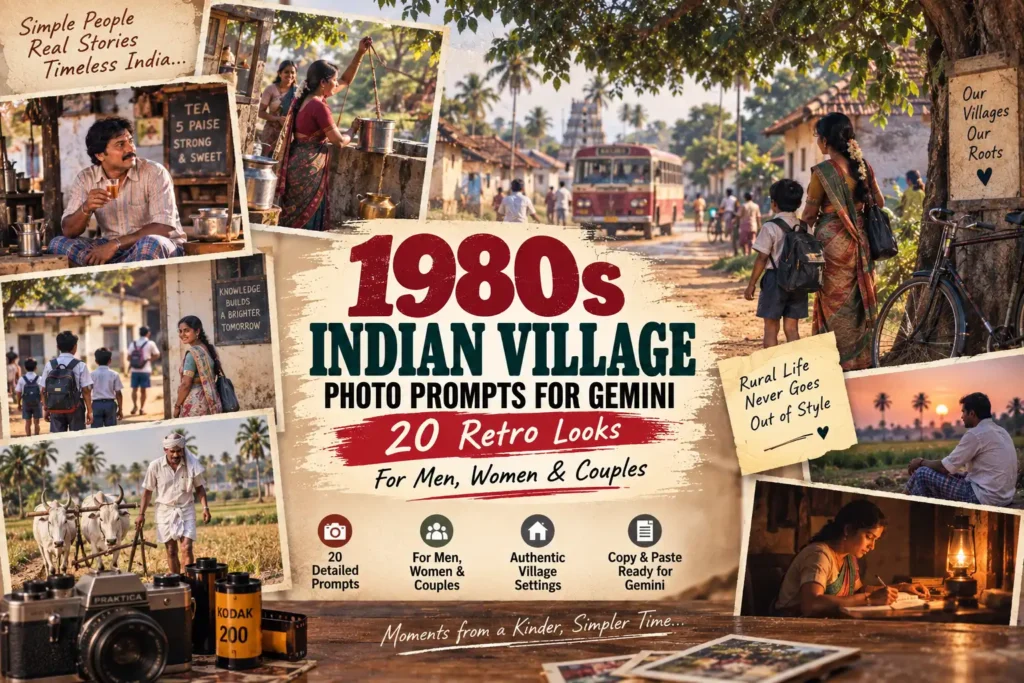
1980s Indian Village Photo Prompts for Gemini – 20 Retro Looks
80s Retro Photo Prompts for Gemini – 25 Vintage Indian Styles
80s Family Photo Prompts for Gemini – 20 Indian Family Styles
80s Wedding Couple Photo Prompts for Gemini – 20 Retro Wedding Looks
80s Bollywood Photo Prompts for Gemini – 20 Indian Movie Looks
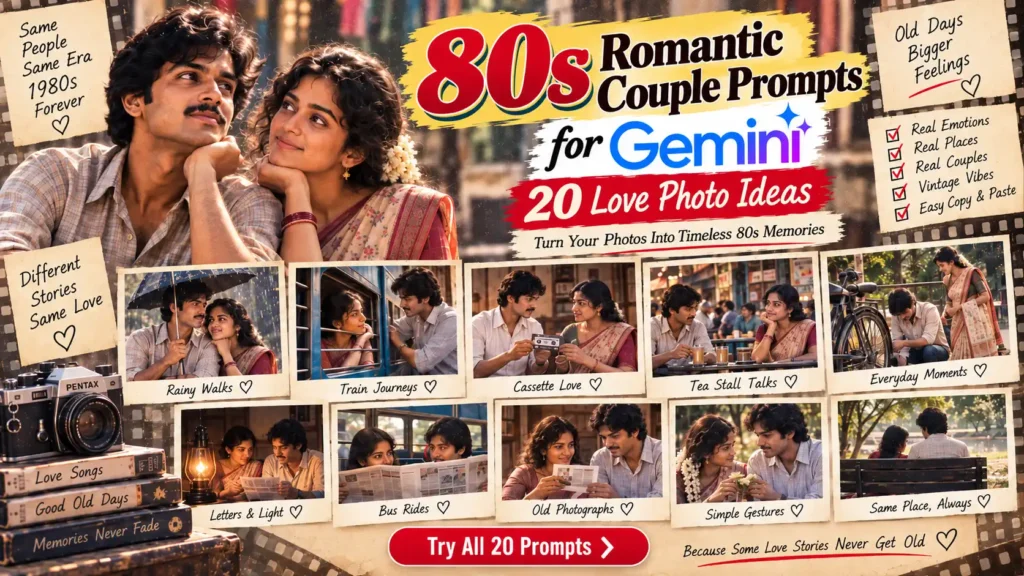
80s Romantic Couple Prompts for Gemini – 20 Love Photo Ideas
Copied!