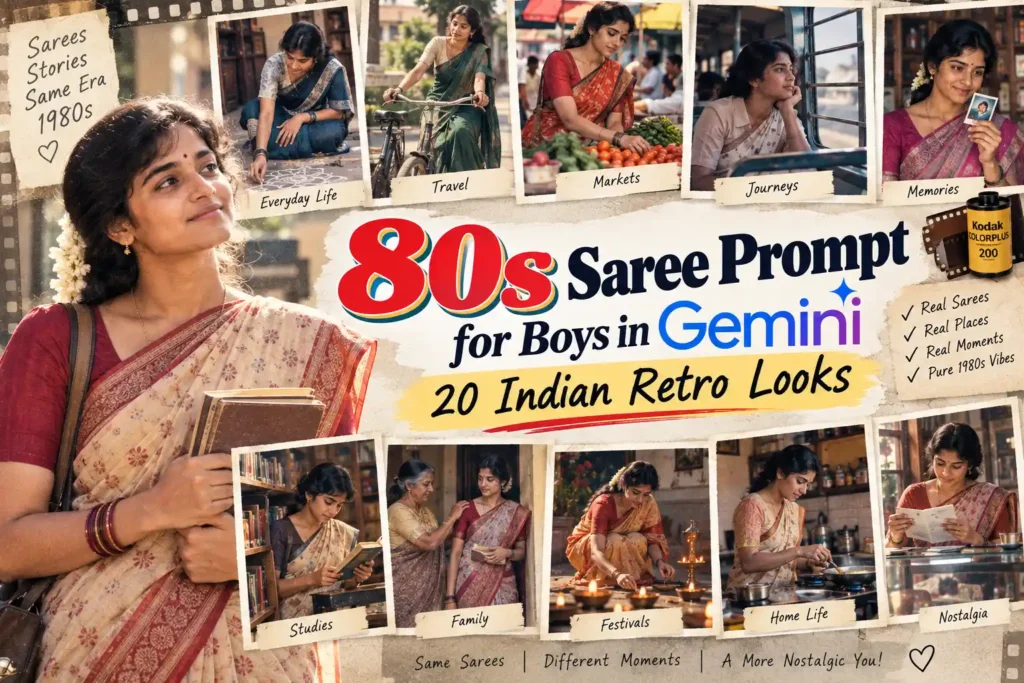
1. 80s Saree Morning — The Pleat Caught in a Bicycle Breeze
Use my uploaded photo as the exact facial identity reference. Preserve my recognizable face faithfully — facial structure, eyes, nose, lips, skin tone, natural age appearance, hairline, facial asymmetry, and important identifying characteristics must remain consistent. Do not replace my identity with a generic beautiful model, excessively beautify my face, alter my body proportions, or automatically make me younger.Transform me into a completely photorealistic Indian woman photographed during an ordinary morning in the mid-1980s.
Respect the natural age and body shape shown in my uploaded photograph. Dress me in an authentic 1980s handloom cotton saree with a small repeating floral or geometric print, narrow contrasting woven border, and a simple modest short-sleeve blouse. The saree must be draped naturally for everyday life, not styled like a modern fashion editorial. Use a tiny bindi, small traditional earrings, a few thin glass bangles, ordinary sandals, and naturally braided or tied-back hair. Keep makeup minimal enough to look almost absent.
Create a story that depends specifically on the saree rather than merely using it as clothing.
I have stepped through the front gate of a modest South Indian house and am preparing to leave with a classic black roadster bicycle. While turning the bicycle around, a light morning breeze lifts only the loose end of my saree pallu toward the rear wheel.
Capture the exact instant BEFORE it reaches the wheel.
I notice what is happening and instinctively gather the pallu safely against my waist with one hand while the other steadies the stationary bicycle. My expression should show a tiny flash of recognition followed by an amused “that was close” reaction.
Both feet remain securely on the ground. Do not show the saree caught inside the wheel or any unsafe riding.
Add believable evidence of the morning: a small cloth shopping bag hanging from the bicycle handle, folded newspaper on a veranda chair, steel tumbler near the doorway, one pair of household slippers, red-oxide or worn cement courtyard, weathered wooden gate, hibiscus or jasmine plant, and a neighboring tiled roof visible beyond the compound wall.
Use the bicycle wheel, saree pallu, and my face as a visual triangle. Photograph from slightly behind the bicycle at low waist height with a natural 35mm documentary perspective. Let a few wheel spokes create foreground depth without crossing my face.
Morning sunlight should strike the pale compound wall and bounce naturally onto my face. Only the lightweight pallu and a few loose hair strands should respond noticeably to the breeze; the heavier saree pleats should remain stable.
PERIOD LOCK: Everything visible must plausibly belong to South India between 1983 and 1987. No smartphones, modern bicycles, LED lights, CCTV cameras, satellite dishes, solar panels, modern plastic water tanks, contemporary handbags, current footwear, modern vehicles, designer blouses, or present-day fashion.
SAREE REALISM: Preserve believable cotton weight, gravity, pleat structure, tucked waist, blouse-to-saree relationship, border continuity, pallu length, and natural wrinkles. Do not fuse the saree with the bicycle, body, hands, or background.
Preserve natural Indian skin pores, realistic hair strands, correct fingers, anatomically natural body proportions, physically believable shadows, and subtle environmental wear.
Use restrained 35mm consumer-film grain, slightly warm color-negative rendering, modest dynamic range, mild lens softness, and tiny family-camera imperfections.
The final photograph should feel like somebody pressed the shutter during a completely ordinary 1980s morning and accidentally captured the fraction of a second when the saree itself changed the action of the scene. No text, no watermark, no plastic skin, no distorted bicycle, no extra fingers, no modern objects, and no artificial AI glow.
2. 80s Saree Tailor Shop — Seeing the New Blouse in Two Mirrors
Use my uploaded photograph as the strict facial identity reference. Preserve my real recognizable face, natural age, skin tone, facial proportions, eyes, nose, lips, hair characteristics, and distinctive identifying features. Do not transform me into a generic saree model or modern bridal-fashion face.Create an intimate Indian tailoring-shop photograph from the mid-1980s built around the first fitting of a newly stitched saree blouse.
Respect my natural age and body proportions. Dress me in a realistic period-correct saree with a tasteful woven border and a newly stitched modest blouse typical of the era. Do not use contemporary deep-neck, sleeveless, designer, padded, corset-style, or fashion-influencer blouse designs. Keep jewellery restrained: small earrings, thin bangles, tiny bindi, and a simple chain only where appropriate.
Place me inside a narrow neighborhood tailoring shop containing one large front mirror and a smaller angled side mirror.
The tailor has just finished pinning or marking a tiny adjustment safely at the sleeve or shoulder and has stepped back.
Create the decisive moment: I turn slightly to inspect the blouse fit from the side, and for the first time both mirrors reveal different natural angles of the same saree and blouse.
My real body should appear partly from behind, my face should be visible in the main mirror, and the smaller mirror may show only a partial secondary angle of the shoulder and saree border.
I am not posing. One hand lightly smooths the saree near the shoulder while my eyes inspect the stitching with a thoughtful, quietly satisfied expression.
Build an authentic working tailor shop: mechanical sewing machine, wooden table scarred from years of cutting fabric, large metal scissors resting safely on the table, tailor's chalk, measuring tape, wooden thread spools, folded textiles stacked imperfectly, paper patterns, cloth scraps, small stool, ceiling fan, and open storefront.
Compose from behind a curtain edge or fabric roll with a 50mm perspective. Use the mirrors to create depth without turning the image into visual confusion.
REFLECTION LOCK: Every reflection must correspond physically to the same woman, same saree, same blouse, same hairstyle, same hand position, and same moment. No duplicated face, third person, impossible reflection, mismatched saree color, extra arm, or reversed body inconsistency.
Daylight from the storefront should provide the main illumination and bounce naturally into the mirrors. A warm practical bulb deeper inside may add slight period color variation.
PERIOD LOCK: Indian tailoring shop between 1983 and 1988. No computerized sewing machines, LED mirror strips, smartphones, QR payment signs, modern fashion posters, contemporary salon mirrors, current designer blouses, digital equipment, or modern retail interiors.
SAREE REALISM: Maintain continuous border design through folds, correct pallu direction, realistic waist pleats, authentic fabric thickness, natural shoulder drape, and physically believable interaction between blouse and saree.
Preserve natural skin texture, realistic fingers, accurate jewellery connections, mirror geometry, sewing-machine mechanics, and environmental wear.
Use subtle analog grain, slightly muted warm colors, realistic shadow density, and mild optical softness.
The final image should feel like a real 1980s woman seeing her newly stitched blouse properly for the first time — a private fashion memory from an era when the neighborhood tailor, not an online catalog, completed the look. No text, no watermark, no distorted reflections, no plastic skin, and no modern objects.
3. 80s Saree Bus Window — Jasmine Bought Without Leaving the Seat
Use my uploaded photo as the exact facial identity anchor. Preserve my recognizable face, natural age, facial anatomy, eyes, nose, lips, skin tone, hairline, hair characteristics, and important identifying features. Do not replace me with a generic young actress or alter my natural body shape.Create an authentic South Indian city-bus photograph from the mid-1980s in which the saree, flowers, window, and street interaction all belong naturally to the same moment.
Dress me in a believable everyday 1980s cotton saree with a modest printed body and contrasting border, paired with a simple period-correct blouse. Use a tiny bindi, small earrings, thin bangles, and a long braid or naturally tied-back hairstyle compatible with my uploaded photo. Do not use heavy bridal jewellery or modern glam makeup.
The bus is completely stopped at a busy roadside stop.
Place me seated beside an open bus window. A flower seller outside has lifted a freshly tied jasmine strand toward me through the safe window opening.
Capture the exact exchange.
One of my hands reaches toward the jasmine while the other searches for or holds a few coins. The saree pallu rests naturally across my shoulder and lap, with its border creating a visual line toward the flowers.
At that precise moment, one tiny jasmine bud falls from the strand and lands on the saree near my wrist.
My eyes shift toward the fallen flower and I begin to smile instinctively. Do not make me look into the camera.
Inside the bus show worn vinyl or period-correct bench seating, painted metal handrails, ticket stubs, another passenger partly visible, and a conductor farther down the aisle.
Outside show a layered but softly focused 1980s street: flower basket, bicycles, old storefronts, period-correct vehicles, pedestrians, and roadside activity.
Compose from the seat diagonally opposite with a 50mm documentary perspective. The bus window should become a frame-within-a-frame, placing my face inside, the vendor outside, and the jasmine strand between the two spaces.
Strong daylight should enter through the window and illuminate the jasmine, my reaching hands, saree border, and one side of my face while the bus interior remains naturally darker.
PERIOD LOCK: South India between 1983 and 1988. No smartphones, digital ticket machines, LED route boards, modern buses, QR payments, current handbags, contemporary advertisements, modern vehicles, designer sarees, or present-day fashion.
SAREE REALISM: Keep the pallu resting with natural gravity, preserve border continuity, realistic cotton folds across the seated body, plausible pleat compression, and correct fabric interaction with the seat and hands.
Render jasmine flowers with irregular natural shapes, realistic thread binding, accurate coins, correct fingers, natural skin pores, worn bus surfaces, and physically believable shadows.
Use restrained 35mm grain, modest saturation, slightly warm analog color, and documentary softness.
The final image should feel like an ordinary five-second transaction from 1980s India that somehow became a beautiful photograph — the bus is waiting, the flowers are changing hands, one bud has fallen, and the journey will continue immediately after the shutter. No text, no watermark, no duplicate people, no extra fingers, no modern objects, and no fake AI glow.
4. 80s Saree Monsoon — Saving the Freshly Starched Saree from Rain
Use my uploaded photograph as the exact facial identity reference. Preserve my recognizable face faithfully — facial structure, eyes, nose, lips, skin tone, natural age appearance, hair characteristics, body proportions, and important identifying features. Do not replace me with a generic model or artificially beautify my face.Create a photorealistic Indian household scene from the mid-1980s during the first seconds of an unexpected monsoon shower.
Respect my natural age. Dress me in an authentic everyday cotton saree with a modest blouse, small bindi, simple earrings, and thin bangles. The saree I am WEARING must be visually different from the freshly washed saree hanging on the clothesline.
Create the story around that second saree.
A carefully washed and freshly starched cotton saree has been drying across a courtyard clothesline. Its crisp pleats and broad border show that someone spent time preparing it.
Rain begins unexpectedly.
Capture me rushing from the shaded veranda into the courtyard to rescue it before it becomes soaked.
I have already unclipped one end and gathered part of the dry saree over my forearm, but the other end remains attached to the clothesline.
At the exact instant of the photograph, a stronger gust pushes the free length outward like a temporary sail while I reach for the final wooden clothespin.
My expression should show focused urgency mixed with the absurdity of wrestling several meters of fabric in sudden wind. Do not turn it into a glamorous rain pose.
Build a believable 1980s courtyard: red-oxide or worn cement floor, traditional drain channel, tiled roof edge, steel bucket, wooden clothespins, other small garments on the line, partially open wooden doorway, household plants, woven laundry basket, and rainwater beginning to spill from the roof.
Photograph from beneath the veranda using a wide 28–35mm perspective. Let the long airborne saree create a sweeping diagonal through the frame from the clothesline toward my arms, making the FABRIC itself the central visual storytelling element.
Grey monsoon daylight should provide soft broad illumination. Reflected light from wet walls and floor should naturally brighten shadows. Do not add golden sunset, artificial rim lighting, or fantasy rain effects.
SAREE PHYSICS: The starched dry section should appear slightly stiffer than ordinary wet cloth. Portions touched by the first rain should begin darkening and becoming heavier. The border, print, folds, wind direction, clothespins, and tension along the clothesline must remain physically consistent.
PERIOD LOCK: Indian household between 1983 and 1988. No modern washing machines visible, contemporary laundry baskets, smartphones, CCTV cameras, LED fixtures, modern water tanks, plastic designer clothespins, current clothing, or present-day architecture.
Preserve natural wet footprints, accurate reaching fingers, believable hair response to humidity, realistic skin texture, correct fabric scale, physically accurate rain streaks, and natural reflections.
Use slightly muted monsoon color-negative rendering, restrained 35mm grain, modest contrast, and subtle motion blur only on the fastest-moving free fabric.
The final photograph should make viewers almost feel the urgency of saving a freshly starched saree from the first rain — an unmistakably Indian domestic memory where the saree is not decoration but the reason the entire moment exists. No text, no watermark, no plastic skin, no impossible fabric, no extra fingers, and no modern objects.
5. 80s Saree Cinema Night — Pallu Pin Fixed in the Ticket Queue
Use my uploaded photo as the strict facial identity reference. Preserve my real recognizable face, facial proportions, eyes, nose, lips, skin tone, natural age, hairline, hair characteristics, and important identifying features. Do not transform me into a movie actress, generic fashion model, or younger version of myself.Create an authentic Indian single-screen cinema evening photograph from the mid-1980s centered around a tiny saree adjustment immediately before entering the theatre.
Respect my natural age and body proportions. Dress me in an elegant but believable 1980s going-out saree — perhaps a deep jewel-tone synthetic, silk-cotton, or printed saree with a tasteful period border — paired with a modest blouse. Use a small bindi, simple earrings, a few bangles, and period-appropriate hairstyle. Keep the look special enough for an evening outing but far below wedding-level glamour.
I am standing near the cinema queue holding two small paper tickets.
A few seconds before the line begins moving, I realize the small safety pin securing the saree pallu at my shoulder has loosened.
Capture the exact moment I use one hand to hold the pallu safely in place while the other carefully adjusts the pin, still keeping the tickets between two fingers.
My attention is on the shoulder adjustment, not the camera.
A female friend or family member beside me notices and briefly shields me from the moving queue or holds my small handbag while I finish. If another woman appears, her face must be clearly distinct from mine.
Behind us create an authentic single-screen theatre: weathered façade, portions of large hand-painted movie artwork, incandescent entrance bulbs, metal queue railings, ticket window, glass soda bottles in wooden crates, bicycles, snack counter, and moviegoers in plausible 1980s clothing. Keep generated signage unreadable and secondary.
Compose from just outside the queue railing using a 50mm street-photography perspective. Use the metal railing as a foreground line leading toward the tickets, saree shoulder, hands, and face.
Warm tungsten theatre bulbs should mix naturally with remaining cool evening light. Preserve the imperfect color balance rather than creating polished modern cinematic lighting.
PERIOD LOCK: India between 1983 and 1988. No multiplexes, digital posters, smartphones, LED signage, contemporary handbags, modern jewellery, current designer sarees, modern vehicles, present-day beverage bottles, or recent hairstyles.
SAREE REALISM: Maintain physically correct pallu layering, pin placement, shoulder drape, border alignment, blouse coverage, waist pleats, and natural fabric tension during the adjustment. Do not fuse the pin, fingers, blouse, or saree.
Render paper tickets, hands, jewellery, natural Indian skin texture, hair strands, fabric sheen, tungsten reflections, and background movement accurately.
Use moderate high-speed film grain, subtle halation around incandescent bulbs, realistic shadow depth, and mild analog softness.
The final image should feel like a candid frame taken seconds before an 80s movie began — the queue is about to move, the tickets are ready, the pallu needs one final fix, and the photographer happened to catch the entire tiny drama. No text, no watermark, no plastic skin, no distorted hands, no modern objects, and no artificial glow.
6. 80s Saree Railway Platform — Pallu Lifted by the Arriving Train
Use my uploaded photo as the exact facial identity reference. Preserve my recognizable face faithfully — facial structure, eyes, nose, lips, skin tone, natural age appearance, hairline, facial asymmetry, body proportions, and important identifying characteristics. Do not replace me with a generic beautiful model, artificially make me younger, or modernize my appearance.Transform me into a photorealistic Indian woman waiting at a railway station in the mid-1980s.
Respect the natural age and body shape shown in my uploaded photograph. Dress me in an authentic 1980s travel saree: a practical lightweight cotton or silk-cotton saree with a narrow contrasting border, modest period-correct blouse, small bindi, simple earrings, thin bangles, and comfortable footwear. Style the hair in a natural braid, low bun, or tied-back arrangement compatible with my real hair.
Create the photograph around the physical movement caused by an arriving train.
I am standing safely well behind the platform edge beside an old hard-sided suitcase and cloth shoulder bag. A train is slowly entering the station several meters away.
The moving air reaches me before the train does.
Capture the exact instant the loose end of my saree pallu suddenly lifts sideways in the airflow. I instinctively catch the pallu against my shoulder with one hand while the other remains wrapped around the handle of my suitcase.
My face turns slightly toward the arriving train with focused anticipation. Do not make me stare at the camera or pose romantically.
A folded paper ticket may be safely tucked beneath my fingers or inside the bag rather than floating unrealistically.
Build a believable 1980s Indian railway platform: old station roof supports, analog clock, worn wooden or metal benches, steel luggage trolley, travelers carrying cloth bags and metal trunks, tea vendor with a period container, painted station signs kept too distant for readable generated text, and a period-correct passenger train entering along the track.
Compose from farther down the platform using a 50–70mm perspective. Let repeating columns create strong depth while my suitcase anchors the foreground and the approaching train forms the background movement.
Keep the camera safely on the platform. Do not place me or the photographer near or on the railway tracks.
LIGHTING: Bright outdoor daylight from the track side should illuminate the lifted pallu and one side of my face, while the station roof creates softer shade over my body. The train windows and metal surfaces should reflect the environment naturally.
SAREE PHYSICS: The airflow should affect the lightweight free pallu much more than the tucked waist pleats. Preserve continuous border design, realistic cloth tension at the shoulder, natural folds across the torso, correct pleat structure, and believable fabric weight. The saree must never appear detached, weightless, or fused with luggage.
PERIOD LOCK: Indian railway station between 1983 and 1988. No smartphones, LED information boards, modern trains, trolley suitcases, contemporary backpacks, plastic bottled water, earbuds, digital clocks, current railway architecture, designer sarees, or present-day fashion.
Preserve accurate hands gripping the suitcase and saree, realistic luggage wear, natural Indian skin pores, individual hair strands, anatomically correct feet, believable train scale, physically correct shadows, and natural background depth.
Use restrained 35mm consumer-film grain, slightly warm analog color, modest dynamic range, gentle motion character on the arriving train, and mild print softness.
The final photograph should feel like one frame taken at the beginning of an important 1980s journey — the train is arriving, the pallu suddenly moves, the suitcase is ready, and within seconds she will leave the platform. No text, no watermark, no unsafe railway behavior, no extra fingers, no distorted train, no plastic skin, and no modern objects.
7. 80s Saree Kitchen — Pallu Tucked Before the Dosa Burns
Use my uploaded photograph as the strict facial identity reference. Preserve my real recognizable face, natural age, facial proportions, eyes, nose, lips, skin tone, hair characteristics, body shape, and distinctive identifying features. Do not replace me with a generic homemaker, fashion model, or artificially younger woman.Create a warm, highly realistic South Indian kitchen photograph from the mid-1980s where the saree participates naturally in an ordinary household action.
Respect my natural age and body proportions. Dress me in a comfortable everyday cotton saree with a small period-correct print and simple contrasting border, paired with a modest short-sleeve blouse. Use only minimal household jewellery, a small bindi, and naturally tied-back hair.
The saree should look genuinely worn for cooking rather than arranged for a photograph.
Place me inside a modest working kitchen during breakfast preparation.
I have temporarily tucked the free end of my saree pallu securely at my waist so it remains safely away from the cooking area.
A dosa is cooking on a period-appropriate iron tawa while another breakfast item or coffee preparation is underway nearby.
Create the decisive moment: I become distracted for only a few seconds while reaching toward a shelf for a steel container. I suddenly remember the dosa.
Capture me turning quickly back toward the tawa with the spatula already in one hand and a spontaneous “I almost forgot it” expression.
Do not show dangerous flames, loose fabric near fire, or unsafe cooking behavior.
The pallu must remain securely tucked away from the stove throughout the scene.
Build a believable 1980s South Indian kitchen: stainless-steel and brass vessels, traditional coffee filter, spice containers, old wooden shelves, iron tawa, simple stove appropriate to the household and exact period, cotton kitchen towel, grinding stone or other culturally plausible utensil kept naturally in the environment, barred window, and evidence that breakfast preparation is genuinely underway.
Avoid making the kitchen excessively rustic or decorative. It should look like a real functioning household.
Compose from the kitchen doorway with a natural 35–50mm documentary perspective. Use one hanging steel utensil or doorway edge as a soft foreground layer, then lead the viewer toward my securely tucked saree, active hand, face, and cooking surface.
Morning sunlight should enter through a side window and strike steam rising from food or coffee. Reflected light from the wall should naturally expose my face. Practical stove light must remain physically restrained.
SAREE REALISM: Show clearly how an everyday saree can be temporarily and safely tucked for household work. Preserve continuous border placement, realistic waist pleats, correct blouse fit, believable cotton thickness, and natural compression where the pallu is tucked. Do not create impossible knots or extra fabric.
PERIOD LOCK: South Indian household between 1983 and 1988. No induction cooktop, microwave, modular cabinets, smartphones, LED lighting, modern non-stick cookware as a focal object, contemporary appliances, plastic packaged foods, or current kitchen design.
Render the dosa, tawa, spatula, steam, steel reflections, hands, saree folds, skin pores, hair strands, and environmental wear realistically.
Use warm but restrained consumer-film color, subtle grain, modest contrast, natural window-light falloff, and slight analog softness.
The final image should feel like a family member photographed a familiar breakfast mishap in the 1980s — not a cooking advertisement and not a saree fashion portrait. The saree should reveal how it was actually worn and managed during daily life. No text, no watermark, no unsafe fabric near flame, no distorted utensils, no extra fingers, no plastic skin, and no modern objects.
8. 80s Saree Photo Studio — The Wind Machine Was Only a Table Fan
Use my uploaded photo as the exact facial identity anchor. Preserve my recognizable face, facial structure, eyes, nose, lips, skin tone, natural age appearance, hairline, body proportions, facial asymmetry, and important identifying features. Do not transform me into a generic cinema actress or modern fashion model.Create a charming Indian neighborhood photo-studio scene from the mid-1980s that reveals how a dramatic saree portrait could actually have been made with extremely simple equipment.
Respect my natural age. Dress me in an elegant period-correct saree appropriate to an ordinary studio portrait — a rich but believable synthetic, silk-cotton, or printed saree with a tasteful border, modest blouse, small bindi, simple earrings, bangles, and carefully arranged but not contemporary hair.
Place me in front of a hand-painted studio backdrop depicting an idealized garden, decorative railing, distant hills, and painted sky.
But do not create the finished formal photograph.
Show the behind-the-scenes moment just before it.
The photographer's assistant has positioned an ordinary metal table fan safely several feet away to create a little movement in the saree pallu.
Capture the instant the fan is switched on slightly too strongly.
The pallu lifts farther than expected.
I instinctively catch its edge with one hand while beginning to laugh, breaking the serious expression the photographer had just asked me to hold.
The fan should remain clearly separated from the saree and body. No fabric may approach the fan blades.
A photographer may appear partly behind a period-correct analog camera on a tripod, reacting naturally to the unexpected moment.
Build a modest studio rather than a luxury set: painted cloth backdrop with visible edge and slight wrinkles, wooden stool, patterned floor mat, heavy side curtain, simple tungsten lamps, old tripod, analog camera, table fan with protective grille, mirror, comb, and paper photo envelopes.
Compose from behind and slightly beside the photographer using a 50–70mm perspective. Let part of the camera or tripod appear softly in the foreground while my spontaneous reaction becomes the clear focal point.
The painted backdrop should remain obviously painted rather than transforming into a real landscape.
LIGHTING: Use period-plausible diffused tungsten portrait lighting with modest frontal fill. Preserve natural cheek shadows and slight mixed illumination from the studio entrance.
SAREE PHYSICS: The fan should affect only the loose free pallu and a few hair strands. Waist pleats, blouse, jewellery, and heavier lower fabric must remain stable. Preserve border continuity and realistic cloth tension where my hand catches the pallu.
PERIOD LOCK: Indian neighborhood photography studio between 1983 and 1988. No digital cameras, smartphones, LED panels, ring lights, modern studio fans, contemporary fashion styling, modern softboxes, digital monitors, designer blouses, or current photographic equipment.
Preserve realistic fan geometry and protective grille, safe distance, correct hands, natural Indian skin pores, authentic fabric sheen, accurate jewellery connections, realistic painted-backdrop texture, and subtle studio wear.
Use restrained film grain, warm color-negative character, mild optical softness, modest dynamic range, and no excessive vintage damage.
The final image should feel like a rare behind-the-scenes photograph revealing the wonderfully simple trick behind an 80s flowing-saree studio portrait — and the unexpected laugh that happened before the real picture was taken. No text, no watermark, no fabric touching the fan, no extra fingers, no plastic skin, and no modern objects.
9. 80s Saree Terrace — One Missing Blouse from the Clothesline
Use my uploaded photograph as the exact facial identity reference. Preserve my real recognizable face, natural age, skin tone, facial proportions, eyes, nose, lips, hair characteristics, body shape, and distinctive personal features. Do not replace me with a generic model or alter my natural age.Create a visually curious Indian rooftop photograph from the mid-1980s centered around a tiny domestic mystery.
Respect my natural age and body proportions. Dress me in a comfortable period-correct cotton saree with a modest blouse, tiny bindi, simple earrings, thin bangles, and naturally braided or tied-back hair.
I have come to the terrace late in the afternoon to collect clothes that have finished drying.
Several garments have already been folded over my forearm.
But something is missing.
Create the exact moment I notice that one blouse which had been hanging beside the saree is no longer on the clothesline.
I stand still for a second, holding one wooden clothespin in my free hand and looking along the line with a puzzled expression.
Then give the viewer the answer before I notice it.
The missing blouse has been blown only a short distance away and is caught safely on the top of a low neighboring section of the same rooftop, a clothesline support, or another reachable household surface — clearly visible somewhere in the composition but outside my current line of sight.
Do not place clothing on electrical wires, dangerous heights, trees requiring climbing, or inaccessible rooftops.
This creates a visual game: the viewer discovers the missing garment before the woman does.
Build a believable 1980s terrace: limewashed parapet with age marks, wooden clothespins, simple clothesline, steel bucket, woven laundry basket, folded cotton clothes, old stairway entrance, period television antenna, neighboring tiled roofs, coconut trees, and evening birds.
Compose from an elevated but natural position near the stairway using a 35mm perspective. Arrange the clothesline diagonally through the image so the viewer's eye travels from the empty clothespin in my hand, across my searching face, along the remaining clothes, and finally toward the missing blouse.
Do not make the hidden blouse too obvious; it should reward a second look while remaining understandable.
Late-afternoon sunlight should illuminate one rooftop wall and some drying clothes while I remain in softer reflected light. Avoid generic golden-hour glamour.
SAREE REALISM: The saree I am wearing and the missing blouse must have clearly different colors or patterns so the story is readable. Maintain realistic waist pleats, pallu placement, blouse fit, cotton weight, and natural folds around the arm carrying clothes.
PERIOD LOCK: Indian residential neighborhood between 1983 and 1988. No smartphones, satellite dishes, solar panels, modern plastic water tanks, CCTV cameras, LED fixtures, contemporary laundry products, modern apartment towers, current clothing, or recent household objects.
Render clothespins, clothesline tension, cotton fabric, hands, natural skin pores, individual hair strands, rooftop texture, distant atmospheric depth, and physically accurate shadows carefully.
Use restrained consumer-film grain, slightly faded warm colors, modest contrast, and authentic family-photo framing.
The final photograph should work as both a beautiful 80s saree image and a tiny visual story: she knows something is missing, the viewer can see where it went, and the next second of the story exists naturally beyond the frame. No text, no watermark, no dangerous retrieval situation, no impossible fabric, no plastic skin, no extra fingers, and no modern objects.
10. 80s Saree Family Wedding — The Hidden Safety Pin Rescue
Use my uploaded photo as the strict facial identity reference. Preserve my recognizable face faithfully — facial structure, eyes, nose, lips, skin tone, natural age appearance, hairline, body proportions, facial asymmetry, and important identifying characteristics. Do not replace me with a generic bridal model, automatically make me younger, or turn me into the bride unless the uploaded reference specifically requires that role.Create an intimate behind-the-scenes Indian family wedding photograph from the mid-1980s focused on the practical intelligence of women managing a saree during a busy celebration.
Respect my natural age and body shape. Dress me as a wedding guest or family member in a period-correct silk or silk-cotton saree with a rich but tasteful woven border, modest blouse, small bindi, traditional earrings, bangles, simple necklace, and period-appropriate hairstyle with jasmine only where culturally suitable.
Avoid contemporary bridal makeup, designer blouse cuts, oversized jewellery, modern draping, or luxury wedding styling.
Place me in a side room or quiet corridor of a busy wedding house shortly before I am expected to return to the main ceremony.
Create the decisive moment: one small section of the saree pleats or pallu has become slightly loose after hours of helping with wedding activities.
An older female relative — mother, aunt, grandmother, or another clearly older family member — has noticed before I do.
She quietly reaches toward the saree and produces a small safety pin that she had kept attached discreetly to the edge of her own saree for exactly this kind of emergency.
Capture the instant I realize what she is doing.
I look down toward her hand with a relieved, amused expression while she concentrates on fixing the loose fabric safely and discreetly.
The interaction must clearly read as practical family care, not fashion styling.
If the uploaded photo contains only me, create the older woman as a distinct generic individual with clearly different facial features and appropriate age. Never duplicate my face onto her.
Build a believable 1980s wedding-house environment: wooden doorway, red-oxide or patterned floor, metal trunk containing folded clothes, small mirror, flower basket, brass or stainless-steel vessels, cotton towels, wedding gifts wrapped in period-plausible paper, relatives moving through the distant corridor, and only a partial glimpse of traditional decorations outside.
Do not show the main wedding stage. The image should reveal the unseen work happening behind the celebration.
Compose from just beyond the partially open doorway using an intimate 50mm documentary perspective. Let the doorway create a foreground frame while the two women and their hands form the emotional center.
Place visual emphasis on THREE things: my relieved facial reaction, the older woman's experienced hands, and the small section of saree being repaired.
LIGHTING: Soft daylight from an adjacent courtyard should illuminate the scene from one side, while warm tungsten household light from deeper inside adds gentle separation. Preserve realistic mixed color temperature.
SAREE REALISM: The safety pin must attach only appropriate layers of fabric and never appear to pierce skin. Maintain continuous saree border, correct pleat direction, natural pallu layering, realistic silk weight, blouse coverage, and believable tension before and after the adjustment.
The older woman's own saree must be different from mine in pattern and color and must drape naturally for her age and role.
PERIOD LOCK: Indian family wedding between 1983 and 1988. No smartphones, LED decorative walls, contemporary wedding stages, modern cosmetics, designer blouses, current jewellery trends, plastic water bottles, digital cameras, modern gift bags, or present-day fashion.
Preserve realistic age differences, distinct faces, correct fingers, accurate jewellery connections, natural Indian skin texture, silk reflections, jasmine irregularity, fabric folds, and physically plausible shadows.
Use restrained 35mm grain, warm analog color, gentle highlight roll-off, mild print softness, and the imperfect framing of a family photograph.
The final image should feel more meaningful than a conventional saree portrait: the celebration is happening elsewhere, the saree has loosened, an experienced elder already knows the solution, and one tiny hidden safety pin allows the younger woman to return to the wedding without anyone else ever knowing there was a problem.
No text, no watermark, no duplicated faces, no extra fingers, no pin touching skin, no plastic skin, no modern objects, and no artificial AI glow.
11. 80s Saree College Library — The Forgotten Note Inside a Borrowed Book
Use my uploaded photo as the exact facial identity reference. Preserve my recognizable face faithfully — facial structure, eyes, nose, lips, skin tone, natural age appearance, hairline, facial asymmetry, body proportions, and important identifying characteristics. Do not replace my identity with a generic beautiful model, artificially make me younger, or modernize my appearance.Transform me into a photorealistic Indian woman inside a college or public library in the mid-1980s.
Respect the natural age shown in my uploaded photograph. If I am college-age, dress me in an authentic lightweight cotton saree commonly worn by students or young women of the period, with a narrow woven border, modest blouse, tiny bindi, small earrings, a few simple bangles, and naturally braided or tied-back hair. If I am older, adapt me naturally as a lecturer, librarian, researcher, or adult reader without de-aging me.
Choose a saree with a subdued hand-block, floral, stripe, or small geometric pattern that remains visually distinct from the bookshelves. Avoid modern designer draping, sleeveless blouses, heavy jewellery, glossy fashion makeup, or contemporary styling.
Create a story that begins with an ordinary library task.
I am standing between two tall wooden bookshelves after selecting an old hardcover book. When I open it to check the pages, a small folded piece of paper that somebody left there years earlier slips out and falls onto the lower edge of my saree pallu before reaching the floor.
Capture the fraction of a second while the note is still resting unexpectedly on the fabric.
One hand holds the open book. My other hand begins moving toward the folded paper. My eyes are already looking down at it with genuine curiosity.
Do not reveal what the note says. It may show only indistinct handwriting marks, never clearly readable personal information.
The saree pallu should become part of the storytelling surface: the small pale paper contrasts against its pattern and visually links the book to my reaction.
Build an authentic 1980s Indian library: tall wooden shelves filled unevenly with worn books, card-catalogue drawers, wooden reading tables, cane or wooden chairs, ceiling fans, high barred windows, manual issue registers, paper library cards, desk lamps where historically plausible, and a librarian or reader working quietly in the distant background.
Do not make the library dark, magical, dusty beyond reason, or fantasy-like.
Compose from the narrow gap between adjacent shelves using a 50mm documentary perspective. Allow blurred book spines near both sides of the lens to form a natural tunnel toward my face, open book, saree pallu, and fallen note.
High-window daylight should enter from one side and create a narrow soft band across the aisle. Tiny airborne dust may become visible only where it crosses that light. Reflected ambient light should expose my face naturally.
SAREE REALISM: Maintain correct shoulder drape, pallu gravity, continuous border and print, realistic cotton thickness, natural folds around the torso, believable waist pleats, and accurate interaction with the lightweight paper. The note should rest on the saree rather than appear glued or floating.
PERIOD LOCK: Indian library between 1983 and 1988. No computers, smartphones, barcode scanners, tablets, modern backpacks, LED lights, contemporary library furniture, digital displays, current fashion, or recent book designs as prominent focal objects.
Preserve realistic book thickness, aged paper edges, correct fingers, natural Indian skin pores, individual hair strands, subtle saree wrinkles, shelf wear, and physically accurate shadows.
Use restrained 35mm film grain, slightly muted color-negative rendering, modest dynamic range, mild lens softness, and documentary imperfection.
The final image should make the viewer immediately wonder who left the note inside the book and what happens after I unfold it — while remaining completely believable as a candid photograph from an Indian library in the 1980s. No text as a focal element, no watermark, no plastic skin, no extra fingers, no floating paper, and no modern objects.
12. 80s Saree Roadside Tea Stop — Steam Fogging Her Spectacles
Use my uploaded photograph as the strict facial identity reference. Preserve my real recognizable face, natural age, facial proportions, eyes, nose, lips, skin tone, hair characteristics, body shape, and distinctive identifying features. Do not replace me with a generic retro model or automatically make me younger.Create an unusually intimate Indian roadside travel photograph from the mid-1980s.
Respect my natural age and body proportions. Dress me in a practical 1980s travel saree made from believable cotton or silk-cotton with a modest period-correct blouse, small bindi, simple earrings, thin bangles, and naturally arranged hair.
If spectacles are appropriate to my uploaded appearance or the requested transformation, use simple period-correct optical frames. Otherwise, preserve the same story without adding spectacles: the steam may briefly cross my face and make me lean away with an amused reaction.
Place me at a tiny roadside tea stall during a journey.
I have just received an unusually hot glass or stainless-steel tumbler of tea.
Create the decisive moment: I lift it carefully toward my face to test the temperature, and a concentrated plume of steam rises directly toward my spectacles, briefly fogging part of the lenses.
I instinctively pull my head back and begin laughing at the inconvenience while still holding the tea safely with both hands or one hand in a culturally and physically plausible manner.
Do not make me look at the camera.
A cloth travel bag rests on the wooden bench beside me. A period-correct bus, Ambassador-style car, or other plausible travel vehicle may be visible far in the background, but the image must not become a vehicle advertisement.
Build a believable 1980s tea stall: blackened kettle, glass tumblers, steel vessels, biscuit jars, old wooden counter, simple shelves, newspaper, cloth towel, transistor radio, hanging banana bunch where locally appropriate, roadster bicycle, mature roadside trees, and an uneven road shoulder.
Compose from inside the darker tea stall looking outward with a 50mm perspective. Let the kettle or glassware become a soft foreground layer while my face, steam, saree border, and hands remain sharp.
LIGHTING: Daylight from the open roadside should provide the dominant exposure. Steam should become visible mainly where it crosses brighter side or back light. A single warm practical bulb inside the stall may create restrained mixed color.
STEAM REALISM: Steam must rise irregularly and dissipate naturally. Do not create thick smoke. If spectacles are used, fog only the portions physically contacted by warm moisture and keep enough facial detail visible to preserve identity.
SAREE REALISM: The saree should respond naturally to seated posture, with realistic pleat compression, pallu placement, border continuity, fabric weight, and folds around the waist and lap. No floating or fashion-arranged pallu.
PERIOD LOCK: India between 1983 and 1988. No smartphones, disposable branded coffee cups, QR codes, modern refrigerators, LED lights, contemporary buses, modern travel bags, current snack packaging, designer sarees, or present-day roadside branding.
Preserve natural Indian skin texture, accurate hands, believable tea level, glass or metal reflections, hair strands, spectacles geometry if present, fabric texture, environmental wear, and physically correct shadows.
Use moderate consumer-film grain, slightly warm colors, realistic outdoor-to-indoor contrast, and subtle analog softness.
The final photograph should make an ordinary roadside tea break unforgettable through one tiny physical event — the tea is too hot, the steam reaches her face, the reaction is real, and the journey waits outside. No text, no watermark, no plastic skin, no distorted spectacles, no extra fingers, and no modern objects.
13. 80s Saree Family Album — Child Hiding Inside the Pallu
Use my uploaded photo as the exact facial identity anchor. Preserve my recognizable face, natural age, facial anatomy, eyes, nose, lips, skin tone, hair characteristics, body proportions, and important identifying details. Do not replace me with a generic mother figure, fashion model, or artificially younger woman.Create a warm Indian family photograph from the mid-1980s in which the saree becomes part of a familiar parent-child interaction.
Respect the natural age in my uploaded reference. If my age plausibly supports a mother or aunt relationship, create the scene directly. If not, adapt the younger person as a little sibling, niece, nephew, or another clearly appropriate family relationship rather than changing my age.
Dress me in a soft everyday 1980s cotton saree with a simple floral, check, stripe, or small geometric print, modest blouse, tiny bindi, small earrings, a few bangles, and naturally tied-back or braided hair.
Place me in the front room or veranda of a modest Indian family home during late afternoon.
A shy young child has just noticed that a visiting relative or family photographer is pointing a camera toward us.
Instead of posing, the child instinctively moves behind me and partly hides beneath or behind the loose outer edge of my saree pallu.
The pallu must remain worn normally over my shoulder. Do not wrap or cover the child's face dangerously.
Capture the exact instant I look downward and realize what the child is doing.
One of my hands reaches back gently toward the child while the child's face peeks safely from beside the fabric with a shy, curious expression.
My reaction should be spontaneous amusement and affection rather than a staged smile.
The relationship must read clearly as protective family affection, never romantic ambiguity.
Build a lived-in 1980s home: cane chair, red-oxide or terrazzo floor, wooden doorway, folded newspaper, stainless-steel tumbler, wall clock, cotton curtains, transistor radio, simple family photographs kept visually small, household plants near the veranda, and ordinary slippers near the threshold.
Compose from the height of a seated family photographer with a 50mm perspective. Use the saree pallu as a soft visual curve connecting my shoulder, reaching hand, and the child's peeking face.
Do not center us perfectly. Preserve the slightly imperfect composition of a real family snapshot.
Late-afternoon daylight should enter from the veranda or window and bounce from a pale wall onto both faces. Keep the room behind naturally darker.
SAREE REALISM: The pallu must remain connected correctly to the saree drape, retain continuous border and print, respond naturally where the child touches or hides behind it, and show believable cotton weight. Do not generate extra fabric or turn it into a curtain.
CHILD REALISM: The child must have age-appropriate clothing, body proportions, expression, and behavior. Preserve correct hands and feet. The child's face must be completely distinct from mine.
PERIOD LOCK: Indian household between 1983 and 1988. No smartphones, modern toys as focal objects, LED lights, flat-screen televisions, contemporary furniture, modern plastic décor, current children's fashion, Wi-Fi devices, or present-day household products.
Preserve natural Indian skin texture, realistic age differences, correct fingers, individual hair strands, believable saree folds, authentic home wear, and physically accurate shadows.
Use restrained family-camera grain, warm but natural color-negative rendering, modest contrast, gentle print softness, and slight framing imperfection.
The final image should feel like the photograph everybody in the family later remembers because the child refused to pose and chose the woman's saree as a hiding place instead. No text, no watermark, no duplicate faces, no extra fingers, no unsafe fabric covering, no plastic skin, and no modern objects.
14. 80s Saree Market Morning — The Pallu Becomes an Emergency Basket
Use my uploaded photograph as the exact facial identity reference. Preserve my real recognizable face, facial structure, eyes, nose, lips, skin tone, natural age, hair characteristics, body proportions, and distinctive personal features. Do not replace me with a generic village woman, commercial model, or younger version of myself.Create an authentic Indian neighborhood market photograph from the mid-1980s based on a spontaneous practical use of the saree.
Respect my natural age. Dress me in a durable everyday cotton saree with a period-correct small print or woven pattern, modest blouse, tiny bindi, simple earrings, thin bangles, and naturally arranged hair. The saree should look suitable for an ordinary morning shopping trip, not a fashion shoot.
I am purchasing a small quantity of loose vegetables or fruit from a street vendor.
My cloth shopping bag is already full.
The vendor unexpectedly adds a few extra small items — perhaps green chilies, lemons, small tomatoes, guavas, or another culturally plausible produce item.
Create the exact moment I improvise.
While keeping the saree securely and modestly draped, I lift only the outermost free edge of the pallu slightly with both hands to form a temporary shallow cradle for the few lightweight items until I can rearrange the shopping bag.
Do not turn the saree into a huge sack. Do not expose the waist or disturb the primary drape. The action must look practical, modest, culturally plausible, and temporary.
One small lemon or similar round item begins rolling toward the edge of the folded fabric.
I notice it and quickly tilt the pallu inward with a surprised, amused expression before it falls.
The vendor sees what is happening and instinctively reaches toward the item but does not need to touch me or the saree.
Build a real 1980s market: vegetables in woven baskets and wooden crates, banana-leaf wrapping, traditional balance scale and metal weights, cloth bags, weathered shopfronts, old bicycles, sacks, uneven stone or packed-earth floor, and naturally dressed shoppers.
Compose from slightly above basket height with a 35mm documentary perspective. Use foreground vegetables to lead toward the rolling item, my improvised fabric cradle, hands, and facial reaction.
Morning sunlight should enter between awnings and create irregular bright areas on produce while my face remains in soft reflected shade.
SAREE PHYSICS: Preserve the normal shoulder and waist drape while only the accessible outer pallu edge forms the temporary cradle. The fabric must sag naturally under the small weight of produce. Maintain border continuity, realistic tension between both hands, correct cotton thickness, and plausible object indentation.
PERIOD LOCK: Indian market between 1983 and 1988. No QR codes, digital weighing scales, smartphones, modern supermarket packaging, plastic branded shopping bags, LED lights, contemporary storefronts, current clothing, designer sarees, or recent vehicles.
Render produce with natural imperfections, traditional scale accurately, correct hands and fingers, realistic cloth tension, natural Indian skin pores, environmental dust, and physically plausible shadows.
Use restrained 35mm grain, warm earthy colors, moderate contrast, and documentary framing.
The final image should feel inventive without being artificial: a shopping bag is full, the vendor has added a little extra, the saree temporarily solves the problem, and one rolling lemon creates the exact second worth photographing. No text, no watermark, no extra fingers, no impossible saree drape, no plastic skin, and no modern objects.
15. 80s Saree Balcony — Watching the First Color Television Next Door
Use my uploaded photo as the strict facial identity reference. Preserve my recognizable face faithfully — facial structure, eyes, nose, lips, skin tone, natural age appearance, hairline, facial asymmetry, body proportions, and important identifying characteristics. Do not replace me with a generic retro model, de-age me, or modernize my features.Create a culturally recognizable Indian neighborhood photograph from the later 1980s centered around the arrival of a television in another household.
Respect my natural age and body proportions. Dress me in a believable everyday 1980s cotton or synthetic saree with a modest blouse, small bindi, simple earrings, thin bangles, and naturally tied or braided hair. Avoid heavy jewellery and fashion styling.
Place me on the balcony or open veranda of a modest Indian house during early evening.
Across a narrow courtyard or through the open doorway of a neighboring family home, several people have gathered around a newly acquired period-correct CRT television.
The television itself should remain small in the composition and show only indistinct broadcast imagery — no copyrighted recognizable program, logos, or readable text.
I have stepped outside after hearing the excitement.
Create the decisive moment: I lean slightly against the balcony railing, still holding a half-folded piece of household fabric or small steel tumbler because I interrupted another task to see what everyone is watching.
A light evening breeze moves the loose edge of my saree pallu.
Without taking my eyes away from the neighboring room, I absent-mindedly catch the pallu with the same hand holding the cloth or tumbler.
My expression should show curiosity and shared neighborhood excitement rather than exaggerated amazement.
A child or family member may call from inside my own house, visible only partly through the doorway, creating the sense that I have paused longer than intended.
Compose from inside my home looking outward through the balcony doorway with a 50mm perspective. My figure should occupy one side of the frame while the neighboring television gathering appears as a smaller secondary story across the courtyard.
The composition should reward inspection: first the viewer sees the woman in the saree, then follows her gaze and discovers what has captured her attention.
Early-evening blue ambient light should illuminate the outdoor areas. Warm tungsten household light should spill from both doorways. The CRT screen may emit a subtle cool glow only onto people immediately around it; it must not illuminate the entire scene.
SAREE REALISM: The pallu should respond naturally to the light breeze while waist pleats remain stable. Maintain border continuity, correct shoulder drape, realistic fabric weight, and believable interaction with the hand.
PERIOD LOCK: Set the scene in an Indian neighborhood during a historically plausible later-1980s period. Use a period-correct CRT television and household environment. No flat-screen TVs, smartphones, satellite dishes associated with later DTH systems, LED lights, Wi-Fi equipment, contemporary furniture, modern balconies, current fashion, or present-day electronics.
Render the CRT cabinet, glass screen reflections, balcony railing, hands, natural skin pores, individual hair strands, saree folds, household lighting, and atmospheric depth accurately.
Use high-speed analog film grain appropriate to evening photography, subtle tungsten halation, restrained colors, and realistic shadow density.
The final photograph should feel like a social memory rather than a technology advertisement: one family's new television has quietly become an event for the surrounding households, and the woman has forgotten her unfinished task for just a few minutes to share the excitement. No text, no watermark, no distorted television, no extra fingers, no plastic skin, and no modern objects.
16. 80s Saree Photo Lab — Seeing Her Developed Photograph for the First Time
Use my uploaded photo as the exact facial identity reference. Preserve my recognizable face faithfully — facial structure, eyes, nose, lips, skin tone, natural age appearance, hairline, facial asymmetry, body proportions, and important identifying characteristics. Do not replace my identity with a generic beautiful model, artificially make me younger, or modernize my appearance.Transform me into a photorealistic Indian woman inside a neighborhood photography and film-development shop in the mid-to-late 1980s.
Respect the natural age and body shape shown in my uploaded photograph. Dress me in an authentic 1980s saree suitable for an ordinary trip into town: a soft cotton, printed synthetic, or silk-cotton saree with a tasteful period border, modest blouse, tiny bindi, simple earrings, thin bangles, and naturally braided or tied-back hair. Avoid contemporary designer styling, modern makeup, sleeveless blouses, and excessive jewellery.
Create a visual story that could exist only in the film-photography era.
I have returned to the photo shop several days after giving a roll of film for developing.
The shopkeeper has just placed a small paper envelope of freshly printed photographs on the glass counter.
Do not show me posing with the photographs.
Capture the exact instant I slide the first print partly out of the envelope and recognize the image.
The print shows only a tiny, indistinct family or travel photograph; do not generate a detailed second portrait that competes with my identity.
My eyes are fixed on the photograph.
One hand holds the paper envelope while the other carefully grips the print only by its edges. My expression begins with concentration and changes into a restrained smile as the memory represented by the photograph returns.
Create a second small storytelling detail: several more prints remain hidden inside the envelope, so the viewer understands that I have not yet seen the rest.
Build an authentic 1980s Indian photo lab and studio counter: glass display case, paper photo envelopes, film-roll boxes, negative sleeves, analog cameras behind glass, simple wooden shelves, sample studio portraits kept too small to identify, old wall calendar with unreadable text, ceiling fan, tungsten or fluorescent practical lighting, and a darkroom doorway or curtain farther behind.
If photographic negatives are visible, they should appear as realistic strips with sprocket holes and tiny indistinct frames, never as oversized decorative film graphics.
Compose from the shopkeeper's side of the counter using a 50mm observational perspective. Place the corner of the first print in the near-middle plane, my hands immediately behind it, and my facial reaction above, creating a clear visual path from photograph to emotion.
The glass counter may contain a soft partial reflection of my saree and hands, but the reflection must remain physically correct and secondary.
Daylight from the open storefront should illuminate one side of my face and the paper print. Interior fluorescent or tungsten light may produce the slightly imperfect mixed color balance typical of a real shop.
SAREE REALISM: Preserve correct waist pleats, natural pallu placement, continuous border design, believable fabric thickness, modest blouse fit, and realistic folds caused by standing and leaning slightly toward the counter. Do not make the saree behave like weightless fashion fabric.
PERIOD LOCK: Indian photography shop between 1984 and 1989. No smartphones, digital cameras, memory cards, computer monitors, inkjet printers, photo kiosks, LED lighting, QR codes, contemporary camera bags, current fashion, or modern photo-lab equipment.
PHOTO-HANDLING REALISM: Fingers should touch only plausible edges of the print. Maintain correct print thickness, paper flexibility, envelope scale, negative-strip geometry, glass reflections, and hand anatomy.
Preserve natural Indian skin pores, individual hair strands, realistic fingernails, accurate jewellery connections, subtle shop wear, and physically believable shadows.
Use restrained 35mm grain, slightly warm color-negative rendering, gentle print softness, modest dynamic range, and natural analog color variation.
The final image should capture something modern instant photography cannot reproduce: she took the photograph days ago, had no idea whether it worked, waited for the film to be developed, and is only now discovering the memory for the first time.
No text as a focal element, no watermark, no duplicated face, no extra fingers, no impossible reflections, no plastic skin, no modern equipment, and no artificial AI glow.
17. 80s Saree Evening Bus Stop — Using the Pallu to Protect a Paper Parcel
Use my uploaded photograph as the strict facial identity reference. Preserve my real recognizable face, natural age, facial proportions, eyes, nose, lips, skin tone, hair characteristics, body shape, and distinctive identifying features. Do not replace me with a generic retro model, movie actress, or artificially younger woman.Create an authentic Indian monsoon-evening photograph from the mid-1980s where the saree becomes part of a practical response to changing weather.
Respect my natural age and body proportions. Dress me in an everyday period-correct cotton saree with a small print or woven pattern, modest blouse, tiny bindi, simple earrings, thin bangles, and naturally arranged hair. Use ordinary footwear suitable for walking and public transport.
Place me beneath a modest roadside bus shelter after light rain has unexpectedly started again.
I am carrying a small brown-paper parcel from a textile shop, pharmacy, bookshop, bakery, or household store. Keep the parcel generic and free of readable branding.
The parcel is dry but the outer edge of the shelter is receiving wind-driven droplets.
Create the decisive moment: instead of covering my own head dramatically with the saree, I use only the accessible outer edge of my pallu to shield the PAPER PARCEL from the rain while keeping the saree properly and modestly draped.
One hand holds the parcel securely against my body while the other draws the pallu edge over its upper surface.
At the same instant, I lean slightly forward and look down the road because the bus may finally be approaching.
My expression should combine concentration on protecting the parcel with uncertainty about whether the distant vehicle is actually my bus.
Do not make this a romantic rain portrait. Do not cover my face with the pallu.
Build a believable 1980s bus-stop environment: simple concrete or tiled shelter, worn bench, faded route board with unreadable text, roadster bicycle beneath cover, old tea stall nearby, utility poles, rain-darkened trees, puddles, muddy roadside shoulder, and a distant period-correct bus appearing through humid evening atmosphere.
Compose from the opposite end of the shelter with a 50mm perspective. Use the roof edge and bench as leading lines toward me while the distant bus occupies a much smaller background position.
Place a puddle in the foreground that reflects only physically plausible portions of the shelter, pale sky, and nearby objects. Do not create a perfect mirror portrait in the puddle.
Cool overcast evening daylight should dominate. A warm tungsten bulb from the nearby tea stall may create one small reflected patch in the wet road, adding color separation without illuminating my face artificially.
SAREE PHYSICS: The pallu edge shielding the parcel should form realistic folds around the rectangular object while remaining continuously connected to the shoulder drape. The main waist pleats should remain stable. Wind may move only the exposed loose edge and a few hair strands.
PAPER REALISM: The protected upper portion of the parcel should remain mostly dry while one exposed lower corner may begin showing a slightly darker damp patch. Do not make paper waterproof or unrealistically destroyed.
PERIOD LOCK: India between 1983 and 1988. No smartphones, LED route boards, modern buses, contemporary umbrellas as focal objects, QR payment signs, plastic courier packaging, trolley bags, modern cars, designer sarees, current fashion, or present-day street furniture.
Preserve accurate hands, believable parcel scale, natural Indian skin texture, realistic wet-road reflections, damp hair behavior, cotton fabric weight, physically correct rain direction, and environmental wear.
Use restrained high-speed-film grain, muted monsoon colors, realistic shadow density, subtle atmospheric softness, and slight motion blur only on distant moving traffic or rain.
The final photograph should tell a complete everyday story without a caption: she is waiting for a bus, rain has returned, something inside the paper parcel matters enough to protect before herself, and a vehicle is finally appearing in the distance.
No text, no watermark, no plastic skin, no extra fingers, no impossible fabric, no distorted bus, no artificial rain glow, and no modern objects.
18. 80s Saree Dressing Mirror — The Jasmine Strand Is One Flower Too Long
Use my uploaded photo as the exact facial identity anchor. Preserve my recognizable face, facial anatomy, eyes, nose, lips, skin tone, natural age appearance, hairline, body proportions, facial asymmetry, and important identifying details. Do not replace me with a generic glamorous woman, bridal model, or younger version of myself.Create an intimate Indian getting-ready photograph from the mid-1980s based on a tiny imperfection rather than a perfect finished look.
Respect my natural age and body shape. Dress me in a beautiful but believable period-correct saree appropriate to visiting relatives, attending a family function, going to a temple, or another modest special occasion. Use a silk-cotton or good-quality cotton saree with an authentic woven border, modest blouse, small bindi, tasteful earrings, bangles, and restrained traditional jewellery.
Style my hair in a period-appropriate braid or low arrangement compatible with my actual hair.
A fresh jasmine strand has just been attached to my hair.
But it hangs slightly longer on one side than expected.
Do not correct it before the photograph.
Place me before an old wooden dressing-table mirror while I inspect the result.
Create the exact moment I notice the uneven jasmine length in the mirror.
One hand reaches behind my head to find where the strand is pinned while the other lightly holds the saree pallu at my shoulder so it does not shift during the adjustment.
My eyes should be focused on the flower arrangement in the mirror rather than toward the viewer.
My expression should show mild concentration followed by the beginning of an amused smile at the tiny imperfection.
A mother, sister, aunt, or female relative may appear only partly at the edge holding one spare hairpin, but she must have a completely distinct face and appropriate relationship body language.
Build an authentic 1980s dressing area: wooden mirror with faint age marks, small comb, hairpins, modest jewellery box, talcum-powder container or simple cosmetics appropriate to the period kept visually secondary, folded cloth, metal trunk or wooden cupboard, cotton curtain, wall clock, and a partially open doorway suggesting that other family members are already waiting.
Compose mainly through the mirror with a 50mm perspective while keeping a small portion of my actual shoulder and saree softly visible in the foreground.
REFLECTION LOCK: The mirror must reproduce the same woman, same saree, same jewellery, same jasmine, same hand positions, same hairstyle, and same moment. No duplicated face, extra hand, different blouse, reversed flower placement inconsistency, or second version of me.
LIGHTING: Natural window light should strike the mirror-side face softly. A warm tungsten bulb near the dressing table may contribute restrained warmth. Do not use modern vanity lighting or ring-light catchlights.
JASMINE REALISM: Flowers must have small natural variations in size, orientation, freshness, and spacing. Do not create a mathematically perfect artificial garland.
SAREE REALISM: Maintain natural shoulder pallu, correct border continuity, waist pleats, blouse coverage, fabric weight, and believable hand interaction during the hair adjustment.
PERIOD LOCK: Indian household between 1983 and 1988. No smartphones, LED vanity mirrors, modern hair tools, contemporary cosmetics as prominent objects, designer blouses, current jewellery styling, digital clocks, modern furniture, or present-day fashion.
Preserve natural Indian skin pores, individual hair strands, accurate fingers, correct jewellery connections, realistic mirror imperfections, authentic silk or cotton texture, and physically believable shadows.
Use restrained analog grain, warm but natural color-negative rendering, modest dynamic range, and gentle print softness.
The final image should feel more human than a perfectly arranged saree portrait: the saree is ready, everyone else may be waiting, but one jasmine strand is slightly wrong and she has just noticed it.
No text, no watermark, no distorted reflection, no duplicated face, no extra fingers, no plastic skin, and no modern objects.
19. 80s Saree Deepavali Morning — A Tiny Diya Oil Mark on the Border
Use my uploaded photograph as the exact facial identity reference. Preserve my real recognizable face faithfully — facial structure, eyes, nose, lips, skin tone, natural age appearance, hairline, facial asymmetry, body proportions, and important identifying characteristics. Do not replace me with a generic festive model, modern influencer, or artificially younger woman.Create a photorealistic Indian Deepavali morning photograph from the mid-1980s that focuses on an imperfect family moment rather than a conventional festival pose.
Respect my natural age and body shape. Dress me in a beautiful period-correct festive saree with a rich but tasteful woven border and modest blouse. Use a small bindi, traditional earrings, bangles, simple necklace, and naturally arranged hair with flowers only where culturally appropriate.
Avoid excessive bridal jewellery, contemporary designer blouse cuts, glossy modern makeup, LED decorations, and luxury-event styling.
Place me in the front courtyard of a modest family home during early Deepavali morning after the kolam or rangoli has been completed and traditional clay diyas are being arranged.
All fire interaction must remain safe.
I am kneeling or crouching at a comfortable distance from the lamps while arranging unlit diyas or checking decorations. The saree pallu and loose fabric remain safely away from every flame.
Create the story AFTER a tiny harmless mishap.
A small drop of lamp oil from the brass oil container has accidentally touched only the very outer edge of my saree border while I was preparing an UNLIT diya.
Capture the instant I notice the tiny darker spot.
I lift only the affected outer edge between two fingers and inspect it with a brief “Oh no” expression that immediately begins turning into laughter because the mark is small and the celebration must continue.
A female relative or child farther behind may have noticed my reaction and is starting to smile, but nobody should be touching fire unsafely.
Keep burning diyas positioned separately and securely on the ground or steps, away from my clothing.
Build a believable 1980s festive household: hand-drawn kolam or rangoli, clay lamps with naturally different flame sizes, brass plate, small oil container placed securely upright, marigold or regional flowers, banana leaves or traditional doorway decoration where appropriate, wooden doors, red-oxide or stone floor, relatives moving naturally inside, and a tray of homemade sweets farther from the lamps.
Compose from low near floor height with a 50mm perspective. Let a few safely distant diya flames create soft foreground depth while my lifted saree border, fingers, and facial reaction form the sharp storytelling center.
LIGHTING: Early morning daylight should be the main source. Diyas provide only small local warm highlights and must not illuminate the entire courtyard. Avoid fantasy festival glow.
SAREE REALISM: Show the oil mark as a subtle darker patch only on the affected fabric edge. Maintain continuous woven border, correct pleat structure, natural pallu placement, realistic silk or cotton weight, and safe distance from flames.
PERIOD LOCK: Indian Deepavali celebration between 1983 and 1988. No smartphones, LED string lights, modern fireworks packaging, contemporary designer sarees, digital cameras, plastic decorative installations, current fashion, or present-day household electronics.
Preserve natural Indian skin texture, correct fingers holding the fabric, realistic diya clay texture, physically accurate flame behavior, brass reflections, natural flower irregularity, fabric sheen, and authentic courtyard wear.
Use restrained 35mm grain, warm color-negative character, natural daylight contrast, gentle highlight halation around small flames, and mild analog softness.
The final image should feel like a real family album photograph where the memorable part of Deepavali was not a perfect pose but the tiny oil spot everybody teased her about for years afterward.
No text, no watermark, no saree near flame, no unsafe fire behavior, no extra fingers, no plastic skin, no modern decorations, and no artificial AI glow.
20. 80s Saree Farewell — The Pallu Holding a Mother’s Last-Minute Gift
Use my uploaded photo as the strict facial identity reference. Preserve my recognizable face faithfully — facial structure, eyes, nose, lips, skin tone, natural age appearance, hairline, facial asymmetry, body proportions, and important identifying characteristics. Do not replace me with a generic actress, idealized bride, or artificially younger woman.Create a deeply emotional but restrained Indian family photograph from the mid-1980s centered around a woman leaving home for an important journey.
Respect my natural age and adapt the reason for travel appropriately — returning to college, moving for work, visiting a distant family member, travelling after marriage, attending training, or another plausible journey. Do not impose a marriage narrative unless it suits the reference and scene.
Dress me in a practical but beautiful period-correct travel saree: soft cotton, silk-cotton, or another believable fabric with a modest woven border, period blouse, small bindi, simple earrings, bangles, and naturally arranged hair. The saree should look carefully worn for travel but not ceremonially styled.
Place me at the threshold of a modest Indian family home in the early morning.
My old hard-sided suitcase or cloth travel bag is already waiting outside the doorway.
I am ready to leave.
Then my mother or another clearly older female family member remembers one final thing.
She returns from inside carrying a small paper-wrapped food parcel, folded handkerchief, fruit, flowers, homemade snack packet, or another simple journey item she wants me to take.
My hands are already occupied with the travel bag and documents.
Create the decisive moment: without ceremony, the older woman gently places the small lightweight parcel into the temporary natural fold created by the outer section of my saree pallu over my forearm while I immediately move my free hand to secure it.
Do not use the saree as an unrealistic carrying sack. The pallu should only support the small parcel for the few seconds needed to reorganize my luggage.
Capture my expression as I look toward the older woman's hands.
There should be no dramatic crying, theatrical embrace, or exaggerated sadness.
Instead, show restrained affection: the older woman checks that the parcel is secure and then instinctively smooths one tiny wrinkle in my saree shoulder as if delaying my departure by only one more second.
If my uploaded image contains only me, create the older woman as a clearly distinct generic mother or elder with an appropriate age difference. Never duplicate my face onto her. Their relationship must visually read as mother-daughter or elder-younger family care, not romantic interaction.
Add subtle departure details: old suitcase with worn metal fittings, cloth shoulder bag, folded paper ticket or document envelope, stainless-steel water flask, newspaper-wrapped food, ordinary footwear near the threshold, wooden doorway, red-oxide or worn cement floor, wall clock visible deeper inside, cane or wooden chair, folded newspaper, simple family photographs kept visually small, and a partially open cupboard suggesting the morning began with packing.
A steel tumbler of tea or coffee may remain unfinished on a nearby ledge, suggesting there was not enough time to finish it before departure.
Outside the doorway, show only enough of the street to suggest that transport is waiting: perhaps the partial edge of a cycle rickshaw, period taxi, Ambassador-style car, distant bus, or another historically plausible travel connection. Do not make the vehicle the focal point.
Create a powerful layered composition from outside the house looking inward with a natural 50mm documentary perspective.
Place the old suitcase in the near foreground, slightly off-center and showing years of travel wear. My saree-clad figure stands in the middle plane at the threshold. My mother's hands, the small parcel, and the temporary fold of the pallu form the emotional center. The familiar family home recedes into softer darkness behind us.
The doorway itself should function as a visual boundary between two parts of the story: the known home behind me and the unknown journey waiting outside.
Do not center the composition perfectly. It should retain the slight imbalance of a real family photograph taken quickly because transport may already be waiting.
LIGHTING: Early-morning daylight outside should be brighter than the house interior. I stand close enough to the threshold for reflected outdoor light to illuminate my face naturally. My mother remains slightly farther inside and therefore a little darker, but her face and hands must still be clearly readable.
A warm tungsten household bulb may remain switched on deeper inside, producing a restrained warm tone against the cooler morning daylight. Do not add symbolic sun rays, artificial rim lighting, or fantasy glow.
SAREE REALISM: The pallu must remain correctly attached to the normal shoulder drape while only a small outer fold temporarily supports the lightweight parcel. Preserve continuous border design, realistic fabric thickness, natural gravity, waist pleats, blouse coverage, shoulder tension, and believable compression where my forearm supports the fabric.
The parcel must visibly create only a small amount of weight in the pallu. Do not stretch the saree unrealistically or turn it into a bag.
MOTHER'S ACTION REALISM: Her hand smoothing the shoulder should make only a tiny change to the fabric. Her other hand may have just released the parcel or remain nearby. Do not create extra hands, duplicated gestures, or impossible overlapping arms.
RELATIONSHIP LOCK: The older woman must clearly appear older than me, with distinct facial features, natural age texture, appropriate clothing, and unmistakable maternal or elder-family body language. Never duplicate my face, hairstyle, jewellery, or exact saree onto her.
Dress the mother or elder in a different, simpler period-correct saree appropriate to her age, with realistic everyday draping and restrained jewellery.
PERIOD LOCK: Everything visible must plausibly belong to an Indian household and journey between 1983 and 1988. No smartphones, modern trolley suitcases, contemporary backpacks, digital tickets, LED bulbs, flat-screen televisions, Wi-Fi devices, plastic takeaway containers of recent design, modern cars, CCTV cameras, current fashion, designer blouses, or present-day household décor.
LUGGAGE REALISM: The suitcase must have historically plausible material, handle, metal fittings, latches, corner wear, scratches, and scale. It should look like an object the family has used on previous journeys rather than a decorative vintage prop.
PARCEL REALISM: Use ordinary brown paper, newspaper wrapping, cotton string, cloth wrapping, or another period-plausible method. Avoid modern branded packaging, plastic courier bags, printed delivery labels, barcodes, and contemporary takeaway boxes.
Preserve natural Indian skin pores, realistic age differences, individual hair strands, correct fingers, believable jewellery connections, authentic saree folds, fabric friction, worn luggage surfaces, doorway texture, and physically accurate shadows.
Use restrained 35mm consumer-film grain, gently warm color-negative rendering, modest dynamic range, subtle optical softness, slight shadow density, and minor exposure imperfections characteristic of a hurried 1980s family photograph.
Do not add artificial scratches, fake torn-photo borders, excessive sepia, floating dust particles, cinematic lens flares, sentimental written messages, or modern retro filters.
The final image should feel as though somebody in the family took one last photograph because the vehicle outside was already waiting.
The suitcase says she is leaving.
The doorway says she has not left yet.
The small parcel says her mother was still thinking about what she might need on the journey.
The mother's hand smoothing the saree says what neither person needs to say aloud.
The photograph must imply a complete story: packing and advice happened before this frame; the final gift and tiny saree adjustment are happening now; immediately afterward she will lift the suitcase, cross the threshold, and begin the journey.
Make the emotional power come from believable Indian family behavior and one ordinary saree pallu — not dramatic acting.
No text, no watermark, no plastic skin, no duplicated faces, no extra fingers, no distorted hands, no impossible saree drape, no oversized parcel, no modern objects, and no artificial AI glow.
Some more you might like
1980s Indian Village Photo Prompts for Gemini – 20 Retro Looks
80s Retro Photo Prompts for Gemini – 25 Vintage Indian Styles
80s Family Photo Prompts for Gemini – 20 Indian Family Styles
80s Wedding Couple Photo Prompts for Gemini – 20 Retro Wedding Looks
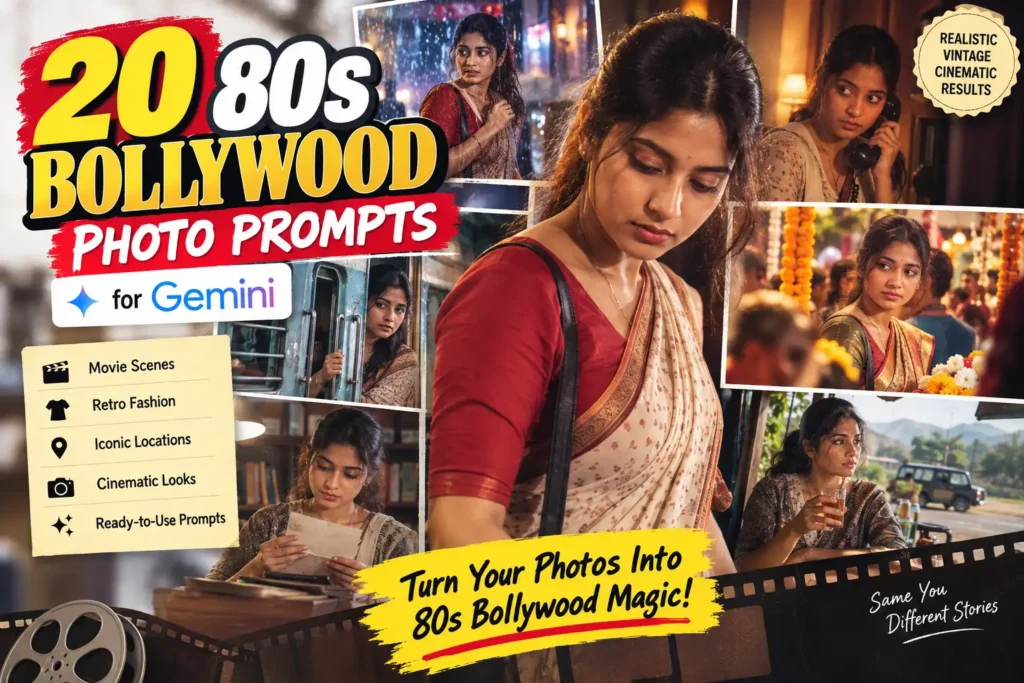
80s Bollywood Photo Prompts for Gemini – 20 Indian Movie Looks
80s Romantic Couple Prompts for Gemini – 20 Love Photo Ideas
Copied!