1. 80s South Indian Rooftop Morning Portrait
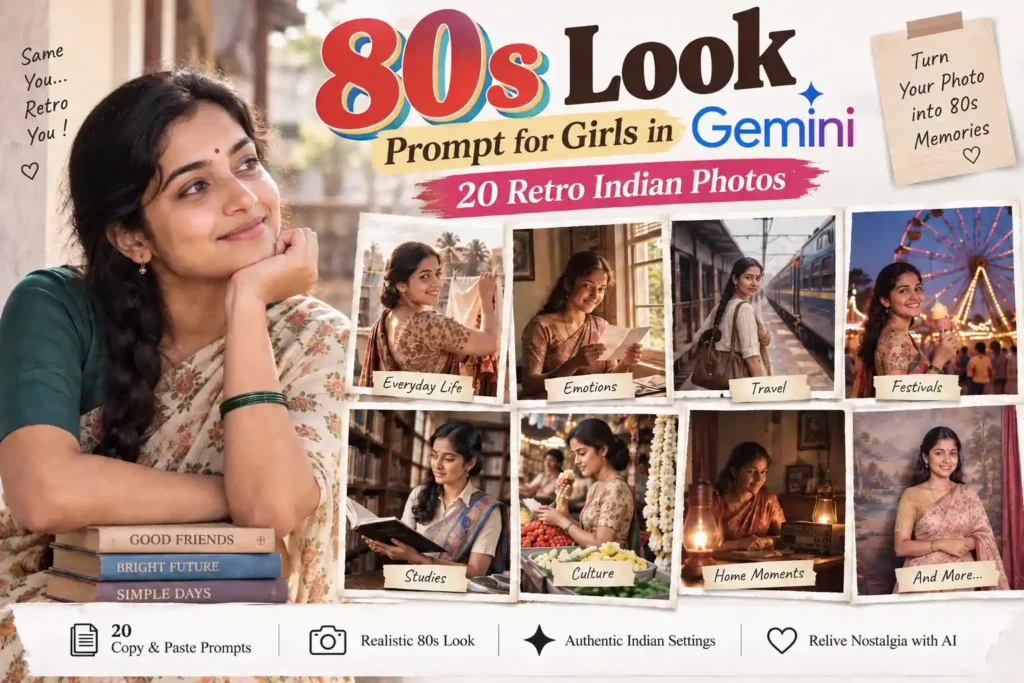
Use my uploaded photo as the exact facial identity reference. Preserve my recognizable face faithfully — facial structure, eyes, nose, lips, skin tone, natural age appearance, hairline, and important identifying characteristics must remain consistent. Do not replace my identity with a generic attractive model or excessively beautify my face.Transform me into a photorealistic Indian girl or woman photographed on the rooftop of a modest South Indian home in the mid-1980s.
Respect the natural age shown in my uploaded photo. Dress me in an authentic 1980s printed cotton saree with a modest short-sleeve blouse if appropriate to my age, or an age-appropriate period outfit if the uploaded subject is younger. Use a small bindi, simple earrings, thin glass bangles, and naturally braided or loosely tied hair. Keep makeup extremely minimal and believable for an ordinary morning at home.
Create a real moment instead of a fashion pose. I have come upstairs after washing my hair and am clipping freshly washed clothes onto a simple clothesline. One garment is still held between my hands when someone from the neighboring terrace calls my name. Capture the instant I turn halfway toward that voice, with a spontaneous expression of recognition.
Show a believable 1980s residential rooftop: weathered limewashed parapet, old wooden clothespins, cotton sarees and towels drying unevenly, steel bucket, woven laundry basket, neighboring tiled and flat-roof houses, period-correct television antennas, coconut trees, and distant morning haze.
Compose from the shadow of the rooftop stairway using a natural 35mm perspective. Let one hanging garment become a softly blurred foreground layer while my face remains clearly visible.
Morning sunlight should enter from one side and strike the pale rooftop wall, which naturally reflects soft light onto my face. A mild breeze should move only loose hair strands and lightweight fabric rather than everything equally.
PERIOD LOCK: Everything visible must plausibly belong to South India between 1982 and 1987. No smartphones, satellite dishes, solar panels, modern plastic water tanks, LED lights, CCTV cameras, contemporary fashion, modern high-rises, or present-day household products.
Preserve natural Indian skin texture, realistic hair strands, correct hands and fingers, believable cotton folds, physically accurate shadows, restrained 35mm grain, slightly warm faded colors, and gentle print softness. The final result should look like a beautiful candid photograph discovered inside a real 1980s family album, not a modern rooftop portrait with a retro filter.
2. 80s Girl Waiting for a Letter at the Window
Use my uploaded photograph as the strict facial identity reference. Preserve my real recognizable face, facial proportions, eyes, nose, lips, skin tone, natural age, hairstyle characteristics, and distinctive features. Do not turn me into a generic retro model.Create an intimate mid-1980s Indian photograph built around the emotional anticipation of receiving a handwritten letter.
Dress me in a soft period-correct cotton saree with a narrow woven border and simple blouse, or another age-appropriate 1980s Indian outfit if the uploaded subject is younger. Style the hair naturally in a braid or simple tied-back arrangement with only modest jewellery and a tiny bindi where appropriate.
Place me beside a large wooden window inside a modest Indian home. I have just noticed the postman approaching outside and have stopped halfway through folding a piece of clothing. One hand still holds the fabric while the other rests instinctively on the window frame. My expression should show quiet anticipation and curiosity rather than a posed smile.
Build the room with believable details: red-oxide or terrazzo floor, wooden cupboard, cane chair, folded newspaper, stainless-steel tumbler, old wall clock, cotton curtain moving slightly in the breeze, transistor radio, and a few envelopes or writing materials on a small table. Keep any generated writing too small to become visually important.
Outside the window, show only a partial glimpse of a period-correct residential lane and the approaching postal figure, softly out of focus.
Photograph from deeper inside the room with a 50mm perspective, using the window and curtain as natural framing. Afternoon sunlight should enter through the window and illuminate the side of my face closest to it, while the room behind remains softly subdued.
PERIOD LOCK: India between 1983 and 1988. No smartphones, modern appliances, LED bulbs, contemporary furniture, digital clocks, modern postal vehicles, current fashion, or present-day packaging.
Render natural skin pores, realistic eyes, correct hands, believable fabric, accurate window shadows, restrained film grain, warm color-negative character, and slight analog softness. The frame should suggest that something meaningful is about to happen after the photograph, creating curiosity without relying on text.
3. 80s Indian Girl Single-Screen Cinema Evening
Use my uploaded photo as the exact facial identity reference. Preserve my recognizable face, natural age, skin tone, facial structure, eyes, nose, lips, hair characteristics, and important identifying details. Do not replace me with an idealized actress.Reimagine me as an Indian girl or woman arriving at a neighborhood single-screen cinema in 1985.
Dress me in an elegant but believable 1980s salwar kameez with period-correct tailoring, a lightly patterned dupatta, modest earrings, thin bangles, and naturally styled hair. If the uploaded reference indicates an older woman, adapt the outfit naturally to her age rather than forcing youthful styling.
I am holding two small paper cinema tickets. Instead of facing the camera, capture the instant I turn toward the arriving crowd because the friend or relative who was supposed to meet me has finally appeared. My expression should shift naturally from waiting to relieved recognition.
Behind me, create an authentic Indian single-screen theatre entrance with portions of huge hand-painted film artwork, weathered walls, metal queue railings, incandescent bulbs, old bicycles, a small snack counter, glass soda bottles in wooden crates, and naturally dressed moviegoers. Avoid prominent readable generated text.
Compose from slightly below eye level with a 35mm street-photography perspective. Allow one or two moving visitors to blur subtly across the foreground while my face and tickets remain sharp.
Warm tungsten bulbs from the theatre should illuminate one side of the scene while the remaining blue evening daylight provides cool ambient fill. Preserve the mixed color temperature instead of making the lighting uniformly cinematic.
PERIOD LOCK: India, 1985. No multiplex architecture, smartphones, LED displays, digital posters, modern motorcycles, current beverage packaging, contemporary fashion, or present-day advertising.
Use authentic high-speed 35mm grain, slight halation around bright bulbs, realistic skin texture, accurate fingers holding the tickets, natural clothing folds, and imperfect edge sharpness. The final photo should feel like an unexpectedly beautiful frame captured immediately before an 80s movie night.
4. 80s Girl Riding Pillion on a Classic Scooter
Use my uploaded photograph as the exact facial identity reference. Keep my recognizable face, eyes, nose, lips, facial structure, skin tone, natural age, hair characteristics, and individual identifying features unchanged.Create a joyful but completely realistic Indian street memory from the mid-1980s involving a period-correct classic scooter.
Respect my natural age. Dress me in a colorful but plausible 1980s Indian salwar kameez or saree appropriate to the reference, using period-correct prints and tailoring rather than exaggerated retro colors. Keep jewellery simple and everyday.
Show me seated naturally as a pillion passenger on a stationary or very slowly moving period-appropriate scooter driven by another adult whose identity is secondary and clearly distinct. The relationship should read as ordinary family or friendly travel, not automatically romantic.
Capture a small spontaneous event: while waiting at a quiet roadside crossing, a gust of wind loosens one end of my dupatta or saree pallu and I quickly secure it with one hand while laughing at the inconvenience. My attention is on the fabric or driver rather than the camera.
Surround us with a believable 1980s Indian town street: old plaster shopfronts, bicycles, period buses or cars far in the background, utility poles, trees, hand-painted signage kept visually secondary, and pedestrians in authentic period clothing.
Use a low three-quarter 35mm composition that clearly shows the scooter geometry while keeping my face dominant. Add only slight wheel or distant traffic motion where physically appropriate.
Late-afternoon sunlight should filter through roadside trees, producing irregular patches of light across the street and soft reflected illumination on my face.
PERIOD LOCK: India between 1983 and 1988. No modern scooters, contemporary helmets, smartphones, LED signage, modern cars, current storefront branding, recent road furniture, or present-day clothing.
Maintain correct scooter proportions, natural body positioning, accurate hands, realistic fabric movement, believable hair, authentic Indian skin texture, mild film grain, restrained saturation, and no artificial AI glow. The image should feel like a lively personal memory from an old photo album, not a scooter advertisement.
5. 80s South Indian Girl Flower Market Morning
Use my uploaded photo as the exact facial identity anchor. Preserve my real recognizable face, natural age, facial proportions, eyes, nose, lips, skin tone, hairline, and distinctive characteristics. Do not replace my identity with a generic model.Create an authentic South Indian flower-market photograph set in the mid-1980s.
Dress me in a period-correct cotton saree with a contrasting modest blouse, or another age-appropriate traditional outfit if required by the uploaded reference. Use a small bindi, understated earrings, glass bangles, and naturally braided hair. Do not overload me with jewellery.
Capture me actively choosing flowers rather than posing among them. I am standing beside a vendor who is measuring a jasmine strand. At the exact moment of the photograph, I lift part of the flowers closer to inspect them while noticing that one loose jasmine bud has fallen onto my hand, creating a tiny spontaneous reaction.
Fill the market with authentic visual texture: imperfect heaps of jasmine, marigold and roses, banana-leaf wrapping, woven baskets, old metal weighing tools, weathered wooden stalls, damp stone flooring, cloth bags, bicycles beyond the market entrance, and vendors naturally working.
Compose from behind hanging flower strands so creamy jasmine becomes a softly blurred foreground frame. Use a 50mm documentary perspective that compresses the colorful market layers without making them artificial.
Morning daylight should enter through gaps in the market roof and create patches of illumination across flowers, while reflected light from pale walls naturally exposes my face.
PERIOD LOCK: South India around 1984–1987. No QR codes, smartphones, modern plastic flower packaging, LED lighting, digital weighing scales, contemporary handbags, current branding, or modern retail fixtures.
Preserve individual flower imperfections, natural skin pores, realistic fingers, believable saree folds, accurate basket texture, environmental wear, restrained film grain, and slightly warm analog color. The image should feel fragrant, busy, human, and unmistakably rooted in an ordinary 1980s morning.
6. 80s Girl Reading a Magazine During a Power Cut
Use my uploaded photograph as the strict facial identity reference. Preserve my recognizable face, facial structure, eyes, nose, lips, skin tone, natural age, hair characteristics, and important identifying details. Do not artificially beautify or de-age me.Create an atmospheric but realistic Indian home scene during an evening electricity cut in the 1980s.
Dress me in comfortable period-correct home clothing appropriate to my age — a simple cotton saree, salwar kameez, or other plausible outfit. Style the hair casually as it might look at the end of an ordinary day.
Place me seated near a table with an open magazine or book when the electricity has already gone out. A kerosene hurricane lamp has been placed nearby. Capture the instant I hear the ceiling fan beginning to move again because electricity may have returned; I look upward with a small hopeful expression while one finger still marks the page I was reading.
Include a modest lived-in room: wooden or cane furniture, wall clock, switched-off CRT television or transistor radio appropriate to the exact year, folded newspaper, steel tumbler, cotton curtains, wooden cupboard, matchbox beside the lamp, and a dark doorway to another room.
Compose from table height with a 50mm intimate perspective. Let the lamp occupy the near foreground without blocking my face.
The kerosene lamp should provide warm directional light from below and to one side, while a faint cool-blue residual evening light enters through a barred window. Keep much of the room naturally dark; do not expose every corner.
PERIOD LOCK: Indian household between 1982 and 1988. No smartphones, LED emergency lights, flat-screen TVs, modern magazines as recognizable covers, contemporary furniture, inverter displays, modern switches as focal details, or digital devices.
Render physically accurate flame light, realistic glass reflections, natural skin, correct fingers, believable eye highlights, high-speed-film grain, warm shadow color, and modest underexposure. The photograph should feel like an intimate 80s household memory rather than a modern candlelight portrait.
7. 80s Indian Girl Train Doorway Travel Memory
Use my uploaded photo as the exact facial identity reference. Preserve my recognizable face, natural age, skin tone, facial anatomy, eyes, nose, lips, hairstyle characteristics, and individual features. Do not transform me into a generic travel model.Create a realistic Indian railway travel photograph from the mid-1980s.
Dress me in comfortable period-correct travel clothing suitable for my age, such as a printed cotton saree or modest salwar kameez with authentic 1980s tailoring. Include only simple jewellery and practical footwear.
For safety and realism, place the train fully stopped at a small station. Show me standing just inside the open carriage doorway rather than leaning from a moving train. I am waiting for a family member who has stepped onto the platform to buy tea or food. Capture the instant I spot them returning through the crowd and my expression changes from searching to relieved amusement.
Include a cloth travel bag hanging naturally from my shoulder or resting beside the doorway. Show period-correct railway details: painted metal carriage, barred windows, worn steps, platform benches, vendors, steel containers, analog clock, luggage trunks, and naturally dressed passengers.
Compose from platform level using a slightly low 50mm perspective. The doorway should frame my body while repeating train windows lead into the background.
Soft station daylight should illuminate my face from the platform side while the carriage interior remains darker. Add atmospheric railway dust and subtle depth without excessive haze.
PERIOD LOCK: Indian railway station around 1985. No smartphones, modern trains, LED displays, wheeled trolley luggage, plastic bottled water, contemporary backpacks, earbuds, modern railway signs, or current fashion.
Maintain realistic train geometry, safe body position, correct hands, natural skin texture, believable cloth movement, gentle analog grain, muted railway colors, and authentic family-camera framing. The final result should feel like a cherished travel photograph taken during a brief station stop.
8. 80s Girl Getting Ready Before a Family Wedding
Use my uploaded photograph as the exact facial identity source. Preserve my real recognizable face, facial proportions, eyes, nose, lips, skin tone, natural age, hair characteristics, and distinctive details. Do not transform me into a bride unless the uploaded reference and requested context explicitly support that role.Create a quiet behind-the-scenes Indian family wedding moment from the mid-1980s.
Dress me as a wedding guest in a beautiful but historically plausible 1980s Indian saree appropriate to my region and age, with tasteful traditional jewellery, small bindi, glass or metal bangles, and period-correct hairstyle. Avoid contemporary bridal makeup, oversized jewellery, designer blouse cuts, or modern styling.
Place me inside a bedroom or dressing room shortly before leaving for the ceremony. I am seated before an old dressing-table mirror while trying to secure a jasmine strand or adjust one earring. Another female relative is visible only partly at the edge, reaching in naturally to help.
Capture the instant something in the mirror makes me suppress a laugh, creating an intimate family interaction rather than a formal beauty pose.
Build a believable 1980s dressing space: wooden mirror with slight age marks, comb, hairpins, small jewellery box, folded saree cover, metal trunk, simple cosmetics of the period kept visually subtle, cotton curtain, wooden wardrobe, and wedding sounds implied through activity beyond the partially open doorway.
Photograph through the mirror using a 50mm perspective. Keep the reflection physically accurate — one face only, correct hands, correct jewellery placement, and no impossible duplicate body parts.
Window daylight should illuminate the reflected face, while a warm tungsten bulb near the dressing table adds gentle warmth.
PERIOD LOCK: Indian wedding preparation around 1985. No ring lights, smartphones, modern cosmetics as focal objects, LED mirrors, contemporary bridal fashion, modern hair tools, or present-day furniture.
Preserve natural skin texture, realistic jasmine, accurate jewellery connections, believable silk folds, correct reflection geometry, gentle film grain, and subtle analog warmth. The result should feel like a private photograph taken before the family left for an actual 1980s wedding.
9. 80s Indian Girl College Bicycle Rain Escape
Use my uploaded photo as the exact facial identity reference. Preserve my recognizable face, facial structure, natural age, skin tone, eyes, nose, lips, hairstyle characteristics, and identifying features. If my reference is clearly older than college age, adapt the setting naturally to an adult workplace or community campus without de-aging me.Create an energetic Indian monsoon photograph inspired by everyday college life in the mid-1980s.
If age-appropriate, dress me in a modest period-correct salwar kameez with a cotton dupatta, simple sandals, small earrings, and naturally braided hair. Add a cloth shoulder bag containing notebooks rather than a modern backpack.
A sudden shower has started just as I am leaving. Show me pushing a classic black roadster bicycle quickly beneath the long veranda of an old college building. I am not riding dangerously in the rain. One hand controls the bicycle while the other gathers my dupatta or protects a notebook from the water.
Capture the precise second I reach shelter and look back at the rain with a relieved, slightly amused expression.
Show a believable campus: weathered plaster walls, high wooden doors, long shaded corridor, old notice boards with unreadable distant papers, other bicycles parked beneath the veranda, puddles forming in the courtyard, mature rain trees, and two or three students moving toward shelter.
Use a wide 35mm composition from farther down the veranda. Repeating pillars should create strong perspective while wet bicycle wheels and footprints add a sense of recent motion.
Grey monsoon daylight from the courtyard should provide soft lateral illumination. Reflections on the wet floor must correspond naturally to pillars, sky, and people.
PERIOD LOCK: India between 1983 and 1988. No smartphones, modern backpacks, contemporary bicycles, LED lights, modern college signage, current footwear, digital devices, or recent architecture.
Render bicycle geometry accurately, wet fabric naturally, correct hands and fingers, realistic rain droplets, damp hair strands, physically believable puddles and reflections, authentic Indian skin texture, and subtle motion only where the movement requires it. Use restrained 35mm film grain, slightly muted monsoon colors, gentle contrast, and the imperfect exposure character of a genuine consumer-film photograph.
The final image should feel like an accidental photograph from an unforgettable rainy college afternoon in the 1980s, not a modern fashion photoshoot staged with vintage props. No text, no watermark, no plastic skin, no artificial rain glow, no distorted bicycle, and no duplicate people.
10. 80s Indian Girl Sunday Morning Radio & Jasmine Memory
Use my uploaded photograph as the exact facial identity reference. Preserve my recognizable face faithfully — facial structure, eyes, nose, lips, skin tone, natural age appearance, hairline, and important identifying characteristics must remain unchanged. Do not replace me with a generic attractive model, over-smooth my skin, or automatically make me younger.Create a deeply nostalgic but photorealistic Sunday-morning scene inside a South Indian home between 1984 and 1987.
Dress me in a simple printed cotton saree with a modest blouse if appropriate to my natural age, or an authentic age-appropriate 1980s Indian outfit if the uploaded subject is younger. Keep the styling relaxed and domestic rather than glamorous. Use a tiny bindi, simple earrings, a few thin bangles, and naturally combed hair that is not yet fully arranged for the day.
Create an unusual story-in-one-frame moment. I am seated on the red-oxide floor near an open wooden doorway, making a jasmine flower strand by hand while an old transistor radio plays nearby. A half-finished jasmine garland lies across a small woven tray in front of me.
At the instant of the photograph, something unexpected has just come on the radio — perhaps a favorite song, familiar voice, or exciting announcement. My hands have paused midway through threading the flowers, and I turn my eyes toward the radio with an involuntary expression of recognition and quiet delight. Do not show me looking directly into the camera.
Add believable lived-in details rather than decorative nostalgia: a stainless-steel tumbler of filter coffee with faint steam, folded Sunday newspaper, one pair of ordinary slippers beside the doorway, wooden cupboard, cotton curtain, old wall clock, ceiling fan, brass or steel household vessels farther inside, and a few loose jasmine buds that have escaped from the tray onto the floor.
Through the open doorway, reveal only part of a small sunlit courtyard with household plants and a pale wall. Let the darker interior, bright doorway, flowers, and radio form separate visual layers.
Photograph from low floor height using an intimate 50mm perspective, as though a family member quietly photographed me from the other side of the room. Keep the foreground jasmine slightly soft while my paused hands, face, and radio form the main storytelling triangle.
Early-morning sunlight should enter through the doorway, strike the courtyard wall, and bounce softly back onto my face. A narrow direct sunbeam may illuminate a few jasmine flowers and reveal subtle dust only inside that beam. Do not fill the entire room with golden light.
PERIOD LOCK: Everything visible must plausibly belong to a South Indian household between 1984 and 1987. No smartphones, flat-screen televisions, LED bulbs, Wi-Fi devices, modern modular furniture, digital clocks, contemporary coffee machines, modern plastic décor, current packaging, or present-day fashion.
Render each jasmine flower with natural irregularity rather than perfect repetition. Preserve realistic fingertips, thread position, natural skin pores, individual hair strands, believable cotton folds, physically accurate shadows, realistic coffee steam, and subtle environmental wear.
Use gentle 35mm consumer-film grain, restrained warm colors, slight print softness, modest dynamic range, and minor exposure imperfections. The finished photograph should feel like a forgotten Sunday morning from the 1980s that became emotionally valuable only many years later — a genuine family memory rather than a modern retro portrait.
11. 80s Indian Girl Balcony Hair-Braiding Morning
Use my uploaded photo as the exact facial identity reference. Preserve my recognizable face faithfully — facial structure, eyes, nose, lips, skin tone, natural age appearance, hairline, and important identifying characteristics. Do not replace me with a generic attractive model or over-beautify my natural features.Transform me into a photorealistic Indian girl or woman during a quiet morning at home in the mid-1980s.
Respect the natural age shown in my uploaded photograph. Dress me in an authentic period-correct cotton saree with a small printed pattern and modest blouse if age-appropriate, or a simple 1980s pavadai-dhavani, salwar kameez, or other age-appropriate Indian outfit if the uploaded subject is younger. Keep jewellery minimal and everyday.
Place me on the narrow balcony of a modest Indian house while I am halfway through braiding my own long hair. One section of the braid is finished while the remaining hair falls naturally over one shoulder.
Do not make this a beauty pose. Capture a tiny interruption: a bicycle bell or familiar voice has just come from the lane below, causing me to pause with both hands still holding the unfinished braid and lean slightly toward the balcony opening to see who has arrived.
Create a believable neighborhood below and around me: weathered plaster walls, wooden windows, patterned iron balcony railing, drying cotton towel, small household plants in reused clay or metal containers, tiled roofs, roadster bicycle passing below, utility wires and poles appropriate to the period, and distant coconut foliage.
Compose from inside the darker room looking outward through the balcony doorway. Use a 50mm perspective so the doorway creates a natural frame around me while the street below remains softly out of focus.
Morning daylight should illuminate my face from the open balcony. Reflected light from the opposite pale wall should soften facial shadows naturally. Avoid modern beauty lighting, artificial rim glow, or excessive golden-hour effects.
PERIOD LOCK: Indian residential neighborhood between 1983 and 1987. No smartphones, modern apartment towers, satellite dishes, contemporary plastic planters, LED lights, CCTV cameras, modern vehicles, current fashion, or present-day household products.
Render the unfinished braid accurately with individual hair strands and believable hand placement. Preserve natural skin pores, facial asymmetry, correct fingers, realistic cotton folds, physical shadow direction, gentle consumer-film grain, restrained warm colors, and subtle print softness.
The final photograph should look like a private morning moment unexpectedly captured by a family member in the 1980s, not a modern hairstyle photoshoot with retro styling.
12. 80s Indian Girl Library Book Discovery
Use my uploaded photograph as the strict facial identity reference. Preserve my real recognizable face, natural age, facial proportions, eyes, nose, lips, skin tone, hairstyle characteristics, and distinctive personal features. Never substitute a generic student or fashion model.Create an atmospheric Indian library photograph set in the mid-1980s.
If my natural age is appropriate for college, dress me in a modest 1980s cotton salwar kameez with a lightly patterned dupatta, simple earrings, sandals, and naturally braided or tied-back hair. If I appear older, adapt me naturally as a teacher, researcher, librarian, or adult reader without de-aging my face.
Place me between tall old wooden bookshelves inside a college, public, or institutional library. I have just pulled an old book from a tightly packed shelf and something slips from between its pages — a forgotten photograph, library card, pressed flower, or folded piece of paper.
Capture the exact second before I pick it up. The book remains open in one hand while I look downward at the unexpected object with genuine curiosity. Do not make the object contain readable personal information.
Build an authentic 1980s library: tall wooden shelves with unevenly arranged books, card-catalogue drawers, wooden reading tables, cane or wooden chairs, green or period-appropriate desk lamps where plausible, ceiling fans, high barred windows, paper issue slips, and a librarian or reader far in the background.
Use the gap between two shelves as a strong foreground frame. Photograph with a 50mm perspective, keeping my face, hands, open book, and fallen object sharp while shelves gradually soften into depth.
High-window daylight should create a narrow directional beam across part of the aisle, revealing faint dust in the light without turning the room hazy. Reflected ambient light should keep my face naturally exposed.
PERIOD LOCK: Indian library between 1982 and 1988. No computers, smartphones, tablets, barcode scanners, modern library furniture, LED fixtures, contemporary backpacks, digital displays, or recent book-cover designs as focal elements.
Preserve realistic book thickness, paper edges, natural skin texture, correct fingers, believable eye direction, subtle shelf wear, moderate film grain, slightly muted colors, and modest dynamic range.
The final frame should create immediate curiosity about what was hidden inside the old book while still looking completely believable as an accidental 1980s photograph.
13. 80s Indian Girl Bus Window Jasmine Seller Moment
Use my uploaded photo as the exact facial identity anchor. Preserve my recognizable face, facial structure, eyes, nose, lips, natural skin tone, age appearance, hair characteristics, and important identifying features. Do not make me look like a different person.Create an authentic mid-1980s South Indian city-bus photograph built around a tiny everyday interaction.
Dress me in plausible period-correct clothing appropriate to my age — a printed cotton saree, salwar kameez, or another authentic everyday outfit. Use simple jewellery, small bindi where appropriate, naturally arranged hair, and no modern makeup styling.
Place me seated beside an open barred or sliding bus window while the bus is stopped at a busy roadside stop.
A flower seller standing outside has lifted a small jasmine strand toward the window. Capture the moment I lean slightly closer and reach through the safe open section of the stationary bus window to accept the flowers or hand over coins.
My attention should be on the seller and flowers rather than the camera. The interaction should feel ordinary, warm, and completely unstaged.
Inside the bus show worn period-correct seating, painted metal rails, simple ticket stubs, another passenger partly visible, and a conductor farther down the aisle. Outside show a softly layered 1980s street with bicycles, old storefronts, period buses or cars, pedestrians, and roadside vendors.
Compose from the seat diagonally across the aisle with a 50mm documentary perspective. Use the bus window as a frame-within-a-frame, with my face inside and the flower seller partially visible outside.
Strong daylight should enter through the window and naturally illuminate my hands, jasmine flowers, and one side of my face while the bus interior remains somewhat darker.
PERIOD LOCK: South India between 1983 and 1988. No smartphones, modern buses, LED route boards, contemporary advertisements, QR codes, plastic payment devices, modern vehicles, current handbags, or present-day fashion.
Render the jasmine strand with natural irregularity, coins and fingers accurately, realistic window geometry, natural skin pores, believable bus wear, gentle film grain, restrained colors, and slight documentary softness.
The finished image should preserve the charm of a tiny 1980s street interaction that would normally have disappeared from memory.
14. 80s Indian Girl Record Shop Listening Moment
Use my uploaded photograph as the exact facial identity reference. Preserve my recognizable face, natural age, skin tone, facial structure, eyes, nose, lips, hair characteristics, and individual identifying details. Do not turn me into a Westernized retro fashion model.Create a culturally believable Indian music-shop photograph from the mid-1980s.
Dress me in a modest period-correct Indian outfit appropriate to my natural age, such as a printed salwar kameez or simple saree. Use understated earrings, thin bangles, natural hair, and restrained styling.
Place me inside a small neighborhood music store selling vinyl records and audio cassettes appropriate to the exact period.
Instead of simply holding a record toward the camera, create a discovery moment. The shopkeeper has just placed a record on a turntable for me to hear before buying it. I stand beside the counter holding the empty record sleeve while leaning slightly toward a small speaker, and the opening notes have apparently surprised me.
Capture a subtle expression of delighted recognition while my eyes remain toward the speaker or shopkeeper rather than the camera.
Build a dense but realistic shop interior: wooden record shelves, period audio cassettes, turntable, wired speakers, simple amplifier, handwritten price tags too small to require readable text, ceiling fan, glass counter, brown paper bags, and faded music artwork kept visually secondary.
Compose from near the end of the counter with a 35mm perspective. Allow stacked record sleeves to form colorful foreground layers while my face remains unobstructed.
Daylight from the open storefront should mix with one or two warm fluorescent or tungsten practical fixtures appropriate to the era. Preserve the slightly imperfect mixed color temperature.
PERIOD LOCK: India between 1983 and 1987. No CDs if the exact scene predates their plausible local presence, no smartphones, wireless headphones, Bluetooth speakers, LED strips, digital music players, modern point-of-sale equipment, QR codes, or contemporary store interiors.
Render vinyl and turntable geometry accurately, preserve natural hand grip on the sleeve, realistic skin texture, correct fingers, believable shop clutter, mild high-speed film grain, and subtle analog warmth.
The final image should feel like a genuine photograph of discovering a favorite song in an 80s Indian music shop, not a generic neon retro aesthetic.
15. 80s Indian Girl Village Well Reflection Portrait
Use my uploaded photo as the strict facial identity reference. Preserve my exact recognizable face, natural age, facial proportions, eyes, nose, lips, skin tone, hairstyle characteristics, and distinctive features. Do not replace my face or beautify it into an idealized village character.Create a photorealistic Indian village morning scene from the mid-1980s centered around an unusual reflection composition.
Dress me in an authentic everyday cotton saree with a modest blouse if appropriate to my age, or another age-appropriate traditional outfit. Keep jewellery extremely simple and practical.
Place me beside a traditional stone-lined or masonry village well in a lived-in residential setting. I have just drawn a metal water vessel and set it safely on the well platform.
Instead of posing, show me leaning slightly over the safe edge because I have noticed a loose flower or small leaf floating on the still water below. My real face should be visible in three-quarter profile while a softer, physically correct partial reflection appears on the water surface.
Do not create a perfect mirror reflection. Small ripples from the recently lifted bucket should gently distort it.
Surround the well with believable details: worn stone from years of use, rope darkened by handling, metal or brass water vessel, damp patches on the platform, a few wet footprints, nearby tiled-roof house, simple wooden doorway, banana or coconut foliage, and another household vessel waiting nearby.
Use an elevated but natural 35mm composition from slightly behind my shoulder so the viewer can see both my profile and the water inside the well without creating dangerous body positioning.
Morning sunlight should strike part of the stone platform while the well interior remains cool and shaded. Reflected daylight from the surroundings should illuminate my face naturally.
PERIOD LOCK: Rural India between 1982 and 1988. No smartphones, electric water pumps as modern focal objects, plastic designer buckets, contemporary plumbing, modern buildings, LED fixtures, current clothing, or present-day accessories.
Keep the water reflection optically plausible, with correct face orientation and ripple distortion. Render rope fibers, stone wear, wet footprints, natural skin pores, correct hands, realistic vessel reflections, subtle analog grain, and restrained earthy color.
The finished photograph should feel visually surprising but entirely possible — an ordinary water-fetching moment transformed into a memorable 1980s family photograph through composition alone.
16. 80s Indian Girl Sewing Beside Monsoon Window
Use my uploaded photograph as the exact facial identity reference. Preserve my real recognizable face, facial anatomy, eyes, nose, lips, skin tone, natural age, hair characteristics, and important identifying details. Do not replace me with a generic model.Create a quiet Indian monsoon-afternoon photograph from the mid-1980s.
Dress me in comfortable, period-correct home clothing suitable for my age, such as a simple cotton saree or modest salwar kameez. Keep the hair naturally tied back and jewellery minimal.
Place me beside a large barred wooden window while repairing or altering a piece of clothing by hand. A small sewing box rests beside me with thread spools, buttons, measuring tape, and folded fabric.
Create a story moment: heavy rain outside suddenly becomes stronger and a few wind-driven drops enter through the open window. I pause halfway through threading or stitching, pull the fabric slightly away from the rain with one hand, and look toward the window with mild surprise.
Include a vintage mechanical sewing machine farther behind, but keep the hand-sewing activity as the immediate focus. Add a wooden table, folded fabrics, steel tumbler of tea, cotton curtain, old wall clock, and a small puddle beginning to form beneath the window.
Photograph from the opposite side of the table using a 50mm perspective. Let the sewing box become a softly focused foreground element while my face, hands, needle area, and rain-covered window form the visual story.
Cool grey daylight should enter through the window. A pale interior wall should provide soft natural fill. If a practical bulb is visible deeper inside, keep its warm contribution subtle.
PERIOD LOCK: Indian household between 1983 and 1988. No computerized sewing machines, smartphones, LED lights, modern synthetic décor, contemporary sewing gadgets, digital clocks, present-day furniture, or current fashion.
Render hands and needle interaction carefully without malformed fingers. Preserve realistic thread tension, cotton texture, rain droplets on glass and bars, damp floor reflections, natural skin, individual hair strands, subtle film grain, and muted monsoon colors.
The image should feel peaceful yet alive, as though the camera caught the exact second an ordinary household task was interrupted by the weather.
17. 80s Indian Girl Fairground Giant Wheel Ticket Moment
Use my uploaded photo as the exact facial identity source. Preserve my recognizable face, natural age, skin tone, facial structure, eyes, nose, lips, hair characteristics, and unique identifying details. Do not replace me with a generic glamorous model.Create a lively Indian exhibition or small-town fair photograph from the mid-1980s.
Dress me in festive but plausible period-correct clothing appropriate to my age: a colorful salwar kameez, saree, or other authentic Indian outfit with restrained jewellery and natural hairstyle.
Place me near a period-appropriate giant wheel at dusk. Instead of simply posing with the ride behind me, capture the instant after I have bought a paper ticket and realize the giant wheel has suddenly started turning faster than expected. I look upward toward it with a mixture of excitement and playful nervousness while holding the small ticket between my fingers.
A friend or relative may appear only partially at one edge, gesturing toward the entrance, but my identity must remain the clear focus.
Build a believable 1980s fair: mechanically simple giant wheel, incandescent bulbs, painted wooden stalls, cloth awnings, snack vendors, balloons and toys appropriate to the period, dusty ground, families in period clothing, and simple loudspeaker equipment in the distance.
Use a low-angle 28–35mm perspective so the wheel rises dramatically into the evening sky while I occupy the lower foreground. Keep perspective flattering and anatomically natural.
Use a shutter character that keeps my face and ticket sharp while giving the moving wheel a restrained amount of motion blur. Warm incandescent bulbs should contrast naturally with deep-blue dusk.
PERIOD LOCK: India between 1983 and 1988. No LED rides, smartphones, digital ticket scanners, modern amusement-park equipment, contemporary plastic merchandise, current fashion, neon strips, or present-day branding.
Render the giant wheel mechanically plausibly, preserve correct hands and ticket grip, natural Indian skin texture, realistic low-light shadows, subtle halation around bulbs, moderate high-speed-film grain, and no artificial fantasy glow.
The final image should instantly communicate the thrill of an 80s Indian fair while looking like a genuine candid photograph rather than a modern carnival editorial.
18. 80s Indian Girl Quiet Temple Tank Morning
Use my uploaded photograph as the exact facial identity reference. Preserve my real recognizable face, natural age, facial proportions, eyes, nose, lips, skin tone, hairstyle characteristics, and important identifying features. Do not transform me into a deity, fantasy character, or generic devotional model.Create a respectful and peaceful South Indian morning photograph set near a traditional temple tank in the mid-1980s.
Dress me in culturally appropriate period-correct clothing suitable for my natural age, such as a simple silk-cotton or cotton saree with modest blouse, small bindi, understated earrings, thin bangles, and jasmine in naturally arranged hair where appropriate.
Show me after prayer, walking slowly along the old stone steps beside the temple tank while carrying a small flower packet or traditional prayer item.
Create the emotional moment through action: one jasmine flower slips from the packet and lands on a lower dry stone step. I stop and turn back toward it, preparing to retrieve it, creating a natural pause rather than a devotional pose.
Show only culturally plausible surroundings: aged stone steps, calm tank water, partial reflection of temple architecture, traditional gopuram or stone structure in the distance where geographically appropriate, a few devotees, brass or clay lamps in suitable areas, pigeons, and morning mist.
Use a wide environmental 35mm composition from several steps away. Repeating stone geometry should lead toward me while the tank reflection provides visual depth.
Early sunlight should strike the upper temple architecture and portions of the stone steps. My face should receive soft reflected light from the pale sky and water rather than supernatural illumination.
PERIOD LOCK: South India between 1982 and 1988. No smartphones, modern railings, LED temple lighting, contemporary advertising, plastic devotional packaging as a focal detail, current fashion, or modern urban structures.
Preserve completely human anatomy, natural skin texture, correct feet and hands, realistic saree draping, physically accurate water reflections, worn stone texture, restrained film grain, and gentle morning colors.
The final photograph should communicate peaceful 80s devotion through authentic human behavior, architecture, and atmosphere without excessive divine effects.
19. 80s Indian Girl Terrace Radio During Approaching Storm
Use my uploaded photo as the exact facial identity anchor. Preserve my recognizable face, natural age, skin tone, facial anatomy, eyes, nose, lips, hair characteristics, and important identifying features. Do not replace me with a generic cinematic model.Create a dramatic but physically realistic Indian rooftop scene from the mid-1980s immediately before a monsoon storm.
Dress me in simple period-correct everyday clothing appropriate to my age. Use a printed cotton saree with a modest blouse if suitable for the uploaded subject, or an authentic age-appropriate 1980s salwar kameez, pavadai-dhavani, or other Indian outfit if younger. Keep jewellery minimal, hairstyle natural, and makeup understated.
I have come onto the terrace to collect drying clothes after noticing the sky suddenly becoming dark. A small portable transistor radio is playing on a wooden stool near the stairway entrance.
Create a story-in-one-frame moment: while gathering the final clothes, a sudden strong gust of wind changes everything. One lightweight garment pulls loose from a clothespin and begins lifting into the air. I instinctively reach toward it with one hand while the other arm holds several already-collected clothes against my body.
At the same instant, I glance toward the rapidly darkening sky with an alert expression, realizing that heavy rain is only moments away. Do not make me stare at the camera or pose dramatically.
Build a believable mid-1980s Indian rooftop: weathered limewashed parapet, simple clotheslines tied between practical supports, mismatched wooden clothespins, galvanized or steel bucket, woven laundry basket, transistor radio with period-correct knobs and antenna, old stairway doorway, neighboring tiled and flat-roof houses, period television antennas, coconut trees bending slightly in the wind, and distant birds moving away from the storm.
Use the flying garment as a dynamic foreground element, but never let it cover my face. A few loose clothespins may have fallen onto the rooftop floor, suggesting that the wind strengthened only seconds earlier.
Compose from very low near rooftop-floor height with a 28–35mm documentary perspective. Use one foreground clothespin, the diagonal clothesline, and the moving fabric to lead the viewer's eye toward me and then toward the enormous storm sky.
Keep perspective natural and avoid distorting my body. My face should remain clearly recognizable even though the composition emphasizes the environment.
Lighting must come entirely from the changing weather. Thick monsoon clouds should block most direct sunlight, creating cool soft ambient illumination. A narrow remaining brighter area near the horizon may cast gentle side light across my face and clothing. Do not add artificial lightning, glowing clouds, fantasy rays, or cinematic face illumination.
Show realistic wind behavior: lightweight cotton fabric moves strongly, heavier folded clothes move less, loose hair strands lift in different directions, and the radio and metal bucket remain firmly stationary.
The first tiny rain droplets may be visible on the parapet or floor, but the heavy rain has not started yet. The visual tension should come from knowing what is about to happen.
PERIOD LOCK: Everything visible must plausibly belong to an Indian residential neighborhood between 1983 and 1988. No smartphones, satellite dishes, solar panels, modern plastic water tanks, LED fixtures, CCTV cameras, contemporary apartment towers, current fashion, modern outdoor furniture, present-day vehicles, or recent household products.
Render the transistor radio accurately with believable knobs, speaker grille, antenna, and physical scale. Preserve correct hands and fingers reaching toward the cloth, realistic cotton weight and folds, individual hair strands, natural Indian skin pores, physically accurate shadows, plausible cloud depth, and authentic rooftop wear.
Use restrained 35mm consumer-film grain, slightly desaturated storm colors, natural highlight roll-off, mild analog softness, and subtle motion blur only on the fastest-moving fabric.
The final photograph should feel like somebody pressed the shutter one second before everyone rushed downstairs — an ordinary 1980s rooftop afternoon transformed into an unforgettable family photograph by timing alone. No text, no watermark, no artificial AI glow, no plastic skin, no distorted hands, no duplicate person, and no modern objects.
20. 80s Indian Girl Old Photo Studio Before the Flash
Use my uploaded photograph as the exact facial identity reference. Preserve my recognizable face faithfully — facial structure, eyes, nose, lips, skin tone, natural age appearance, hairline, facial asymmetry, and important identifying characteristics. Do not replace me with a generic beautiful model, excessively smooth my skin, or alter my natural age.Create an extraordinarily believable Indian neighborhood photo-studio portrait from the mid-1980s, but capture the seconds BEFORE the official studio photograph rather than reproducing a stiff formal portrait.
Respect the age visible in my uploaded photo. Dress me in an elegant but realistic 1980s Indian outfit appropriate to that age. For an adult woman, use a graceful saree with a tasteful period-correct print or woven border, modest blouse, small bindi, simple earrings, thin bangles, and naturally arranged hair. For a younger girl, use an age-appropriate 1980s dress, pavadai-dhavani, salwar kameez, or other culturally plausible outfit with restrained styling.
Place me inside a modest neighborhood photography studio containing a slightly faded hand-painted cloth backdrop. The painted scenery should depict an idealized garden with distant trees, decorative balustrade, soft hills, and painted clouds typical of inexpensive studio photography of the era. Keep slight wrinkles, hanging imperfections, and the lower edge of the backdrop visible so it clearly feels like a real painted studio cloth rather than an actual landscape.
Include a simple wooden chair or upholstered studio stool, patterned floor mat, heavy side curtain, small wooden table, old photographic equipment, and subtle signs that many families have been photographed here before.
Create a highly specific candid moment. The photographer has already positioned me for the formal portrait and has stepped behind the camera. I am sitting slightly angled with my hands arranged carefully on my lap.
Just before the shutter is pressed, somebody from my family standing beside the photographer quietly says something that makes me begin to laugh.
Capture the exact transition between the formal expression and genuine laughter — lips only beginning to curve, eyes reacting first, shoulders becoming slightly relaxed, and one hand starting to leave the carefully arranged studio position.
I should look slightly beside the lens toward that family member rather than directly into the camera.
This emotional transition is the central idea of the photograph. Do not make me look like a professional fashion model.
Compose from the actual photographer's position at approximately chest height with a period-appropriate 50–80mm portrait perspective. Leave enough space around me to reveal the chair, backdrop edges, curtain, and studio floor so viewers immediately understand the old photography-studio environment.
Use a large diffused tungsten studio lamp positioned slightly above and to one side of the camera. Add modest frontal fill appropriate to older portrait studios. The face should be clearly exposed but retain natural cheek and jaw shadows.
Do not reproduce modern beauty lighting, ring-light catchlights, perfect digital skin, extreme background blur, or glossy contemporary fashion photography.
Include a subtle visual clue that this is the moment before the final exposure: the photographer's old camera or edge of its tripod may appear softly out of focus in the extreme foreground, but it must never obscure my face.
PERIOD LOCK: The complete visible world must plausibly belong to an Indian neighborhood photography studio between 1983 and 1988. No digital cameras, smartphones, modern softboxes, LED panels, ring lights, contemporary studio furniture, current fashion, modern makeup, digital monitors, present-day accessories, or recent photographic equipment.
Reproduce authentic analog photographic behavior rather than simply adding a vintage filter: natural Indian skin texture, visible but subtle pores, realistic hair strands, accurate hands and fingers, believable saree or clothing folds, correct jewellery connections, gentle lens softness toward the frame edges, restrained film grain, slightly warm color-negative response, modest dynamic range, and subtle print softness.
Do not artificially damage the photograph with excessive scratches, sepia, dust overlays, torn edges, or extreme fading. It should appear like a well-preserved original color print from the 1980s.
The final image should feel as though a family member later preferred this accidental pre-pose frame over the official studio portrait because it captured the girl's real personality — a genuine 1980s Indian memory that viewers would immediately want to recreate using their own uploaded photograph.
No text, no watermark, no modern objects, no duplicate people, no distorted hands, no extra fingers, no plastic skin, no fake AI glow, and no contemporary fashion styling.
Some more you might like
1980s Indian Village Photo Prompts for Gemini – 20 Retro Looks
80s Retro Photo Prompts for Gemini – 25 Vintage Indian Styles
80s Family Photo Prompts for Gemini – 20 Indian Family Styles
80s Wedding Couple Photo Prompts for Gemini – 20 Retro Wedding Looks
80s Bollywood Photo Prompts for Gemini – 20 Indian Movie Looks
80s Romantic Couple Prompts for Gemini – 20 Love Photo Ideas
Copied!