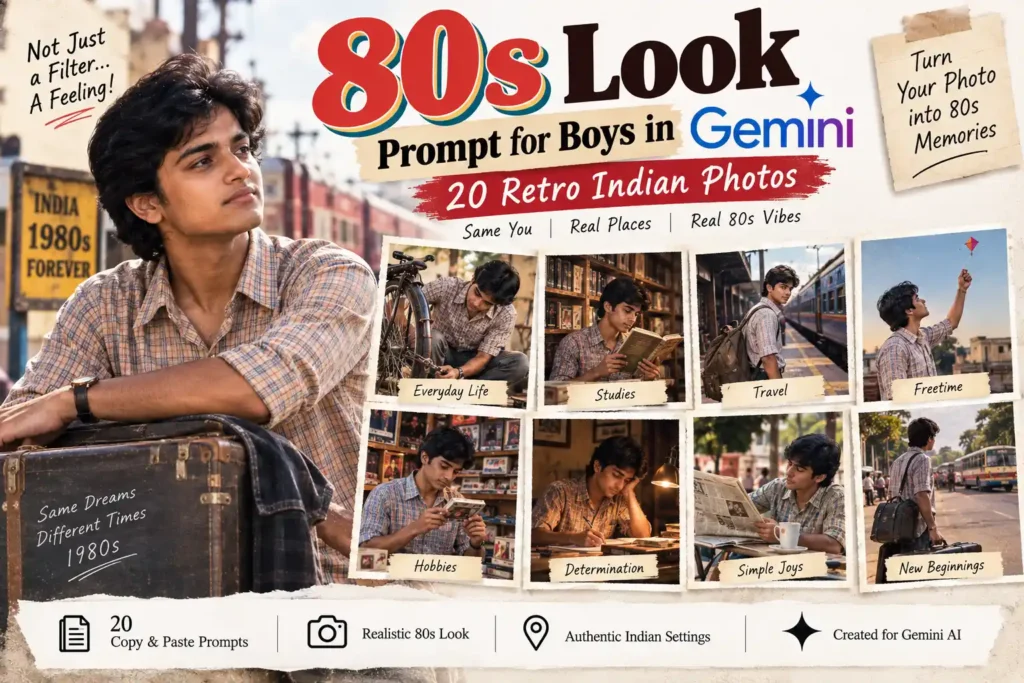
1. 80s Indian Boy Sunday Morning Bicycle Repair
Use my uploaded photo as the exact facial identity reference. Preserve my recognizable face faithfully — facial structure, eyes, nose, lips, skin tone, natural age appearance, hairline, facial asymmetry, and important identifying characteristics must remain consistent. Do not replace my identity with a generic handsome model, artificially sharpen my jawline, add a modern hairstyle, or automatically make me younger.Transform me into a photorealistic Indian boy or man photographed during an ordinary Sunday morning in the mid-1980s.
Respect the natural age shown in my uploaded photograph. If I am a teenager or young adult, dress me in a slightly faded half-sleeve checked cotton shirt with period-correct trousers or simple pants and practical sandals. If I am older, adapt the clothing naturally to my age while preserving the same modest 1980s middle-class character. Avoid fashionable modern retro styling.
Create a genuine story rather than a pose. I am crouched beside a classic black roadster bicycle in the front courtyard of a modest Indian house, trying to put the bicycle chain back onto the sprocket after it has slipped. One hand carefully holds the pedal while the other has just finished guiding the chain into place.
At the exact instant of the photograph, I notice the dark grease that has transferred onto two of my fingers and instinctively hold the hand away from my clean shirt with a small amused, mildly annoyed expression. I should be looking at my greasy fingers, not at the camera.
Add evidence that this is a real unfinished household moment: a small metal oil can nearby, an old cotton rag partly stained with grease, a simple hand pump leaning against the wall, one slipper shifted slightly from where I crouched down, and a folded newspaper left on a veranda chair because repairing the bicycle unexpectedly interrupted the morning.
Build a believable 1980s Indian home around me: red-oxide or worn cement courtyard floor, limewashed wall with natural age marks, wooden doorway, cane or wooden chair, steel tumbler of tea on the veranda ledge, flowering household plants, tiled roof where regionally appropriate, and a quiet residential lane visible through the open gate.
Use the bicycle wheel as a strong visual storytelling device. Photograph from low near wheel height with a natural 35mm documentary perspective, allowing part of the large front wheel to occupy the foreground and frame me through its spokes without obscuring my face. Keep bicycle geometry physically correct.
Morning sunlight should enter diagonally through a tree outside the courtyard, producing irregular patches of light on the wall and floor. Reflected light from the pale wall should illuminate my face naturally. Do not add artificial golden rim light or modern cinematic face lighting.
PERIOD LOCK: Everything visible must plausibly belong to an Indian residential environment between 1983 and 1987. No smartphones, modern bicycles, contemporary sports shoes, plastic toolboxes, LED lights, CCTV cameras, satellite dishes, modern cars, present-day packaging, current hairstyles, or recent household products.
Preserve realistic chain grease, mechanically correct bicycle parts, accurate hands and fingers, natural fingernails, believable cotton wrinkles, individual hair strands, natural Indian skin pores, physically accurate shadows, subtle environmental wear, and correct body proportions.
Use restrained 35mm consumer-film grain, slightly warm but natural colors, modest dynamic range, mild lens softness toward the edges, and tiny exposure imperfections. Do not add fake scratches or heavy sepia.
The final photograph should look like a family member happened to capture an ordinary boy fixing his bicycle on a Sunday morning in the 1980s — a simple moment that became valuable decades later. No text, no watermark, no plastic skin, no extra fingers, no distorted bicycle, no artificial AI glow, and no modern objects.
2. 80s Indian Boy Cassette Shop Song Discovery
Use my uploaded photograph as the strict facial identity reference. Preserve my real recognizable face, facial proportions, eyes, nose, lips, skin tone, natural age, hairline, hairstyle compatibility, and distinctive personal features. Do not transform me into a generic Bollywood hero or modern fashion model.Create an authentic Indian audio-cassette shop scene from the mid-1980s.
Respect the age visible in my uploaded photo. Dress me in a period-correct tucked or naturally worn cotton shirt with subtle stripes or checks, simple trousers, belt and sandals or shoes appropriate to my age and social setting. Keep the hairstyle naturally compatible with the reference while adapting only enough to belong convincingly to the 1980s.
Place me inside a narrow neighborhood music shop filled with audio cassettes, a few vinyl records where historically plausible, wooden shelves, glass counter, wired speakers, period amplifier, cassette player, handwritten paper labels kept too small to require readable text, brown paper bags, ceiling fan, and faded music artwork that remains visually secondary.
Do not show me simply displaying a cassette toward the camera.
Create a discovery moment. The shopkeeper has just inserted a cassette I was considering buying into the shop's player. I am standing beside the glass counter holding the empty cassette case when the first few seconds of the song begin.
Capture the instant I recognize the song.
My attention shifts toward the speaker; one eyebrow lifts slightly, the beginning of a smile appears, and my hand holding the cassette case pauses halfway toward the counter. The emotion should be subtle enough to look genuinely photographed rather than acted.
The shopkeeper may appear farther behind the counter, naturally occupied with the cassette deck rather than looking at the camera. Keep every visible person's face distinct.
Compose from the far end of the counter with a 35mm documentary perspective. Use a few cassette cases close to the lens as softly blurred foreground layers, leading toward my hand, face, and then the speaker.
Daylight from the open shopfront should provide the strongest illumination. A warm fluorescent or tungsten practical fixture deeper inside may create the slightly imperfect mixed color temperature characteristic of real shops of the era.
PERIOD LOCK: Indian music shop between 1984 and 1988. No CDs where historically inappropriate, smartphones, wireless headphones, Bluetooth speakers, LED strips, digital music players, modern point-of-sale systems, QR codes, contemporary store interiors, current fashion, or recent audio equipment.
Render cassette proportions, clear plastic case reflections, tape reels, wired equipment, natural hand grip, skin pores, realistic hair, glass-counter reflections, shelf wear, and environmental clutter accurately.
Use moderate high-speed 35mm grain, slightly imperfect indoor color balance, natural shadow density, restrained saturation, and gentle analog softness.
The final image should feel like the exact afternoon an Indian boy first heard a song he would remember for the rest of his life — visually nostalgic without relying on exaggerated retro clichés. No text, no watermark, no duplicate people, no distorted fingers, no modern technology, and no neon synthwave styling.
3. 80s Indian Boy Train Window Tea Exchange
Use my uploaded photo as the exact facial identity anchor. Preserve my recognizable face, facial anatomy, eyes, nose, lips, skin tone, natural age, hair characteristics, and important identifying details. Do not replace me with a generic traveler or change my natural age.Create a highly believable Indian railway journey photograph from the mid-1980s centered around one tiny interaction that instantly communicates the era.
Dress me in practical period-correct travel clothing appropriate to my age: a simple cotton shirt with sleeves naturally positioned, period trousers, ordinary wristwatch only if suitable, and no modern accessories. Add a soft cloth shoulder bag or old holdall rather than contemporary luggage.
The train is completely stopped at a small railway station.
Place me seated beside an open barred carriage window inside a non-air-conditioned period passenger coach. A platform tea vendor outside has just handed a small glass or period-appropriate cup of hot tea toward the window.
Capture the exact exchange.
One of my hands reaches carefully toward the tea while the other holds the correct coins ready for payment. My eyes are on the vendor's hand because the tea is hot. A thin trail of steam rises between our hands and briefly catches the station light.
Do not make me pose or look toward the camera.
Inside the compartment include worn bench seating, painted metal window frame, simple luggage rack, cloth travel bag, folded newspaper, another passenger partly visible, and period-correct ceiling fan or fittings where appropriate.
Outside show only enough platform context to establish the journey: old station columns, wooden or metal bench, passengers carrying trunks and cloth bags, another tea container, analog clock in the distance, and a stationary period-correct train section farther along.
Use the window bars and two reaching hands as the core composition. Photograph from the seat diagonally across the compartment with a 50mm perspective so my face, tea steam, hands, and vendor interaction form a compact storytelling triangle.
Platform daylight should enter strongly through the window, illuminating my face and hands while the compartment behind falls naturally into deeper exposure. Steam should only become clearly visible where it crosses the brighter light.
PERIOD LOCK: Indian railway environment between 1983 and 1988. No smartphones, modern trains, LED information boards, plastic bottled water, disposable branded coffee cups, modern backpacks, trolley suitcases, charging sockets, contemporary watches, earbuds, or present-day railway interiors.
Render the train window geometry correctly, keep fingers anatomically accurate during the exchange, make the hot glass physically believable, show realistic steam, natural skin pores, worn painted metal, authentic fabric folds, and proper object scale.
Use restrained 35mm film grain, modest dynamic range, slightly warm consumer-film rendering, realistic shadow density, and subtle analog softness.
The final photograph should feel like a genuine 1980s railway memory where the smell of platform tea, metal carriage, and an unfinished journey can almost be imagined from a single frame. No text, no watermark, no unsafe train behavior, no extra fingers, no duplicate faces, and no modern objects.
4. 80s Indian Boy Monsoon Cinema Poster Shelter
Use my uploaded photograph as the exact facial identity reference. Preserve my real recognizable face, natural age, facial structure, eyes, nose, lips, skin tone, hairline, hair characteristics, and important identifying features. Do not convert me into an idealized movie hero.Create a visually striking but completely plausible Indian street photograph from the mid-1980s during a sudden monsoon shower.
Dress me in authentic everyday 1980s clothing appropriate to my age: a light cotton full-sleeve or half-sleeve shirt, simple trousers and ordinary footwear. The clothing may become slightly damp at the shoulders and lower edges but should obey realistic wet-fabric behavior.
I was walking home when rain suddenly became heavy, forcing me to take shelter beneath the narrow projecting awning of an old single-screen cinema wall.
Behind me is a huge hand-painted movie poster mounted directly onto the weathered exterior wall. Do not rely on readable movie titles. Instead, use period-plausible painted faces, expressive brushwork and faded colors as environmental texture.
Create the decisive moment: a passing bus or vehicle has just sent water through a roadside puddle. I instinctively pull one foot farther beneath the shelter and glance toward the splash with a surprised, almost laughing reaction while holding a folded newspaper or cloth bag safely against my chest.
Do not make the scene romantic or heroic. It should feel like everyday inconvenience captured at exactly the right second.
Include wet bicycles leaning against the wall, an old ticket-window shutter, rainwater pouring from one damaged roof edge, puddles reflecting incandescent cinema bulbs, a small tea stall across the road, period pedestrians running for shelter, and a blurred period-correct bus or vehicle farther behind.
Compose from across the shallow puddle with a low 35mm perspective. Use the water reflection to show a broken, rippled version of the cinema poster and my lower silhouette while keeping my actual face naturally sharp above.
Cool monsoon daylight should dominate. A few warm tungsten bulbs beneath the cinema awning may produce believable warm reflections in the wet ground. Do not add fake lightning or glowing rain.
PERIOD LOCK: India between 1983 and 1988. No multiplex architecture, digital posters, smartphones, LED signage, modern buses, contemporary rain jackets, current advertisements, modern sneakers, plastic takeaway cups, or present-day street furniture.
Render water splashes, puddle reflections, damp shirt texture, wet hair strands, accurate hands, natural Indian skin, weathered painted poster surfaces, and physically correct shadows carefully.
Use moderate high-speed-film grain, muted rainy colors, subtle tungsten halation, natural motion blur only on moving rain or distant traffic, and slight edge softness.
The final image should look like a remarkable street photograph taken during an ordinary rainy evening in 1980s India — visually strong because of timing and composition, not because of artificial cinematic effects. No text, no watermark, no plastic skin, no distorted reflections, and no modern objects.
5. 80s Indian Boy Terrace Kite Rescue at Sunset
Use my uploaded photo as the exact facial identity reference. Preserve my recognizable face faithfully — facial structure, eyes, nose, lips, skin tone, natural age appearance, hairline, facial asymmetry, and important identifying characteristics. Never replace my identity with a generic young model or artificially de-age me.Create a distinctive Indian rooftop photograph from the mid-1980s built around a kite-flying moment, but avoid the common pose of simply holding a kite and smiling at the camera.
Respect my natural age. If I am young enough for active kite flying, dress me in a faded period-correct cotton shirt with sleeves casually positioned and simple trousers. If I am older, adapt the activity naturally as an adult helping younger family members fly a kite while keeping my age unchanged.
Set the scene on the flat rooftop of a modest Indian neighborhood during late afternoon.
The kite has suddenly lost tension and its line has caught briefly around an old rooftop television antenna or clothesline support.
Capture the exact second I move across the terrace to free the line before the kite disappears. One hand carefully controls the wooden spool while the other reaches upward toward the slack thread. My body is turned away from the camera, but my face is visible in three-quarter profile as I track the kite overhead with focused concentration.
Do not create unsafe climbing or standing on parapet walls. Both feet must remain securely on the rooftop floor.
Let the kite itself appear high in the background sky, small enough to be believable, with the loose line forming a subtle diagonal through the composition.
Build an authentic 1980s residential rooftop around me: weathered limewashed parapet, simple antenna, clothesline with only a few household garments, steel bucket, old stairway entrance, neighboring tiled and flat roofs, coconut trees, period utility poles, and two distant children or family members on another rooftop watching the kite.
Create a surprising composition from behind a hanging bedsheet or shirt near the stairway. The fabric should form one soft foreground edge, while the kite string leads the viewer toward my hands, face, and then upward into the sky.
Use a 28–35mm perspective with enough depth to show the surrounding neighborhood and sky without distorting my anatomy.
The low sun should be partially hidden behind distant buildings, creating warm directional light on rooftop walls rather than bathing the entire scene in artificial gold. Reflected light from a pale parapet should keep my face naturally visible. A light breeze should affect the kite, loose shirt fabric, and hanging clothes according to their different weights.
PERIOD LOCK: Indian residential neighborhood between 1983 and 1988. No smartphones, satellite dishes, modern solar panels, contemporary plastic water tanks, LED lights, CCTV cameras, current high-rise skyline, modern clothing, recent antennas, or present-day household objects.
Render the kite string continuously and physically plausibly from spool to direction of travel. Preserve correct fingers around the spool, realistic kite geometry, natural body balance, authentic skin pores, individual hair strands, believable cotton folds, and physically accurate rooftop shadows.
Use restrained consumer-film grain, warm but realistic late-afternoon color, mild highlight softness, modest dynamic range, and the slight compositional imperfection of a photograph taken quickly by another family member.
The final image should feel like the instant before the kite either escapes forever or is successfully saved — a complete childhood or family story contained in one genuine-looking 1980s Indian photograph. No text, no watermark, no artificial AI glow, no impossible kite string, no distorted hands, no duplicate people, and no modern objects.
6. 80s Indian Boy Barbershop Mirror Before a Haircut
Use my uploaded photo as the exact facial identity reference. Preserve my recognizable face faithfully — facial structure, eyes, nose, lips, skin tone, natural age appearance, hairline, natural facial asymmetry, and important identifying characteristics. Do not replace my identity with a generic handsome model, modernize my face, or automatically make me younger.Transform me into a photorealistic Indian boy or man inside a small neighborhood barbershop in the mid-1980s.
Respect the natural age shown in my uploaded photograph. Dress me in a simple period-correct cotton shirt appropriate to my age. Keep my hairstyle compatible with my real hairline and hair type while adapting the grooming naturally to the 1980s. No modern fade haircut, sculpted beard, salon styling, or contemporary grooming.
Create the photograph around the large old mirror rather than making a conventional front-facing portrait.
I have just sat in the barber chair and the barber has wrapped a slightly worn striped or plain cotton cutting cloth around my shoulders. Before beginning, he uses a comb to lift a small section of my hair while asking how short I want it.
Capture the instant I raise one hand toward the mirror to indicate “just a little” with my fingers while studying my reflection with a slightly uncertain, amused expression.
The barber should appear naturally behind or beside me in the mirror, focused on the haircut rather than posing. Keep our faces completely distinct.
Build a genuine working 1980s Indian barbershop: large rectangular mirror with faint age marks, wooden counter darkened by years of use, metal scissors, combs, shaving brush and ceramic mug where appropriate, manual razor equipment, glass grooming bottles, folded cotton towels, old wall calendar whose text is not required to be readable, ceiling fan, simple wooden shelves, and a narrow open storefront.
Through the doorway, reveal only a fragment of the street — a parked roadster bicycle, weathered shopfront opposite, and one passerby in period clothing.
Use a reflection-within-environment composition. Photograph from slightly behind and beside the barber chair with a natural 50mm perspective. Part of the actual back of my head and chair may appear softly in the foreground while my reflected face becomes the sharp visual focus.
REFLECTION ACCURACY: The mirror must show exactly one correct reflected version of me and the barber. My raised hand, clothing, chair, comb, and body orientation must correspond physically between the real scene and reflection. No duplicated face, extra hand, mismatched hairstyle, impossible mirror perspective, or unrelated person appearing in the glass.
Natural daylight entering from the open storefront should be the primary light. A simple tungsten or fluorescent practical fixture near the mirror may add subtle warmth or period-appropriate mixed color. Do not use ring-light catchlights or modern salon illumination.
PERIOD LOCK: Indian neighborhood barbershop between 1983 and 1988. No smartphones, electric trimmers of obviously modern design, LED mirror strips, modern salon chairs, contemporary cosmetics, current hairstyle posters, QR codes, digital equipment, air-conditioned luxury interiors, or present-day accessories.
Render individual hair strands, comb teeth, metal scissors, mirror imperfections, natural Indian skin pores, realistic fingertips, cotton cutting-cloth folds, chair wear, and reflections accurately.
Use restrained 35mm film grain, slight indoor color imbalance, gentle lens softness, realistic shadow density, and modest saturation.
The final photograph should feel like a family member unexpectedly photographed the nervous few seconds before an ordinary 1980s haircut — intimate, culturally familiar, and much more memorable than a posed retro portrait. No text, no watermark, no plastic skin, no distorted reflection, no duplicate face, no extra fingers, and no modern objects.
7. 80s Indian Boy Street Cricket Lost-Ball Moment
Use my uploaded photograph as the exact facial identity anchor. Preserve my recognizable face, natural age, skin tone, facial anatomy, eyes, nose, lips, hairline, hair characteristics, and important identifying details. Never replace me with a generic sports model or alter my age to fit the scene.Create an authentic Indian street-cricket memory from the mid-1980s, but avoid the predictable image of a boy simply posing with a cricket bat.
Respect my natural age. If I am a child, teenager, or young adult, place me naturally among players of an appropriate age. If I am clearly older, portray me as an adult joining younger relatives or neighborhood players for a casual game without de-aging me.
Dress me in simple period-correct everyday clothes rather than a professional cricket uniform: a slightly faded cotton shirt or T-shirt of historically plausible styling, ordinary trousers or shorts where age-appropriate, and simple footwear or barefoot play only if culturally and environmentally plausible.
Create the scene immediately AFTER a powerful shot.
The tennis or rubber cricket ball has accidentally landed on the low tiled roof or veranda shade of a nearby house.
I am standing in the narrow street holding the wooden bat loosely in one hand while tilting my head upward to locate the missing ball. One of the other players points toward the roof, another waits near improvised wickets, and everybody has temporarily forgotten the game.
Capture the exact second the house's partially open upper window or doorway begins to move, making us realize somebody inside may have heard the ball hit the roof.
My expression should combine “Where did the ball go?” with the beginning of playful concern about disturbing the household. Do not make everyone laugh directly at the camera.
Build a richly believable 1980s neighborhood: weathered plaster houses, tiled and flat roofs, wooden doors, chalk or brick wickets, roadster bicycles against a wall, old utility poles, drying clothes, small front steps, steel or clay household containers, shade from a mature tree, and a quiet lane with minimal traffic.
Avoid modern cricket branding. The wooden bat should look used, with believable scuffs and grip appropriate to casual street play.
Compose from near ground level behind the improvised wicket using a 28–35mm documentary perspective. Let the wicket and dusty street form the foreground, my body and other players occupy the middle ground, and the roof containing the unseen ball complete the visual story above.
The ball does not need to be prominently visible; curiosity about where it landed is part of the image.
Late-afternoon sunlight should enter between houses and create one bright patch across the street while most of the players remain under softer reflected light. Dust disturbed during play may be faintly visible only near the ground where sunlight crosses it.
PERIOD LOCK: Indian residential neighborhood between 1983 and 1988. No smartphones, modern cricket kits, branded sportswear from later decades, contemporary sneakers, modern cars, LED lights, CCTV cameras, satellite dishes, current plastic toys, or present-day architecture.
Keep all players' faces distinct and anatomically correct. Render realistic bat geometry, hands, feet, clothing folds, environmental dust, natural Indian skin texture, and physically believable shadows.
Use moderate consumer-film grain, slightly warm colors, modest shutter character, and subtle motion residue only where somebody is still moving.
The final image should feel like an entire 1980s childhood story captured in one frame — the shot has already happened, the game has stopped, the ball is missing, and everyone is waiting to discover what happens next. No text, no watermark, no extra fingers, no duplicated children, no distorted bat, and no modern objects.
8. 80s Indian Boy Doordarshan TV Antenna Rescue
Use my uploaded photo as the exact facial identity reference. Preserve my real recognizable face, facial structure, eyes, nose, lips, skin tone, natural age, hairline, hairstyle characteristics, and important identifying features. Do not replace me with a generic retro actor.Create an unmistakably Indian 1980s household memory built around the familiar ritual of trying to improve television reception.
Respect my natural age. Dress me in ordinary period-correct home clothing appropriate to the uploaded reference — a simple cotton shirt with period trousers, lungi or veshti where culturally and age appropriate, or another believable household outfit. Avoid modern retro-fashion styling.
Set the scene during early evening on the rooftop of a modest Indian home.
I am carefully adjusting a period-correct rooftop television antenna while another family member communicates from the stairway or room below about whether the picture has improved.
Keep both of my feet safely on the flat rooftop floor. I must not climb onto the parapet, antenna mast, chair, or any unstable object.
Create the decisive moment: one hand gently rotates the antenna pole while I lean my head toward the stairway entrance, listening for the response from downstairs. My expression should show intense concentration mixed with mild frustration — the universal feeling of being told, “a little more... no, go back.”
A family member may appear only partly at the rooftop doorway, gesturing from a safe position. Keep their face distinct from mine.
Add a second layer to the story through a window or open rooftop-room doorway where a small period-correct CRT television is barely visible inside. Its screen should show only indistinct monochrome or low-detail broadcast imagery, not copyrighted recognizable programming or readable text.
Build an authentic rooftop environment: simple metal antenna mast with horizontal elements, weathered parapet, old coaxial cable running toward the house, clothesline, steel bucket, stairway enclosure, neighboring television antennas, tiled and flat-roof homes, coconut foliage, utility wires, and evening birds.
Use the antenna itself as a graphic compositional element. Photograph from slightly below chest height with a 35mm perspective, allowing its diagonal structure to lead from the sky toward my hands and face.
The sun has already dropped low. Remaining blue evening daylight provides broad ambient illumination while a warm tungsten bulb inside the stairway doorway creates a small contrasting pool of light behind me.
Do not create lightning, glowing antenna signals, floating waves, futuristic graphics, or visual effects representing television reception.
PERIOD LOCK: Indian residential setting between 1983 and 1988. No satellite dishes, DTH equipment, smartphones, flat-screen televisions, digital antennas, LED lights, solar panels, CCTV cameras, modern water tanks, Wi-Fi devices, or contemporary high-rise skyline.
Render the antenna mechanically plausibly, cable connections naturally, hands correctly wrapped around the pole, realistic body balance, natural Indian skin pores, believable hair movement, and authentic rooftop wear.
Use high-speed 35mm grain appropriate to fading evening light, subtle tungsten halation near the doorway, restrained colors, and realistic shadow depth.
The final image should instantly evoke a uniquely familiar 1980s household experience: one person on the terrace moving the antenna while everybody downstairs waits for the television picture to become clear. It should look documentary-real, humorous through recognition rather than exaggeration, and completely free of modern objects. No text, no watermark, no unsafe rooftop behavior, no distorted hands, and no artificial AI effects.
9. 80s Indian Boy College Canteen Last Samosa Moment
Use my uploaded photograph as the strict facial identity reference. Preserve my recognizable face, facial proportions, natural age, skin tone, eyes, nose, lips, hair characteristics, and distinctive personal features. If I am clearly older than college age, adapt me naturally as a lecturer, staff member, visitor, or former student without de-aging my face.Create a lively but believable Indian college-canteen photograph from the mid-1980s centered around a tiny social moment rather than a formal portrait.
If age-appropriate, dress me in a period-correct cotton shirt with subtle checks or stripes, simple trousers, belt, practical watch where appropriate, and ordinary sandals or shoes. Carry books or a cloth shoulder bag rather than a modern backpack.
Place me at a long, worn wooden canteen table with two or three friends or classmates whose identities are completely distinct from mine.
On the table are small glasses of tea, stainless-steel tumblers, simple plates, newspapers or notebooks, and exactly one final samosa or similar period-plausible snack remaining on a shared plate.
Create the photograph around the instant TWO hands — mine and a friend's — reach toward the last snack at exactly the same time.
Both hands stop.
I look toward my friend with a restrained “Are you really taking that?” expression while the friend reacts naturally. Another person at the table has already noticed what is happening and is beginning to laugh.
Do not turn it into slapstick comedy. The humor should come from subtle eye contact and familiar friendship.
Build an authentic 1980s campus canteen around us: long wooden benches, tables marked by years of use, glass tea cups, stainless-steel vessels, simple service counter, biscuit jars, ceiling fans, high windows, wall clock, handwritten menu board whose words are not required to be readable, and students naturally talking in the background.
Through the open canteen entrance, show a few parked roadster bicycles and part of an older institutional campus building.
Compose from table height using a 50mm documentary perspective. Place a softly blurred tea glass in the near foreground, then the two competing hands and final snack in the sharp middle plane, with my facial reaction just beyond them. This creates an immediate visual story even before the viewer notices the wider canteen.
Window daylight should illuminate the table from one side. The canteen interior can remain slightly darker, with a mild period fluorescent or tungsten cast in the background.
PERIOD LOCK: Indian college environment between 1983 and 1988. No smartphones, laptops, modern backpacks, disposable coffee cups, contemporary beverage bottles, LED lights, digital menu boards, modern cafeteria furniture, current clothing, earbuds, or recent campus technology.
Keep every visible person's face unique. Render the samosa or snack naturally rather than perfectly styled, show realistic tea levels and glass reflections, correct reaching fingers, believable table wear, natural skin pores, and authentic cotton texture.
Use moderate 35mm grain, slightly imperfect indoor white balance, modest dynamic range, natural facial expressions, and documentary framing.
The final photograph should feel like an inside joke among old friends preserved for decades — a small 1980s college moment viewers can understand immediately without any caption. No text, no watermark, no duplicate faces, no extra fingers, no modern objects, and no artificial cinematic glow.
10. 80s Indian Boy Midnight Exam Study and Radio
Use my uploaded photo as the exact facial identity anchor. Preserve my recognizable face faithfully — facial structure, eyes, nose, lips, skin tone, natural age appearance, hairline, facial asymmetry, and important identifying characteristics. Do not make me younger, more muscular, more handsome, or replace my identity with a generic student.Create an intimate late-night Indian study photograph from the mid-1980s that feels like a real memory rather than a staged “student aesthetic.”
Respect the age in my uploaded reference. If I am student-age, portray me preparing for an examination. If I am older, naturally adapt the activity to studying for professional qualifications, preparing lessons, checking accounts, or doing late-night paperwork while retaining the same visual concept.
Dress me in comfortable period-correct home clothing: a simple slightly wrinkled cotton shirt or undershirt with appropriate lower garment, depending on age and cultural context. Hair should look naturally disturbed after hours of studying rather than professionally styled.
Place me at a small wooden study table late at night.
The table contains open textbooks or notebooks, handwritten notes whose text does not need to be readable, fountain or ballpoint pens appropriate to the era, ruler, old spectacles if age-appropriate, steel tumbler, a half-finished cup of tea, and a small transistor radio playing quietly beside the books.
Do not make me simply sit and read.
Create a precise story moment: after studying for hours, I have apparently fallen asleep for only a few minutes with my cheek or forehead resting near one arm.
A sudden sound from the transistor radio or an old mechanical alarm clock has just awakened me.
Capture the exact second I lift my head, still disoriented, while one hand remains on an open page and the other reaches instinctively toward the radio or clock to lower the volume or check the time.
My expression should show genuine sleepy confusion gradually turning back into awareness. Do not exaggerate it into comedy.
Add subtle evidence of the long study session: one pencil has rolled toward the edge of the table, tea has gone cold, several pages are slightly displaced, a chair has shifted from its original position, and a small stack of books has become uneven.
Build a modest 1980s Indian room: wooden shelf with books, simple wall calendar kept unreadable, old clock, cotton curtain, ceiling fan, metal trunk or wooden cupboard, mosquito coil holder only if safely and culturally appropriate, and a dark doorway beyond.
Use an intimate 50mm perspective from just beyond the opposite corner of the table. Let the edge of an open book occupy the near foreground, leading toward my hand, face, and radio.
Lighting should be highly believable. A simple shaded tungsten desk lamp positioned to one side creates the primary warm pool of light across the books, my hands, and part of my face. The rest of the room falls gradually into darkness. A faint cool night tone may enter through the window but should remain secondary.
Do not illuminate the entire room or create dramatic modern cinematic rim light.
PERIOD LOCK: Indian household between 1983 and 1988. No smartphones, laptops, calculators of obviously later design, LED lamps, digital tablets, modern office chairs, contemporary stationery as focal objects, flat-screen televisions, Wi-Fi equipment, or current décor.
Render paper edges, handwritten marks without requiring readable generated sentences, pen geometry, natural hand position, realistic sleepy eyes, subtle skin texture, individual hair strands, believable cotton wrinkles, physically accurate desk-lamp shadows, and proper transistor-radio scale.
Use high-speed analog film grain suitable for dim indoor photography, warm tungsten color cast, slight shadow noise, modest dynamic range, and gentle lens softness. Avoid excessive clarity or digitally perfect exposure.
The final image should feel like somebody quietly opened the bedroom door and photographed a boy who had fallen asleep while studying for an important exam in the 1980s — an instantly recognizable memory of effort, tiredness, radio music, cold tea, and another unfinished chapter waiting on the desk. No text, no watermark, no plastic skin, no distorted hands, no modern devices, and no artificial AI glow.
11. 80s Indian Boy Old Camera First Photo Adventure
Use my uploaded photo as the exact facial identity reference. Preserve my recognizable face faithfully — facial structure, eyes, nose, lips, skin tone, natural age appearance, hairline, facial asymmetry, and important identifying characteristics. Do not replace my identity with a generic handsome model, modern influencer, or artificially younger face.Transform me into a photorealistic Indian boy or man experiencing the excitement of using a film camera in the mid-1980s.
Respect the natural age shown in my uploaded photograph. Dress me in believable period-correct casual clothing: a tucked or naturally worn cotton shirt with subtle checks or stripes, simple trousers, period-appropriate belt, ordinary sandals or shoes, and an understated mechanical wristwatch only if suitable. Avoid exaggerated bell-bottom styling or costume-like retro fashion.
Set the scene during a family outing at an old public garden, lakeside promenade, hill viewpoint, heritage monument grounds, or similar Indian leisure destination that plausibly existed in the 1980s.
I have been trusted with a family member's manual 35mm film camera for one photograph.
Do not show me simply holding the camera and smiling.
Capture the exact moment AFTER I press the shutter and begin lowering the camera from my eye. My expression changes from intense concentration to uncertainty because I am wondering whether I actually captured the photograph correctly.
One hand still supports the camera body while the other begins reaching toward the manual film-advance lever. The camera strap hangs naturally around my neck or wrist.
A family member outside the frame may be gesturing or waiting for me to finish. My eyes should shift toward that person rather than directly toward the viewer.
Add small clues that this is a real family outing: a cloth shoulder bag resting on a bench, folded newspaper, stainless-steel water container or period-plausible flask, simple snack packet wrapped in paper, and another family member partly visible farther behind.
Compose from the perspective of somebody standing slightly beside the person I just photographed. Use a natural 50mm documentary look. Keep my face and camera controls clear enough to understand the action while the destination remains recognizable as environmental context.
Use soft late-morning or afternoon daylight filtered through mature trees. Dappled sunlight may strike the ground and parts of my shirt, while reflected light from the surrounding path or wall naturally illuminates my face.
CAMERA ACCURACY: Use a plausible manual 35mm SLR or rangefinder-style camera available in the era. Keep lens placement, film-advance lever, viewfinder, strap attachment, hands, and camera scale physically correct. Do not create a modern digital camera disguised with retro colors.
PERIOD LOCK: India between 1983 and 1988. No smartphones, digital cameras, selfie sticks, contemporary backpacks, modern sports shoes, LED signage, current vehicles, plastic tourist infrastructure of obviously recent design, or present-day fashion.
Preserve natural Indian skin pores, realistic fingernails, individual hair strands, believable shirt wrinkles, correct camera grip, authentic environmental wear, physically plausible shadows, and natural body proportions.
Use restrained consumer-film grain, gentle color-negative warmth, modest contrast, mild lens softness, and realistic highlight roll-off.
The final image should feel like the exact day an Indian boy was first allowed to use the precious family camera — and nobody knew whether the photograph had worked until the film was developed days later. No text, no watermark, no extra fingers, no malformed camera, no plastic skin, no modern technology, and no artificial AI glow.
12. 80s Indian Boy Village Bus Missed by Seconds
Use my uploaded photograph as the strict facial identity reference. Preserve my real recognizable face, natural age, facial structure, eyes, nose, lips, skin tone, hairline, hair characteristics, and distinctive identifying features. Do not transform me into a generic movie hero or de-age me to fit the story.Create a visually powerful Indian travel photograph from the mid-1980s built around the frustrating moment of missing a bus by only a few seconds.
Respect my natural age. Dress me in practical period-correct travel clothing appropriate to the reference: simple cotton shirt, ordinary trousers or culturally appropriate lower garment, practical sandals or shoes, and a cloth shoulder bag or small old holdall.
Place me at a modest rural or small-town bus stop.
The bus I intended to catch has just departed.
Do not show me running dangerously behind it.
Instead, capture me standing safely beside the road a moment after realizing I am too late. One hand still grips the strap of my travel bag while the other holds a folded paper ticket, letter, newspaper, or small parcel related to the journey.
Farther down the road, the rear of a period-correct bus is already becoming smaller as it drives away.
My body remains angled in the direction I had been moving, but my shoulders have relaxed in resignation. I look toward the departing bus with a believable mixture of disbelief, mild frustration, and the beginning of a reluctant smile at my bad luck.
Create a second narrative clue: an elderly tea-stall owner or another waiting passenger beneath the shelter looks toward me with the familiar expression of somebody who witnessed the whole thing. Keep this person naturally secondary and visually distinct.
Build an authentic 1980s bus-stop environment: simple concrete or tiled shelter, worn wooden bench, faded hand-painted route information kept unreadable, roadster bicycle leaning nearby, old tea kettle and glasses at a tiny stall, cloth bags, utility poles, broad roadside trees, fields or modest buildings, and dusty or slightly damp roadside surfaces depending on weather.
Compose from beneath the shaded bus shelter using a 50–70mm perspective. Frame me between two structural posts while the road creates a strong diagonal leading toward the disappearing bus.
The bus should remain recognizable but distant enough that the photograph is about my reaction, not the vehicle.
Use realistic morning or late-afternoon sunlight. The open road may be bright while I stand partly in reflected shade. Do not artificially illuminate my face.
PERIOD LOCK: India between 1983 and 1988. Use a bus design, road environment, luggage, clothing, bicycles, architecture, and roadside objects plausible for that period. No smartphones, modern buses, LED route displays, current road signs, trolley suitcases, contemporary backpacks, modern cars, plastic takeaway cups, QR codes, or recent advertising.
Render the bus perspective correctly, preserve accurate hands and bag straps, natural skin texture, realistic dust or road moisture, believable fabric folds, and physically correct shadows.
Use modest 35mm film grain, slightly muted colors, natural atmospheric distance, and the imperfect framing of a photograph taken quickly by a travel companion.
The final photograph should contain a complete story without text: the bus has gone, I arrived seconds too late, somebody saw it happen, and now the viewer naturally wonders where I was trying to go. No watermark, no unsafe road behavior, no distorted vehicle, no duplicate people, and no modern objects.
13. 80s Indian Boy First Salary Gift Shop Moment
Use my uploaded photo as the exact facial identity anchor. Preserve my recognizable face, facial proportions, eyes, nose, lips, skin tone, natural age, hairline, hair characteristics, and important identifying features. Never replace me with a generic attractive model.Create an emotionally meaningful Indian photograph from the mid-1980s centered around buying a small gift with personally earned money.
Respect the age shown in my uploaded reference. If I appear old enough to work, portray this naturally as a first-salary or early-career moment. If I am younger, adapt the story into carefully saved pocket money or scholarship money without artificially aging me.
Dress me in a neat but modest period-correct cotton shirt and trousers appropriate to my age and circumstances. The shirt should be freshly washed but not fashionably styled. Use an ordinary mechanical watch only where suitable.
Place me inside a small Indian textile, household-goods, book, or gift shop appropriate to the period.
Do not show me proudly holding a shopping bag toward the camera.
Create a quieter moment.
A shopkeeper has just placed a modest item on the counter — perhaps a folded saree or textile intended for my mother, a shirt or useful item for my father, a book, a small household gift, or another culturally plausible present.
I am counting paper currency carefully on the wooden counter before paying.
One hand separates the final note while the other rests beside a simple paper envelope or folded salary cover. My eyes move between the money and the gift with a restrained expression combining concentration and private satisfaction.
The emotional point is that the purchase matters more than its monetary value.
Build an authentic 1980s shop around me: wooden and glass counters, neatly but imperfectly stacked merchandise, brown paper wrapping, cotton string, manual cash box, old calculator only if period-appropriate or handwritten ledger instead, ceiling fan, simple fluorescent or tungsten fixtures, wall calendar kept unreadable, and open storefront revealing bicycles and pedestrians outside.
Use a 50mm observational perspective from slightly behind the shopkeeper's side of the counter. Place the gift in the near foreground, my hands counting money in the middle, and my face immediately beyond, creating three layers that explain the story visually.
Daylight from the storefront should illuminate one side of my face and the counter. Interior practical light may add a mild warm or greenish period cast, but do not neutralize it into modern commercial lighting.
PERIOD LOCK: Indian retail environment between 1983 and 1988. No credit-card terminals, QR codes, smartphones, digital POS systems, contemporary shopping bags, modern branding, LED lighting, current fashion, or recent shop interiors.
Keep currency visually plausible but do not make denomination text or serial numbers prominent or readable. Render natural paper handling, correct fingers, gift wrapping, counter reflections, skin pores, hair strands, realistic cotton texture, and environmental wear.
Use restrained 35mm grain, slightly warm consumer-film color, modest dynamic range, and natural documentary framing.
The final image should feel like an old photograph whose meaning becomes more powerful after learning that the simple object on the counter was the first gift somebody bought for their family with money they had earned themselves. No text, no watermark, no distorted hands, no fake currency emphasis, no plastic skin, and no modern objects.
14. 80s Indian Boy Village Festival Balloon Rescue
Use my uploaded photograph as the exact facial identity reference. Preserve my recognizable face, natural age, skin tone, facial anatomy, eyes, nose, lips, hairline, hairstyle characteristics, and distinctive personal features. Do not turn me into a generic cinematic hero or artificially younger boy.Create a lively Indian village or small-town festival photograph from the mid-1980s with a visually surprising vertical action inside the frame.
Respect my natural age. If I am a child or teenager, portray me naturally enjoying the fair. If I am an adult, adapt the scene so I am helping a younger sibling, child, niece, nephew, or family member whose face remains clearly distinct from mine.
Dress me in believable festive but modest period-correct clothing appropriate to my age: cotton shirt with subtle pattern, simple trousers or culturally plausible traditional lower garment, and ordinary footwear.
Create the scene moments after a balloon accidentally slips from a child's hand.
The balloon string has caught safely on the low edge of a cloth awning or decorative bamboo support above a nearby fair stall instead of disappearing into the sky.
Capture me stretching one arm upward from stable ground to retrieve the dangling string while holding a small paper snack packet, fair ticket, or another harmless object in the other hand.
If a child is part of the scene, show them standing safely beside me, watching the balloon with intense anticipation. The body language must clearly read as protective family interaction, not ambiguity.
Do not make me climb a structure, chair, stall, vehicle, or unsafe object.
Surround us with a believable 1980s Indian fair: cloth-canopy stalls, incandescent bulbs, painted wooden signs kept unreadable, simple toys, paper decorations, food vendors, manually operated or period-correct rides in the distance, dusty ground, families in period clothing, and a modest temple or community structure only where culturally appropriate.
Use the balloon string as a visual line through the composition. Photograph from slightly below chest height with a 35mm perspective so the eye follows from the waiting child or fair objects, to my reaching hand, to the balloon above.
Capture the exact instant my fingers are almost touching the string — not after I have already retrieved it. This creates unresolved visual tension.
Late-evening daylight should still provide enough ambient exposure while warm incandescent fair bulbs begin appearing behind us. Keep the lighting realistic rather than turning the scene into neon spectacle.
PERIOD LOCK: India between 1983 and 1988. No LED strips, smartphones, modern amusement rides, contemporary plastic merchandise as dominant objects, digital ticketing, current fashion, modern branded stalls, or present-day festival infrastructure.
Render balloon shape and string tension physically correctly, preserve accurate reaching fingers, natural body balance, realistic child proportions if present, believable clothing folds, natural Indian skin texture, dusty ground, and incandescent bulbs.
Use moderate high-speed film grain, slight halation around bulbs, restrained colors, natural motion character, and documentary composition.
The final photograph should freeze the fraction of a second before the balloon is either rescued or escapes — a tiny 1980s fairground drama understandable immediately without a caption. No text, no watermark, no unsafe climbing, no extra fingers, no duplicate people, no impossible balloon string, and no modern objects.
15. 80s Indian Boy Father’s Wristwatch Before an Interview
Use my uploaded photo as the strict facial identity reference. Preserve my real recognizable face, facial structure, eyes, nose, lips, skin tone, natural age appearance, hairline, facial asymmetry, and important identifying characteristics. Do not replace me with a generic professional model, modernize my appearance, or artificially change my age.Create a deeply human Indian photograph from the mid-1980s centered around the minutes before an important job interview, examination, appointment, or first day of work.
Respect the natural age in my uploaded photograph. If I am old enough for employment, use the interview story directly. If I am younger, adapt the event to an important school or college examination while retaining the emotional idea of borrowing a treasured family wristwatch.
Dress me in a neatly ironed but modest period-correct light cotton shirt tucked into simple dark trousers. The clothes should look carefully prepared for an important day but not expensive. Use period-appropriate shoes or sandals and understated grooming.
Place me inside the front room of a modest Indian family home early in the morning.
I am standing beside a wooden mirror or dressing table while fastening an older mechanical wristwatch onto my wrist.
The watch belongs to my father or another respected family elder and has been lent to me for this important day.
Do not show a sentimental embrace or staged family pose.
Instead, create the emotional connection through one subtle action: an older male family member appears only partially in the background or mirror, adjusting the collar of my shirt, straightening one shoulder seam, handing me a folded document envelope, or quietly checking that I am ready.
If the older relative is visible, keep his face completely distinct from mine and preserve a clear age difference. Do not duplicate my facial identity onto him.
Capture the instant I finish fastening the watch and look at it for half a second longer than necessary. My expression should combine nervous concentration, responsibility, and restrained pride rather than confidence-model posing.
Add meaningful environmental details: brown document envelope on the table, fountain or ballpoint pen appropriate to the era, folded newspaper with unreadable text, polished shoes near the doorway, stainless-steel tumbler of coffee or tea, cloth shoulder bag, old wall clock, wooden cupboard, family photograph frames kept small and indistinct, and morning light entering through a barred window.
Use the mirror intelligently without making it the entire image. Compose from slightly behind my wrist side with a 50mm perspective so the mechanical watch and fastening hand occupy the near-middle plane, my face remains clearly visible above, and the older relative or family context appears softly deeper in the frame.
If a mirror reflection is visible, keep it geometrically correct with no duplicated face or mismatched hand position.
Morning sunlight should enter from the side window and strike the pale wall, creating natural reflected fill on my face. The room behind may retain a mild warm tungsten tone if a practical light is still on.
PERIOD LOCK: Indian middle-class household between 1983 and 1988. No smartphones, smartwatches, digital documents, laptops, modern office bags, LED bulbs, flat-screen TVs, contemporary formalwear, modern grooming products, Wi-Fi devices, or current household décor.
WATCH ACCURACY: The wristwatch must look like a plausible mechanical analog watch of the period, with realistic case size, crown, dial, hands, crystal, strap, and wrist fit. No smartwatch-like proportions or modern digital display.
Preserve natural Indian skin pores, realistic wrist hair where appropriate, accurate fingers fastening the strap, believable shirt fabric and ironing creases, subtle nervous facial tension, individual hair strands, and physically correct window shadows.
Use restrained 35mm film grain, slightly warm color-negative rendering, mild print softness, modest contrast, and authentic family-camera imperfection.
The final image should communicate something larger than “a boy getting ready”: a family has placed its hopes into an ordinary morning, an old watch has been passed temporarily from one generation to another, and the person is about to step through the doorway toward an uncertain future. It should feel like a photograph that became more meaningful with age. No text, no watermark, no plastic skin, no duplicate face, no distorted hands, no modern objects, and no artificial AI glow.
16. 80s Indian Boy Photo Studio Passport Picture Waiting Moment
Use my uploaded photo as the exact facial identity reference. Preserve my recognizable face faithfully — facial structure, eyes, nose, lips, skin tone, natural age appearance, hairline, facial asymmetry, and important identifying characteristics. Do not replace my identity with a generic handsome model, over-smooth my skin, modernize my hairstyle, or automatically make me younger.Transform me into a photorealistic Indian boy or man inside a modest neighborhood photography studio in the mid-1980s.
Respect the natural age shown in my uploaded photograph. Dress me in a neatly ironed period-correct light cotton shirt appropriate to my age, with simple trousers if visible. The shirt should look deliberately chosen because this photograph may be needed for a college application, examination form, job application, identity document, or another important purpose.
Do not create the finished passport photograph itself.
Instead, capture the overlooked moment BETWEEN exposures.
I am seated upright on a simple wooden or upholstered studio stool in front of a plain pale backdrop. The photographer has just asked me not to move while he adjusts something on his camera.
I have been holding a serious expression for too long.
At that exact moment, somebody from my family waiting near the studio entrance quietly says something amusing. My eyes shift slightly toward them while the corners of my mouth begin to move, but I am still trying hard to maintain the formal expression requested by the photographer.
The result should capture the tension between “stay serious for the photo” and “trying not to laugh.”
Build a believable 1980s neighborhood studio: plain cloth backdrop with slight wrinkles, wooden stool, heavy side curtain, small mirror, comb on a shelf, old camera equipment, tripod, simple tungsten portrait lamps, paper envelopes for developed photographs, wall calendar kept unreadable, and a counter containing sample portrait prints that remain too small to identify.
A family member may appear only as a softly blurred shoulder or silhouette near the entrance. Do not create a second focal portrait.
Compose from slightly beside the photographer's actual camera position using a 70–85mm portrait perspective. Allow part of the old camera body or tripod to appear softly out of focus in the extreme foreground, immediately explaining why I am sitting there.
Use a large diffused tungsten source slightly above and beside the camera with restrained frontal fill. The face should be clearly visible while retaining natural cheek and jaw shadows. Daylight from the shop entrance may add a faint cooler tone to one side of the room.
PERIOD LOCK: Indian neighborhood photo studio between 1983 and 1988. No digital cameras, smartphones, LCD screens, ring lights, LED panels, modern softboxes, contemporary studio chairs, current formalwear, digital printers, modern photo kiosks, or present-day accessories.
CAMERA REALISM: Any visible studio camera must plausibly belong to the analog era. Do not create a modern DSLR with retro styling.
Preserve natural Indian skin pores, realistic facial asymmetry, individual hair strands, correct hands, believable shirt creases, accurate stool geometry, physically plausible shadows, and subtle studio wear.
Use restrained analog grain, slightly warm color-negative rendering, modest dynamic range, gentle optical softness, and the mild tonal character of an old lab print.
The final image should feel like the accidental photograph a family treasured more than the official passport pictures because it captured the boy's real personality during an otherwise serious 1980s studio visit. No text, no watermark, no plastic skin, no distorted hands, no modern camera, and no artificial AI glow.
17. 80s Indian Boy Sunday Newspaper Cricket Score Moment
Use my uploaded photograph as the strict facial identity reference. Preserve my real recognizable face, natural age, facial proportions, eyes, nose, lips, skin tone, hairline, hair characteristics, and distinctive identifying features. Never replace me with a generic model or artificially alter my age.Create an authentic Sunday-morning Indian household photograph from the mid-1980s centered around the ritual of reading yesterday's or that morning's cricket news in the newspaper.
Respect my natural age. Dress me in relaxed period-correct home clothing — a simple cotton shirt, baniyan with an appropriate overshirt, or another modest household outfit suitable for my age and cultural setting. Do not style me like a professional cricketer.
Place me seated on the front veranda or beside an open window with a large folded newspaper in my hands.
A transistor radio sits nearby broadcasting cricket commentary or sports news.
Create the photograph at the exact moment the radio announces something that apparently contradicts, updates, or dramatically changes what I have just been reading.
I lower the upper edge of the newspaper and turn my eyes sharply toward the radio.
One finger remains pressed against the newspaper column where I had been reading, while my expression shows sudden concentration and disbelief — as though I need to hear the announcement again.
Do not make the newspaper contain clearly readable fabricated headlines. Its print should look naturally newspaper-like but remain visually secondary.
Build an authentic lived-in environment: cane chair or wooden bench, stainless-steel tumbler of tea or filter coffee, mechanical wall clock, ordinary slippers, folded cloth bag, wooden doorway, red-oxide or terrazzo floor, ceiling fan inside, and a bicycle visible through the gate or veranda opening.
A second family member may pass naturally through the deeper background without noticing the photograph.
Compose from slightly outside the veranda using a 50mm perspective. Let the folded newspaper occupy part of the foreground, with my eyes visible just above it and the transistor radio placed off to one side, forming a clear visual triangle.
Morning daylight reflected from the courtyard should softly illuminate my face. A narrow strip of direct sunlight may fall across the floor and lower newspaper, but avoid dramatic golden lighting.
PERIOD LOCK: Indian household between 1983 and 1988. No smartphones, sports apps, laptops, flat-screen televisions, LED lights, contemporary newspapers as recognizable layouts, modern furniture, Wi-Fi devices, current beverage packaging, or recent household products.
RADIO ACCURACY: Use a plausible portable transistor radio with period-correct speaker grille, tuning dial, physical knobs, antenna, and scale.
Render the newspaper with believable folds, thin paper behavior and ink density. Preserve correct fingers, natural skin pores, realistic hair, cotton wrinkles, tea reflections, and physically correct shadows.
Use gentle consumer-film grain, restrained saturation, mild print softness, and slightly warm analog color.
The final photograph should immediately evoke an era when a newspaper and radio together carried the day's cricket world into an Indian home — a tiny reaction preserved before instant digital updates existed. No text as a focal element, no watermark, no extra fingers, no duplicate people, no modern technology, and no fake AI glow.
18. 80s Indian Boy Village Barber Under a Tree
Use my uploaded photo as the exact facial identity anchor. Preserve my recognizable face, natural age, facial anatomy, eyes, nose, lips, skin tone, hairline, hair characteristics, and important identifying details. Do not transform me into a generic rural character or modern fashion model.Create a distinctive outdoor Indian grooming photograph from the mid-1980s involving a traditional small roadside or village barber setup beneath the shade of a mature tree.
Respect my natural age. Dress me in simple period-correct everyday clothing appropriate to the reference. Keep the styling practical and understated.
Place me safely seated on a sturdy wooden chair beneath the tree while receiving a straightforward haircut or grooming appropriate to my age.
Do not create the usual static haircut pose.
The barber has momentarily stopped cutting because a sudden breeze has blown several freshly cut hair strands onto my nose or forehead.
Capture the exact instant I instinctively wrinkle my nose, close one eye slightly, or raise a hand carefully to brush the irritating strand away while the barber pauses with the comb and scissors safely away from my face.
The barber's body language should clearly show that cutting has stopped during this movement.
Create a believable improvised barber setup: small rectangular mirror hanging securely from the tree or supported on a simple stand, wooden box containing combs and grooming tools, folded cotton towel, shaving brush and mug where appropriate, old metal scissors, simple water container, newspaper, and another empty waiting chair.
In the background, reveal an ordinary 1980s village or small-town street with roadster bicycle, tiled-roof shops or houses, pedestrians, trees, and perhaps a tea stall farther away.
Use the hanging mirror creatively. Compose from a three-quarter side position with a 50mm documentary perspective so my actual profile is visible while a small secondary reflection reveals part of my expression from another angle.
REFLECTION ACCURACY: The mirror reflection must correspond physically to my real pose and facial expression. No duplicated head, extra face, mismatched hand, incorrect barber position, or impossible reflection.
Sunlight should filter through leaves overhead, creating moving patches of light across the ground and chair. Keep my face mostly under open shade with soft reflected illumination, avoiding harsh random spots across the eyes.
PERIOD LOCK: India between 1983 and 1988. No modern electric clippers as focal equipment, smartphones, LED mirrors, salon products from later decades, contemporary plastic salon chairs, current hairstyles, modern vehicles, QR payment signs, or present-day advertising.
Preserve natural skin pores, realistic freshly cut hair, accurate scissors and comb geometry, correct hands, believable mirror reflections, tree-bark texture, chair wear, and natural body proportions.
Use restrained 35mm grain, earthy color-negative tones, gentle highlight roll-off, and documentary imperfection.
The final photograph should feel like a rare slice of everyday 1980s Indian street life — visually memorable because a tiny gust of wind interrupted an ordinary haircut at exactly the moment somebody pressed the shutter. No text, no watermark, no unsafe scissors position, no distorted reflection, no duplicate people, and no modern objects.
19. 80s Indian Boy Diwali First Sparkler After Lighting Diyas
Use my uploaded photograph as the exact facial identity reference. Preserve my recognizable face faithfully — facial structure, eyes, nose, lips, skin tone, natural age appearance, hairline, facial asymmetry, and important identifying characteristics. Do not replace me with a generic festive model or artificially make me younger.Create a warm, authentic Indian Diwali family photograph from the mid-1980s, but avoid the common image of somebody simply standing among decorative lights.
Respect my natural age. Dress me in a period-correct festive kurta, shirt with traditional lower garment, or other culturally appropriate outfit suitable for my age and region. Keep the clothing elegant but believable for a middle-class family celebration rather than a luxury fashion shoot.
Set the scene in the front courtyard or veranda of a modest Indian home after sunset.
Rows of small clay diyas have already been arranged along the steps and doorway. Some are burning while one or two have gone out naturally because of the breeze.
I am crouched or kneeling safely near the entrance, helping finish the decorations.
Create the central moment around a simple handheld sparkler being lit from a safe existing flame by an adult or from another appropriate source, with safe distance from clothing and decorations.
Capture the exact instant the sparkler has JUST begun to catch.
Instead of waving it, I hold it safely away from my body and look toward its first small burst of sparks with an involuntary expression of surprise and delight.
If my uploaded reference shows an older adult, adapt the interaction naturally: I may be helping a younger family member light their first sparkler while my own recognizable face remains the principal subject. The relationship must read clearly as family, and the child must remain at a safe distance with age-appropriate behavior.
Keep fireworks restrained. The scene should not contain explosions, dangerous firecrackers, excessive smoke, or a fantasy sky filled with fireworks.
Add believable family details: hand-drawn rangoli or kolam, marigold flowers, brass plate, matchbox placed safely away after use, clay lamps with slightly different flame sizes, traditional doorway decorations, relatives visible deeper inside the home, and a tray of sweets on a table.
Compose from low near diya height with a 35–50mm perspective. Let several warm lamp flames create soft foreground points while my face and the newly lit sparkler remain the main focus.
Lighting must be physically plausible. The diyas and nearby household tungsten bulbs provide warm local illumination, while the sparkler briefly adds a small brighter source near my hand. Do not let one tiny sparkler illuminate the entire courtyard.
PERIOD LOCK: Indian Diwali between 1983 and 1988. No LED string lights, smartphones, modern decorative lighting, contemporary designer clothing, current fireworks packaging, digital cameras, modern plastic décor, or present-day architecture as focal elements.
Render sparkler sparks realistically with short varied trajectories rather than magical particles. Preserve safe hand position, correct fingers, natural skin texture, realistic diya flames, physically accurate light falloff, authentic fabric folds, and distinct family faces.
Use high-speed 35mm film grain, gentle halation around bright practical lights, warm color-negative character, realistic dark shadows, and modest dynamic range.
The final photograph should feel like the fraction of a second when an ordinary family Diwali suddenly became unforgettable — intimate, joyful, unmistakably 1980s, and believable enough to belong in a real family album. No text, no watermark, no dangerous firework behavior, no excessive sparks, no plastic skin, no extra fingers, and no modern objects.
20. 80s Indian Boy Leaving Home for a New Journey
Use my uploaded photo as the exact facial identity anchor. Preserve my real recognizable face faithfully — facial structure, eyes, nose, lips, skin tone, natural age appearance, hairline, facial asymmetry, hairstyle characteristics, and important identifying features. Do not replace my identity with a generic actor, artificially beautify me, or change my natural age.Create a deeply emotional but restrained Indian family photograph from the mid-1980s centered around leaving home for an important new chapter — college, first job, training, military or government posting where appropriate, or another long journey away from the family home.
Respect my natural age and adapt the reason for travel accordingly. Do not portray a child as leaving for employment or another adult responsibility.
Dress me in neat but practical period-correct travel clothing: a clean cotton shirt, simple trousers or culturally appropriate lower garment, period footwear, and an understated analog wristwatch if suitable.
Use authentic 1980s luggage: a hard-sided suitcase, old holdall, canvas or cloth shoulder bag, or small metal trunk depending on the journey. No modern trolley luggage.
Set the photograph at the threshold of a modest Indian family home in the early morning.
My luggage has already been carried to the doorway.
I am technically ready to leave, but create the photograph around the final tiny delay before departure.
One of my parents or an older family member has noticed that my shirt collar is slightly folded, a button is misaligned, or a small piece of lint is on my shoulder.
They instinctively reach up and fix it.
I remain still while they do so.
My eyes are not on the camera. I look slightly downward toward their hand or toward the waiting luggage with a restrained expression that mixes excitement, nervousness, gratitude, and the awareness that this morning is different from an ordinary day.
Do not create crying, dramatic hugging, or exaggerated farewell gestures.
The emotional power must come from familiar family behavior: even at the moment their son is leaving for a larger world, somebody is still making sure his collar is straight.
Preserve each person's identity separately. If the uploaded photo contains only me, create secondary relatives as distinct generic individuals appropriate to their age and relationship, never copies of my face. The older relative must visibly read as a parent or elder through age, positioning, and body language, never as a romantic partner.
Add subtle evidence of preparation around the doorway: folded travel ticket or document envelope safely tucked into a shirt pocket or bag, stainless-steel flask or water container, newspaper-wrapped food prepared for the journey, ordinary sandals or shoes near the threshold, wall clock visible inside, wooden cupboard, family photo frames kept small, and another relative waiting quietly farther in the room.
Outside the doorway, reveal only enough context to suggest departure: a roadster bicycle, cycle rickshaw, period taxi, Ambassador-style car, bus-stop direction, or quiet street element appropriate to the exact setting. Do not overload the image with transportation.
Create a layered composition from outside the house looking inward with a natural 50mm perspective.
Place the old suitcase in the near foreground slightly off-center. My body occupies the middle plane at the doorway. The parent's hand adjusting my collar becomes the emotional center, while the darker family home stretches behind us.
The doorway itself should form a strong visual boundary between two worlds: the familiar interior behind me and the brighter unknown journey outside.
Early-morning sunlight should fall across the exterior courtyard or street. I stand near the threshold where reflected daylight softly illuminates my face while the family member inside receives slightly lower exposure. This natural difference should reinforce the feeling of stepping outward without becoming symbolic fantasy lighting.
PERIOD LOCK: Everything visible must plausibly belong to an Indian household and journey between 1983 and 1988. No smartphones, modern trolley suitcases, backpacks of recent design, digital tickets, LED bulbs, flat-screen televisions, modern cars, contemporary clothing, current plastic food containers, Wi-Fi devices, CCTV cameras, or present-day household décor.
LUGGAGE REALISM: Use authentic materials, handles, metal fittings, locks, wear marks, and proportions appropriate to 1980s Indian travel. The suitcase should look used by a real family rather than purchased as a decorative vintage prop.
Preserve accurate parent-child or elder-younger body language, realistic age differences, correct hands adjusting the collar, natural Indian skin texture, individual hair strands, believable cotton wrinkles, realistic luggage wear, physically accurate doorway shadows, and subtle morning atmosphere.
Use restrained 35mm consumer-film grain, gently warm color-negative rendering, modest dynamic range, slight lens softness, and minor compositional imperfections characteristic of a hurried family photograph.
Do not add fake vintage scratches, heavy sepia, dramatic tears, artificial sun rays, floating particles, or sentimental text.
The final image should look like the last photograph taken at home before an Indian boy stepped out toward a new life in the 1980s. The viewer should immediately understand that something happened before this frame — packing, advice, preparation — and something important will happen after it — the journey, separation, and a new beginning. The emotion must come entirely from the small act of an elder fixing his collar before letting him go.
No text, no watermark, no plastic skin, no duplicate faces, no extra fingers, no distorted hands, no modern objects, and no artificial AI glow.
Some more you might like
1980s Indian Village Photo Prompts for Gemini – 20 Retro Looks
80s Retro Photo Prompts for Gemini – 25 Vintage Indian Styles
80s Family Photo Prompts for Gemini – 20 Indian Family Styles
80s Wedding Couple Photo Prompts for Gemini – 20 Retro Wedding Looks
80s Bollywood Photo Prompts for Gemini – 20 Indian Movie Looks
80s Romantic Couple Prompts for Gemini – 20 Love Photo Ideas
Copied!