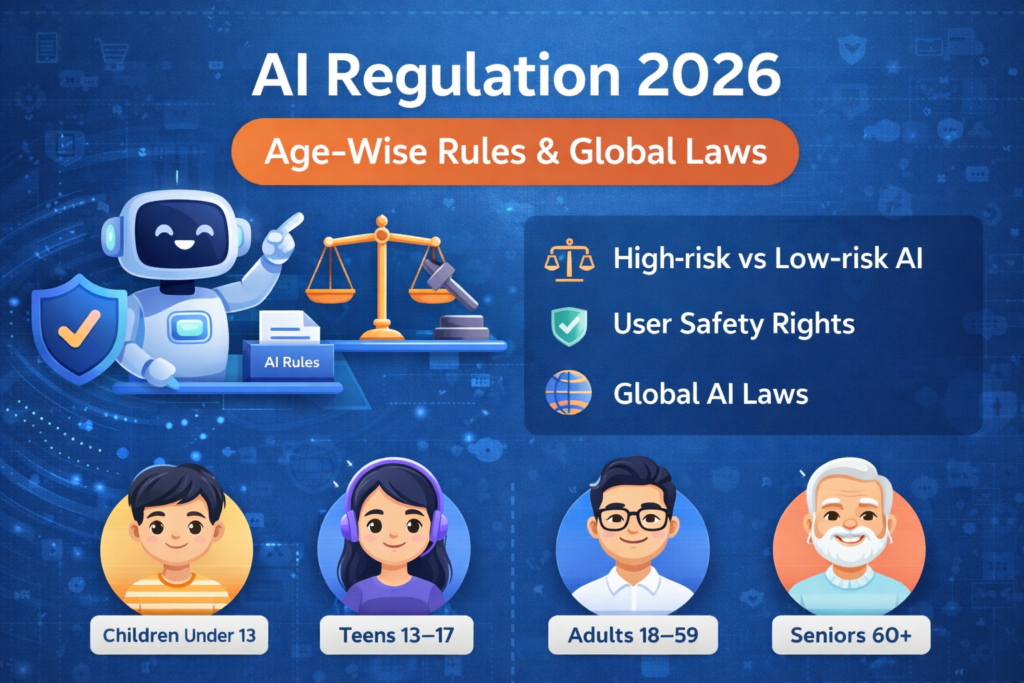
Artificial Intelligence is now part of daily life — from chatbots and image tools to education apps and smart assistants. By 2026, many countries are strengthening AI regulation to protect users, especially children, while encouraging innovation. This guide explains what AI regulation 2026 means, how it affects different age groups, and what individuals and businesses should prepare for.
Table of Contents
AI Regulation 2026: Quick Overview
| Aspect | Details (2026) |
|---|---|
| What it means | Laws and rules that control how AI systems are built and used |
| Main goal | Ensure safety, fairness, transparency, and user protection |
| Who is covered | AI developers, businesses, and end users |
| Age focus | Special protections for children, teens, and seniors |
| Risk approach | High-risk AI faces stricter compliance and audits |
| User rights | Right to know, opt out, correct, and delete data |
| Business duties | Testing, documentation, transparency, and monitoring |
| Penalties | Fines, bans, or legal action for non-compliance |
| Global trend | Move from guidelines to enforceable AI laws |
What Is AI Regulation?
AI regulation refers to laws, policies, and guidelines created by governments to control how artificial intelligence systems are built, used, and managed. The goals are to:
- Protect privacy and data
- Prevent misuse and harm
- Ensure fairness and transparency
- Safeguard children and vulnerable users
- Hold AI providers accountable
In 2026, regulation is shifting from voluntary guidelines to enforceable legal frameworks.
Why AI Regulation Is Important in 2026
AI systems now influence:
- Education and learning
- Hiring and recruitment
- Healthcare decisions
- Finance and credit scoring
- News, content, and social media
Without rules, AI can:
- Spread misinformation
- Discriminate unfairly
- Violate privacy
- Expose children to unsafe content
AI regulation 2026 focuses on building trust, safety, and responsibility.
Key Global Trends in AI Regulation (2026)
Across the world, common themes include:
- 📜 Risk-based regulation – higher risk AI faces stricter rules
- 🔍 Transparency – users must know when AI is used
- 🧑⚖️ Accountability – clear responsibility for harm
- 🔐 Data protection – strong privacy controls
- 👶 Child safety – age-appropriate design
Major regions shaping policy:
- European Union (AI Act style rules)
- United States (sector-based approach)
- India (ethics + data protection focus)
- UK, Japan, and others (safety frameworks)
AI Regulation 2026 – Age-Wise Guidelines
One of the biggest changes in 2026 is age-based AI access and protection.
👶 Children Under 13 Years
Main focus: Protection & parental control
Likely rules:
- AI tools must be child-safe by design
- No collection of personal data without parents
- No targeted ads or profiling
- Content filters mandatory
- Parental consent required for use
Examples:
- Learning chatbots with safe responses
- No open-ended generative content without controls
Goal: Prevent exposure to harmful content and data misuse.
🧒 Teens (13–17 Years)
Main focus: Supervised access & digital literacy
Rules may include:
- Clear AI content labeling
- Limited data collection
- Warnings about misinformation
- Tools to report harmful outputs
- Age verification for advanced tools
Allowed:
- Educational AI tools
- Creative tools with safeguards
Goal: Teach responsible use while still enabling learning.
🧑 Adults (18–59 Years)
Main focus: Rights, transparency, and choice
Expected rules:
- Right to know when AI is used
- Ability to opt out of data usage
- Explanation for important AI decisions
- Protection against bias & discrimination
- Data portability and deletion rights
Examples:
- AI in hiring must be fair
- AI credit decisions must be explainable
Goal: Empower users and protect civil rights.
👴 Seniors (60+ Years)
Main focus: Accessibility & protection from misuse
Special attention on:
- Simple explanations of AI systems
- Protection from scams & fraud
- Consent for health-related AI
- Human oversight in decisions
Use cases:
- Health assistants
- Smart home AI
Goal: Ensure safety and inclusiveness.
High-Risk vs Low-Risk AI (2026 Approach)
Many regulations classify AI by risk:
🔴 High-Risk AI
Examples:
- Medical diagnosis AI
- Hiring & recruitment AI
- Credit scoring AI
- Biometric identification
Rules:
- Strict testing & audits
- Human oversight required
- Detailed documentation
- Regular monitoring
🟢 Low-Risk AI
Examples:
- Chatbots for info
- Image generators for art
- Productivity tools
Rules:
- Basic transparency
- Clear user notices
- Optional safeguards
What AI Companies Must Do in 2026
Businesses building or using AI must:
✔ Register high-risk systems
✔ Keep training data records
✔ Test for bias & safety
✔ Provide user disclosures
✔ Allow audits
✔ Set age-appropriate design
✔ Offer complaint & redress systems
Failure may lead to:
- Fines
- Bans
- Product removal
- Legal action
What Users Should Know
As a user in 2026, you should expect:
- 🏷️ Clear labels when content is AI-generated
- 🔍 Ability to ask how decisions were made
- 🗑️ Option to delete your data
- 👤 Human support for critical issues
- 🛡️ Safer experiences for children
Tip: Always check privacy settings in AI apps.
AI Regulation in India (2026 Outlook)
India’s approach is likely to focus on:
- Ethical AI use
- Data Protection laws
- Sector-specific rules (health, finance, education)
- Innovation-friendly policies
- Strong child online safety
India aims to balance:
“Innovation + Responsibility.”
Challenges of AI Regulation
While needed, regulation faces challenges:
- ⚖️ Balancing safety with innovation
- 🌍 Different rules across countries
- 🧠 Fast-changing AI technology
- 📊 Enforcement complexity
- 💼 Cost for startups
Still, most experts agree regulation is essential.
How to Prepare for AI Regulation 2026
For Individuals:
- Learn basic AI literacy
- Teach kids safe AI use
- Use trusted AI platforms
- Review privacy policies
For Businesses:
- Audit AI tools
- Update privacy systems
- Add age checks
- Train staff on compliance
- Keep documentation ready
Future of AI Regulation Beyond 2026
Looking ahead:
- Global standards may emerge
- More real-time monitoring
- Stronger penalties for misuse
- User-controlled AI settings
- AI ethics boards becoming common
The goal is safe, fair, and human-centric AI.
AI regulation 2026 marks a shift from optional guidelines to strong, enforceable rules. With age-wise protections, risk-based controls, and user rights, these laws aim to make AI safer for everyone — from children to seniors.
Understanding these rules helps users stay informed and helps businesses stay compliant in the evolving AI world.
Some more you might like