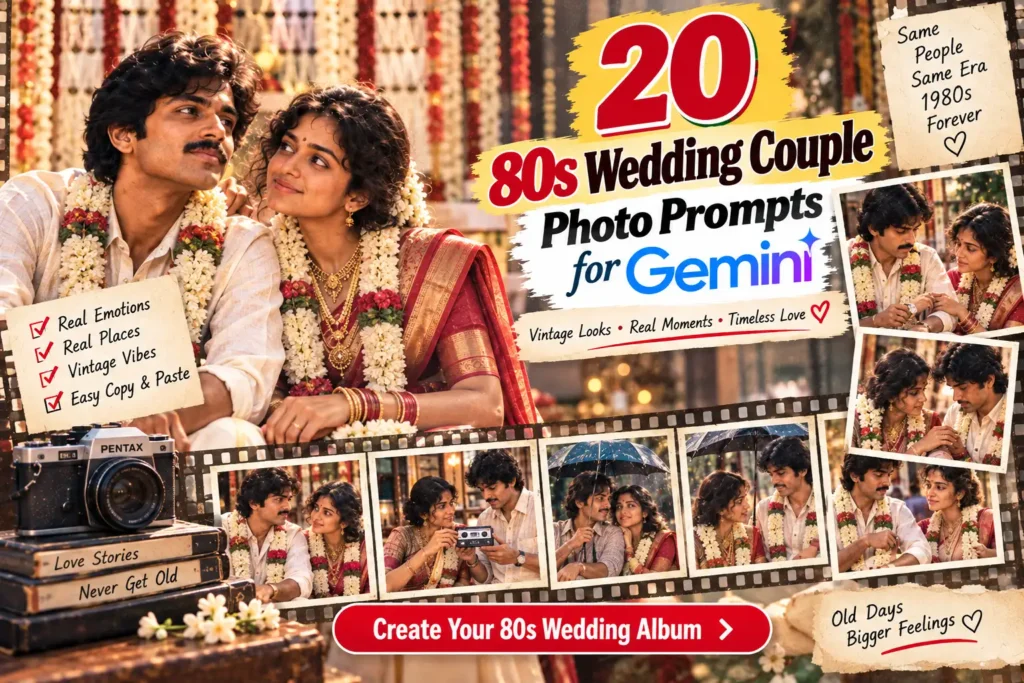
1. 80s Wedding Couple — The Formal Portrait That Breaks into a Real Smile
Use our uploaded couple photo as the exact facial identity reference for BOTH partners. Preserve each person's recognizable face faithfully and independently — facial structure, eyes, nose, lips, skin tone, natural age appearance, hairline, facial asymmetry, hairstyle characteristics, body proportions, and important identifying details must remain consistent.IDENTITY LOCK: Keep Person 1 as Person 1 and Person 2 as Person 2. Never swap, merge, average, duplicate, or blend their faces. Preserve their natural gender presentation and age relationship shown in the uploaded reference. Do not replace either person with generic attractive wedding models.
Transform us into a completely photorealistic Indian wedding couple photographed in the mid-1980s.
Create authentic 1980s Indian wedding styling rather than a modern wedding dressed with a retro filter.
For the bride, use a historically believable silk saree with a traditional woven border, modest period-correct blouse, neatly arranged saree pleats, traditional gold-toned wedding jewellery appropriate to the region, glass or metal bangles, flowers arranged naturally in the hair where culturally suitable, and restrained 1980s bridal makeup.
For the groom, use a period-correct traditional wedding outfit appropriate to the chosen Indian region — such as veshti and shirt, dhoti and kurta, simple sherwani, suit, or another historically plausible outfit. Keep grooming, hairstyle, footwear, watch, and accessories consistent with the mid-1980s.
Do not automatically add a bindi, tilak, forehead mark, religious symbol, or ceremonial mark unless it is culturally appropriate to the chosen wedding context or already present in the uploaded reference. Never place a bindi or feminine forehead decoration on the groom.
Create the photograph around the seconds AFTER the photographer has carefully arranged the couple for a formal wedding portrait.
Place us side by side in front of a modest 1980s wedding backdrop with fresh flower garlands, cloth decoration, brass lamps, wooden chairs, and restrained incandescent lighting.
The photographer has asked both of us to remain completely still and look serious for the photograph.
We try.
The bride's hands are carefully arranged in front of her.
The groom is sitting or standing slightly stiffly because the photographer has repeatedly corrected his posture.
Everything looks like a conventional formal 1980s wedding portrait.
Then create the decisive moment.
Just before the shutter is pressed, the groom quietly says something only the bride can hear.
Do not show dialogue or text.
The bride tries to maintain the photographer's serious expression.
Her eyes react first.
The corners of her mouth begin to lift.
The groom realizes she is trying not to laugh and also begins losing his formal expression.
Capture the exact transition — NOT a broad staged laugh and NOT the original serious pose.
Both faces should still be oriented generally toward the photographer, but their eyes briefly move toward each other.
That tiny shared reaction is the emotional center of the photograph.
Do not create kissing, forehead touching, hugging, exaggerated leaning, cinematic romance, or modern pre-wedding-photo poses.
Keep the couple physically positioned as a traditional wedding photographer of the era would plausibly arrange them.
Add subtle evidence that the wedding is genuinely happening around them: a slightly displaced flower petal on the floor, an extra garland resting on a wooden chair, brass plate on a side table, folded ceremonial cloth, relatives moving softly in the distant background, and one child or family member briefly peeking from behind the studio-like wedding curtain if compositionally appropriate.
Every secondary person must have a completely distinct face. Never duplicate the bride or groom onto relatives.
Create one particularly authentic behind-the-scenes detail: the edge of the photographer's period-correct analog camera or tripod may appear softly out of focus in the extreme foreground, making it clear that this is the instant the official wedding portrait is being created.
COMPOSITION: Use the perspective of a professional 1980s wedding photographer with approximately a 50–80mm portrait lens. Keep both faces clearly readable, maintain realistic body proportions, and leave enough environmental space to establish the old wedding setting.
Avoid extreme modern background blur. The decorations should remain recognizable enough to communicate the period.
LIGHTING: Use period-plausible wedding photography lighting. A diffused tungsten photographic lamp or simple flash setup may provide the main facial exposure, mixed naturally with incandescent wedding-hall bulbs and modest ambient daylight where appropriate.
Do not use ring-light catchlights, modern LED panels, dramatic cinematic rim lighting, perfect digital HDR, or glossy contemporary bridal illumination.
BRIDE SAREE LOCK: Maintain physically correct saree draping, continuous woven border, realistic silk weight, natural waist pleats, believable pallu placement, modest blouse coverage, and accurate interaction with jewellery and hands. No fused fabric, impossible pleats, or floating pallu.
JEWELLERY LOCK: Every necklace, earring, bangle, chain, garland, and hair ornament must connect physically and naturally to the correct person. Do not generate floating jewellery, duplicated earrings, impossible chains, or jewellery crossing through skin or clothing.
GARLAND LOCK: If wedding garlands are worn, each garland must follow gravity naturally around the correct neck and chest. Flowers should have individual irregularity and believable weight. Do not fuse the bride's and groom's garlands together.
HAND LOCK: Wedding portraits often place hands close together, so prioritize anatomical accuracy. Exactly five fingers per visible hand where fully visible. Maintain correct wrist direction, jewellery placement, finger ownership, and natural resting positions. Do not merge the bride's fingers with the groom's.
EYE LOCK: Both partners must have two anatomically natural, aligned eyes with realistic pupils, irises, eyelids, catchlights, and gaze direction. No crossed eyes, mismatched pupils, duplicated iris, wandering eye, distorted eyelid, or unnatural asymmetry. Their subtle sideways glance must remain physically believable.
PERIOD LOCK: Everything visible must plausibly belong to an Indian wedding between approximately 1983 and 1988. No smartphones, digital cameras, LED walls, modern floral installations, contemporary bridal stages, designer blouse cuts, current makeup trends, modern watches, plastic water bottles, present-day furniture, QR codes, or modern event equipment.
ANALOG PHOTO CHARACTER: Reproduce genuine film-era photography rather than adding a simple vintage filter. Use restrained 35mm or medium-format grain, slightly warm color-negative response, modest dynamic range, natural highlight roll-off, gentle optical softness, realistic skin tones, and subtle lab-print character.
Do not add heavy sepia, fake torn edges, excessive scratches, artificial dust overlays, light leaks, or Instagram-style retro filters.
Preserve natural Indian skin texture, visible but subtle pores, realistic facial asymmetry, individual hair strands, believable silk texture, physically accurate shadows, correct feet where visible, and natural age characteristics.
The final photograph should look like the wedding photographer intended to make a serious formal portrait — but accidentally captured something better.
The decorations show the wedding.
The clothing shows the 1980s.
The formal posture shows what the photographer wanted.
The couple's eyes and barely controlled smiles show what was actually happening between them.
It should feel like the photograph the family eventually loved more than the perfectly posed frame taken immediately afterward.
No text, no watermark, no face swap, no duplicated bride or groom, no wrong-gender facial decoration, no distorted eyes, no extra fingers, no merged hands, no floating jewellery, no malformed garlands, no plastic skin, no artificial AI glow, and absolutely no modern objects.
2. 80s Wedding Couple — The Garland Gets Slightly Tangled After the Ceremony
Use our uploaded couple photo as the exact facial identity reference for BOTH partners. Preserve each person's recognizable face independently — facial structure, eyes, nose, lips, skin tone, natural age appearance, hairline, facial asymmetry, hairstyle characteristics, body proportions, and important identifying details.IDENTITY LOCK: Keep Person 1 as Person 1 and Person 2 as Person 2. Never swap, merge, average, duplicate, or blend their faces. Preserve their natural gender presentation, age, height relationship, and recognizable characteristics from the uploaded reference.
Transform us into a photorealistic Indian wedding couple photographed in the mid-1980s.
Dress both partners in historically believable wedding clothing appropriate to the selected Indian regional setting. If the bride wears a saree, use authentic silk or silk-cotton with a traditional woven border, modest period-correct blouse, natural pleats, restrained bridal makeup, traditional jewellery, bangles, and period-appropriate hairstyle with flowers where culturally suitable.
Dress the groom in a historically plausible traditional wedding outfit appropriate to the same region and ceremony. Keep hairstyle, footwear, jewellery, watch, and grooming consistent with the 1980s.
Do not automatically add a bindi, tilak, forehead mark, religious symbol, or ceremonial decoration unless culturally appropriate to the chosen wedding setting or already supported by the uploaded reference. Never place a feminine bindi or bridal forehead decoration on the groom.
The main ceremony has just finished.
The couple has been wearing traditional flower garlands for some time.
While turning slightly to respond to a family photographer, the lower loose sections of the two garlands become lightly crossed against each other.
Do not create a dangerous knot or impossible fusion.
Capture the exact instant both partners notice the small problem.
The groom stops moving immediately.
The bride looks down toward the crossed flowers.
One partner carefully lifts only their own garland slightly while the other uses one hand to separate the overlapping flower strands.
Their hands come close but remain anatomically distinct.
Then their eyes meet for a second because both realize that even turning around has become complicated while wearing wedding garlands.
Use restrained amusement rather than broad laughter.
Do not create kissing, hugging, forehead touching, modern romantic posing, or exaggerated cinematic expressions.
A clearly older female relative may begin approaching from the side as if she already knows how to fix the situation, but she should remain secondary and have a completely distinct face.
Build an authentic 1980s Indian wedding environment: modest flower decorations, banana stems or traditional greenery where regionally appropriate, brass lamps, wooden chairs, woven or cloth backdrop, incandescent bulbs, flower petals on the floor, ceremonial vessels, and relatives moving naturally in the background.
COMPOSITION: Photograph from slightly below chest height using a natural 50–70mm documentary perspective. The crossed lower garlands create the foreground storytelling detail, the careful hands occupy the middle plane, and both facial reactions remain clearly visible above.
GARLAND PHYSICS: Each garland must remain separately identifiable from neck to lower end. Flowers should compress naturally where the two garlands touch. Maintain realistic gravity, flower weight, thread continuity, and neck placement. Do not merge them into one impossible garland.
HAND LOCK: Preserve exact hand ownership. No merged fingers, duplicated hands, extra fingers, impossible wrist angles, or hands passing through flowers or clothing.
EYE LOCK: Both partners must have anatomically natural eyes with aligned pupils, realistic irises, eyelids, and gaze direction. If they look toward each other, both eye lines must physically correspond.
PERIOD LOCK: Indian wedding between approximately 1983 and 1988. No smartphones, digital cameras, LED wedding walls, contemporary floral installations, modern stage furniture, designer blouse cuts, present-day makeup, current watches, plastic water bottles, QR codes, or modern event equipment.
Use restrained analog grain, slightly warm color-negative rendering, modest dynamic range, realistic silk highlights, gentle optical softness, and subtle lab-print character.
The final photograph should feel like a tiny wedding problem nobody planned: two garlands cross, both people stop, they carefully separate them, and a formal ceremony suddenly produces one genuinely human photograph.
No text, no watermark, no face swap, no duplicated bride or groom, no wrong-gender facial decoration, no distorted eyes, no extra fingers, no fused garlands, no plastic skin, and no modern objects.
3. 80s Wedding Couple — Bride Notices the Groom’s Crooked Flower Garland
Use our uploaded couple photograph as the strict facial identity reference for BOTH partners. Preserve both recognizable faces independently, including natural age, facial proportions, eyes, nose, lips, skin tone, hairline, hairstyle characteristics, facial asymmetry, and body proportions.Never copy the bride's facial features, bindi, makeup, jewellery, hairstyle, or forehead decoration onto the groom. Never swap or blend identities.
Create an authentic Indian wedding photograph from the mid-1980s immediately after a formal ceremony segment.
Dress the couple in historically believable regional Indian wedding clothing from the same cultural context. Keep all garments, jewellery, flowers, grooming, and accessories appropriate to approximately 1983–1988.
The couple has been asked to stand for another photograph.
The groom's flower garland has shifted slightly during the ceremony and is now hanging noticeably lower on one side.
He has not noticed.
The bride notices immediately.
Do not make her dramatically fix his clothing.
Capture the exact moment she subtly points toward the uneven garland with only her eyes and a tiny downward gesture of one finger.
The groom initially looks confused.
Then he follows her gaze downward and finally understands.
His hand begins moving toward his own garland to straighten it.
The bride tries not to smile at how long it took him to understand.
Capture that exact transition.
Keep both bodies generally positioned for the formal wedding photographer. The charm should come from a private correction occurring inside a public pose.
A photographer or older relative farther away may be waiting patiently for them to become ready.
Build a believable wedding environment with traditional flower decoration, cloth backdrop, brass lamp, wooden chairs, period lighting, ceremonial items, and relatives softly visible farther behind.
COMPOSITION: Use a 70mm portrait perspective from slightly beside the official photographer. Keep the uneven garland immediately understandable without making it disproportionately large.
LIGHTING: Use soft period-plausible flash or diffused tungsten mixed with ambient wedding-hall illumination. Retain realistic shadows and analog exposure limitations.
GARLAND LOCK: Preserve realistic flower shapes, thread, weight, compression, and gravity. The groom's garland may be uneven but must remain physically attached correctly around his neck.
BRIDE ATTIRE LOCK: If the bride wears a saree, maintain continuous border design, correct pleat direction, pallu placement, blouse coverage, jewellery connections, and realistic silk weight.
GROOM ATTIRE LOCK: Maintain historically plausible male wedding clothing and accessories. No feminine bindi, bridal jewellery, jasmine hairstyle, or other accidental transfer of bride styling onto the groom.
EYE LOCK: The bride's gaze must clearly point toward the garland first; the groom's gaze then follows downward. No crossed eyes, wandering pupils, mismatched irises, or distorted eyelids.
PERIOD LOCK: India, approximately 1983–1988. No smartphones, digital photography equipment, LED walls, modern stage décor, contemporary designer fashion, present-day watches, current cosmetics, or recent wedding accessories.
Use authentic film grain, slightly warm color-negative response, gentle optical softness, modest contrast, and realistic skin tones.
The final photograph should feel like an old wedding album frame where the bride noticed one tiny detail before everyone else and corrected it without needing to say anything.
No text, no watermark, no face swap, no duplicate people, no distorted eyes, no extra fingers, no malformed garland, no plastic skin, and no modern objects.
4. 80s Wedding Couple — One Chair, One Missing Seat, One Quiet Adjustment
Use our uploaded couple photo as the exact facial identity reference for BOTH partners. Preserve both recognizable faces independently — facial anatomy, natural age, skin tone, eyes, nose, lips, hair characteristics, facial asymmetry, body proportions, and important identifying details.Do not swap, merge, duplicate, de-age, or idealize either partner.
Create a photorealistic Indian wedding reception photograph from the mid-1980s centered around an imperfect seating arrangement rather than a modern staged couple pose.
Dress both partners in authentic period-correct wedding clothing appropriate to the same regional Indian setting.
The photographer wants to take a seated portrait of the couple.
Two matching wooden or upholstered wedding chairs were supposed to be ready.
But one chair has temporarily been moved elsewhere by relatives.
Only one remains.
Do not create a modern pose where one partner sits on the other's lap.
Instead, capture the practical seconds while everybody solves the problem.
One partner is already seated.
The other remains standing beside the chair while a relative farther behind hurriedly brings the missing chair back into the scene.
The seated partner quietly shifts the existing chair a few centimeters sideways to make enough space.
The standing partner notices the gesture and helps clear a small section of saree, garment, garland, or ceremonial cloth so the second chair can be positioned safely.
Their eyes meet with mild amusement at how even a simple photograph requires organization.
Capture the moment BEFORE the missing chair reaches its final position.
Build a believable 1980s wedding setting: modest cloth backdrop, traditional flowers, brass lamps, patterned floor covering, wooden furniture, incandescent bulbs, family members helping, and analog photography equipment.
Compose with a 50mm documentary perspective from near the photographer's position. The empty floor space where the second chair belongs should be visually obvious, while the approaching chair and couple reactions explain the situation.
Keep the scene elegant rather than chaotic.
PERIOD LOCK: Indian wedding between 1983 and 1988. No modern throne-style wedding sofas, LED walls, contemporary luxury stages, smartphones, digital cameras, modern floral installations, acrylic furniture, designer fashion, or present-day event equipment.
CHAIR REALISM: Maintain correct legs, seat height, perspective, weight, and human interaction. Do not generate floating furniture or chairs intersecting clothing.
COUPLE LOCK: Exactly two principal partners with distinct identities, correct hand ownership, natural body spacing, and realistic posture.
Preserve authentic wedding textiles, jewellery, garlands, skin texture, hands, furniture wear, and physically accurate shadows.
Use restrained 35mm grain, warm analog color, mild print softness, and modest dynamic range.
The final photograph should feel like the candid frame taken before the official seated wedding portrait — one chair is missing, relatives are fixing it, and the couple is quietly enjoying the absurdity of waiting to pose.
No text, no watermark, no duplicate bride or groom, no wrong-gender decoration, no extra fingers, no malformed chairs, no plastic skin, and no modern objects.
5. 80s Wedding Couple — The Photographer Says “Closer,” but Both Misunderstand
Use our uploaded couple photograph as the strict identity reference for BOTH partners. Preserve each recognizable face independently — facial structure, eyes, nose, lips, skin tone, natural age appearance, hairline, facial asymmetry, hairstyle characteristics, and body proportions.IDENTITY LOCK: Never swap, merge, average, duplicate, or blend the bride and groom. Preserve natural gender presentation, age, and distinctive facial features.
Create an authentic formal Indian wedding portrait session from the mid-1980s.
Dress both partners in historically plausible regional Indian wedding clothing and jewellery appropriate to the same ceremony and era.
The photographer is arranging the couple for a traditional standing portrait.
The couple is standing with a slightly larger gap between them than the photographer wants.
From behind the camera, the photographer gestures for them to move “a little closer.”
Do not include readable speech or text.
Create the humorous decisive moment: BOTH partners misunderstand the instruction and each takes a small step in the SAME direction instead of toward each other.
The gap between them therefore remains almost exactly the same, but the entire couple has shifted sideways.
The photographer lowers one hand in mild confusion.
The couple realizes what happened.
Capture the instant they look toward each other and begin suppressing a laugh.
Do not create broad comedy, exaggerated body movement, kissing, hugging, leaning faces together, or modern pre-wedding posing.
Their wedding garlands, saree, dhoti, suit, kurta, or other regional clothing must move naturally with the tiny step.
A relative in the background may notice what happened and begin smiling, but all secondary faces must remain distinct.
Build an authentic 1980s wedding portrait area: simple cloth or flower backdrop, brass lamps, wooden chairs, traditional decorations, patterned floor, tungsten bulbs, analog camera on tripod, and modest family-wedding surroundings.
COMPOSITION: Photograph from slightly beside the official photographer with a 50–70mm perspective. Allow the camera or tripod edge to appear softly in the foreground so viewers understand why the couple is being repositioned.
LIGHTING: Use historically plausible portrait flash or diffused tungsten illumination mixed with ambient hall light. No modern ring lights, LED panels, or cinematic rim lighting.
BODY GEOMETRY LOCK: Both partners take only a small realistic sideways step. Maintain correct foot placement, balance, garment movement, garland gravity, and body spacing.
EYE LOCK: Their sideways glance toward each other must be anatomically correct with aligned pupils and natural eyelids. No crossed or malformed eyes.
PERIOD LOCK: Indian wedding between approximately 1983 and 1988. No smartphones, digital cameras, LED walls, modern stage furniture, designer wedding outfits, contemporary makeup, current watches, plastic water bottles, or present-day décor.
Use restrained film grain, slightly warm color-negative rendering, natural skin texture, realistic textile highlights, gentle optical softness, and subtle lab-print character.
The final photograph should look like the photographer wanted a perfectly arranged 80s wedding portrait, gave one simple instruction, and accidentally created a much better candid moment because both partners misunderstood it in exactly the same way.
No text, no watermark, no face swap, no duplicated bride or groom, no wrong-gender facial decoration, no distorted eyes, no extra fingers, no malformed feet, no plastic skin, and absolutely no modern objects.
6. 80s Wedding Couple — The Bride Quietly Fixes the Groom’s Folded Collar
Use our uploaded couple photo as the exact facial identity reference for BOTH partners. Preserve each person's recognizable face independently — facial structure, eyes, nose, lips, skin tone, natural age appearance, hairline, facial asymmetry, hairstyle characteristics, body proportions, and important identifying details.IDENTITY LOCK: Keep Person 1 as Person 1 and Person 2 as Person 2. Never swap, merge, average, duplicate, or blend their faces. Preserve their natural gender presentation, age relationship, and distinctive features from the uploaded reference.
Transform us into a completely photorealistic Indian wedding couple photographed during the mid-1980s.
Choose one coherent Indian regional wedding context and keep BOTH partners' clothing, jewellery, flowers, ceremonial details, architecture, and styling consistent with that same context.
Dress the bride in a historically believable silk or silk-cotton wedding saree with a traditional woven border, modest period-correct blouse, authentic pleats, restrained bridal makeup, traditional jewellery, bangles, and period-appropriate hairstyle with flowers where culturally suitable.
Dress the groom in a historically plausible wedding outfit appropriate to the same region and ceremony. Keep his hairstyle, footwear, watch, jewellery, and grooming consistent with the 1980s.
Do not automatically add a bindi, tilak, forehead mark, religious symbol, or ceremonial decoration unless culturally appropriate to the selected wedding context or supported by the uploaded reference. Never transfer feminine forehead decoration, bridal makeup, jewellery, or hairstyle onto the groom.
The main ceremony has paused briefly before the couple is called for another family photograph.
They are standing beside each other near a decorated wedding-hall wall.
The groom's collar, upper garment edge, angavastram, shawl, or another culturally appropriate clothing detail has accidentally folded inward on one side.
He has not noticed.
The bride notices immediately.
Do not create a glamorous modern styling pose.
Capture the exact instant she reaches toward the small folded section and quietly straightens it.
The groom initially looks downward to understand what she is doing.
Then his eyes move toward her face.
The bride remains focused on the clothing for another fraction of a second before realizing he is looking at her.
Capture that transition BEFORE both people smile fully.
The bride's hand should touch only the garment, never appear fused into his chest, neck, jewellery, or garland.
The groom should remain still rather than helping unnecessarily.
A photographer or family member farther away may be waiting for them, giving the small adjustment a practical reason.
Build a believable 1980s Indian wedding environment: fresh flowers used with restraint, brass lamps, wooden chairs, cloth backdrop, ceremonial vessels, incandescent bulbs, traditional floor decoration where culturally appropriate, and relatives moving naturally in the distance.
COMPOSITION: Use an intimate 70mm documentary portrait perspective from slightly to the side rather than directly front-on. Place the bride's adjusting hand in the middle plane and keep both facial reactions clearly visible above it.
LIGHTING: Use soft period-plausible wedding photography illumination — restrained flash or diffused tungsten mixed naturally with ambient hall light. Preserve realistic facial shadows.
HAND LOCK: The bride's adjusting hand must contain anatomically correct fingers and believable wrist orientation. The groom's hands must remain separately identifiable. No merged hands, extra fingers, or floating jewellery.
EYE LOCK: Preserve two anatomically natural eyes per person, correctly aligned pupils, realistic irises, eyelids, catchlights, and corresponding gaze direction.
GARMENT LOCK: Maintain physically correct collar, shawl, angavastram, saree, blouse, dhoti, suit, kurta, or other selected regional clothing. All fabric must respond naturally to gravity and hand contact.
PERIOD LOCK: Indian wedding between approximately 1983 and 1988. No smartphones, digital cameras, LED walls, contemporary floral installations, modern designer wedding fashion, current makeup, smartwatches, plastic water bottles, QR codes, or present-day event equipment.
Use restrained analog grain, warm color-negative response, modest dynamic range, gentle optical softness, realistic skin texture, authentic textile highlights, and subtle lab-print character.
The final photograph should feel romantic because the bride notices one tiny thing nobody else has noticed and fixes it without making a ceremony out of the gesture.
No text, no watermark, no face swap, no duplicated bride or groom, no wrong-gender facial decoration, no distorted eyes, no extra fingers, no fused clothing, no plastic skin, and no modern objects.
7. 80s Wedding Couple — The Heavy Garland Makes Them Both Lean the Wrong Way
Use our uploaded couple photograph as the strict facial identity reference for BOTH partners. Preserve both recognizable faces independently, including facial anatomy, eyes, nose, lips, skin tone, natural age, hair characteristics, facial asymmetry, and body proportions.Never swap, merge, duplicate, de-age, or idealize either partner.
Create an authentic Indian wedding photograph from the mid-1980s centered around the physical reality of wearing traditional flower garlands for a long ceremony.
Dress both partners in historically plausible wedding attire from ONE consistent Indian regional tradition. Preserve realistic fabric, jewellery, flowers, hairstyle, footwear, and ceremonial accessories.
After standing for several photographs, both partners are wearing substantial but believable flower garlands.
The photographer asks them to straighten themselves for another portrait.
At almost the same instant, each partner unconsciously shifts slightly in the opposite direction to relieve the garland weight.
Instead of becoming straighter, they accidentally create a tiny mirrored lean away from each other.
The photographer gestures for them to correct it.
Both partners realize what happened.
Capture the exact instant they glance sideways toward each other with restrained amusement while still trying to maintain formal wedding expressions.
Do not exaggerate the lean. Both bodies must remain naturally balanced and upright enough to be safe.
Do not create slapstick comedy, hugging, kissing, or modern romantic posing.
An older relative in the background may already be smiling because they noticed the problem.
COMPOSITION: Use a 50–70mm perspective from near the photographer's position. Keep enough of both bodies visible to make the subtle opposite lean understandable.
GARLAND PHYSICS: Each garland must follow gravity independently around the correct neck and chest. Flowers should compress naturally against clothing. The garlands must not fuse together, float, pass through jewellery, or distort body anatomy.
BODY LOCK: Preserve realistic spine alignment, shoulder height, feet, balance, and weight distribution. The tiny lean should appear involuntary rather than choreographed.
EYE LOCK: Both sideways glances must correspond physically. No crossed eyes, mismatched pupils, duplicated irises, or unnatural eyelids.
Build an authentic 1980s wedding portrait area with traditional flower decoration, brass lamps, cloth backdrop, wooden chairs, patterned floor, incandescent bulbs, analog camera equipment, and relatives in period clothing.
PERIOD LOCK: India between approximately 1983 and 1988. No LED wedding stages, smartphones, digital cameras, modern luxury seating, designer blouse cuts, contemporary jewellery trends, current makeup, plastic water bottles, or modern event equipment.
Preserve natural Indian skin texture, realistic hair, silk and cotton folds, accurate jewellery connections, correct hands, flower irregularity, and physically believable shadows.
Use restrained 35mm or medium-format grain, warm color-negative rendering, modest contrast, slight optical softness, and realistic lab-print character.
The final photograph should reveal something formal wedding portraits usually hide: beautiful ceremonial clothing and garlands have real weight, both people are tired, and the tiny shared reaction makes the photograph more memorable than a perfect pose.
No text, no watermark, no face swap, no duplicate people, no distorted eyes, no fused garlands, no malformed bodies, no plastic skin, and no modern objects.
8. 80s Wedding Couple — The Photographer Captures the Second After the Blessing
Use our uploaded couple photo as the exact identity anchor for BOTH partners. Preserve both recognizable faces independently — facial structure, natural age, eyes, nose, lips, skin tone, hairline, facial asymmetry, hairstyle characteristics, body proportions, and identifying features.Do not merge, swap, duplicate, or artificially beautify either partner.
Create a respectful Indian wedding photograph from the mid-1980s immediately after the couple receives a traditional blessing from an older family member.
Choose ONE coherent regional wedding context and keep all clothing, ceremonial gestures, jewellery, flowers, architecture, and customs culturally consistent. Do not mix unrelated wedding traditions merely for decoration.
The blessing itself has just finished.
The older relative has begun stepping aside.
The couple has not yet returned to formal photographic posture.
Capture the exact transitional second.
One partner is still slightly inclined from the respectful gesture.
The other begins straightening first and quietly checks whether their partner is also ready to move.
Their eyes meet briefly.
A small relieved smile begins because they have successfully completed another important ceremonial moment together.
Do not turn the blessing into a romantic physical interaction.
Do not show kissing, forehead touching, dramatic embraces, or exaggerated emotional expressions.
The older relative must be clearly older, have a completely distinct face, and remain secondary.
Build a believable ceremony environment with regionally appropriate brass or metal ceremonial vessels, flowers, cloth, wooden seating, lamps, floor decoration, relatives, and period wedding-hall architecture.
COMPOSITION: Photograph from slightly behind and beside the elder using a 50mm documentary perspective. A softly blurred shoulder or hand of the elder may create foreground depth while the couple remains sharply visible beyond.
LIGHTING: Use natural hall or courtyard daylight mixed with restrained incandescent or period photographic illumination. Avoid supernatural glow or modern cinematic lighting.
CULTURAL CONSISTENCY LOCK: Do not randomly combine symbols, garments, forehead marks, rituals, or jewellery from unrelated regions or traditions. Choose one plausible wedding context and remain consistent.
COUPLE LOCK: Preserve exact identities, correct age relationship, natural body spacing, accurate hands and feet, and clear eye direction.
PERIOD LOCK: Indian wedding between approximately 1983 and 1988. No smartphones, digital cameras, LED lighting walls, contemporary event furniture, modern bridal fashion, current cosmetics, smartwatches, QR codes, or present-day décor.
Use restrained analog grain, warm natural color, realistic skin texture, authentic textiles, modest dynamic range, gentle optical softness, and family-album framing.
The final photograph should feel like the photographer caught the couple in the one second between ritual and pose — the blessing has ended, the formal photograph has not begun, and both people instinctively check on each other before continuing.
No text, no watermark, no face swap, no duplicated people, no distorted eyes, no extra fingers, no culturally inconsistent decoration, no plastic skin, and no modern objects.
9. 80s Wedding Couple — The Bride’s Jasmine Flower Falls onto His Shoulder
Use our uploaded couple photograph as the strict facial identity reference for BOTH people. Preserve each person's recognizable face independently — natural age, skin tone, facial proportions, eyes, nose, lips, hair characteristics, facial asymmetry, and body proportions.Never copy the bride's face, bindi, hairstyle, jasmine arrangement, makeup, or jewellery onto the groom. Never swap identities.
Create a photorealistic Indian wedding couple photograph from the mid-1980s centered around one tiny accidental detail.
Where culturally appropriate, arrange fresh jasmine naturally in the bride's period-correct wedding hairstyle. Dress both partners in authentic regional wedding clothing from the same cultural setting.
The couple is seated or standing side by side after several ceremonies and photographs.
One tiny jasmine flower has loosened naturally from the bride's hair arrangement.
It falls and lands on the groom's shoulder.
Capture the exact instant BEFORE either person removes it.
The groom does not notice.
The bride notices immediately.
Her eyes move toward the small white flower on his shoulder and she begins suppressing a smile.
Then the groom realizes she is looking at something and turns his eyes toward her with a questioning expression.
Do not make the bride immediately reach across him.
The unresolved visual joke is stronger if the viewer can see the flower before the groom understands what has happened.
Keep the jasmine flower small and physically believable. Do not make it look like a giant decorative prop.
Build a modest 1980s Indian wedding environment: flower decoration, brass lamps, wooden chairs, traditional cloth backdrop, ceremonial objects, incandescent bulbs, and softly moving relatives.
COMPOSITION: Use a 70–85mm intimate portrait perspective. Keep the small jasmine flower visible against a darker section of the groom's clothing while both faces remain the primary focus.
FLOWER PHYSICS: The flower must rest naturally on the shoulder according to gravity and clothing angle. It must not float or embed itself into fabric.
BRIDE HAIR LOCK: Maintain realistic hair strands, jasmine thread, flower spacing, and period-correct arrangement. Do not create excessive perfect repetition.
GROOM FACE LOCK: No bindi, feminine forehead decoration, bridal makeup, jasmine hairstyle, or transferred jewellery unless independently appropriate to his cultural role.
EYE LOCK: The bride looks first toward the flower; the groom looks toward her reaction. Preserve anatomically accurate pupils and gaze.
PERIOD LOCK: Indian wedding between 1983 and 1988. No smartphones, digital cameras, LED stages, modern wedding furniture, contemporary fashion, current makeup, plastic water bottles, or present-day event technology.
Use restrained film grain, warm analog color, mild optical softness, realistic flower texture, natural skin pores, authentic clothing folds, and subtle print character.
The final photograph should work almost like a tiny visual secret: the bride knows why she is smiling, the viewer knows why she is smiling, but the groom has not figured it out yet.
No text, no watermark, no face swap, no duplicate partner, no wrong-gender bindi, no distorted eyes, no floating flower, no extra fingers, no plastic skin, and no modern objects.
10. 80s Wedding Couple — The Last Photograph After Almost Everyone Has Gone Home
Use our uploaded couple photo as the exact facial identity reference for BOTH partners. Preserve each person's recognizable face faithfully and independently — facial structure, eyes, nose, lips, skin tone, natural age appearance, hairline, facial asymmetry, hairstyle characteristics, body proportions, and important identifying details.IDENTITY LOCK: Never swap, merge, average, duplicate, de-age, or idealize either partner.
Create a deeply nostalgic Indian wedding photograph from the mid-1980s taken near the END of the wedding day rather than during the perfectly arranged main ceremony.
Dress both partners in authentic period-correct wedding clothing from one coherent Indian regional tradition.
The wedding hall or family house has become noticeably quieter.
Most guests have left.
The couple has spent hours standing, sitting, greeting relatives, receiving blessings, posing for photographs, and participating in ceremonies.
Do not make them look disheveled or unhappy.
Instead, show small realistic signs that the day has been long.
One garland may sit slightly lower than earlier.
A few flowers in the bride's hair may have softened naturally.
The groom's clothing may have small realistic wrinkles.
One chair is no longer perfectly aligned.
Several flower petals remain on the floor.
A brass plate or ceremonial item has been moved to one side.
A relative in the distant background is beginning to collect or organize things.
The official photographer asks for ONE final photograph of the couple.
They stand or sit together again.
But they no longer have the energy to recreate the stiff formal pose from earlier.
Create the decisive moment BEFORE the photographer presses the shutter.
One partner quietly exhales and relaxes their shoulders.
The other notices.
Instead of correcting the posture, they also relax.
Their hands remain naturally close but not theatrically intertwined.
Their eyes meet for a brief second and both show the smallest tired, satisfied smile.
The expression should communicate: the long day is almost over, and they went through all of it together.
Do not create sleeping, exaggerated exhaustion, crying, kissing, hugging, forehead touching, or modern romantic posing.
Make the wedding environment visibly different from the beginning of the event while remaining tidy and respectful: partially emptied chairs, softened flower decorations, dimmer hall, relatives leaving, old cloth backdrop, brass lamps, analog camera equipment, and a few remaining incandescent bulbs.
COMPOSITION: Use a slightly wider 50mm environmental portrait so the couple remains dominant but the quieter end-of-day wedding hall becomes part of the story.
Leave a little negative space around them. Avoid the dense decorative framing typical of the earlier formal photographs.
LIGHTING: Some decorative lights may already have been switched off. Use softer remaining tungsten illumination mixed with ambient hall or doorway light. Preserve realistic shadow depth and film-era exposure.
END-OF-DAY DETAIL LOCK: Decorations should look naturally used, not destroyed. Flowers may soften or lose a few petals but must not appear rotten. Clothing may wrinkle but remain appropriate. The couple should look tired in body language, not unhealthy or distressed.
COUPLE LOCK: Exactly two principal wedding partners. Preserve distinct identities, correct hands, realistic eye direction, natural age, and believable body spacing.
PERIOD LOCK: Indian wedding between approximately 1983 and 1988. No smartphones, digital cameras, LED walls, contemporary stage furniture, modern designer wedding fashion, current makeup, smartwatches, plastic water bottles, QR codes, or present-day event equipment.
ANALOG PHOTO CHARACTER: Use restrained 35mm or medium-format grain, slightly warm color-negative rendering, modest dynamic range, realistic tungsten response, mild optical softness, and subtle lab-print character.
Preserve natural Indian skin texture, realistic eyes, individual hair strands, accurate jewellery connections, believable silk folds, physically correct garland weight, correct hands and fingers, and natural environmental shadows.
The final image should feel completely different from a glamorous wedding portrait.
The first photographs of the day showed how the wedding looked.
This final photograph should show how the day felt.
The hall is quieter.
The decorations are no longer perfect.
The couple is tired of posing.
And for the first time all day, they are simply standing beside each other without trying to perform for anybody.
It should look like the last photograph on an old 1980s wedding film roll — and decades later, perhaps the one that feels most real.
No text, no watermark, no face swap, no duplicated bride or groom, no wrong-gender facial decoration, no distorted eyes, no extra fingers, no malformed garlands, no plastic skin, no artificial AI glow, and absolutely no modern objects.
11. 80s Wedding Couple — The Bride Finds One Grain of Rice in His Hair
Use our uploaded couple photo as the exact facial identity reference for BOTH partners. Preserve each person's recognizable face independently — facial structure, eyes, nose, lips, skin tone, natural age appearance, hairline, facial asymmetry, hairstyle characteristics, body proportions, and important identifying details.IDENTITY LOCK: Keep Person 1 as Person 1 and Person 2 as Person 2. Never swap, merge, average, duplicate, or blend their faces. Preserve their natural gender presentation, age relationship, height difference, and distinctive characteristics shown in the uploaded reference.
Transform us into a completely photorealistic Indian wedding couple photographed in the mid-1980s.
Choose ONE coherent Indian regional wedding tradition and keep the bride's clothing, groom's clothing, jewellery, flowers, ceremonial details, architecture, and surrounding family styling consistent with that same context.
Do not randomly combine unrelated regional wedding traditions.
Dress the bride in a historically believable period-correct wedding saree or regional bridal outfit with authentic fabric weight, modest blouse construction, traditional jewellery, restrained 1980s makeup, bangles, and culturally appropriate hairstyle.
Dress the groom in a historically plausible traditional wedding outfit from the same regional context.
Do not automatically add a bindi, tilak, forehead mark, religious symbol, or ceremonial mark unless appropriate to the chosen ceremony or already supported by the uploaded reference. Never transfer the bride's feminine forehead decoration, makeup, flowers, jewellery, or hairstyle onto the groom.
A ceremonial moment involving rice or another culturally appropriate small blessing material has recently finished.
Do not show the ritual itself unless it belongs naturally to the chosen regional wedding context.
The couple has moved aside for another photograph.
One tiny grain of rice remains caught naturally in the groom's hair near the upper side of his head.
He has no idea it is there.
The bride notices.
Create the decisive moment BEFORE she removes it.
Her eyes first move upward toward the tiny grain.
The groom notices that she is looking above his eyes rather than at his face.
He becomes slightly puzzled and instinctively glances upward even though he obviously cannot see the top of his own head.
The bride begins suppressing a smile.
Only then does she carefully raise one hand toward the grain.
Capture the exact fraction of a second BEFORE her fingers reach it.
Do not show her touching his forehead, stroking his hair romantically, or creating a modern couple pose.
The humor should come from the groom trying to understand what she has noticed.
The rice grain must remain tiny and realistic. Do not enlarge it into a visually absurd object.
A sibling or older relative in the background may already understand what is happening and begin smiling, but every secondary face must remain distinct.
Build an authentic 1980s Indian wedding environment: traditional flowers used with restraint, brass or metal ceremonial vessels appropriate to the selected context, wooden chairs, cloth decoration, incandescent bulbs, flower petals, relatives in period clothing, and analog photography equipment.
COMPOSITION: Use an intimate 70–85mm portrait perspective. Keep both faces dominant while making the tiny white grain just visible against the groom's darker hair.
EYE LOCK: The bride's gaze must clearly point toward the grain. The groom's pupils remain anatomically aligned even while his expression shows that he is trying to understand what she sees. No crossed eyes, mismatched pupils, distorted eyelids, duplicated iris, or wandering eye.
HAND LOCK: The bride's raised hand must remain anatomically correct and clearly hers. Exactly five fingers where fully visible. No hand fusion with hair, face, garland, or jewellery.
HAIR REALISM: Preserve individual strands, natural hair volume, period-appropriate grooming, and realistic physical placement of the tiny rice grain.
PERIOD LOCK: Indian wedding between approximately 1983 and 1988. No smartphones, digital cameras, LED walls, modern wedding stages, contemporary designer fashion, present-day cosmetics, smartwatches, plastic water bottles, QR codes, or current event technology.
Use restrained film grain, slightly warm color-negative rendering, modest dynamic range, realistic skin texture, gentle optical softness, and subtle lab-print character.
The final photograph should work as a tiny visual secret: the bride has already discovered what is wrong, the viewer can discover it too, but the groom is still trying to understand why she is looking at his hair.
No text, no watermark, no face swap, no duplicate bride or groom, no wrong-gender facial decoration, no distorted eyes, no extra fingers, no oversized rice, no plastic skin, and no modern objects.
12. 80s Wedding Couple — The Wedding Ring Refuses to Slide Easily
Use our uploaded couple photograph as the strict facial identity reference for BOTH partners. Preserve both recognizable faces independently — facial anatomy, natural age, eyes, nose, lips, skin tone, hairline, hairstyle characteristics, facial asymmetry, body proportions, and important identifying features.Never swap, merge, duplicate, de-age, or idealize either partner.
Create a respectful photorealistic Indian wedding photograph from the mid-1980s in a regional or community wedding context where exchanging rings is culturally appropriate.
If a ring exchange is NOT appropriate to the selected wedding tradition, adapt this concept to another historically and culturally appropriate small hand-based ceremonial item rather than forcing a ring ritual into the scene.
Choose ONE coherent cultural context and maintain it consistently.
The ring-exchange moment is underway.
Do not create a polished modern close-up of two perfect hands.
Instead, capture a tiny realistic complication.
The ring begins sliding onto one partner's finger but meets slight natural resistance at the knuckle.
Nobody pulls or forces it.
Both partners pause.
The person receiving the ring looks down at the finger with a tiny uncertain expression.
The partner holding the ring looks up briefly as if silently asking, “Is this okay?”
Their eyes meet for one second.
An older relative nearby begins smiling because the situation is completely ordinary and harmless.
Capture the instant BEFORE they calmly continue.
The ring must remain correctly aligned with the appropriate finger and must never appear embedded in skin.
Do not exaggerate finger swelling or create discomfort.
COMPOSITION: Use a 70–85mm documentary portrait perspective rather than an extreme macro shot. Keep the ring and hands readable while both facial reactions remain clearly visible.
HAND LOCK: This prompt requires exceptional anatomical accuracy. Every visible hand must belong clearly to the correct person. Maintain realistic knuckles, nails, finger lengths, wrist orientation, jewellery placement, and contact. Exactly five fingers per fully visible hand.
RING PHYSICS: Preserve realistic ring thickness, diameter, metal reflection, perspective, and finger interaction. The ring may pause naturally at the knuckle but must not cut into skin, float, duplicate, or appear on multiple fingers.
Dress both partners in authentic 1980s wedding attire appropriate to the same chosen regional context.
Build a believable ceremony environment with restrained flowers, cloth decorations, brass lamps or appropriate ceremonial objects, wooden seating, incandescent bulbs, relatives, and analog photography equipment.
LIGHTING: Use soft period-plausible flash or diffused tungsten mixed with ambient hall light. Avoid glossy modern jewellery-advertisement lighting.
PERIOD LOCK: Indian wedding between approximately 1983 and 1988. No smartphones, digital cameras, LED stages, contemporary luxury wedding décor, modern designer clothing, current makeup trends, smartwatches, or present-day event technology.
Use restrained analog grain, warm color-negative response, natural skin texture, realistic metal highlights, modest contrast, and gentle optical softness.
The final photograph should capture an imperfect ceremony detail that makes the memory more believable: the ring pauses, both people stop, their eyes ask the same question, and the formal ritual becomes human for one second.
No text, no watermark, no face swap, no duplicate people, no extra fingers, no malformed ring, no distorted eyes, no plastic skin, and no modern objects.
13. 80s Wedding Couple — One Plate of Food, Two People Too Busy to Eat
Use our uploaded couple photo as the exact facial identity anchor for BOTH partners. Preserve both recognizable faces independently — facial structure, natural age, skin tone, eyes, nose, lips, hair characteristics, facial asymmetry, body proportions, and distinctive identifying details.Never swap, merge, duplicate, de-age, or replace either partner with generic wedding models.
Create an authentic Indian wedding photograph from the mid-1980s during a brief meal break between ceremonies, greetings, or photographs.
Choose one culturally coherent Indian wedding setting and make the food service, clothing, jewellery, seating, architecture, and customs appropriate to that same context.
Dress both partners in historically plausible wedding clothing from approximately 1983–1988.
The couple has finally been given a few minutes to eat.
They sit safely beside each other at a traditional wedding meal arrangement appropriate to the selected region — banana leaf, metal plate, or another culturally plausible serving format.
Do not create a feeding-each-other romantic cliché.
Both partners are hungry but keep being interrupted.
One partner has just picked up or prepared a small bite of food.
Before eating it, a relative outside the frame calls their attention.
They pause and turn slightly.
At the same instant, the second partner notices that a tiny drop of curry, chutney, water, or another plausible food item is about to reach the first partner's wedding sleeve, saree edge, shawl, or garment.
The second partner quickly slides a small napkin, cloth, or safe section of plate underneath to prevent the stain.
Capture the exact instant the first partner turns back and realizes what happened.
Their expression should communicate grateful amusement: they nearly stained the wedding clothes before managing to eat properly.
Do not show messy eating, food on faces, feeding each other, or exaggerated comedy.
Build a believable 1980s wedding dining environment: long tables or traditional floor seating depending on the selected context, banana leaves or steel vessels, servers carrying period-plausible containers, relatives eating naturally, simple ceiling fans, incandescent or fluorescent practical lighting, and wedding decorations visible farther away.
COMPOSITION: Use a 50–70mm documentary perspective from across the meal area. Keep the preventative hand gesture, food, wedding clothing, and both facial reactions clearly readable.
FOOD REALISM: Use culturally coherent dishes and serving style. Food portions should look naturally served rather than styled for advertising.
HAND LOCK: Preserve correct fingers, utensils where appropriate, wrist direction, plate contact, and hand ownership.
CLOTHING LOCK: Food must not magically stain fabric before contact. Keep saree, shirt, kurta, veshti, shawl, or other wedding garments physically correct.
PERIOD LOCK: Indian wedding between approximately 1983 and 1988. No smartphones, plastic disposable cutlery of obviously recent design, contemporary catering décor, LED lighting, digital cameras, modern bottled drinks, current fashion, or present-day event equipment.
Use restrained 35mm grain, slightly warm analog colors, natural indoor contrast, realistic skin texture, authentic food surfaces, and candid framing.
The final photograph should show romance through practical awareness: both people have barely had time to eat, one almost stains the wedding clothes, and the other notices before they do.
No text, no watermark, no face swap, no duplicate partner, no extra fingers, no malformed food, no plastic skin, and no modern objects.
14. 80s Wedding Couple — The Bride’s Bangles Catch His Garland Thread
Use our uploaded couple photograph as the strict facial identity reference for BOTH partners. Preserve each person's recognizable face independently — natural age, facial proportions, eyes, nose, lips, skin tone, hair characteristics, facial asymmetry, and body proportions.IDENTITY LOCK: Never swap, merge, duplicate, average, or blend the two partners. Never transfer the bride's makeup, bindi, jewellery, hairstyle, or feminine decorations onto the groom.
Create a photorealistic Indian wedding photograph from the mid-1980s centered around a tiny accidental interaction between traditional wedding accessories.
Dress both partners in culturally coherent period-correct wedding attire from the same regional tradition.
The couple has just finished greeting relatives and is turning back toward the photographer.
The bride's bangles lightly catch ONLY a loose external thread or small floral tie at the lower edge of the groom's garland.
Do not catch the bangles in his clothing, skin, hair, or neck.
Do not create a tight knot.
Both partners stop immediately.
The bride keeps her wrist completely still to avoid pulling the garland.
The groom looks down, understands what happened, and carefully lifts the loose garland thread with one hand to free it from the bangle.
Capture the exact moment BEFORE it comes loose.
The bride looks toward his hand with focused concentration.
The groom looks toward the tiny connection.
Then one of them begins to smile because such a small thing has managed to stop both of them.
Do not create romantic hand-holding or turn the entanglement into a staged pose.
ACCESSORY PHYSICS: Preserve every bangle as a separate circular object around the correct wrist. Maintain realistic garland thread, flower attachment, gravity, and tension. Only one small loose thread may catch. Do not fuse flowers, jewellery, skin, or fabric.
HAND LOCK: Preserve exact hand ownership, correct finger count, anatomically plausible wrist angles, and realistic spacing between hands.
Build an authentic 1980s wedding environment with restrained flowers, brass lamps, cloth decoration, wooden furniture, incandescent bulbs, ceremonial objects, analog photography equipment, and relatives in period clothing.
COMPOSITION: Use an intimate 70–85mm perspective. Keep the caught bangle and thread visible in the middle plane while both faces remain clearly readable.
PERIOD LOCK: India between approximately 1983 and 1988. No smartphones, digital cameras, LED walls, modern wedding stages, contemporary designer jewellery, current bridal fashion, plastic water bottles, smartwatches, or present-day décor.
Use restrained analog grain, warm film color, realistic jewellery reflections, natural Indian skin texture, silk highlights, mild optical softness, and subtle print character.
The final image should transform a tiny inconvenience into a believable wedding memory: one loose thread catches one bangle, both people freeze, and a photographer captures the careful teamwork required to separate them.
No text, no watermark, no face swap, no duplicated bride or groom, no wrong-gender bindi, no extra fingers, no fused jewellery, no impossible garland, no plastic skin, and no modern objects.
15. 80s Wedding Couple — The Secret Five-Minute Break Behind the Wedding Hall
Use our uploaded couple photo as the exact facial identity reference for BOTH partners. Preserve each person's recognizable face faithfully and independently — facial structure, eyes, nose, lips, skin tone, natural age appearance, hairline, facial asymmetry, hairstyle characteristics, body proportions, and important identifying details.Never swap, merge, duplicate, de-age, beautify excessively, or replace either partner with generic wedding models.
Create a deeply natural Indian wedding couple photograph from the mid-1980s during a tiny break away from the formal stage and crowd.
Choose ONE coherent Indian regional wedding setting and keep clothing, jewellery, ceremonial flowers, architecture, and customs consistent.
Dress both partners in authentic period-correct wedding attire appropriate to approximately 1983–1988.
The couple has spent hours surrounded by relatives, photographers, ceremonies, greetings, and instructions.
For perhaps five minutes, they have stepped into a quiet side veranda, corridor, courtyard, or shaded area behind the wedding hall.
They are not hiding romantically.
They simply need a short break before somebody calls them back.
Do not create kissing, hugging, forehead touching, hand-holding, or modern pre-wedding poses.
One partner is seated on a simple wooden chair or low safe ledge.
The other stands nearby leaning lightly against a wall or pillar.
Both have relaxed their formal posture for the first time.
Create the decisive moment around an ordinary shared object.
One partner has been given a steel tumbler or glass of water.
After taking a drink, they silently offer it to the other.
The second partner accepts it.
At that exact moment, distant relatives can be seen through the doorway beginning to search for them.
The couple notices.
They look toward the doorway.
Then they look back at each other with the same restrained expression: the five-minute break is already over.
Capture the fraction of a second before they stand up and return.
Do not make them appear unwilling to participate in the wedding. Their expressions should combine tiredness, amusement, and readiness to continue.
Build the quieter backside of a believable 1980s wedding venue: plain plaster wall, wooden doorway, stacked extra chairs, flower basket, folded cloth, brass vessel, old ceiling fan, utility table, partially visible wedding decorations through the doorway, and relatives moving in the brighter hall beyond.
The contrast is important: the main wedding space is decorated and busy; this side area is plain and calm.
COMPOSITION: Photograph from farther inside the quiet corridor using a 50mm documentary perspective. Use the bright doorway as a natural frame showing the busy wedding beyond, while the couple occupies the softer foreground.
LIGHTING: Soft daylight or ambient courtyard light should illuminate the resting couple. Warmer incandescent wedding-hall light spills through the doorway behind them. Preserve realistic mixed color temperature.
WATER GLASS REALISM: Use a period-plausible steel tumbler or simple glass with realistic scale, reflections, liquid level, and hand grip. Do not create modern bottled water.
BODY LANGUAGE LOCK: Relaxed shoulders and natural posture are essential. Do not make either person collapse, sleep, appear distressed, or lean unnaturally.
COUPLE LOCK: Exactly two principal partners. Preserve distinct identities, correct hands, natural age, realistic eye lines, and believable physical distance.
PERIOD LOCK: Indian wedding between approximately 1983 and 1988. No smartphones, plastic bottled water, digital cameras, LED event lighting, contemporary banquet furniture, modern designer wedding clothing, current cosmetics, smartwatches, QR codes, or present-day equipment.
ANALOG PHOTO CHARACTER: Use restrained 35mm film grain, slightly warm color-negative response, modest dynamic range, gentle optical softness, natural skin tones, and candid exposure.
The final photograph should show something the official wedding album usually misses.
On the stage they are the wedding couple.
In this quiet corridor, for five minutes, they are simply two tired people sharing water and enjoying the only silence they have had all day.
Then somebody begins looking for them.
The break ends.
They exchange one knowing look and return together.
No text, no watermark, no face swap, no duplicated bride or groom, no wrong-gender facial decoration, no distorted eyes, no extra fingers, no malformed tumbler, no plastic skin, no artificial AI glow, and absolutely no modern objects.
16. 80s Wedding Couple — The Bride Notices His Wedding Watch Has Stopped
Use our uploaded couple photo as the exact facial identity reference for BOTH partners. Preserve each person's recognizable face independently — facial structure, eyes, nose, lips, skin tone, natural age appearance, hairline, facial asymmetry, hairstyle characteristics, body proportions, and important identifying details.IDENTITY LOCK: Keep Person 1 as Person 1 and Person 2 as Person 2. Never swap, merge, average, duplicate, or blend their faces. Preserve their natural gender presentation, age relationship, height difference, and distinctive characteristics shown in the uploaded reference.
Transform us into a completely photorealistic Indian wedding couple photographed in the mid-1980s.
Choose ONE coherent Indian regional wedding tradition and keep clothing, jewellery, flowers, ceremonial details, architecture, and styling culturally consistent throughout the scene.
Dress the bride in a historically believable period-correct wedding saree or regional bridal outfit with authentic fabric weight, modest blouse construction, traditional jewellery, restrained 1980s makeup, bangles, and culturally appropriate hairstyle.
Dress the groom in a historically plausible traditional wedding outfit from the same regional context.
Do not automatically add a bindi, tilak, forehead mark, religious symbol, or ceremonial decoration unless culturally appropriate to the selected wedding context or supported by the uploaded reference. Never transfer the bride's feminine forehead decoration, makeup, flowers, or jewellery onto the groom.
The couple has been moving through ceremonies and photographs for hours.
They are standing briefly beside the wedding stage waiting for the next instruction.
The groom glances at his analog wristwatch to check the time.
He looks at it again.
Something is wrong.
The watch has stopped.
Create the decisive moment when the bride notices him lightly tapping or checking the watch and realizes why he keeps looking at it.
She instinctively looks toward a large analog wall clock in the wedding hall.
Then she looks back toward him.
The groom follows her gaze and finally understands how far wrong his stopped watch is.
Capture the exact instant both partners begin suppressing a smile at the uselessness of checking a stopped watch during a wedding day when neither of them has controlled the schedule anyway.
Do not create broad comedy.
Do not show the bride grabbing his wrist, holding his hand, or turning the scene into a modern watch advertisement.
The groom may hold his wrist slightly closer to inspect the dial while the bride's eyes move naturally between the watch and the distant wall clock.
A relative farther behind may already be gesturing that they are needed somewhere else, adding another layer of irony: the watch has stopped, but the wedding schedule has not.
COMPOSITION: Use a 70mm documentary portrait perspective. Keep the groom's watch readable as an analog object without making its tiny dial text important. Both facial reactions remain the primary focus, while the distant wall clock is visible enough to explain the story.
WATCH ACCURACY: Use a plausible mid-1980s analog mechanical or quartz wristwatch with realistic case diameter, crystal, crown, hands, strap, buckle, and wrist fit. No smartwatch proportions, digital touchscreen, or contemporary luxury-watch styling.
EYE LOCK: Preserve anatomically natural eyes, aligned pupils, realistic eyelids and catchlights. The bride's gaze should logically travel toward the wall clock and back; the groom's gaze should correspond naturally.
HAND LOCK: Preserve correct wrists, fingers, jewellery, and hand ownership. No fused hands or distorted watch straps.
PERIOD LOCK: Indian wedding between approximately 1983 and 1988. No smartphones, smartwatches, digital cameras, LED walls, modern wedding stages, contemporary designer fashion, current makeup, plastic water bottles, QR codes, or present-day event technology.
Use restrained analog grain, slightly warm color-negative rendering, modest dynamic range, realistic skin texture, authentic textile highlights, gentle optical softness, and subtle lab-print character.
The final photograph should turn an almost invisible problem into a memorable wedding story: the groom keeps checking the time, the bride discovers his watch stopped long ago, somebody is already calling them to the next ceremony, and both realize the clock has become completely irrelevant.
No text, no watermark, no face swap, no duplicate bride or groom, no wrong-gender facial decoration, no distorted eyes, no extra fingers, no malformed watch, no plastic skin, and no modern objects.
17. 80s Wedding Couple — A Sudden Breeze Lifts the Wedding Photo Backdrop
Use our uploaded couple photograph as the strict facial identity reference for BOTH partners. Preserve both recognizable faces independently — facial anatomy, natural age, eyes, nose, lips, skin tone, hair characteristics, facial asymmetry, hairstyle characteristics, body proportions, and distinctive identifying details.Never swap, merge, duplicate, de-age, or idealize either partner.
Create a photorealistic Indian wedding portrait from the mid-1980s in a family-home courtyard, semi-open wedding hall, veranda, or another setting where a simple cloth portrait backdrop is historically plausible.
Choose one coherent Indian regional wedding context and keep all clothing, jewellery, flowers, customs, architecture, and ceremonial details consistent.
The wedding photographer has arranged the couple in front of a large decorative cloth backdrop for a formal portrait.
The backdrop is not a modern printed vinyl wall.
It is a real period-plausible fabric backdrop secured carefully to a wooden or metal support frame.
The couple is ready.
The photographer is almost ready.
Then a sudden outdoor breeze reaches the semi-open portrait area.
One LOWER CORNER of the backdrop lifts slightly away from the support.
Do not make the entire backdrop collapse.
Do not create danger.
A family member or photographer's assistant immediately moves toward the loose corner.
Capture the couple's reaction BEFORE the assistant fixes it.
The bride notices the movement first and glances toward the rising cloth.
The groom follows her eyes.
For one second, the formal portrait pose is completely forgotten.
Then both realize that behind the lifted corner is not another decorative wall but the ordinary practical backside of the wedding venue — stacked chairs, plain plaster wall, a household doorway, or relatives carrying things.
That unexpected glimpse behind the “perfect” wedding portrait creates the humor.
The bride begins smiling.
The groom tries to maintain the photographer's formal expression but fails.
Do not create exaggerated laughter or slapstick chaos.
The assistant must remain safely away from the couple and should only secure the cloth support.
COMPOSITION: Photograph from slightly beside the official photographer using a 50mm perspective. Keep the couple centered enough to resemble a formal portrait, but allow the lifted backdrop corner to reveal the ordinary world behind it.
The contrast between the carefully created wedding-photo foreground and the practical backstage environment is the central visual idea.
BACKDROP PHYSICS: Fabric must remain attached securely at most points. Only one lower or side corner may lift naturally in the breeze. Preserve realistic cloth weight, folds, tension, support geometry, and shadow direction.
LIGHTING: Use period-plausible diffused tungsten or restrained flash on the couple, mixed with natural daylight from the semi-open venue. The area behind the backdrop should have its own physically plausible ambient exposure.
PERIOD LOCK: Indian wedding between 1983 and 1988. No digital printed vinyl backdrops, smartphones, LED walls, modern photo booths, digital cameras, contemporary studio lighting, designer wedding stages, current fashion, or present-day equipment.
COUPLE LOCK: Exactly two principal wedding partners with distinct identities, natural age, correct hands, realistic eye direction, and appropriate body spacing.
Preserve realistic silk and cotton texture, jewellery connections, garland weight, skin pores, individual hair strands, backdrop texture, support structure, and physically accurate shadows.
Use restrained 35mm or medium-format grain, warm analog color, gentle optical softness, modest contrast, and authentic print character.
The final photograph should reveal the beautiful illusion behind an old wedding portrait: the photographer created a perfect background, one breeze lifted its corner, and for a second the real wedding happening behind the photograph became visible.
No text, no watermark, no face swap, no duplicate people, no distorted eyes, no extra fingers, no collapsing structure, no plastic skin, and no modern objects.
18. 80s Wedding Couple — The Photographer Runs Out of Film at the Perfect Moment
Use our uploaded couple photo as the exact facial identity anchor for BOTH partners. Preserve each recognizable face independently — facial structure, natural age, skin tone, eyes, nose, lips, hairline, hair characteristics, facial asymmetry, body proportions, and important identifying details.Never merge, swap, duplicate, de-age, or replace either partner with generic wedding models.
Create an authentic Indian wedding photography moment from the mid-1980s centered around a limitation unique to film-era photography.
Dress both partners in historically believable wedding attire from ONE consistent Indian regional tradition.
The couple has just been arranged for another formal portrait.
The photographer looks through the analog camera.
Both partners finally achieve the exact natural expression he has been trying to capture.
Then nothing happens.
The film roll has reached its end.
Do not create readable camera counters or modern warning displays.
Create the decisive moment when the photographer lowers the camera slightly and begins operating the rewind control or checking the film advance.
The couple realizes the photograph was NOT taken.
The bride's carefully held expression disappears first.
The groom looks toward the photographer with mild disbelief.
Then both look toward each other with restrained amusement because after repeated posing, the best expression happened when there was no film left to capture it.
A photographer's assistant may already be reaching for a fresh film roll or film box from a camera bag.
Do not make the photographer appear incompetent or panicked. Running out of film is a normal physical limitation.
COMPOSITION: Photograph the event from the viewpoint of a second family camera or observer standing slightly to one side. Part of the photographer's analog camera and hands should be visible in the foreground while the couple remains sharp beyond.
CAMERA ACCURACY: Use a plausible 1980s professional or enthusiast analog camera. Preserve realistic lens, film-advance mechanism, rewind control, strap, viewfinder, camera body, and photographer grip. No DSLR screens or digital controls.
FILM REALISM: If a fresh film box or canister appears, keep its design generic and period-plausible. Do not rely on readable brand text.
LIGHTING: Use realistic wedding-hall ambient light mixed with restrained flash or tungsten portrait illumination. Since the official shutter was not released, do not create a visible flash burst from that camera.
PERIOD LOCK: Indian wedding between approximately 1983 and 1988. No digital cameras, smartphones, memory cards, LCD screens, LED walls, modern studio lighting, contemporary wedding stages, current fashion, or present-day technology.
COUPLE LOCK: Preserve distinct identities, correct eye direction, natural wedding posture, accurate hands, and believable facial transition from formal pose to amusement.
Use restrained analog grain, slightly warm color-negative rendering, modest dynamic range, natural skin texture, authentic wedding textiles, mild optical softness, and candid framing.
The final image should contain an irony that belongs completely to the film era: the couple finally gives the photographer the expression he wanted, but the roll ends one frame too early.
No text, no watermark, no face swap, no duplicate bride or groom, no wrong-gender decoration, no malformed camera, no extra fingers, no plastic skin, and no modern objects.
19. 80s Wedding Couple — The Family Group Leaves Them Alone Without Realizing It
Use our uploaded couple photograph as the strict facial identity reference for BOTH people. Preserve each person's recognizable face independently — facial anatomy, natural age, eyes, nose, lips, skin tone, hair characteristics, facial asymmetry, body proportions, and distinctive identifying details.Never swap, merge, duplicate, or idealize their identities.
Create a warm Indian wedding photograph from the mid-1980s immediately after a large family group portrait.
Dress both partners in authentic period-correct wedding clothing from one coherent regional tradition.
A large family group has just completed a formal photograph with the couple.
The photographer says the group photograph is finished.
Relatives begin leaving the frame from both sides.
Some collect children.
Some move chairs.
An older person turns toward another ceremony.
Within only a few seconds, nearly everybody has walked away.
The couple remains exactly where the photographer originally positioned them.
Create the decisive moment when BOTH partners suddenly realize they are now standing alone in the center of the portrait area.
For the first time in several minutes, nobody is adjusting them, standing beside them, handing them something, or telling them where to look.
They turn slightly toward each other with the same subtle expression of surprise and relief.
Do not create kissing, hugging, forehead touching, hand-holding, or modern romantic posing.
Their formal wedding posture should remain partly intact because the group dispersed faster than they could react.
The photographer may still be behind the analog camera and realizes that the unexpected empty frame has created an opportunity for one more photograph.
Capture the instant BEFORE he takes it.
Use relatives leaving naturally at the far edges of the frame to show what just happened. No one should appear duplicated.
Build an authentic 1980s wedding portrait area: wooden chairs left slightly out of alignment, traditional flower decorations, brass lamps, cloth backdrop, ceremonial objects, incandescent bulbs, analog camera equipment, and period wedding architecture.
COMPOSITION: Use a slightly wider 50mm environmental portrait. Leave meaningful empty space around the couple where relatives had been standing moments earlier.
The empty chairs and departing figures should make the couple suddenly appear visually isolated without creating sadness.
LIGHTING: Use soft period-plausible portrait illumination mixed with ambient wedding-hall light.
PERIOD LOCK: Indian wedding between approximately 1983 and 1988. No smartphones, digital cameras, LED walls, contemporary wedding sofas, modern floral installations, designer clothing, current makeup, plastic water bottles, or present-day event technology.
COUPLE LOCK: Exactly two principal partners. Preserve distinct faces, natural age, correct hands, realistic eye contact, believable body spacing, and period-correct clothing.
BACKGROUND PEOPLE LOCK: Every departing relative must have a distinct face and anatomically correct body. No cloned family members or duplicate clothing patterns.
Use restrained analog grain, warm color-negative response, modest dynamic range, natural skin texture, gentle optical softness, and candid print character.
The final image should feel like a beautiful accident: dozens of relatives were there one second earlier, everybody walks away at once, and the wedding couple suddenly discovers themselves alone in the middle of the frame.
No text, no watermark, no face swap, no duplicate relatives, no distorted eyes, no extra fingers, no plastic skin, and no modern objects.
20. 80s Wedding Couple — The Final Film Frame Before They Leave the Hall
Use our uploaded couple photo as the exact facial identity reference for BOTH partners. Preserve each person's recognizable face faithfully and independently — facial structure, eyes, nose, lips, skin tone, natural age appearance, hairline, facial asymmetry, hairstyle characteristics, body proportions, and important identifying details.IDENTITY LOCK: Never swap, merge, average, duplicate, de-age, excessively beautify, or replace either partner with generic wedding models.
Create an exceptionally believable Indian wedding photograph from the mid-1980s that feels like the FINAL frame taken at the end of a long wedding day.
Choose ONE coherent Indian regional wedding context and maintain cultural consistency across clothing, jewellery, flowers, architecture, ceremonial details, family styling, and wedding environment. Do not randomly mix unrelated regional traditions.
The major ceremonies are finished.
The formal family photographs are finished.
Most guests have already begun leaving.
The wedding hall that was crowded only a few hours earlier is becoming quiet.
The couple is preparing to leave.
Do NOT create a modern cinematic wedding exit.
No luxury decorated car.
No confetti.
No flower shower.
No dramatic farewell line.
No exaggerated crying.
No kissing or forehead touching.
Instead, create a quiet moment that feels like something a real 1980s wedding photographer might accidentally preserve.
Place the couple at the main doorway of the wedding hall or family wedding house.
One partner has already picked up a small period-correct suitcase, cloth travel bag, folded umbrella, gift bundle, or another plausible departure item.
The other carries a modest wedding gift, cloth handbag, flower bundle, or carefully gathered part of their wedding clothing appropriate to the selected cultural setting.
They are ready to walk outside.
But the photographer suddenly realizes there may be one final unused frame remaining on the film roll.
He calls for the couple to stop.
Do not show readable film-counter numbers or text.
The couple stops at the doorway.
They do NOT reconstruct the formal pose they have repeated all day.
Their bodies remain naturally positioned as people who had already started leaving.
Create the decisive moment.
One partner turns back toward the wedding hall.
They look at the room for only a second.
The other partner initially remains facing toward the photographer.
Then they notice that their partner is looking backward.
Instead of immediately calling them forward, they also turn slightly to see what the other person is looking at.
Behind them, the wedding hall tells the entire story of the day that has just ended.
Several wooden chairs are no longer perfectly aligned.
One relative is stacking or moving a chair.
Another person is collecting a cloth or flower basket.
A few flower petals remain scattered naturally on the floor.
A brass ceremonial vessel has been moved safely to one side.
Some decorative incandescent bulbs have already been switched off.
The main wedding backdrop is still visible deeper inside, but without the crowd it suddenly looks smaller and quieter.
A folded ceremonial cloth rests on a chair.
A child or elderly relative may be leaving through a distant side doorway.
The wedding is not being dismantled chaotically.
It is simply winding down.
Now create the emotional center.
The partner who first looked backward slowly turns forward again.
The second partner is already watching them.
Their eyes meet.
Capture the exact fraction of a second BEFORE either person smiles fully.
The expressions should contain several emotions at once without theatrical acting: physical tiredness after a long day, quiet satisfaction, awareness that something important has finished, and the beginning of a new shared memory.
Do not create sadness as the dominant emotion.
Do not make either partner cry.
Do not show exaggerated romantic eye contact.
The look should last only as long as a real glance between two people standing in a doorway.
COMPOSITION: Photograph from OUTSIDE the wedding venue looking inward with a natural 50mm documentary perspective.
Use the doorway as a strong frame-within-a-frame.
The couple should stand exactly at the threshold rather than deep inside or fully outside.
The quieter wedding hall fills the background.
The exterior occupies only enough foreground to establish that they are about to leave.
Place the period-correct suitcase, cloth bag, or gift bundle near the lower side of the composition rather than directly in front of the couple.
Do not center every object.
Allow slight asymmetry and natural empty space.
The image should feel like a photographer had only seconds to compose the final frame.
DEPTH STORY:
Foreground = the place they are about to go.
Middle ground = the couple standing at the threshold.
Background = the wedding day becoming a memory.
Do not make this symbolism visually exaggerated. It should emerge naturally from realistic composition.
LIGHTING: Preserve two physically plausible lighting environments.
Inside the wedding hall, remaining tungsten and incandescent bulbs create restrained warm illumination.
Outside, use soft late-afternoon, dusk, or early-evening natural light appropriate to the chosen time.
The couple stands where these two sources overlap.
Warm interior light may gently touch the back or side of their clothing while cooler exterior ambient light exposes their faces naturally.
Do NOT create a glowing outline around the couple.
No artificial sun rays.
No heavenly light.
No dramatic lens flare.
No modern cinematic teal-and-orange grading.
BRIDE ATTIRE LOCK: If one partner is the bride and wears a saree, maintain historically and culturally correct draping, continuous woven border, natural silk weight, realistic waist pleats, correct pallu direction, modest period blouse, physically connected jewellery, and naturally softened end-of-day flowers where appropriate.
The saree should show only subtle realistic evidence of having been worn throughout a long wedding day — gentle wrinkles and natural settling, never messy or damaged.
GROOM ATTIRE LOCK: Preserve historically appropriate male wedding clothing from the SAME regional context. Maintain realistic fabric folds, garment construction, footwear, jewellery where culturally appropriate, and period grooming.
Never place the bride's bindi, feminine forehead decoration, jasmine hairstyle, bridal makeup, necklace arrangement, or gender-specific jewellery onto the groom.
FOREHEAD DETAIL LOCK: Do not automatically generate a bindi, tilak, religious mark, ceremonial forehead mark, or decorative dot on either person unless it is culturally appropriate to the chosen wedding context or supported by the uploaded reference.
Never randomly add a bindi to the groom.
EYE LOCK: Both partners must have two anatomically natural, well-aligned eyes with realistic irises, pupils, eyelids, catchlights, and gaze direction.
The partner turning forward should have eyes naturally transitioning toward the other person's face.
The watching partner's eyes should correspond physically to the first person's actual position.
No crossed eyes.
No wandering pupil.
No mismatched iris size.
No duplicated pupil.
No distorted eyelid.
No artificial glass-eye appearance.
HAND LOCK: Every visible hand must clearly belong to the correct person.
Maintain exactly five fingers per fully visible hand, natural knuckles, fingernails, wrist orientation, jewellery placement, and grip.
Hands holding luggage, cloth, gifts, or clothing must interact with those objects physically.
No merged hands.
No duplicated arms.
No fingers passing through handles.
No floating jewellery.
LUGGAGE LOCK: Use historically plausible 1980s Indian travel luggage — hard-sided suitcase with worn metal fittings, small canvas or cloth holdall, simple cloth bag, or another culturally appropriate item.
Maintain realistic handle thickness, latches, corner wear, scratches, material texture, gravity, and scale.
No trolley wheels.
No telescopic handles.
No modern travel backpacks.
No contemporary branded luggage.
GIFT LOCK: Wedding gifts or parcels must use period-plausible wrapping such as paper, cloth, cotton string, simple box, or traditional packaging.
No glossy modern gift bags, barcodes, courier labels, plastic e-commerce packaging, or contemporary branding.
GARLAND AND FLOWER LOCK: If either partner is still wearing a wedding garland, preserve realistic gravity, thread continuity, flower irregularity, compression, and natural end-of-day softness.
Do not make flowers rotten or dramatically wilted.
Do not fuse the two garlands together.
If flowers are worn in the bride's hair, preserve individual flower shapes and realistic attachment. No flowers growing from skin or floating beside the head.
JEWELLERY LOCK: Every earring, chain, necklace, bangle, ring, anklet, watch, or other accessory must connect physically to the correct person.
No floating earrings.
No necklace passing through garlands.
No duplicated bangles.
No impossible rings.
No jewellery copied from bride to groom.
BACKGROUND PEOPLE LOCK: Every relative or worker visible in the hall must have a distinct face, age, clothing, and body.
Never duplicate the bride or groom onto background people.
Keep secondary faces naturally less detailed according to distance rather than distorted.
PERIOD LOCK: EVERYTHING visible must plausibly belong to an Indian wedding between approximately 1983 and 1988.
Absolutely no smartphones.
No digital cameras.
No LED video walls.
No LED strip decorations.
No modern wedding sofas or throne chairs.
No contemporary floral installations.
No QR codes.
No plastic bottled water as a modern focal object.
No smartwatches.
No modern trolley luggage.
No wireless speakers.
No contemporary designer wedding clothing.
No modern cosmetics packaging.
No current event equipment.
No present-day vehicles dominating the background.
No objects introduced much later than the selected period.
ANALOG CAMERA CHARACTER: Make the final image look like an actual photograph exposed onto film, developed at a neighborhood photo lab, printed, and preserved in a wedding album.
Use restrained 35mm or medium-format film grain.
Slightly warm color-negative rendering.
Natural Indian skin tones.
Modest dynamic range.
Realistic tungsten response.
Gentle highlight roll-off.
Subtle optical softness.
Very mild edge softness where physically appropriate.
Natural shadow density.
Slightly imperfect white balance.
Minor family-photo compositional imperfection.
Do NOT fake age using heavy sepia.
Do not add torn paper edges.
Do not add film sprocket borders.
Do not add excessive scratches.
Do not add fake dust overlays.
Do not add artificial light leaks.
Do not make the photograph look damaged.
It should resemble a WELL-PRESERVED original 1980s wedding print.
SKIN REALISM: Preserve natural pores, fine facial lines appropriate to age, subtle uneven skin tone, individual eyebrow hairs, realistic lips, natural facial asymmetry, and believable texture.
No beauty filter.
No waxy face.
No porcelain skin.
No excessive sharpening.
No modern makeup polish.
No AI-perfect symmetry.
HAIR REALISM: Preserve individual strands, natural hairline, realistic density, period-appropriate styling, and believable movement.
No helmet-like hair.
No fused flowers.
No impossible hair volume.
No duplicated strands crossing through jewellery.
FINAL STORY REQUIREMENT:
The photograph must communicate the story even without a caption.
The viewer should be able to understand:
The wedding happened here.
It lasted all day.
The crowd has begun disappearing.
The decorations are becoming quiet.
The couple was already leaving.
The photographer stopped them for one final frame.
One partner looked back.
The other noticed.
They looked at each other.
And immediately after this photograph, they will cross the doorway and leave the wedding hall together.
The photograph should NOT feel like the beginning of the wedding.
It should unmistakably feel like the END of the wedding day.
The official portraits captured the clothes.
The ceremony photographs captured the rituals.
The family photographs captured the relatives.
This final frame should capture the moment the entire day becomes a memory.
Make it look like the LAST photograph on a real 1980s wedding film roll — quiet, imperfect, human, emotionally restrained, historically believable, and more valuable decades later than anybody realized when it was taken.
No text, no watermark, no face swap, no duplicated bride or groom, no wrong-gender facial decoration, no random bindi on the groom, no distorted eyes, no crossed eyes, no extra fingers, no merged hands, no malformed luggage, no floating jewellery, no fused garlands, no impossible saree drape, no plastic skin, no artificial AI glow, and absolutely no modern objects.
Some more you might like
80s Bollywood Photo Prompts for Gemini – 20 Indian Movie Looks
80s Romantic Couple Prompts for Gemini – 20 Love Photo Ideas

80s Trend Prompt for Gemini – 25 Latest Copy & Paste Prompts
80s Saree Prompt for Gemini – 20 Indian Retro Looks
80s Look Prompt for Boys in Gemini – 20 Retro Indian Photos
80s Look Prompt for Girls in Gemini – 20 Retro Indian Photos
Copied!
