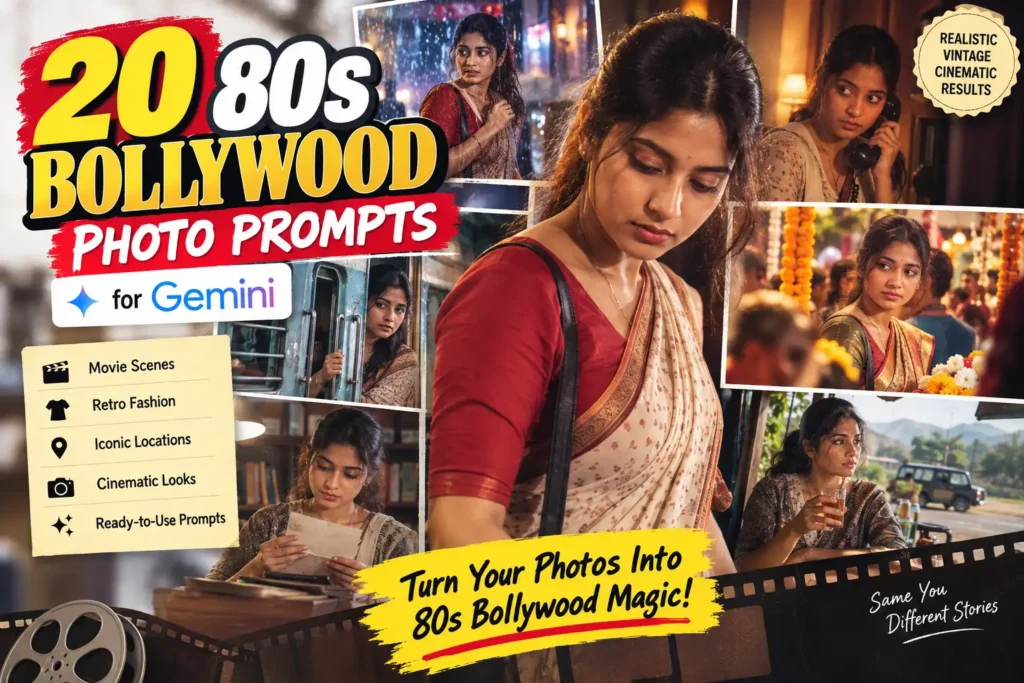
1. 80s Bollywood — Hero Entry Through a Crowded Cinema Street
Use my uploaded photo as the exact facial identity reference. Preserve my recognizable face, facial structure, eyes, nose, lips, skin tone, natural age appearance, hairline, hairstyle characteristics, facial asymmetry, body proportions, and important identifying details. Do not replace my identity with a generic model, and do not make me resemble any real Bollywood celebrity.Transform me into the central character of an original mid-1980s Indian Hindi-film street sequence. Capture the visual energy and storytelling language of mainstream 1980s Bollywood cinema without copying any existing actor, actress, movie scene, poster, costume, or copyrighted character.
Create the decisive instant of a dramatic but believable arrival outside a busy single-screen cinema district in Bombay during the mid-1980s.
I have just stepped from a crowded pavement toward the roadside when somebody unexpectedly calls from behind. Capture me halfway through turning toward the voice. My body is still oriented forward while my face has begun turning back, creating a natural interrupted movement rather than a posed hero portrait.
Dress me in stylish but historically believable 1980s Indian clothing appropriate to my gender, natural age, and the urban setting. Use era-correct tailoring, fabric weight, footwear, hairstyle, and accessories. The styling may have Bollywood personality but must remain original and must not reproduce a famous star's recognizable outfit.
Build the street as a lived-in cinematic world: weathered single-screen theatre façade, ticket windows, large hand-painted fictional movie artwork with no readable copyrighted title, old paper posters layered unevenly on walls, cloth shop awnings, street-food or tea stalls, roadster bicycles, Ambassador and Premier Padmini-era cars, black-and-yellow taxis where appropriate, pedestrians in authentic period clothing, and slightly worn pavement.
Do not arrange the background like extras waiting for a film shoot. Some people should continue walking, one vendor should remain occupied with work, and only one or two distant people may naturally notice whatever caused me to turn.
COMPOSITION: Photograph from slightly below chest height using approximately a 35mm cinematic perspective. Position me away from perfect center. Allow one pedestrian passing close to the camera to become partially motion-blurred, creating foreground depth while my face and eyes remain naturally sharp.
LIGHTING: Use hard late-afternoon Bombay sunlight entering between buildings. Let direct sunlight catch one shoulder, part of the hair, or one edge of the clothing while reflected light from pale theatre walls naturally fills the face. Shadows must follow the street geometry.
FILM CHARACTER: Reproduce the photographic behavior of an authentic 1980s Indian 35mm movie frame — restrained visible grain, warm but natural skin tones, modest contrast, gentle highlight roll-off, slight halation around intense highlights, subtle optical softness, and minor exposure imperfection. Avoid modern HDR and digital clarity.
PERIOD LOCK: Bombay, approximately 1983–1988. Everything visible must plausibly belong to that period. No smartphones, LED displays, modern cars, contemporary sneakers, QR codes, digital billboards, modern storefronts, present-day fashion, current advertising aesthetics, or modern glass architecture dominating the frame.
Preserve natural Indian skin pores, realistic hair strands, anatomically correct hands and fingers, believable fabric folds, proper footwear contact, distinct background faces, realistic object scale, and physically correct shadows.
The final photograph should feel like a rediscovered frame from an original 1980s Bollywood movie: a crowded street continues normally, the protagonist has suddenly heard something behind them, and the viewer immediately wants to know who called.
No text, no watermark, no celebrity likeness, no copied movie character, no duplicate people, no extra fingers, no plastic skin, no artificial AI glow, and no modern objects.
2. 80s Bollywood — Monsoon Night Outside the Last Cinema Show
Use my uploaded photograph as the strict facial identity anchor. Preserve my real recognizable face, natural age, facial proportions, eyes, nose, lips, complexion, hairline, hairstyle characteristics, facial asymmetry, body proportions, and important identifying details. Never transform me into an existing Bollywood celebrity or generic glamorous model.Create an original romantic-drama frame from a fictional mid-1980s Hindi movie during a sudden Bombay monsoon shower.
Avoid the common Bollywood image of simply standing and posing beautifully in heavy rain.
The late-evening show at an old single-screen cinema has just finished. Moviegoers have emerged from the theatre when intense rain suddenly begins, trapping everybody beneath the narrow marquee and nearby shop awnings.
I am standing safely beneath the theatre overhang holding a small folded paper cinema ticket and preparing to leave.
At that exact moment, a period-correct taxi or car passes through accumulated roadside water and sends a splash toward the pavement.
I instinctively step backward to avoid it.
Capture the split second after the movement, when I realize the water narrowly missed me and my startled expression begins changing into restrained amusement.
Do not make me stare directly at the camera.
Dress me in believable 1980s Indian cinema-going clothing appropriate to my gender, natural age, and social setting. Parts of the hem, footwear, shoulder, or hair may show realistic rain dampness, but do not soak the entire person unrealistically while they are standing under shelter.
Build the environment through story-specific details: water dripping irregularly from the cinema marquee, wet ticket fragments stuck to the pavement, one person folding a dripping umbrella, another protecting a paper parcel beneath clothing, an old tea vendor shielding the stove from wind-driven rain, period vehicles creating stretched reflections across the road, and warm incandescent bulbs beneath the theatre entrance.
Large hand-painted movie artwork may appear in the background, but it must depict fictional indistinct characters and must not reproduce a real film poster or require readable generated lettering.
COMPOSITION: Shoot from across a narrow section of rain-darkened pavement with approximately a 50mm perspective. Let the reflective road occupy part of the foreground. Use a cinema pillar or edge of an umbrella as subtle foreground framing rather than placing me in the exact center.
LIGHTING: Warm incandescent bulbs from the cinema entrance should illuminate one side of my face while cool blue-gray monsoon ambient light fills the street. Reflections from the wet ground may gently illuminate lower surfaces. Do not create neon cyberpunk colors or unexplained facial glow.
RAIN REALISM: Rain direction must remain consistent with the wind. Water should accumulate naturally along pavement edges. Wet fabric should darken and gain weight where exposed. Hair should form believable damp strands rather than glossy artificial clumps.
PERIOD LOCK: Bombay or another plausible Indian city, approximately 1984–1988. No multiplexes, LED signs, smartphones, modern cars, contemporary backpacks, current footwear, QR codes, plastic bottled water, digital advertising, or present-day street furniture.
Use authentic high-speed 35mm film character: controlled grain, mild halation around incandescent bulbs, slightly imperfect mixed-light color balance, realistic dark shadows, soft highlight roll-off, and modest optical softness.
Preserve natural skin texture, correct hands, realistic feet, believable garment folds, accurate wet-road reflections, distinct background faces, proper umbrella geometry, and physically consistent shadows.
The final photograph should look like a memorable frame from an original 1980s Bollywood romantic film even though nothing conventionally romantic is being performed: the movie inside the theatre has ended, the monsoon has unexpectedly stopped everybody outside, and one tiny near-miss with a splash creates the human moment.
No text, no watermark, no celebrity imitation, no copied film scene, no broken umbrella geometry, no extra fingers, no plastic skin, and no modern objects.
3. 80s Bollywood — Ten Seconds Before the Stage Curtain Opens
Use my uploaded photo as the exact facial identity source. Preserve my recognizable face, facial anatomy, eyes, nose, lips, natural skin tone, natural age, hairline, facial asymmetry, hairstyle characteristics, body proportions, and individual identifying features. Do not beautify me into another person and do not recreate any real Bollywood star.Create an original backstage photograph from a fictional 1980s Hindi movie musical sequence.
The spectacular performance has NOT begun yet.
Place me inside a modest backstage dressing room of an Indian film studio or theatre around 1985–1987. I am already dressed for a major stage performance, but the photograph captures the private final seconds before walking onto the stage.
Design an original period-plausible Bollywood performance outfit appropriate to my gender and natural age. Use believable 1980s Indian cinema influences in the tailoring, fabric, embroidery, jewellery, hairstyle, and makeup without copying any recognizable costume from an existing movie.
Someone outside the dressing room has just given the final stage call.
I have stopped midway through adjusting one small detail — perhaps a cuff, collar, dupatta edge, earring, jacket, hair ornament, or other appropriate costume element.
My hands remain near that unfinished adjustment, but my eyes have shifted toward the half-open doorway.
Capture the instant nervous concentration turns into readiness.
Do not create an exaggerated heroic expression.
The dressing room must look actively used rather than like a luxury modern vanity studio: slightly aged wooden dressing table, period mirror, a few exposed tungsten bulbs, comb, metal hairpins, powder container, folded cotton cloth, costume pieces placed imperfectly, glass of water, wooden chair, and ordinary backstage wear.
Through the partly open doorway reveal only a narrow fragment of the world outside: a heavy stage curtain, warm beam of theatrical light, perhaps the blurred silhouette of a stagehand moving past, and a hint of stage haze caused naturally by performance equipment.
Do not reveal the complete stage. The unseen performance should remain part of the anticipation.
MIRROR COMPOSITION: Photograph from behind and slightly to one side using approximately a 50mm perspective. A small portion of my real shoulder or back should appear near the edge while my reflected face becomes the primary focus.
REFLECTION LOCK: The mirror must be physically correct. Exactly one real person and exactly one corresponding mirror reflection. Facial identity, clothing, jewellery, hands, hairstyle, and eye direction must match. No duplicate faces, impossible reflection angles, or extra reflected limbs.
LIGHTING: Warm tungsten dressing-room bulbs should illuminate the reflected face naturally and somewhat unevenly. Stronger stage light entering through the doorway should create a narrow believable edge of light along one shoulder or section of hair. Preserve shadows instead of illuminating every corner.
FILM CHARACTER: Fine-to-moderate 35mm grain, warm tungsten color response, gentle highlight bloom, mild optical softness, modest dynamic range, and the slight imperfection of an archived production still.
PERIOD LOCK: Indian film or theatre backstage environment, approximately 1983–1988. No LED vanity mirrors, smartphones, digital cameras, modern salon furniture, contemporary cosmetics displays, current electrical accessories, LED stage panels, or present-day fashion.
Preserve natural skin texture beneath makeup, realistic hair strands, correct fingers, believable jewellery attachment, physically accurate textile weight, mirror depth, wood wear, and plausible shadows.
The final image should feel like a photograph discovered among old film-production negatives: audiences supposedly remember the elaborate performance that followed, but this forgotten frame preserves the quieter ten seconds before the performer stepped through the door.
No readable text, no watermark, no celebrity face, no copied movie costume, no duplicate reflection, no extra limbs, no plastic skin, and no modern objects.
4. 80s Bollywood — Suspense Inside the Empty Villain’s Office
Use my uploaded image as the precise facial identity reference. Preserve my actual recognizable face, natural age, facial structure, skin tone, eyes, nose, lips, hair characteristics, facial asymmetry, body proportions, and distinctive identifying features. Never replace me with an existing actor or make me resemble a famous Bollywood character.Transform me into the protagonist of an original suspense sequence from a fictional 1980s Hindi thriller.
Do not show the villain.
Instead, make the unseen person's recent presence visible through the environment.
Place me inside a large but believable 1980s Indian private office. I apparently arrived expecting somebody to be sitting behind the desk, but the oversized wooden chair is empty.
Something feels wrong.
A rotary telephone receiver is resting slightly out of position.
One desk drawer remains partly open.
Several paper files appear to have been moved recently.
A desk lamp is still switched on.
One curtain or blind moves slightly because a window has been left partly open.
Avoid supernatural effects. Every clue must have an ordinary physical explanation.
I notice one unexpected personal-looking object lying near the desk edge — perhaps an old photograph turned face-down, a distinctive key, or an opened envelope whose contents are not readable.
I am about to inspect it.
Capture the exact instant my hand stops a few centimeters above the object because I hear a sound from somewhere beyond a shadowed doorway.
My eyes turn toward that doorway before the rest of my body follows.
The expression should show alert recognition rather than exaggerated fear.
Dress me in original 1980s Hindi-film protagonist clothing appropriate to my gender and natural age. Give the outfit a strong period silhouette while avoiding imitation of any famous actor's costume.
Build the office with dark polished wooden furniture, rotary telephone, heavy desk, period metal lamp, wooden filing cabinets, analog wall clock, old ceiling fan, paper folders, curtains or venetian blinds where architecturally plausible, framed indistinct photographs, period stationery, and one large empty chair.
COMPOSITION: Shoot from a low observational position using approximately a 40mm lens, partially obscured by a foreground bookshelf, doorframe, or filing cabinet. This should make the viewer feel they have entered the room quietly behind me.
Use the empty chair as an important secondary visual anchor while my suspended hand and redirected eyes carry the story.
LIGHTING: Hard daylight should enter through the window or partially closed blinds, producing geometrically correct areas of illumination across the desk and floor. The tungsten desk lamp should create a localized warm pool around the mysterious object.
Do not randomly paint dramatic light stripes across the face unless the window geometry physically supports them.
COLOR AND FILM CHARACTER: Deep wood tones, slightly warm highlights, restrained saturation, dense but readable shadows, moderate 35mm grain, subtle diffusion, gentle lamp halation, and mild optical imperfection associated with period cinema.
PERIOD LOCK: India, approximately 1982–1988. No computers, laptops, smartphones, flat monitors, modern office chairs, LED fixtures, digital clocks, contemporary stationery, modern CCTV, QR codes, Wi-Fi equipment, or present-day office design.
Preserve realistic hand anatomy, paper thickness, telephone cable behavior, wooden texture, glass reflections, fabric folds, natural skin pores, believable object scale, and physically accurate shadows.
The final image should resemble a suspense frame from a lost 1980s Bollywood thriller. The most important character in the scene is never actually visible; the viewer senses that somebody was sitting in the empty chair only moments earlier.
No visible villain, no readable confidential text, no watermark, no celebrity likeness, no duplicate person, no extra fingers, no plastic skin, no fake AI glow, and no modern objects.
5. 80s Bollywood — Railway Goodbye Through a Moving Platform Crowd
Use my uploaded photograph as the strict facial identity reference. Preserve my recognizable face, facial proportions, natural age, complexion, eyes, nose, lips, hairline, hairstyle characteristics, body proportions, and individual identifying details. Do not transform me into a famous Bollywood actor or actress.Create an original emotionally powerful railway farewell from a fictional mid-1980s Hindi film without recreating any recognizable existing movie scene.
Place me safely INSIDE a stationary or just-about-to-depart period-correct Indian non-air-conditioned railway carriage. Both feet must remain securely inside the compartment behind the doorway threshold.
Someone important to me is somewhere on the platform.
Do not clearly reveal that person's face.
I apparently intended to say something before leaving but waited too long.
Departure activity has started around the train.
Instead of dramatic crying, running beside the train, leaning dangerously from the doorway, or reaching toward somebody, create the emotion through visual interruption.
I suddenly recognize the person I have been searching for through the crowded platform.
I raise one hand only slightly, uncertain whether they have noticed me.
At first, people repeatedly pass between us.
A porter carrying luggage crosses the line of sight.
Another traveler moves through the foreground.
For one fraction of a second, a narrow gap opens between the moving passengers.
Capture that exact instant.
My face becomes visible through the gap, and my eyes lock toward the unseen person on the platform.
The expression should contain recognition, urgency, affection, and the realization that there may not be enough time to speak — but keep it restrained and human rather than melodramatic.
Dress me in authentic mid-1980s Indian travel clothing appropriate to my gender, natural age, region, and social setting. Include realistic travel wear such as slight fabric creasing, practical footwear, and modest period accessories.
Build an authentic station world: painted non-AC railway carriage, barred windows, old metal handles, analog station clock or signage shapes without relying on readable text, cloth holdalls, metal trunks, steel water containers, wicker or cloth baskets, folded newspapers, porters in period clothing, wooden or metal station benches, period lamps, and naturally crowded passenger activity.
COMPOSITION: Photograph from safely within the platform crowd using approximately a 100–135mm telephoto perspective. Use natural lens compression so passing foreground passengers become soft visual layers while my face appears through the temporary opening.
The camera must remain on the platform, never on the railway tracks.
FOCUS AND MOTION: Keep my face and especially the eyes reasonably sharp. Let one or two nearby walking passengers carry restrained directional motion blur. Do not blur the entire frame and do not make the train appear to be traveling at dangerous speed.
LIGHTING: Use diffused morning or late-afternoon daylight entering along the station roof. Reflected light from the painted carriage exterior should naturally illuminate the face while deeper parts of the compartment remain subdued.
PERIOD LOCK: Indian railway travel approximately 1982–1988. No smartphones, earbuds, modern trains, LED coach displays, trolley suitcases, plastic bottled water, charging sockets, contemporary backpacks, digital information boards, current fashion, or present-day railway architecture dominating the frame.
Use restrained 35mm color-negative characteristics: moderate grain, slightly muted station colors, modest contrast, imperfect exposure, subtle highlight softness, believable shadow density, and mild telephoto atmospheric softness.
Preserve distinct passenger faces, correct hands, believable luggage weight, realistic cloth folds, proper carriage geometry, natural skin texture, physically plausible eye direction, and accurate body placement.
The final photograph should feel unmistakably like an emotional 1980s Bollywood movie frame without needing exaggerated romance: a huge railway station separates two people, the crowd keeps blocking their view, and for one brief instant the moving bodies align perfectly enough for them to finally see each other.
No unsafe train behavior, no hanging outside the carriage, no running beside a moving train, no text, no watermark, no celebrity imitation, no duplicate faces, no extra fingers, no plastic skin, and no modern objects.
6. 80s Bollywood — Rooftop Dance Rehearsal After Everyone Leaves
Use my uploaded photo as the exact facial identity anchor. Preserve my recognizable face, facial anatomy, eyes, nose, lips, natural skin tone, natural age appearance, hairline, hairstyle characteristics, facial asymmetry, body proportions, and important identifying details. Do not substitute my identity with a generic dancer or make me resemble any real Bollywood celebrity.Create an original behind-the-scenes photograph from a fictional mid-1980s Bollywood production rather than showing the polished final song sequence.
Place me on the broad flat rooftop of a period-plausible Bombay film-studio building or old urban building shortly after a dance rehearsal has finished.
The choreographer, dancers, and most of the crew have already gone downstairs.
I stayed behind for another minute because one difficult movement was not working during rehearsal.
Do not show me performing a perfect theatrical dance pose.
Instead, capture the exact instant immediately AFTER I finally execute the difficult turn correctly.
One foot has just settled firmly onto the rooftop.
The other foot is naturally recovering its balance.
One arm is lowering from the movement rather than being held artificially in position.
Part of the clothing is still rotating or settling from the turn.
A few loose hair strands respond to the same movement.
My expression changes from intense concentration into a small spontaneous look of satisfaction, as if I know this attempt finally worked.
Dress me in authentic but original 1980s Bollywood rehearsal clothing appropriate to my gender, natural age, and the physical movement involved. It should have recognizable period styling without resembling a famous film costume. Clothing must move with believable fabric weight and gravity.
Leave evidence that a larger rehearsal happened moments earlier: a period cassette player or portable audio unit resting safely beside the parapet, steel water flask, folded towel, one wooden chair, rolled electrical cable, cloth prop, choreography papers with no readable writing, and subtle floor marks showing where performers were supposed to stand.
One distant crew member may be disappearing through the rooftop stairwell while carrying a harmless piece of equipment, reinforcing that rehearsal has ended.
Build a believable 1980s Bombay skyline beyond the roof: old apartment blocks, water tanks of period-plausible construction, television antennas, laundry lines, industrial roofs, mature trees between buildings, and atmospheric urban haze.
Do not include modern skyscrapers.
COMPOSITION: Shoot extremely low from near rooftop-floor height using approximately a 28mm lens. Allow rehearsal marks, a loose section of cable, or another harmless foreground object to lead toward me without visually intersecting my legs.
Keep the camera far enough away that the wide lens does not distort my face, hands, or body proportions.
LIGHTING: The sun has just disappeared behind neighboring buildings. Soft residual evening sky provides broad natural illumination from above and one side. Warm tungsten light escaping from the open stairwell doorway creates a small secondary pool of light behind me.
Do not create theatrical spotlights on the rooftop. This is rehearsal, not the finished performance.
MOTION REALISM: The movement of hair and clothing must correspond to the same turn. Keep my face and planted foot naturally sharp while allowing only a subtle trace of motion in the settling garment or moving hand.
PERIOD LOCK: Bombay, approximately 1983–1988. No smartphones, wireless speakers, modern sportswear, LED fixtures, contemporary sneakers, modern high-rise towers, satellite dishes of later designs, current water bottles, digital cameras, or present-day rooftop equipment.
Use restrained 35mm film grain, warm-neutral skin reproduction, gentle optical softness, slightly subdued evening colors, modest dynamic range, and realistic exposure.
Preserve natural skin pores, anatomically correct hands, proper finger count, realistic feet, believable balance, physically accurate fabric motion, individual hair strands, and consistent shadows.
The final image should feel like an unusually intimate production photograph from an old Bollywood film: the audience would eventually see the polished dance number, but this forgotten frame shows the private moment when the performer finally mastered the step after everybody else had left.
No text, no watermark, no celebrity likeness, no copied choreography, no impossible dance anatomy, no floating fabric, no duplicate person, no plastic skin, and no modern objects.
7. 80s Bollywood — Romantic Song Moment Seen Only in a Puddle Reflection
Use my uploaded photograph as the strict identity reference. Preserve my recognizable face, natural age, skin tone, facial structure, eyes, nose, lips, hair characteristics, facial asymmetry, body proportions, and distinctive identifying details. Do not replace me with a generic romantic-film model or imitate a real Bollywood celebrity.Create an original visual idea for a fictional 1980s Bollywood romantic drama.
Avoid the conventional composition of the protagonist standing in the center of the frame during a romantic song.
Instead, build the photograph around a large rain puddle on an old Indian street shortly after a monsoon shower has stopped.
The camera is looking primarily DOWN toward the puddle.
My reflection becomes the main way the viewer sees me.
I am standing several feet away from the puddle beside the entrance of an old residential building or neighborhood shop.
Someone important to me has apparently just walked away beyond the camera.
Do not show that person.
I have turned toward them one last time.
Capture the exact moment when I begin to raise my hand as if I might call them back, but hesitate before completing the gesture.
The emotion should remain uncertain.
The viewer should not know whether I will speak or allow the person to leave.
Dress me in authentic 1980s Indian clothing appropriate to my gender, natural age, region, and the romantic-film context. Keep the styling attractive but believable rather than turning it into contemporary retro fashion.
REFLECTION STORYTELLING: My reflected face, upper body, and incomplete hand gesture should be visible in the puddle. The real person may appear only partially at the extreme top edge of the composition — perhaps shoes, garment hem, or a small portion of the lower body.
Do not show a second duplicate version of my face outside the reflection.
A few small ripples from residual roof drips may gently distort peripheral areas of the reflection, but my eyes and facial identity must remain readable.
The puddle should also reflect fragments of the surrounding 1980s environment: old balcony edges, electrical wires, a tree canopy, faded building façade, and warm light from one doorway.
Add small post-rain details around the puddle: darkened pavement, wet bicycle tyre marks, scattered leaves stuck to the road, water dripping from an awning, a parked roadster bicycle, and one distant period vehicle.
COMPOSITION: Use a high downward camera position with approximately a 50mm perspective. Let the irregular natural shape of the puddle form the visual frame around my reflection. Avoid making the puddle perfectly circular or mirror-clean.
REFLECTION LOCK: Reflection geometry must obey the actual position of the person, camera, buildings, and light sources. No impossible duplicated limbs, reversed clothing inconsistencies, extra faces, or floating reflected objects.
LIGHTING: The rain has stopped near dusk. Cool overcast sky should illuminate the street while a warm incandescent doorway or shop light appears within part of the reflection. Facial illumination must correspond to those actual sources.
PERIOD LOCK: Indian urban neighborhood, approximately 1983–1988. No modern cars, smartphones, LED signage, contemporary shopfronts, current motorcycles, QR codes, modern footwear, plastic bottled water, or present-day architecture dominating the reflected world.
Use period color-negative characteristics: slightly muted wet-weather colors, restrained grain, modest contrast, gentle highlight halation around reflected tungsten light, and subtle analog softness.
Preserve natural skin texture even within the reflection, realistic wet-surface behavior, physically correct ripple distortion, believable footwear, fabric folds, pavement texture, and object scale.
The final photograph should initially look like an atmospheric picture of a rain puddle. Only a second later should the viewer realize that the entire emotional Bollywood moment is happening inside the reflection: someone has left, I almost call them back, and the decision has not yet been made.
No text, no watermark, no celebrity imitation, no copied film scene, no duplicate face outside the intended reflection, no impossible mirror geometry, no plastic skin, and no modern objects.
8. 80s Bollywood — Comedy Scene When the Scooter Refuses to Start
Use my uploaded photograph as the exact facial identity reference. Preserve my recognizable face, natural age, facial proportions, complexion, eyes, nose, lips, hairline, hairstyle characteristics, body proportions, and individual identifying features. Never replace me with a generic comedy actor or reproduce the appearance of a real Bollywood star.Create an original lighthearted frame from a fictional 1980s Hindi movie.
The humor must come from an ordinary believable situation rather than exaggerated facial expressions, slapstick injury, or cartoon behavior.
Place me beside a period-correct Indian scooter on a lively neighborhood street during the mid-1980s.
I am apparently dressed and ready to leave for something important — perhaps work, a family function, cinema outing, meeting, or journey appropriate to my natural age and clothing.
The scooter refuses to start.
Do not show dangerous mechanical work.
I have already made several harmless attempts to start it.
At the moment of the photograph, I pause and look down at the scooter with restrained disbelief.
A nearby older neighborhood mechanic, shopkeeper, friend, relative, or passerby has silently noticed one embarrassingly simple explanation — perhaps the stand, control position, fuel setting, or another harmless period-plausible issue.
Do not make the technical detail the focal point and do not provide repair instructions.
The secondary person points subtly toward the overlooked detail.
I follow their gesture with my eyes.
Capture the instant I realize what happened.
My expression should be a mixture of embarrassment, amusement, and an attempt to preserve dignity.
Do not create exaggerated open-mouth comedy.
Dress me in attractive but realistic 1980s Indian clothing appropriate to my gender, natural age, destination, and scooter travel.
Build the neighborhood with an old repair shop or tea stall, hand-painted commercial boards whose writing need not be readable, roadster bicycle, stacked metal containers, cloth awning, period storefront shutters, mature roadside tree, modest houses, pedestrians, and a few era-correct vehicles farther away.
The scooter must have believable 1980s Indian proportions and mechanical geometry without prominently reproducing protected logos.
COMPOSITION: Shoot from across the narrow street using approximately a 70mm perspective. Place part of a tea-stall doorway or hanging shop item softly in the foreground, giving the scene the feeling of an observed neighborhood incident.
Keep my reaction, the subtle pointing gesture, and the scooter together within the storytelling triangle.
LIGHTING: Use ordinary bright morning daylight softened by shop awnings and nearby buildings. Reflected light from the street should naturally fill faces. Avoid dramatic movie spotlights because the comedy should feel observational.
PERIOD LOCK: India, approximately 1983–1988. No smartphones, modern scooters, contemporary helmets as conspicuous props, LED shop lights, QR codes, current vehicles, plastic bottled water, digital signage, or modern fashion.
Preserve correct hand ownership between people, distinct facial identities, realistic scooter contact with the ground, believable metal reflections, fabric folds, natural skin texture, proper body balance, and accurate shadows.
Use moderate consumer-film grain, slightly warm 1980s color reproduction, gentle optical softness, restrained saturation, and candid framing.
The final photograph should feel like a beloved comic beat from an old Bollywood movie: nothing spectacular has happened, the scooter simply refuses to cooperate, and the protagonist realizes the problem only after somebody else quietly points it out.
No text, no watermark, no celebrity likeness, no dangerous vehicle behavior, no duplicate people, no extra fingers, no distorted scooter geometry, no plastic skin, and no modern objects.
9. 80s Bollywood — Family Drama at the Dining Table After the Doorbell Rings
Use my uploaded image as the exact facial identity source. Preserve my recognizable face, natural age, facial anatomy, eyes, nose, lips, skin tone, hair characteristics, facial asymmetry, body proportions, and important identifying features. Do not turn me into an existing Bollywood actor or generic melodrama character.Create an original domestic-drama frame from a fictional 1980s Hindi family movie.
Avoid crying, shouting, pointing fingers, broken objects, and exaggerated soap-opera acting.
Place me at the dining table of a modest but comfortable Indian family home during an ordinary evening meal.
The family was apparently in the middle of dinner.
Then the front doorbell rang.
Someone went to answer it.
Do not show whoever is at the front door.
Instead, capture the reaction inside the dining room when a family member returning from the doorway quietly says or signals something unexpected.
I am still seated at the table.
My hand has stopped midway through an ordinary action — perhaps serving food, reaching toward a steel tumbler, folding a piece of bread, or setting down a spoon.
My eyes move toward the hallway before my body turns.
Other family members react differently and subtly: one pauses eating, another looks toward me rather than toward the door, and perhaps an older relative remains still for an extra second as if they understand the significance first.
Do not overcrowd the scene.
If secondary family members are generated, every person must have a distinct face, plausible natural age, clear body placement, and visually understandable family relationship.
Dress everyone in ordinary period-correct 1980s Indian home clothing suitable for their age and gender. Do not dress the entire family as though attending a wedding.
Build the home through authentic details: wooden or laminate dining table, stainless-steel plates and tumblers, serving bowls, cotton table cloth where plausible, wooden cabinet, CRT television or radio farther away, analog wall clock, ceiling fan, simple curtains, framed family photographs with indistinct faces, household calendar without readable text, and a corridor leading toward the unseen front entrance.
The food should appear like a real family meal rather than decorative restaurant plating.
COMPOSITION: Photograph from the far end of the table using approximately a 50mm lens. Use plates, tumblers, and one softly out-of-focus shoulder in the foreground to establish depth.
The hallway should remain visible in the background but the unseen visitor must stay outside the frame.
LIGHTING: Use warm tungsten or incandescent household lighting above or beside the dining area. A cooler trace of evening light may remain near a distant window. Preserve natural falloff into the hallway.
Do not artificially brighten every face equally.
PERIOD LOCK: Indian household, approximately 1983–1988. No smartphones, flat-screen TVs, LED lights, induction cooktops, modern dining furniture, contemporary food packaging, plastic bottled water, Wi-Fi devices, or present-day décor.
Preserve realistic food scale, utensil handling, correct fingers, plate reflections, distinct family faces, natural Indian skin texture, believable clothing folds, proper seated anatomy, and physically consistent shadows.
Use restrained high-speed 35mm grain, warm household color response, slight tungsten cast, modest dynamic range, and mild print-like softness.
The final photograph should resemble a powerful 1980s Bollywood family-drama frame without showing the cause of the drama. The meal is still on the table, nobody has stood up yet, and the viewer understands from several tiny reactions that whoever has arrived at the door matters enormously.
No visible visitor, no readable personal information, no text, no watermark, no celebrity likeness, no duplicated relatives, no extra fingers, no plastic skin, and no modern objects.
10. 80s Bollywood — Final Scene Inside a Nearly Empty Single-Screen Theatre
Use my uploaded photograph as the strict facial identity anchor. Preserve my real recognizable face, natural age, skin tone, facial structure, eyes, nose, lips, hairline, hairstyle characteristics, facial asymmetry, body proportions, and distinctive identifying details. Do not transform me into a real Bollywood celebrity or copy the appearance of any existing movie character.Create an original closing-shot concept for a fictional 1980s Hindi film.
Set the scene inside an old single-screen cinema after the final screening of the night has ended.
The movie audience has already left.
Cleaning has not fully begun.
I remain seated alone for a few extra seconds somewhere in the middle rows.
Do not make this a sad person simply staring at an empty screen.
Build a more specific story.
During the film, I apparently came to the cinema carrying an important unresolved thought, decision, or memory.
The end credits have finished and the projector image has disappeared.
The blank screen now reflects only weak residual light from the auditorium.
I finally decide to leave.
Capture the exact instant I rise from the folding cinema seat and notice that a small harmless personal item belonging to another moviegoer has been forgotten on the neighboring seat — perhaps a folded handkerchief, paper ticket, inexpensive spectacles case, or small notebook.
Do not generate readable private information.
I pause.
One hand rests lightly on the back of the seat while I look at the forgotten object, deciding whether to pick it up and hand it to theatre staff.
The emotion should be reflective curiosity rather than fear or melodrama.
Dress me in authentic late-1980s Indian cinema-going clothing appropriate to my gender and natural age.
Build the theatre with rows of worn upholstered or wooden folding seats, faded aisle carpeting or cement floor as appropriate, old wall sconces, heavy curtains beside the screen, ceiling fans or period ventilation fixtures, balcony architecture where plausible, paper ticket fragments, and subtle signs of years of use.
A theatre employee may appear very far away near an exit preparing to close part of the auditorium, but must not compete with the main subject.
COMPOSITION: Shoot from near the front of the auditorium looking diagonally back toward me with approximately a 35mm lens. Rows of empty seats should create repeating geometric lines leading toward my position.
Do not center me perfectly.
Allow one large dark seat back close to the camera to create foreground depth.
The enormous blank cinema screen should occupy part of the composition without becoming a featureless white rectangle.
LIGHTING: The projector is OFF. Use dim warm aisle or wall lights as the primary illumination. A partially open exit door farther away may introduce a narrow cooler corridor light. My face should receive only believable reflected illumination from these sources.
Preserve deep auditorium shadows.
FILM CHARACTER: Give the frame authentic late-1980s 35mm cinema texture — visible grain in the dark areas, warm practical-light halation, restrained saturation, gentle shadow color variation, modest contrast, and slightly imperfect optical sharpness.
PERIOD LOCK: Indian single-screen cinema, approximately 1985–1989. No multiplex seats, LED aisle strips, smartphones, digital projectors visible in the auditorium, modern emergency displays as dominant elements, contemporary drink cups, current advertising, or present-day theatre architecture.
Preserve natural skin pores, correct hands, realistic seat geometry, believable upholstery wear, proper object scale, physically accurate shadows, natural fabric folds, and plausible auditorium perspective.
The final photograph should work as the last frame of an unseen 1980s Bollywood movie. The screen has gone blank, the story everyone paid to watch is finished, but one small forgotten object causes the protagonist to stop before walking out — suggesting that another story may begin after the credits.
No readable text, no watermark, no celebrity likeness, no copied movie imagery on the screen, no duplicate  people, no extra fingers, no distorted hands, no plastic skin, no artificial AI glow, no impossible seat geometry, and no modern objects.
11. 80s Bollywood — Secret Letter Hidden Inside a Library Book
Use my uploaded photograph as the exact facial identity reference. Preserve my recognizable face, natural age, facial structure, eyes, nose, lips, skin tone, hairline, hairstyle characteristics, facial asymmetry, body proportions, and important identifying details. Do not replace me with a generic model or make me resemble any real Bollywood celebrity.Create an original emotionally intriguing scene from a fictional mid-1980s Hindi romantic-drama film.
Place me inside an old college, university, or public library in India during a quiet afternoon.
Do not create the ordinary cliché of a person posing romantically between bookshelves.
I came to the library looking for a specific book.
After finding it on a tall wooden shelf, I carry it to a reading table and open it.
Something unexpected slips from between the pages.
It is a small folded handwritten letter that was apparently hidden inside the book long ago.
Do not make any handwriting clearly readable.
The letter is not addressed to me, but one tiny visual detail on the folded paper — perhaps an indistinct initial, old date shape, pressed flower fragment, recognizable drawing, or familiar style of handwriting — makes me suddenly suspect that I know who wrote it.
Capture the exact moment BEFORE I unfold the letter completely.
One hand holds the book open.
The other hand gently lifts the folded paper.
My eyes are no longer reading the book; they are fixed on the tiny clue on the letter.
My expression should move from ordinary concentration into private recognition and curiosity.
Do not make me cry, gasp dramatically, or stare at the camera.
Dress me in believable mid-1980s Indian college-going, professional, or everyday clothing appropriate to my gender and natural age. If the uploaded reference shows an older adult, keep me that age and make the library visit appropriate to an adult rather than automatically turning me into a student.
Build an authentic period library: tall dark wooden bookcases, card-catalog drawers, worn reading tables, wooden chairs, ceiling fans, old tube or incandescent fixtures appropriate to the building, cloth-bound and paper-bound books of varied age, librarian's desk, paper borrowing slips, wall clock, and high windows.
Books must appear naturally used rather than arranged by color like modern interior decoration.
COMPOSITION: Photograph from the opposite side of the reading table using approximately a 70mm perspective. Let one open book or stack of books remain softly out of focus in the lower foreground. Keep the folded letter, my hands, and changing expression within the same visual path.
A bookshelf aisle behind me should create depth without forming distracting lines through my head.
LIGHTING: Soft afternoon daylight enters through tall windows from one side and falls across the table. Dust may be visible only where it crosses a genuine shaft of sunlight. Reflected light from pale walls keeps the face naturally exposed while the deeper shelves remain darker.
LETTER REALISM: The paper should have believable thickness, small folds, slight age discoloration, and natural handling marks. Do not create theatrical burnt edges, artificial antique stains, perfect calligraphy, or clearly readable personal information.
PERIOD LOCK: India, approximately 1983–1988. No laptops, smartphones, modern barcode scanners, LED fixtures, contemporary plastic library furniture, QR codes, digital catalog terminals, modern backpacks, current fashion, or present-day electronics.
Use restrained 35mm color-negative character: fine grain, slightly warm paper tones, modest contrast, natural highlight roll-off, mild optical softness, and subtle print-like imperfection.
Preserve realistic fingers, fingernails, paper contact, book thickness, natural skin pores, individual hair strands, believable fabric folds, and physically accurate shadows.
The final photograph should feel like a turning point in an unseen 1980s Bollywood story: I came looking for a book, found something that had nothing to do with me, and then noticed one tiny clue suggesting that perhaps it does.
No readable letter text, no watermark, no celebrity likeness, no copied film scene, no duplicate person, no extra fingers, no floating paper, no plastic skin, and no modern objects.
12. 80s Bollywood — Midnight Telephone Call While the Whole House Sleeps
Use my uploaded photo as the strict facial identity anchor. Preserve my recognizable face, facial anatomy, natural age, skin tone, eyes, nose, lips, hairline, hairstyle characteristics, facial asymmetry, body proportions, and distinctive identifying features. Do not convert me into an existing Bollywood star or generic movie character.Create an original suspenseful yet intimate frame from a fictional 1980s Hindi family or romantic drama.
Set the scene late at night inside a modest Indian family home.
Everyone else in the house appears to be asleep.
A landline telephone unexpectedly rings.
By the time the photograph is taken, I have quietly reached the telephone and lifted the receiver, trying not to wake anybody.
Do not show another person on the telephone.
Do not make the scene about screaming, threatening behavior, or exaggerated fear.
The unusual moment happens AFTER I answer.
At first I expect an ordinary conversation.
Then I recognize either the caller or the significance of what I hear.
Capture the exact instant my expression changes.
The telephone receiver remains naturally beside my ear.
My free hand has stopped midway through an absent-minded household action — perhaps straightening the telephone cord, holding a small notebook closed, or resting against the edge of the table.
My eyes shift toward the dark hallway leading to the sleeping rooms, as if I am checking whether anybody else heard the ring.
The emotional tone may suggest surprise, secrecy, concern, or unexpected familiarity, but do not over-explain what the caller said.
Dress me in believable 1980s Indian nighttime home clothing appropriate to my gender, natural age, family setting, and region. Keep the styling modest and ordinary rather than glamorous.
Build a lived-in period interior around the telephone: wooden side table, rotary or period push-button landline appropriate to the chosen year, coiled cable, small analog clock, switched-off CRT television farther away, folded newspaper, steel water tumbler, simple curtains, ceiling fan, wooden doorway, family photographs whose faces remain indistinct, and a corridor disappearing into darkness.
One door in the background may remain slightly open, but no mysterious person should be hiding behind it.
COMPOSITION: Shoot from partly behind the darkened doorway of an adjoining room using approximately a 50mm lens. The doorway becomes a natural foreground frame around the brighter telephone area.
Keep enough negative space toward the dark hallway to make my glance meaningful.
LIGHTING: Do not illuminate the room like a film set. Use one small warm tungsten wall lamp, table lamp, or practical household fixture near the telephone as the dominant source. Faint cool night light may enter through a barred window farther away.
The warm light should fall naturally across one side of my face while the opposite side remains softly shadowed.
TELEPHONE REALISM: Correct receiver orientation, believable hand grip, physically plausible cable connection, realistic telephone proportions, and no floating or disconnected cord.
PERIOD LOCK: Indian household, approximately 1983–1988. No mobile phones, cordless phones from inappropriate periods, flat-screen TVs, LED emergency lights, digital smart clocks, modern switches as conspicuous features, contemporary furniture, Wi-Fi equipment, or current décor.
Use authentic high-speed 35mm-film behavior appropriate to a dim interior: visible restrained grain, warm practical-light cast, realistic shadow density, gentle highlight bloom, and slightly imperfect sharpness without destroying facial identity.
Preserve natural skin pores, realistic fingers, individual hair strands, believable clothing folds, correct eye direction, and physically consistent shadows.
The final image should feel like a memorable late-night scene from an original 1980s Bollywood film: the entire house is asleep, one telephone rings unexpectedly, and the story changes because of the person on the other end whom the audience never sees.
No readable private information, no watermark, no visible caller, no celebrity likeness, no extra fingers, no duplicate person, no plastic skin, and no modern objects.
13. 80s Bollywood — Festival Crowd Freezes When an Old Friend Appears
Use my uploaded photograph as the exact facial identity source. Preserve my recognizable face, natural age, skin tone, facial structure, eyes, nose, lips, hair characteristics, facial asymmetry, body proportions, and important identifying details. Do not substitute another person's face and do not imitate any real Bollywood celebrity.Create an original reunion moment from a fictional mid-1980s Hindi film during a lively Indian neighborhood festival or community celebration.
Choose one culturally coherent celebration appropriate to the region and visual environment. Do not randomly combine unrelated festival traditions simply for decoration.
The scene is full of movement and ordinary celebration.
I am helping carry, arrange, distribute, or hold something harmless and culturally appropriate to the event — perhaps a flower tray, small packet of prasad, decorative cloth, family basket, or other plausible object.
I am NOT posing for a festival portrait.
Someone passes an object into my hands.
At that exact moment, I look beyond the person's shoulder and unexpectedly recognize someone entering from the far side of the gathering.
That unseen or indistinct person is somebody I apparently have not seen for a long time.
Do not clearly reveal their face.
Capture the fraction of a second when recognition interrupts my current action.
My hands still hold the festival object correctly, but the movement has paused.
My eyes fix toward the distant arrival.
My expression should show disbelief gradually turning into recognition rather than immediate exaggerated happiness.
People immediately around me should continue their celebration because they have not yet noticed what I noticed.
This contrast is essential: the environment keeps moving while my personal moment temporarily stops.
Dress me in festive but historically believable 1980s Indian clothing appropriate to my gender, natural age, region, and the selected celebration. Avoid modern designer styling and costume-like excess.
Build a culturally plausible community environment with period architecture, cloth decorations, flowers, brass or steel vessels where appropriate, incandescent decorative bulbs if historically plausible, families in distinct period clothing, children behaving naturally, old bicycles, simple stalls, and regional details that genuinely belong together.
COMPOSITION: Use approximately a 70–85mm lens from within the celebration. Photograph through two naturally blurred foreground participants or decorations, allowing layers of moving people to surround me.
Place the direction of my gaze toward a small opening in the crowd so viewers instinctively search that area for the person I have recognized.
MOTION: My eyes and face remain sharp while one foreground participant or moving decorative element may carry mild motion blur. Avoid freezing every background person identically.
LIGHTING: Use late-afternoon natural daylight or a believable early-evening mixture of fading daylight and warm practical festival bulbs. Explain illumination through actual visible or implied sources rather than adding random golden glow.
PERIOD LOCK: India, approximately 1983–1988. No smartphones, LED decorative walls, modern event stages, contemporary plastic banners, current vehicles, QR codes, digital cameras, modern fashion, or present-day commercial branding.
Preserve culturally correct object handling, distinct faces among secondary people, realistic hands, proper clothing drape, natural skin texture, jewellery connections where applicable, believable crowd spacing, and accurate shadows.
Use restrained 35mm film grain, slightly warm period color response, gentle highlight halation around practical bulbs, modest dynamic range, and candid documentary framing.
The final photograph should resemble a major emotional beat from an old Bollywood movie without needing dialogue: hundreds of small festival activities continue normally, but one person has just seen somebody in the crowd who changes the meaning of the entire evening.
No readable text, no watermark, no celebrity likeness, no copied movie scene, no duplicated crowd faces, no extra fingers, no plastic skin, and no modern objects.
14. 80s Bollywood — Detective Clue Revealed by a Developing Photograph
Use my uploaded photograph as the strict facial identity reference. Preserve my actual recognizable face, natural age, facial proportions, eyes, nose, lips, skin tone, hairline, hairstyle characteristics, facial asymmetry, body proportions, and distinctive identifying features. Do not make me resemble any existing Bollywood actor, detective character, or famous film role.Create an original investigative frame from a fictional 1980s Hindi mystery movie.
Place me inside a small period photographic darkroom or professional photo studio's processing room.
Do not turn the scene into fantasy and do not create glowing holograms or impossible forensic technology.
I am examining a newly developed photographic print connected to an ongoing mystery.
The photograph initially appeared ordinary.
Then, while looking at it under appropriate darkroom illumination, I notice a small background detail that was overlooked earlier — perhaps the silhouette of a person, distinctive vehicle shape, clock position, doorway, reflection, sign shape, or another harmless visual clue.
Do not make the clue readable text.
Do not create a detailed photograph-within-a-photograph containing recognizable celebrities or copyrighted movie imagery.
The internal photograph should remain visually plausible and slightly limited in detail, like a genuine period print.
Capture the exact instant I recognize the clue.
I bring the photograph slightly closer.
One finger approaches the relevant area but does not unnaturally cover it.
My eyes narrow naturally with concentration while the rest of my posture remains still.
Another photographic print may be lying on the work surface, allowing the viewer to understand that I have been comparing images.
Dress me in original period-correct 1980s Indian clothing appropriate to my gender, natural age, profession, and story context. Avoid trench-coat detective clichés unless the environment genuinely justifies such clothing.
Build a believable photographic workspace: enlarger, developing trays, tongs, hanging negatives, film canisters, contact sheets, timer, chemical bottles with indistinct labels, wooden or metal workbench, drying clips, old camera equipment, and ventilation appropriate to a working darkroom.
All photographic chemistry must remain safely contained in its intended trays and containers. Do not depict unsafe handling.
COMPOSITION: Use approximately a 50mm lens from across the workbench. Let one hanging strip of negatives remain softly out of focus in the near foreground, partially framing my face and the print.
Keep the developed photograph large enough to be understood as the story object but not so large that impossible miniature details become visible.
LIGHTING: Respect darkroom conditions. Use restrained period-plausible safelight illumination combined with a small amount of neutral light only where consistent with the stage of photographic processing being depicted. Do not brightly flood the room.
The face should remain recognizable despite low illumination, with shadows preserved.
PHOTOGRAPH REALISM: Correct print thickness, believable paper surface, realistic wet or dry state according to the depicted stage, accurate finger contact, plausible negative strips, and no impossible image appearing magically from blank paper.
PERIOD LOCK: Indian photographic workspace, approximately 1982–1988. No digital cameras, computers, flat monitors, smartphones, inkjet printers, modern editing software screens, LED panels, memory cards, or contemporary photographic accessories.
Use period-cinema characteristics suitable for a dark scene: moderate grain, deep shadows, restrained saturation, subtle safelight color cast, realistic highlight response, and mild optical softness.
Preserve natural skin texture, anatomically correct fingers, proper print handling, realistic equipment geometry, fabric folds, individual hair strands, and physically accurate shadows.
The final photograph should feel like the instant an entire Bollywood mystery changes direction: the clue was always inside an ordinary photograph, but nobody noticed it until now.
No readable clue text, no watermark, no celebrity likeness, no copied detective character, no impossible photographic technology, no extra fingers, no duplicate person, no plastic skin, and no modern objects.
15. 80s Bollywood — Sunrise After an All-Night Road Journey
Use my uploaded photo as the exact facial identity anchor. Preserve my recognizable face, natural age, facial anatomy, skin tone, eyes, nose, lips, hairline, hairstyle characteristics, facial asymmetry, body proportions, and important identifying details. Never de-age me automatically, replace me with a generic film star, or make me resemble a real Bollywood celebrity.Create an original transitional scene from a fictional 1980s Hindi road movie.
The dramatic journey happened during the night.
Do not show the dramatic event itself.
Instead, capture the quiet morning immediately afterward.
Place me at a modest roadside tea stall somewhere along a period-plausible Indian highway or rural intercity road shortly after sunrise.
A period-correct car, jeep, bus, or other plausible vehicle connected to the journey is parked safely nearby.
I have apparently been traveling for many hours.
Do not make me look fashionably perfect.
Show subtle believable evidence of the journey: slightly creased clothing, tired but alert eyes, hair mildly disturbed from travel, a folded road map or paper route note, small cloth travel bag, and perhaps dust on footwear appropriate to the environment.
I am holding a small glass or steel tumbler of hot tea.
The stall owner has just placed it in front of me.
Before drinking, I notice the first direct sunlight reaching a distant landscape feature — perhaps hills, fields, an old bridge, roadside trees, or a town emerging through morning haze.
Capture the instant I stop and look toward it.
The expression is not simple admiration of a sunrise.
It should feel like relief after making it through a difficult night and quietly realizing that the journey is not over, but something has changed.
Do not show dramatic victory poses.
Build an authentic roadside environment: simple tea stall made from period-plausible materials, blackened kettle, glass jars, wooden bench, newspapers, metal stove, hanging cups or utensils, road milestone shape without relying on readable generated text, parked roadster bicycle, utility poles, dusty road shoulder, mature trees, and occasional period vehicles farther away.
If another traveler or stall owner appears, keep them secondary with distinct facial identity and natural behavior.
COMPOSITION: Shoot from inside the shaded tea stall looking outward using approximately a 35mm lens. Use the dark roof edge, doorway, or hanging utensils as foreground framing around the brighter road and landscape.
Place me near the boundary between shade and morning light rather than directly in the center.
The parked journey vehicle should appear in the middle distance as evidence of what happened before this frame.
LIGHTING: Low sunrise should illuminate the landscape and road from one side. I remain mostly under the tea-stall shade, with soft reflected morning light naturally revealing the face. A narrow strip of direct sunlight may reach one shoulder or the edge of the clothing.
Do not create a glowing orange face.
TEA REALISM: Steam should be subtle and dependent on temperature and ambient conditions. Preserve correct tumbler grip, liquid level, glass or metal reflections, and believable contact with the table.
PERIOD LOCK: India, approximately 1983–1988. No smartphones, GPS devices, modern cars, contemporary highway barriers, LED signs, current fuel-station branding, plastic bottled water, modern travel backpacks, digital watches, or present-day roadside architecture dominating the frame.
Use restrained 35mm color-negative rendering: gentle morning warmth, modest contrast, visible but controlled grain, slightly lifted atmospheric haze, natural highlight roll-off, and mild lens softness.
Preserve realistic tired facial texture rather than beauty-filter smoothing, natural hair strands, correct hands, believable fabric creasing, dust behavior, accurate vehicle scale, realistic road perspective, and physically consistent shadows.
The final photograph should feel like the morning-after scene from an unseen 1980s Bollywood  film: the difficult part of the journey happened somewhere in the darkness behind me, morning has finally arrived, and the protagonist has stopped for one ordinary cup of tea before deciding what comes next.

No text, no watermark, no celebrity likeness, no copied movie scene, no duplicate people, no extra fingers, no distorted hands, no plastic skin, no artificial AI glow, no impossible vehicle geometry, and no modern objects.
16. 80s Bollywood — The Photograph Booth Captures the Moment Between Poses
Use my uploaded photograph as the exact facial identity reference. Preserve my recognizable face, natural age, facial structure, eyes, nose, lips, skin tone, hairline, hairstyle characteristics, facial asymmetry, body proportions, and important identifying details. Do not replace my identity with a generic model or make me resemble any real Bollywood celebrity.Create an original playful character moment from a fictional mid-1980s Hindi movie.
Place me inside or immediately beside a small period-plausible automatic photo booth, passport-photo kiosk, or compact portrait-photo corner at a busy Indian railway station, shopping arcade, cinema complex, or commercial street.
Do not create a polished studio portrait.
I entered intending to take one serious photograph for an ordinary practical reason.
The first exposure has apparently already been taken.
While waiting for the next exposure, I mistakenly believe the camera has finished.
I relax completely.
I straighten a piece of clothing, rub one tired eye, suppress a laugh about the awkward first pose, check my hair casually, or make another natural between-photographs movement appropriate to my age and gender.
At that exact moment, the booth unexpectedly takes the NEXT photograph.
Capture the instant immediately after the flash.
My expression should contain genuine surprise and the beginning of laughter or embarrassment rather than a deliberately funny face.
The humor comes from the machine photographing the one moment I was not posing.
Dress me in believable mid-1980s Indian everyday clothing appropriate to my gender, natural age, location, and reason for needing a photograph.
Build the environment with period-plausible booth curtains, simple stool, mechanical camera opening, old instruction panel whose writing does not need to be readable, coin mechanism if appropriate, small mirror, worn laminate surfaces, incandescent indicator lamps, and ordinary signs of heavy public use.
Outside the booth, reveal only fragments of the surrounding location: passing legs, cloth bags, old shopfront, station bench, or cinema lobby depending on the chosen environment.
COMPOSITION: Do not simply reproduce the photograph generated by the booth.
Instead, photograph the scene from just outside the partly open booth curtain using approximately a 50mm perspective.
The curtain edge creates strong foreground framing.
My face is visible inside, caught immediately after the unexpected flash.
If a strip of previously developed booth photographs appears, keep it small and visually secondary. Any miniature face must remain consistent with my identity but naturally limited in detail.
LIGHTING: Use the brief direct flash from the booth as the decisive exposure source, mixed with weak warm ambient light from the surrounding interior. Allow realistic flash falloff, slightly harder facial shadows, and mild highlight brightness typical of inexpensive period photography.
Do not create modern beauty-light softness.
PERIOD LOCK: India, approximately 1983–1988. No touchscreen controls, digital cameras, smartphones, LED panels, modern photo printers, QR payments, contemporary mall interiors, current fashion, or present-day kiosk design.
Preserve realistic skin texture, correct hands, natural post-flash eye reaction without deformity, believable curtain folds, accurate booth geometry, proper clothing texture, and physically plausible shadows.
Use subtle 1980s consumer-film characteristics: visible fine grain, slightly imperfect white balance, restrained saturation, mild flash overexposure in small highlight areas, and gentle print softness.
The final image should feel like a charming comedy beat from an old Bollywood movie: the carefully planned serious portrait happened one second earlier, but the photograph everybody would eventually remember is the accidental one taken when the protagonist thought the camera had stopped.
No readable personal information, no watermark, no celebrity likeness, no copied movie scene, no duplicate face, no extra fingers, no plastic skin, no modern photo-booth technology, and no modern objects.
17. 80s Bollywood — Love Song Through Two Apartment Windows Across the Courtyard
Use my uploaded photo as the strict facial identity anchor. Preserve my real recognizable face, natural age, facial anatomy, eyes, nose, lips, skin tone, hairline, hairstyle characteristics, facial asymmetry, body proportions, and distinctive identifying details. Never transform me into an existing Bollywood celebrity or generic romantic model.Create an original understated romantic frame from a fictional mid-1980s Hindi film.
Avoid the conventional Bollywood love-song setup of a couple standing together in a scenic location.
Instead, create romance through architecture and distance.
Place me inside a modest upper-floor apartment in a dense 1980s Indian residential building built around a narrow shared courtyard.
Across the courtyard is another apartment window belonging to someone important to me.
Do not clearly show that person's face.
Earlier in the evening, both windows were open.
Now a sudden breeze begins moving through the courtyard.
A loose sheet of paper, lightweight cloth, curtain edge, or another harmless household item near my window begins to blow away.
I reach to catch it.
At exactly the same moment, movement at the opposite window makes me look across the courtyard.
The other person has apparently noticed me too.
Do not show waving, blowing kisses, exaggerated romantic gestures, or dramatic posing.
Create the emotional moment through one restrained action.
I successfully catch the paper or cloth with one hand but momentarily forget what I was doing because my attention has shifted across the courtyard.
My expression changes into a small involuntary smile.
The distant person's identity may be suggested only through silhouette, clothing color, hand movement, or body outline.
The romance should come from familiarity: this apparently happens often enough that neither person needs to perform for the other.
Dress me in authentic 1980s Indian home or early-evening clothing appropriate to my gender, natural age, region, and household setting.
Build the courtyard as a believable lived-in vertical environment: weathered plaster walls, wooden or metal-framed windows, balconies with practical railings, drying cotton garments, household plants, old electrical wiring, incandescent bulbs, buckets, curtains, radio sounds implied through an open window, and fragments of ordinary family activity in other apartments.
Secondary residents may appear naturally but must not stare at the principal interaction.
COMPOSITION: Photograph from another apartment or corridor across one corner of the courtyard using approximately an 85mm perspective.
Use several architectural layers — foreground railing, my window, courtyard void, and opposite window — to create visual depth.
Do not center either window perfectly.
The viewer should discover the relationship between the two windows rather than being shown a conventional couple portrait.
LIGHTING: Use blue-hour ambient sky entering from above the courtyard combined with warm tungsten household bulbs glowing inside individual apartments.
My face should be illuminated primarily by warm room light softened by the window opening, with cool ambient fill from the courtyard.
Keep exposure realistic; do not make every apartment equally bright.
PERIOD LOCK: Indian urban residential building, approximately 1983–1988. No smartphones, LED strips, modern aluminum windows where historically implausible, satellite dishes of later design, contemporary air-conditioning units dominating the scene, modern plastic furniture, current fashion, or present-day high-rise architecture.
Preserve physically accurate window perspective, believable distance between buildings, natural curtain and fabric motion, correct hands, realistic skin texture, distinct secondary residents, proper shadow direction, and authentic environmental wear.
Use restrained 35mm grain, warm household colors against cool evening ambient light, modest contrast, slight highlight halation around incandescent bulbs, and gentle optical softness.
The final photograph should feel like an inventive 1980s Bollywood love-song frame without showing a conventional romantic pose: two people remain in separate homes, separated by an entire courtyard, but one accidental glance turns two ordinary windows into the emotional center of the scene.
No text, no watermark, no celebrity likeness, no copied movie sequence, no duplicate people, no impossible architecture, no plastic skin, and no modern objects.
18. 80s Bollywood — The Wedding Guest Who Recognizes a Song from the Past
Use my uploaded photograph as the exact facial identity source. Preserve my recognizable face, natural age, facial structure, eyes, nose, lips, complexion, hairline, hairstyle characteristics, facial asymmetry, body proportions, and individual identifying features. Do not automatically make me the bride or groom, do not change my age, and do not imitate any real Bollywood star.Create an original emotional scene from a fictional mid-1980s Hindi family drama set during an Indian wedding celebration.
Do not create the standard wedding portrait.
I am attending as a family member, friend, relative, or guest appropriate to my natural age.
The ceremony or main formal event is happening elsewhere.
Place me at the edge of a lively wedding-house courtyard or modest period wedding hall while musicians begin playing an old familiar melody.
Do not reference or reproduce an actual copyrighted Bollywood song.
The melody is fictional but carries a private memory for my character.
At first I am occupied with an ordinary wedding task — arranging a gift, carrying a flower tray, helping with chairs, holding a small serving vessel, checking a family photograph, or another culturally plausible action.
Then I hear the first few notes.
Capture the exact instant recognition arrives.
My hands continue holding the object correctly, but the task pauses.
Instead of looking toward the musicians, I instinctively look toward a particular empty chair, doorway, balcony, or place within the wedding environment because the melody reminds me of someone associated with that spot.
Do not reveal the entire backstory.
Do not create dramatic crying.
My expression should contain a subtle mixture of recognition, warmth, and an old memory returning unexpectedly.
People around me continue celebrating.
A child may run past.
Relatives may talk.
Someone may adjust decorations.
The musicians continue playing.
Nobody else realizes that the song has temporarily changed the meaning of the evening for me.
Dress me in elegant but historically believable 1980s Indian wedding-guest clothing appropriate to my gender, natural age, region, and family role. Avoid modern designer styling, excessive contemporary jewellery, and current makeup trends.
Choose culturally coherent wedding details rather than mixing unrelated regional traditions.
Build the environment with period-appropriate flower decoration, cloth canopy or backdrop, brass lamps where culturally appropriate, wooden chairs, stainless-steel serving items, incandescent decorative bulbs, cotton or silk textiles, simple loudspeaker equipment, and authentic family activity.
COMPOSITION: Photograph through a gap between two foreground wedding guests using approximately an 85mm lens. Keep them softly out of focus while my face, paused hands, and the meaningful empty location farther away form the storytelling path.
Do not make the musicians the visual focus.
LIGHTING: Use warm late-afternoon daylight entering from an open courtyard, mixed with incandescent bulbs beginning to glow beneath the wedding canopy or hall roof. Reflected light from pale walls should softly expose my face.
PERIOD LOCK: Indian wedding, approximately 1983–1988. No smartphones, LED walls, digital cameras, contemporary wedding stages, modern designer fashion, current event lighting, QR codes, plastic bottled water, or present-day décor.
Preserve realistic jewellery connections, natural skin pores, correct fingers, believable silk or cotton folds, distinct family faces, physically accurate flower placement, proper object handling, and natural body spacing.
Use warm 35mm color-negative rendering, restrained grain, gentle practical-light halation, modest dynamic range, and candid family-film softness.
The final photograph should look like a secondary moment from a large 1980s Bollywood wedding sequence that quietly becomes more important than the celebration itself: everybody else hears background music, but one guest hears a memory.
No copyrighted lyrics, no readable song title, no watermark, no celebrity likeness, no duplicated relatives, no extra fingers, no plastic skin, and no modern objects.
19. 80s Bollywood — Action Hero Arrives After the Fight Is Already Over
Use my uploaded image as the precise facial identity reference. Preserve my recognizable face, natural age, facial anatomy, skin tone, eyes, nose, lips, hair characteristics, facial asymmetry, body proportions, and distinctive identifying details. Do not replace me with a generic action hero or make me resemble any existing Bollywood actor or copyrighted character.Create an original aftermath scene from a fictional mid-1980s Hindi action-drama film.
Do NOT depict an active fight.
Do NOT show graphic injury, weapons, or violent action.
The interesting idea is that I arrive too late for whatever confrontation occurred.
Place me inside or just outside a modest 1980s warehouse, market storage building, workshop, garage, or industrial courtyard.
The place shows harmless signs of recent disorder: one overturned wooden chair, scattered papers, fallen empty cardboard cartons, a rolling metal tumbler that has nearly stopped, a hanging curtain or tarpaulin still swaying, and one door left open.
Avoid excessive destruction.
I enter cautiously and immediately realize that the event has already ended.
Then I notice one tiny clue suggesting where somebody went next — perhaps fresh muddy footprints, a dropped cloth item, a recently opened side door, a vehicle tyre mark, or another visually understandable but harmless clue.
Capture the exact instant I change direction toward that clue.
My torso has just entered the room from one side.
My eyes notice the clue first.
One foot begins pivoting toward it while the rest of my body is still oriented toward the main room.
The pose must look physically transitional rather than like a staged action poster.
Dress me in original 1980s Hindi-film protagonist clothing appropriate to my gender, natural age, profession, and environment. Use a strong period silhouette without copying a famous action-star costume.
ENVIRONMENT: Corrugated or plastered industrial surfaces, wooden crates, period handcart, old desk, metal shelves, analog clock, hanging work lamp, paper files or invoices without readable text, canvas tarpaulin, industrial fan, and period vehicle glimpsed outside where plausible.
Do not make the environment look like a modern abandoned warehouse used for a fashion shoot.
COMPOSITION: Use a wide 32–35mm perspective from behind a partially open interior door or stacked crate. Place me in the middle plane while the small clue occupies a visually discoverable position elsewhere in the frame.
The viewer should be able to understand my eye line and then find what I have noticed.
LIGHTING: Strong daylight enters through the open warehouse entrance and one high window, creating realistic directional beams only where dust and architecture justify them. A warm hanging work lamp may remain switched on in a darker corner.
Avoid colored action-movie lighting.
PERIOD LOCK: India, approximately 1983–1988. No smartphones, modern security cameras, LED work lights, contemporary forklifts as conspicuous elements, current packaging, modern cars, digital equipment, QR codes, or present-day industrial signage.
Preserve correct foot placement, realistic body balance, natural hands, believable fabric tension during the turn, physically accurate fallen-object positions, realistic dust, proper shadows, and natural skin texture.
Use gritty but restrained 35mm cinema grain, slightly desaturated industrial colors, modest contrast, mild highlight bloom, and period optical softness.
The final photograph should carry the energy of an 1980s Bollywood action sequence without showing violence: the confrontation happened before the camera arrived, the room is becoming still again, and one tiny remaining clue sends the protagonist toward the next scene.
No active violence, no graphic injury, no weapons as focal objects, no text, no watermark, no celebrity likeness, no copied action scene, no duplicate person, no extra fingers, no plastic skin, and no modern objects.
20. 80s Bollywood — The Last Film Frame Reveals the Story Has Come Full Circle
Use my uploaded photograph as the strict facial identity anchor. Preserve my real recognizable face, natural age, facial structure, eyes, nose, lips, skin tone, hairline, hairstyle characteristics, facial asymmetry, body proportions, and important identifying details. Do not de-age me, artificially age me, replace me with a generic movie star, or make me resemble any real Bollywood celebrity.Create an original final-frame concept for a fictional 1980s Hindi film built around visual memory rather than a conventional happy-ending pose.
Return me to an ordinary location that appears to have been important much earlier in the unseen story.
Choose a period-plausible setting such as a neighborhood tea stall, old bus shelter, modest railway waiting room, seaside promenade, college corridor, public garden entrance, apartment courtyard, or small town street.
The place should not look spectacular.
Its emotional importance comes from one tiny object or environmental detail that has remained unchanged.
Perhaps it is an old wooden bench, chipped painted pillar, distinctive window grille, tree growing beside a wall, small tea-stall counter, old clock, stone step, or faded non-readable painted symbol.
I return to this location after a long absence.
Respect the natural age shown in my uploaded reference. Do not artificially change my age to imply that decades have passed.
Instead, suggest that meaningful time has passed within a plausible period through subtle changes in clothing, weather, circumstance, or the condition of the environment.
I carry one small object connected to an earlier event — perhaps an old cinema ticket, folded photograph, cloth handkerchief, book, key, postcard, or another harmless personal item.
Do not make readable writing important.
At first I compare the object with the location.
Then I notice that the tiny environmental detail I remember is still there.
Capture the exact moment recognition turns into a restrained smile.
Do not make me stare nostalgically into the distance.
Give me a specific action: my fingertips briefly touch the old bench mark, I align the edge of an old photograph with the real building, I place the old ticket beside the unchanged object for comparison, or I gently remove dust from the familiar surface.
If an old photograph appears, do not generate a highly detailed younger duplicate of me inside it. The small print should contain only an indistinct period-plausible figure or recognizable location geometry.
Add ordinary life continuing around the memory: a cyclist passes, tea is being prepared, leaves move in a mild breeze, a bus arrives farther away, children cross the courtyard, or another context-appropriate everyday event happens without acknowledging my private moment.
This is essential.
The world has continued even though the location carries personal meaning for me.
COMPOSITION: Use approximately a 50mm observational perspective from slightly behind or beside the meaningful object. Let that object occupy part of the foreground while my face and reaction remain in the middle plane.
Create a visual relationship between the unchanged detail, the object in my hand, and my eyes.
LIGHTING: Use soft late-afternoon or early-morning natural light appropriate to the selected location. Allow reflected light from walls or pavement to expose the face naturally. Avoid exaggerated golden-hour glow.
PERIOD LOCK: The entire scene must remain within a believable 1980s Indian world, approximately 1983–1989. Even though this is a return to an earlier location, do not accidentally introduce smartphones, modern vehicles, LED signs, contemporary architecture, QR codes, digital cameras, modern fashion, plastic bottled water, or other present-day objects.
FILM CHARACTER: Use restrained 35mm consumer-film grain, warm-neutral period colors, modest dynamic range, natural highlight roll-off, slight print softness, and subtle imperfections consistent with a final surviving frame from an old film reel.
Preserve natural skin pores, realistic hair strands, correct hands and fingers, believable object handling, authentic environmental wear, natural clothing folds, accurate scale, and physically consistent shadows.
The final photograph should close the 20-image collection like the last shot of an original 1980s Bollywood movie.
There  are no dramatic reunions, no grand victory pose, and no need to explain what happened during the unseen story.

The same ordinary place still exists.

One small detail has survived.

The object in my hand proves why I returned.

My restrained reaction completes the story without dialogue.

The image should leave the viewer with the feeling that the movie has ended exactly where an earlier part of the story once began — but both the character and the meaning of the place have changed.

No readable personal text, no watermark, no celebrity likeness, no copied Bollywood movie scene, no highly detailed duplicate younger version of me, no duplicate people, no extra fingers, no distorted hands, no plastic skin, no artificial AI glow, no impossible object geometry, and absolutely no modern objects.
Some more you might like
80s Wedding Couple Photo Prompts for Gemini – 20 Retro Wedding Looks
80s Romantic Couple Prompts for Gemini – 20 Love Photo Ideas
80s Trend Prompt for Gemini – 25 Latest Copy & Paste Prompts
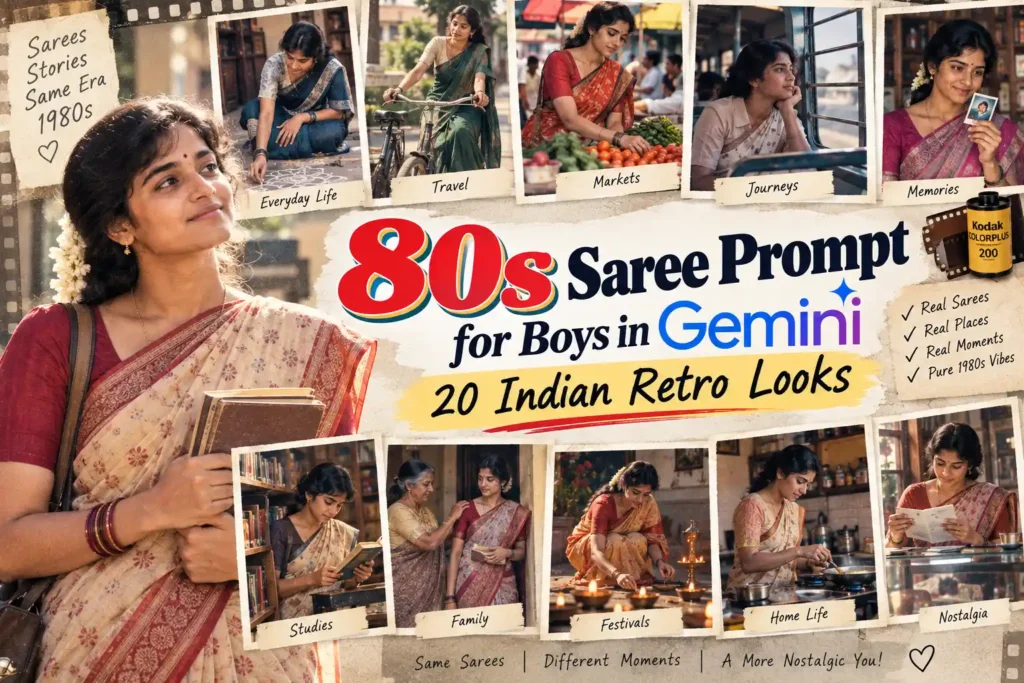
80s Saree Prompt for Gemini – 20 Indian Retro Looks
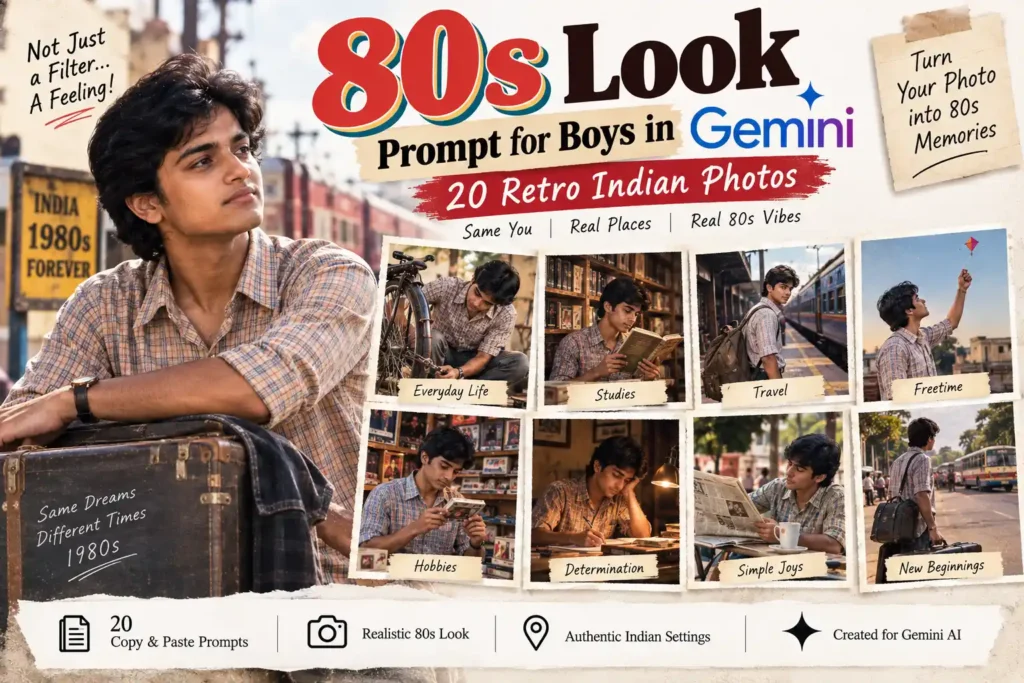
80s Look Prompt for Boys in Gemini – 20 Retro Indian Photos
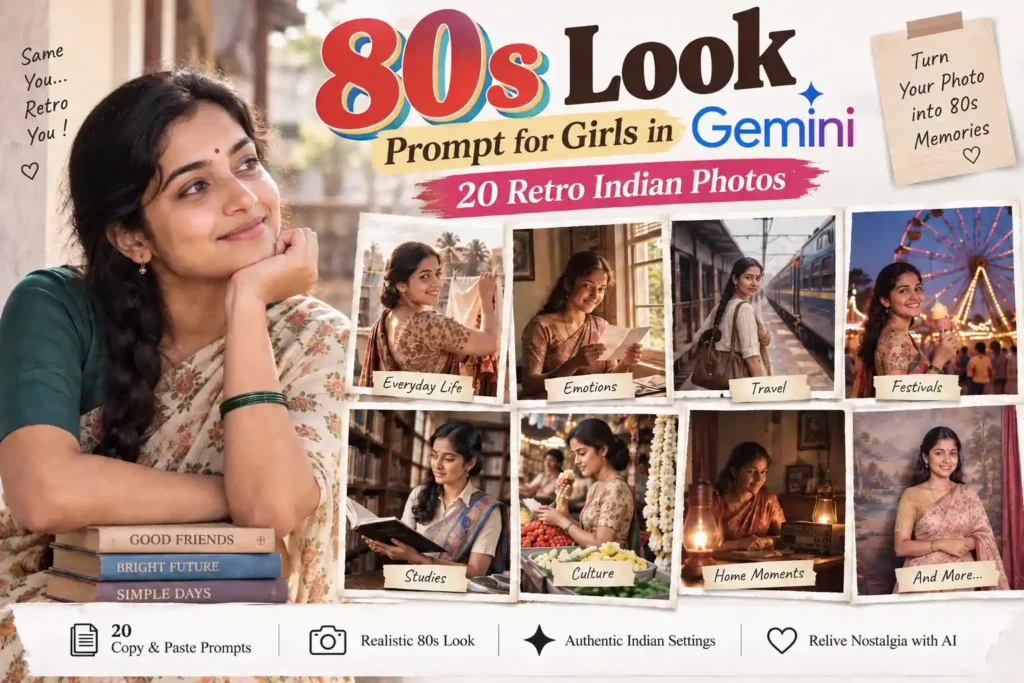
80s Look Prompt for Girls in Gemini – 20 Retro Indian Photos
Copied!
