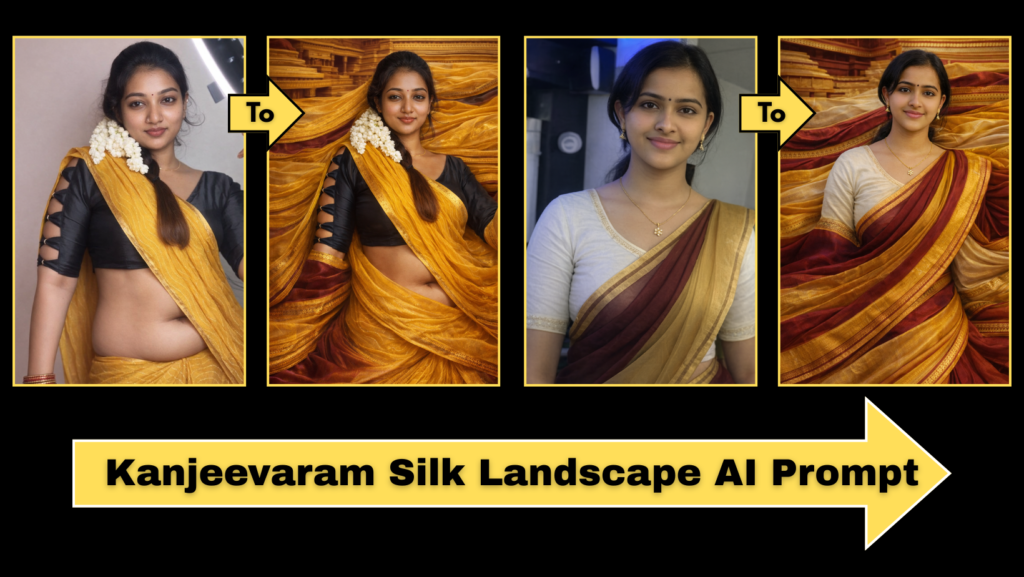
Kanjeevaram silk is more than clothing. It carries centuries of South Indian craft, temple symbolism, and ritual beauty. Traditionally woven with heavy silk and shimmering zari threads, it represents permanence, devotion, and heritage.
This AI prompt explores a new artistic idea: reimagining Kanjeevaram silk not just as attire, but as an entire landscape. In this concept, fabric and environment merge into one continuous form. The person remains real and grounded, while the silk itself becomes space, terrain, and architecture.
This guide explains the concept clearly and provides a ready-to-use AI image prompt.
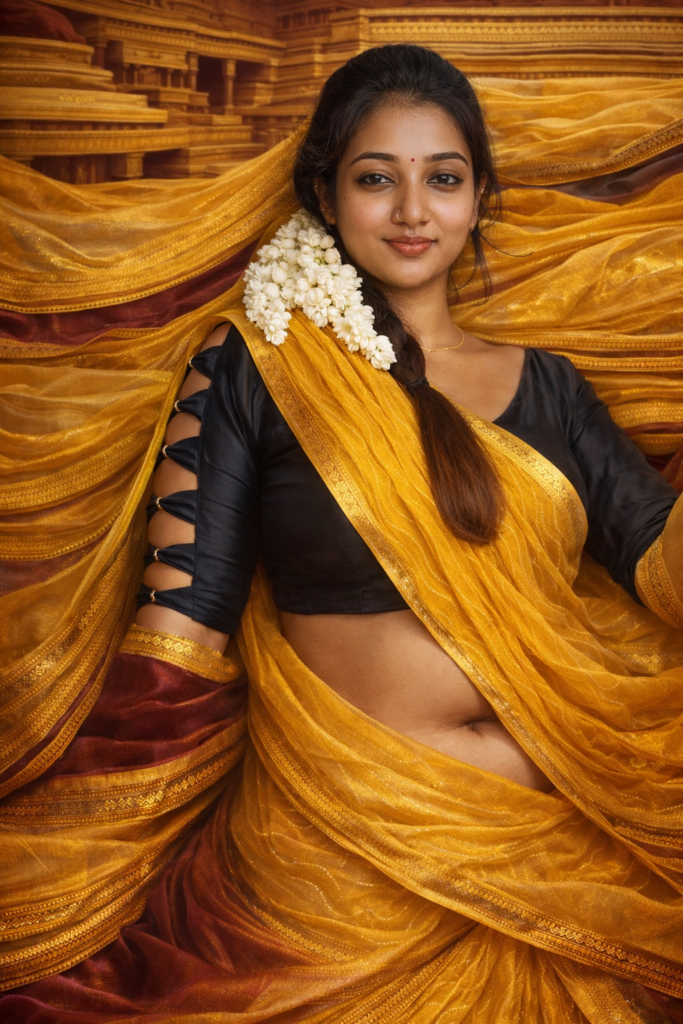
Concept Overview: Fabric as Environment
Unlike traditional portraits with backgrounds, this prompt removes the idea of a “setting.”
Instead:
- Clothing flows outward and becomes the environment
- Silk folds replace walls, hills, and horizons
- Zari threads act like sacred rivers or glowing paths
- The person’s face stays realistic and natural
- Everything else transforms into woven form
The result is immersive, meditative, and timeless rather than cinematic or dramatic.
Key Visual Inspirations
This prompt draws from three major South Indian visual traditions:
1. Kanjeevaram Silk Craft
- Heavy silk texture
- Rich jewel tones (crimson, magenta, emerald, gold)
- Broad borders and temple motifs
- Subtle metallic shimmer from zari threads
2. South Indian Temple Architecture
- Layered stone terraces
- Horizontal rhythm and balance
- Repetition and symmetry
- Sacred calm rather than spectacle
3. Contemporary Conceptual Art
- Minimal literal storytelling
- Emphasis on material, form, and flow
- Meditative visual silence
- Seamless transitions between subject and space
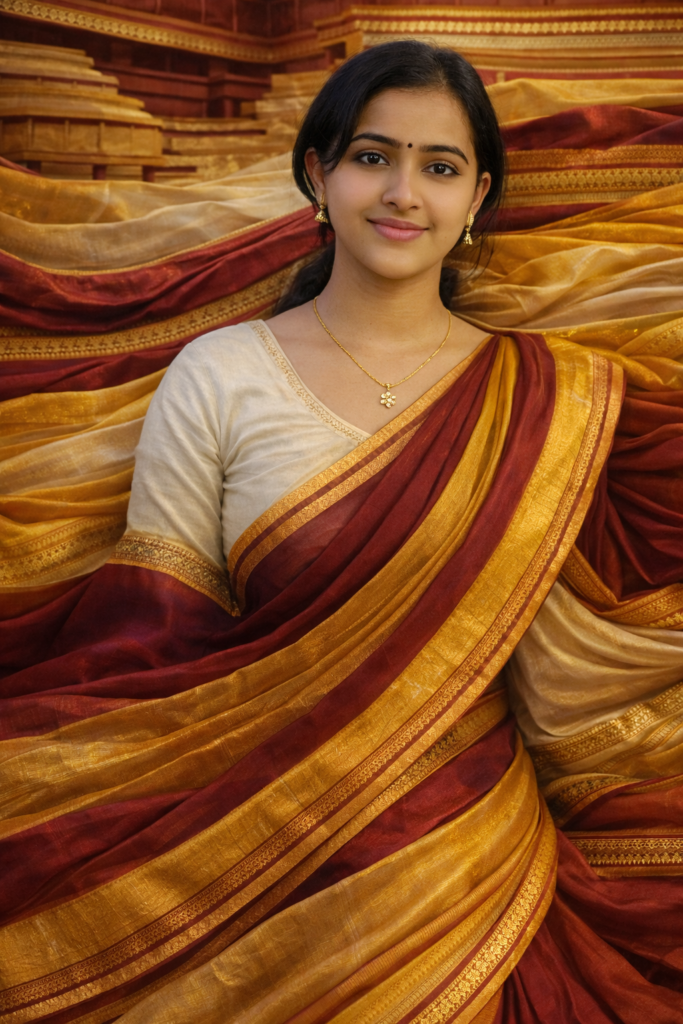
What Makes This Prompt Unique
- No literal background (no room, sky, or landscape)
- The face remains realistic and human
- The body and surroundings dissolve into silk
- Movement is slow, heavy, and deliberate
- Light behaves gently, not dramatically
- Emotion comes from stillness, not expression
This makes the artwork suitable for heritage, craft, culture, and fine-art themes.
Kanjeevaram Silk Landscape AI Prompt (Copy-Paste)
You can directly copy and paste this into any AI image generator that supports detailed prompts.
Reimagine the subject within a continuous landscape of flowing Kanjeevaram silk, where clothing and environment merge into a single seamless form. Preserve the person’s real face, natural skin texture, and calm expression with realistic proportions. Let the silk fabric sculpt both the body and the surrounding space, unfolding outward like terrain rather than clothing. The environment should feel entirely woven, with no literal background elements. Draw inspiration from South Indian temple architecture, using bold color fields arranged like layered stone terraces. Incorporate wide silk borders and woven patterns that echo traditional Kanjeevaram motifs. Metallic zari threads should shimmer softly throughout the fabric, catching light like sacred rivers flowing across the landscape. The silk must feel heavy, luminous, and richly woven, with deep folds creating depth and rhythm. Use gentle, diffused lighting with no harsh shadows. The mood should be immersive and meditative, rooted in craft, heritage, and timeless elegance rather than modern fashion or fantasy. Avoid photorealistic backgrounds, avoid modern environments, and maintain a conceptual fine-art aesthetic.
Prompt Variations: Kanjeevaram Silk as Living Landscape
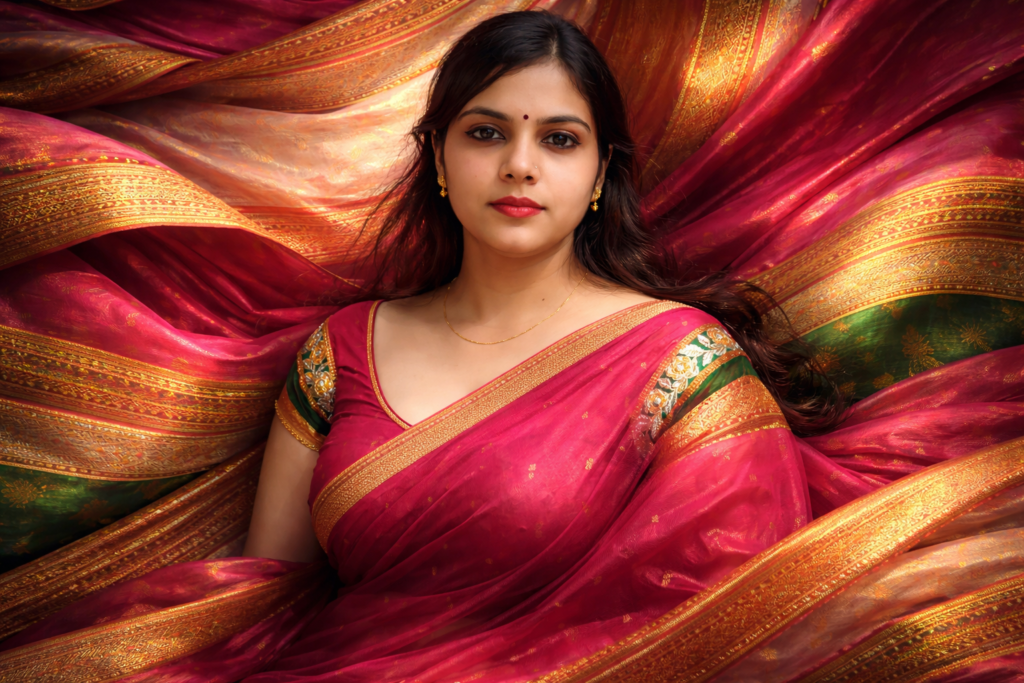
1️⃣ Temple Silence Variant (Sacred & Meditative)
Focus: Spiritual calm, temple rhythm, stillness
Reimagine the subject within a continuous landscape of flowing Kanjeevaram silk, where clothing and environment dissolve into one sacred woven form. Preserve the person’s real face, natural expression, and human presence with gentle realism. Let the silk unfold like quiet temple terraces, layered horizontally with balanced symmetry inspired by South Indian stone architecture. Avoid literal backgrounds and allow the fabric itself to define space, depth, and silence. Metallic zari threads should glow softly, like sacred rivers or ritual lamps seen from afar. Use restrained color fields—deep crimson, temple gold, muted green, and stone-like pink. Lighting should be soft and devotional, with no dramatic contrast. The overall feeling must be calm, timeless, and contemplative, rooted in heritage, ritual, and stillness rather than narrative or action.
2️⃣ Feminine Heritage Variant (Grace & Continuity)
Focus: Womanhood, lineage, generational memory
Reimagine the subject within an endless flow of Kanjeevaram silk, where the garment expands outward to become both body and surrounding space. Preserve the person’s real face and gentle expression with natural proportions. The silk should feel maternal and protective, folding around the subject like layers of inherited memory. Let borders widen and repeat, echoing traditional Kanjeevaram patterns passed through generations. Zari threads should shimmer delicately, symbolizing continuity, tradition, and lineage. Use warm jewel tones—rose, maroon, gold, and emerald—blended softly. Avoid literal environments. The scene should feel intimate, rooted in craft, womanhood, and quiet strength, with a timeless, museum-quality fine-art aesthetic.
3️⃣ Architectural Weave Variant (Structure & Geometry)
Focus: Form, rhythm, woven architecture
Reimagine the subject within a constructed landscape made entirely of Kanjeevaram silk, where fabric behaves like architecture rather than clothing. Preserve the subject’s real face and neutral expression with subtle realism. Let the silk form terraces, steps, and planes inspired by South Indian temple geometry. Borders should align like structural layers, creating rhythm and depth through repetition. Metallic zari threads should act as structural highlights, catching light along edges and folds. Use strong but controlled colors—saffron, deep red, antique gold, and stone green. The image should feel architectural, balanced, and timeless, blending textile craft with spatial design. Avoid fantasy, modern fashion, or literal scenery.
4️⃣ Sacred River Variant (Flow & Movement)
Focus: Motion, continuity, sacred flow
Reimagine the subject within a flowing expanse of Kanjeevaram silk, where fabric moves like a sacred river across the composition. Preserve the person’s real face, natural gaze, and calm presence. Let the silk ripple outward in long, continuous folds, creating movement and depth without literal landscapes. Zari threads should shimmer like flowing water under temple light. Use layered color transitions—deep pinks, gold, emerald, and warm crimson—to suggest rhythm and flow. Borders should curve and dissolve into the surrounding fabric. Lighting should be gentle and directional, emphasizing movement rather than drama. The mood should feel immersive, poetic, and timeless, rooted in South Indian cultural symbolism.
5️⃣ Museum Fine-Art Variant (Minimal & Conceptual)
Focus: Gallery-ready, abstract, refined
Reimagine the subject as part of a minimalist conceptual artwork where Kanjeevaram silk becomes both form and space. Preserve the person’s real face and subtle expression with quiet realism. Reduce visual elements to fabric, light, and texture. Let the silk expand outward in controlled folds, filling the frame completely with no identifiable background. Use limited colors—one dominant silk tone with gold zari accents. Lighting should be even and soft, revealing texture rather than emotion. The final image should resemble a museum-grade textile installation, focused on material, craft, and timeless elegance rather than storytelling or fashion.
| Prompt Variant | Core Mood | Best Use |
|---|---|---|
| Temple Silence | Sacred, calm, meditative | Cultural articles, spiritual visuals, temple-inspired storytelling |
| Feminine Heritage | Graceful, intimate, timeless | Women-centric narratives, heritage blogs, tradition-focused art |
| Architectural Weave | Structured, balanced, rhythmic | Design studies, textile analysis, architecture-inspired visuals |
| Sacred River | Flowing, poetic, immersive | Symbolic storytelling, artistic essays, conceptual visuals |
| Museum Fine-Art | Minimal, refined, conceptual | Gallery-style artwork, premium collections, exhibition concepts |
How to Use These Variations
- Use Temple Silence for spiritual or cultural articles
- Use Feminine Heritage for women-centric storytelling
- Use Architectural Weave for design or craft studies
- Use Sacred River for poetic or symbolic visuals
- Use Museum Fine-Art for premium or gallery-style content
All prompts work best with:
- Portrait or half-body reference images
- Calm facial expressions
- High-quality AI image generators
Prompt Usage Tips
- Works best with portrait or half-body images
- Avoid adding action words like dramatic or cinematic
- Use calm descriptors: flowing, heavy, luminous, quiet
- If supported, add:
“conceptual art, museum-style composition” - Keep expressions neutral or serene
Ideal Use Cases for This Prompt
- AI art blogs and galleries
- Cultural and textile heritage content
- Fine-art inspired social posts
- Museum or exhibition mockups
- Design inspiration articles
- Indian craft storytelling projects
Why This Concept Resonates
This prompt does not try to modernize tradition.
Instead, it extends tradition into space.
By turning silk into landscape, the artwork honors:
- Time-intensive craftsmanship
- Sacred geometry and repetition
- The quiet dignity of South Indian aesthetics
It feels slow, grounded, and respectful — qualities often missing in fast digital visuals.
The Kanjeevaram silk landscape prompt offers a new way to think about portrait art. It removes boundaries between body, clothing, and space, creating an image that feels woven rather than constructed.
Using this prompt, AI becomes a tool not for spectacle, but for meditative cultural expression rooted in heritage and material memory.
Some more you might like